




























































The Future of AI Depends on Computer Vision Experts
AI can’t succeed without computer vision experts. Explore careers, skills, and opportunities driving the future of artificial intelligence.


Artificial intelligence is changing the industries worldwide, from healthcare and finance to retail and transportation. But for all its promise, AI faces one critical limitation: it cannot interpret the physical world on its own. Language models can analyze text, and algorithms can process numbers, but when it comes to recognizing faces, reading medical scans, or navigating busy streets, machines need vision. This is where computer vision experts play an essential role.
These specialists create systems that allow AI to interpret and understand images and video, bridging the gap between digital intelligence and real-world applications. Without them, many of the technologies we associate with the “future of AI” would remain incomplete. That dependency also explains why careers in computer vision are expanding rapidly — making this field one of the most relevant paths for students, professionals, and career switchers alike.
Why AI Needs Computer Vision Experts
AI can solve complex problems, but many real-world tasks require perception. For example:
-
A self-driving car cannot simply “calculate routes.” It must detect traffic lights, pedestrians, and obstacles in real time.
-
In healthcare, algorithms cannot improve diagnostics without analyzing X-rays, CT scans, or MRIs.
-
Retail systems cannot enable cashier-less stores unless they can track objects and people through video feeds.
Computer vision experts design and train models that handle this visual interpretation. Their work involves:
-
Building algorithms that recognize objects, patterns, and environments.
-
Training AI systems on large datasets to improve accuracy.
-
Deploying models in real-world conditions, where lighting, noise, and unpredictability create challenges.
AI’s growth depends on these contributions. Without them, innovations in robotics, surveillance, augmented reality, and autonomous systems would stall. This dependency explains the growing demand for computer vision expertise worldwide.
The Expanding Demand for Computer Vision Experts
The computer vision market is projected to reach nearly $50 billion by 2030. This growth reflects how industries are adopting AI that requires sight.
-
Healthcare: Automating diagnostics, surgical assistance, and patient monitoring.
-
Automotive: Powering autonomous driving and advanced driver assistance systems.
-
Retail: Enabling automated checkout and personalized in-store experiences.
-
Manufacturing: Supporting quality control and predictive maintenance.
-
Security: Enhancing surveillance and facial recognition.
Each of these areas relies not just on AI tools but on the expertise of professionals who can build and manage them. For students and professionals, this means more opportunities in both established firms and emerging startups.
What Does a Computer Vision Expert Do?
Computer vision experts combine skills from computer science, artificial intelligence, and applied mathematics. Their responsibilities often include:
-
Designing algorithms for image classification, detection, and segmentation.
-
Training neural networks to recognize objects, scenes, and behaviors.
-
Deploying vision systems into real-world products like drones, medical devices, or AR apps.
-
Collaborating with data scientists, software engineers, and business leaders to align technical solutions with practical needs.
Unlike general AI roles, computer vision positions require deeper knowledge of visual processing. This makes expertise in the field highly specialized and valuable.
Skills You Need to Become a Computer Vision Expert
The pathway into computer vision requires both technical and non-technical skills.
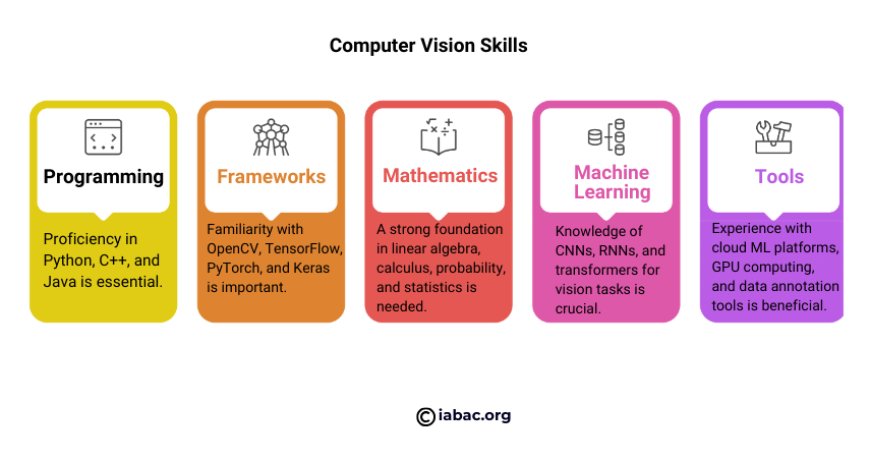
Technical skills include:
-
Programming: Python, C++, Java.
-
Frameworks: OpenCV, TensorFlow, PyTorch, Keras.
-
Mathematics: Linear algebra, calculus, probability, and statistics.
-
Machine Learning & Deep Learning: CNNs, RNNs, transformers for vision tasks.
-
Tools: Cloud ML platforms, GPU computing, and data annotation tools.
Non-technical skills include:
-
Analytical thinking to interpret complex problems.
-
Collaboration with cross-disciplinary teams.
-
Ethical awareness when working with sensitive data, such as biometric information.
For example, a student might begin by learning Python and OpenCV through small projects like face detection, while a professional might deepen their expertise through TensorFlow-based medical imaging models. Career switchers often combine online certifications with practical case studies to demonstrate applied skills.
Career Pathways Into Computer Vision
The journey depends on your background:
-
For Students: A degree in computer science, AI, or data science is a common entry point. Projects, internships, and competitions like Kaggle build credibility.
-
For Professionals: If you’re already in tech, pursuing certifications in AI or deep learning, and contributing to computer vision projects within your organization, you can accelerate growth.
-
For Career Switchers: Online courses, bootcamps, and portfolio projects can demonstrate capability. Many switchers enter through related roles in software development, data analysis, or machine learning.
The path is flexible, but all approaches emphasize continuous learning, as the field evolves quickly.
Career Opportunities and Job Roles
Computer vision expertise opens doors to diverse roles, including:
-
Computer Vision Engineer – Builds and deploys algorithms for applications.
-
AI Research Scientist – Develops new models and techniques.
-
Machine Learning Engineer (Vision-focused) – Integrates vision systems into larger AI solutions.
-
Data Scientist (Vision projects) – Analyzes and interprets visual datasets.
These roles appear across industries — from hospitals and research labs to autonomous vehicle companies and security firms.
Salary and Future Outlook
Salaries vary by geography, experience, and role:
-
Entry-level positions in the U.S. often start around $80,000 to $100,000.
-
Mid-level professionals earn between $120,000 and $150,000.
-
Senior experts and researchers may command $180,000 or more, particularly in high-demand sectors.
Globally, demand is rising in Asia and Europe, with salaries scaling to local markets.
The outlook is strong. As AI systems expand into everyday life, the reliance on computer vision grows. Job stability is supported by industries where visual intelligence is essential — healthcare, defense, and automation.
Challenges Faced by Computer Vision Experts
Despite opportunities, challenges exist:
-
Data quality: Training requires large, diverse datasets, which are costly to obtain.
-
Bias: Vision systems can inherit biases if training data is unbalanced.
-
Real-time processing: Applications like self-driving cars demand instant accuracy.
-
Ethical concerns: Privacy and surveillance raise social questions.
Addressing these challenges requires both technical solutions and ethical frameworks.
Artificial intelligence is often described as the future of technology, but that future cannot be realized without the ability to see and interpret the world. Computer vision experts enable this capability. They design the systems that allow AI to function in healthcare, transportation, retail, and countless other fields.
For students, professionals, and career switchers, this dependency translates into opportunity. As AI expands, the demand for vision experts grows. Pursuing this path is not only a career move but also a chance to contribute to the next stage of AI innovation.
FAQs
1. What is a computer vision expert?
A professional who designs and builds systems enabling AI to process and interpret visual data.
2. Is computer vision a good career?
Yes. The field is growing, offers competitive salaries, and is applied across industries.
3. How do I become a computer vision expert?
Learn programming, AI frameworks, and deep learning, and build projects that showcase practical applications. Pathways vary for students, professionals, and career switchers.
4. What industries hire computer vision experts?
Healthcare, automotive, retail, manufacturing, and security are major employers.
5. What is the salary of a computer vision expert?
Salaries range from ~$80,000 at the entry level to $180,000+ for senior roles in high-demand sectors.