



















































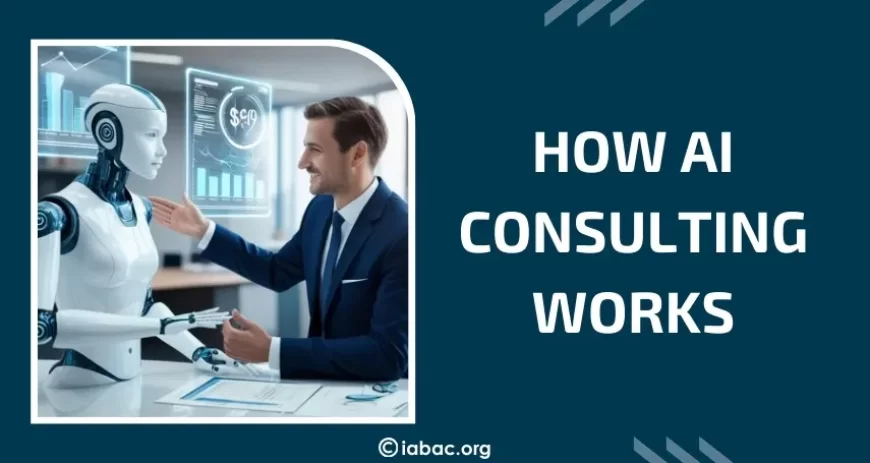
How AI Consulting Works in Real Businesses
AI consulting helps businesses align strategy, data, and execution to drive measurable outcomes, reduce risk, and turn AI investments into real impact.

Artificial intelligence has moved quickly from experimental technology to strategic priority. Organizations across industries are investing in machine learning, automation systems, and AI-driven tools with the expectation of improving efficiency, decision-making, and competitive advantage.
Yet a recurring pattern continues to emerge.
Despite adopting sophisticated technologies, many businesses struggle to convert AI investments into meaningful outcomes. Projects stall, expectations diverge from reality, and decision-makers often find themselves asking a deceptively simple question:
If the technology is powerful, why are results inconsistent?
The answer rarely lies in algorithms alone. In many cases, challenges stem from unclear strategy, misaligned objectives, data readiness limitations, or unrealistic implementation assumptions. This is precisely where AI consulting becomes critical.
AI consulting acts as the structured bridge between technological capability and business practicality, helping organizations design, evaluate, and operationalize AI initiatives in ways that align with real-world constraints.
Why AI Consulting Is Frequently Misunderstood
AI consulting is often interpreted too narrowly. Some assume it involves only model development or technical deployment, while others view it as a vendor-driven service tied directly to specific tools.
In reality, AI consulting plays a far broader role.
It is not merely about building AI systems. It is about ensuring that AI initiatives are strategically sound, technically feasible, and operationally meaningful. Without this layer of structured evaluation and alignment, even advanced technologies can produce confusion rather than clarity.
Several misconceptions commonly distort how organizations perceive AI consulting:
-
AI consulting is seen as purely technical work
-
Consulting is mistaken for tool implementation
-
It is considered relevant only for large enterprises
-
AI adoption is assumed to succeed automatically
These assumptions frequently lead businesses to underestimate the complexity of AI initiatives.
What AI Consulting Actually Means in Practice
At its core, AI consulting is a decision-support and strategy-alignment discipline. Consultants help organizations translate business challenges into AI opportunities while evaluating feasibility, risks, and expected value.
Rather than beginning with algorithms, consulting engagements typically begin with business logic.
Consultants work with stakeholders to understand objectives, constraints, decision-making requirements, and operational realities. This approach ensures that AI initiatives are grounded in purpose rather than technology enthusiasm.
AI consulting often involves:
✔ Identifying high-impact use cases
✔ Assessing data readiness and quality
✔ Evaluating technical feasibility
✔ Designing implementation strategies
✔ Supporting deployment and refinement
This structured progression prevents organizations from pursuing AI initiatives disconnected from measurable outcomes.
How AI Consulting Works Inside Real Organizations
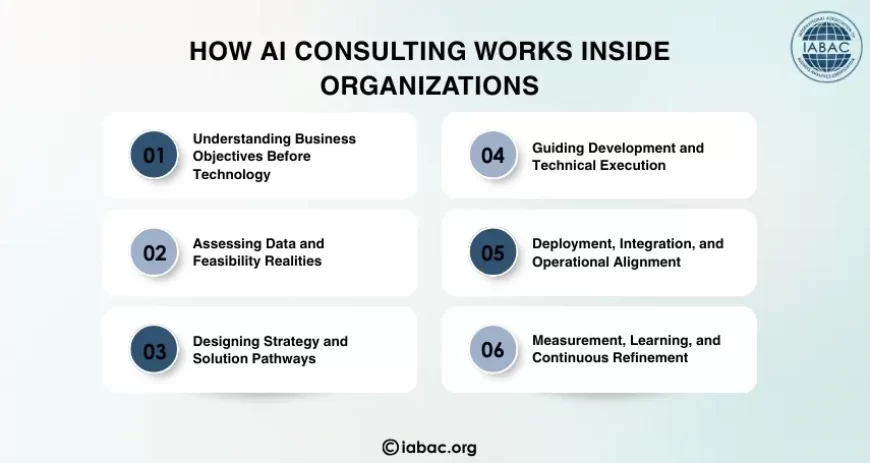
While consulting engagements vary across industries and organizational contexts, most follow a logical lifecycle designed to stabilize expectations and guide execution.
Understanding Business Objectives Before Technology
Effective AI consulting begins with business understanding. Without clarity around organizational priorities, AI initiatives risk becoming technically impressive yet strategically irrelevant.
Consultants explore questions such as
-
What decisions require improvement?
-
Which processes create inefficiencies?
-
Where does uncertainty limit performance?
For instance, a business experiencing unpredictable demand patterns may benefit more from predictive modeling than generic automation.
Assessing Data and Feasibility Realities
Many AI ideas fail not due to algorithmic limitations but due to data constraints. Consultants evaluate whether available datasets support proposed initiatives.
This stage examines:
✔ Data availability and completeness
✔ Data consistency and structure
✔ Integration challenges
✔ Practical feasibility constraints
Early feasibility assessment often prevents costly missteps.
Designing Strategy and Solution Pathways
Consultants help organizations prioritize initiatives based on impact potential, implementation complexity, and organizational readiness.
Rather than recommending tools immediately, consulting emphasizes structured solution design aligned with business logic.
Guiding Development and Technical Execution
Once feasibility and strategy are clarified, AI systems or models are developed. Consulting ensures execution remains aligned with objectives rather than drifting into unnecessary complexity.
Deployment, Integration, and Operational Alignment
Deploying AI systems introduces practical challenges involving workflows, user adoption, and system integration.
Consultants assist organizations in navigating:
✔ Process integration
✔ Change management considerations
✔ Performance measurement frameworks
Measurement, Learning, and Continuous Refinement
AI systems are dynamic. Performance improves through iteration and feedback rather than static deployment.
Consulting engagements frequently extend into refinement cycles.
Role of AI Consulting Companies in Business Transformation
Many organizations engage AI consulting companies to access specialized expertise and structured methodologies. These firms combine technical knowledge with strategic advisory capabilities, helping businesses accelerate AI adoption while reducing uncertainty.
AI consulting companies typically assist organizations by:
✔ Evaluating AI opportunities
✔ Designing adoption strategies
✔ Supporting implementation
✔ Stabilizing measurement frameworks
Their value lies in aligning technological potential with operational practicality.
Why AI Consulting Differs from AI Tools and Platforms
AI tools provide computational and analytical capability. Consulting provides interpretive structure and decision alignment.
Tools generate outputs.
Consultants contextualize implications.
Without structured consulting frameworks, organizations may possess powerful technology yet lack clarity about priorities, risks, or measurement logic.
Situations Where Businesses Commonly Seek AI Consulting
Organizations frequently turn to AI consulting when:
-
Scaling AI initiatives across operations
-
Facing ROI uncertainty from AI investments
-
Navigating complex data environments
-
Designing transformation strategies
These scenarios often require expertise extending beyond internal capabilities.
The Often-Overlooked Value of AI Consulting
AI consulting contributes value not only through technical guidance but also through reducing ambiguity and improving decision confidence.
Benefits commonly include:
✔ Improved strategic clarity
✔ Reduced implementation risk
✔ Faster experimentation cycles
✔ Better cross-functional alignment
Why Many AI Projects Struggle Without Consulting
AI initiatives often encounter difficulties when organizations adopt tool-first thinking, overlook feasibility constraints, or lack measurement frameworks.
Common failure patterns involve:
-
Misaligned objectives
-
Data readiness gaps
-
Unrealistic expectations
-
Weak integration planning
Consulting helps mitigate these risks.
Does Every Business Truly Need AI Consulting?
Not necessarily.
Organizations with mature AI capabilities, highly structured data environments, and clearly defined analytical frameworks may operate effectively without continuous consulting involvement. However, many businesses encounter complexity thresholds where consulting becomes highly valuable.
Choosing and Evaluating AI Consulting Partners
Selecting consulting partners requires evaluating expertise, alignment with objectives, and implementation experience rather than brand visibility alone.
Organizations should consider:
✔ Domain understanding
✔ Strategic capabilities
✔ Integration experience
AI consulting helps organizations transform artificial intelligence from a conceptual ambition into a structured, decision-support capability. By aligning strategy, feasibility, and execution, consulting reduces uncertainty and enhances the practical impact of AI initiatives.
As AI adoption continues to expand, businesses increasingly collaborate with AI consulting companies to design scalable, reliable, and outcome-driven implementations.