




























































What is a Recommendation System and How Does It Work?
Understand what a recommendation system is, how it works, its types, real-world applications & why it powers personalized experiences across digital platforms.


Every time Netflix lines up your next show, Amazon suggests an item you did not know you wanted, or Spotify builds a playlist that somehow fits your mood, you are seeing a recommendation system at work. These systems have quietly become one of the most valuable applications of machine learning in business, shaping what billions of people watch, buy, read, and listen to every day.
This guide explains what a recommendation system is, how it actually works under the hood, the main types you will encounter, and where the technology is heading in 2026. It is written for learners, analysts, and professionals who want a clear, accurate picture without the jargon fog and who may be considering recommendation systems as a career skill.
Key Takeaways
-
A recommendation system is a machine learning application that predicts what a user is most likely to want next and surfaces those items, ranked by relevance.
-
The two foundational approaches are collaborative filtering (learning from user behavior patterns) and content-based filtering (matching item attributes to user preferences). Most large platforms now use a hybrid recommendation system that blends both.
-
Recommendation engines run on data: clicks, watch time, purchases, ratings, and other user behavior analytics signals that feed models such as matrix factorization and, increasingly, deep learning recommendation networks.
-
Real recommendation system examples include the Netflix recommendation algorithm, the Amazon recommendation system, and the ranking engines behind YouTube and Spotify.
-
The hardest problems are the cold start problem, data sparsity, filter bubbles, bias, and privacy. Good design treats these as core requirements, not afterthoughts.
What Is a Recommendation System?
A recommendation system, also called a recommender system or recommendation engine, is a type of information filtering software that predicts the preferences a user is likely to have for a set of items and then presents the most relevant options. Instead of forcing you to search through a catalog of thousands or millions of items, it narrows the field to a short, personalized list.
At its core, the job is a prediction problem. Given what the system knows about you and about the available items, it estimates a relevance score for each item you have not yet interacted with, then ranks them. The items with the highest predicted relevance become your recommendations.
This is why so many people ask what a recommendation system is and quietly assume it must be complicated. The underlying idea is simple. The sophistication comes from doing it accurately, at scale, in real time, for millions of users at once. That combination is where machine learning earns its place, and it is one reason personalization algorithms sit near the center of modern data science.
Recommendation systems appear in more places than most people realize:
-
Streaming: what to watch next, autoplay queues, and personalized rows.
-
E-commerce: "customers who bought this also bought," related products, and personalized homepages.
-
Music and podcasts: daily mixes, radio stations, and discovery playlists.
-
Social platforms: the posts, videos, and accounts in your feed.
-
Professional tools: suggested connections, jobs, articles, and courses.
Why Recommendation Systems Matter
The business case is direct: relevance drives engagement, and engagement drives revenue and retention. When a platform reliably shows people things they value, users stay longer, come back more often, and convert more.
The most cited evidence comes from Netflix's own engineers. In their 2015 paper, The Netflix Recommender System, Carlos Gomez-Uribe and Neil Hunt reported that the recommender influences roughly 80% of the hours streamed on the platform, with the remaining share coming from search. They also estimated that the combined effect of personalization and recommendations was worth more than one billion dollars per year, largely through improved member retention.
On the commerce side, a widely referenced 2013 McKinsey analysis attributed about 35% of Amazon purchases to its recommendation engine. That figure is an estimate rather than an audited number, and later academic work has questioned how much of the effect is truly incremental, so it is best read as a directional signal of scale rather than a precise measurement.
Even with the caveats, the pattern is clear. Recommendation systems are not a cosmetic feature. They are often the primary way users discover value on a platform, which is why they attract heavy engineering investment and why recommendation skills are in steady demand across the AI and analytics job market.
For the reader, the value is different but real. A good recommendation engine reduces choice overload, surfaces things you would not have found on your own, and saves time. A poor one wastes attention and erodes trust. That tension between business goals and user experience runs through everything that follows.
How Do Recommendation Systems Work?
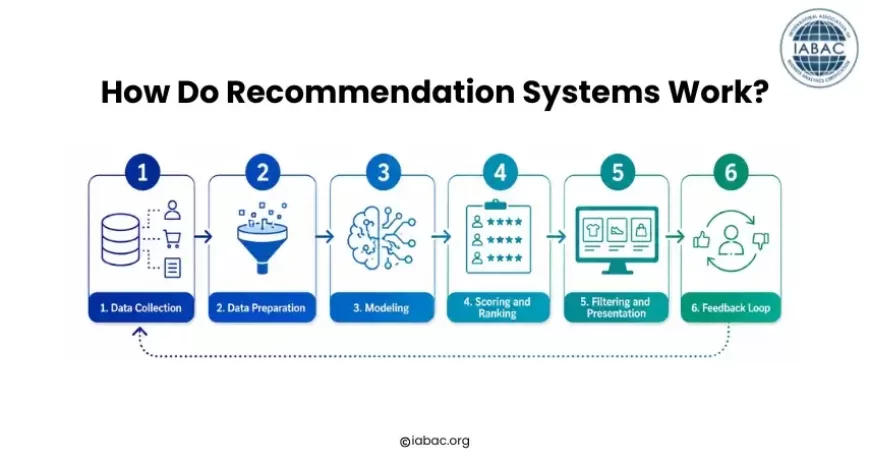
To understand how recommendation systems work, it helps to break the process into stages. Almost every production system, from a small store plugin to the Netflix recommendation algorithm, follows a version of this pipeline.
1. Data Collection
The system gathers signals about users and items. Explicit signals include ratings, likes, and reviews. Implicit signals, which are far more common, include clicks, watch time, purchases, skips, dwell time, and search queries. This layer is essentially user behavior analytics, and the quality of these signals sets a ceiling on how good the recommendations can be.
2. Data Preparation
Raw signals are cleaned, deduplicated, and organized. A central structure here is the user-item interaction matrix, a large table where rows are users, columns are items, and each cell records an interaction or rating. In practice, this matrix is extremely sparse because any single user interacts with a tiny fraction of the catalog.
3. Modeling
A model learns patterns from the prepared data. This is where techniques such as matrix factorization, nearest-neighbor methods, and deep learning recommendation networks come in. The model's job is to fill in the blanks in that sparse matrix by predicting how a user would rate or engage with items they have not seen.
4. Scoring and Ranking
For a given user, the model scores candidate items by predicted relevance and ranks them. Large platforms often split this into two steps: a fast candidate generation stage that narrows millions of items to a few hundred, followed by a slower, more precise ranking stage.
5. Filtering and Presentation
Business rules apply on top of the scores. The system removes items already purchased, respects content restrictions, adds diversity so the list does not feel repetitive, and formats the final results into the rows and carousels you actually see.
6. Feedback Loop
Your response to the recommendations, whether you click, watch, buy, or ignore, becomes new training data. This continuous loop is what lets recommendation systems improve over time, and it is a defining feature of any machine learning recommendation approach.
A practical way to picture the modeling step is the idea of latent factors. Matrix factorization assumes that both users and items can be described by a small set of hidden features. For movies, those features might loosely correspond to genre, tone, or era, though the model discovers them from data rather than being told. A user's predicted interest in a movie is then the alignment between the user's factors and the movie's factors.
The landmark reference here is Koren, Bell, and Volinsky's 2009 work on matrix factorization techniques, which grew directly out of the Netflix Prize competition and still underpins many systems today.
Types of Recommendation Systems
There are several types of recommendation systems, and understanding the differences is the fastest way to reason about any real product. The three you must know are collaborative filtering, content-based filtering, and hybrid systems, with a few specialized variants worth naming.
1. Collaborative Filtering
Collaborative filtering makes recommendations based on the behavior of many users rather than the content of the items.
The core intuition: if two users have agreed in the past, they are likely to agree in the future. So if you and another user share a long history of similar ratings, items that person liked but you have not seen become strong candidates for you.
There are two broad flavors.
-
Memory-based methods find similar users or similar items directly, for example, "people similar to you also watched."
-
Model-based methods, including matrix factorization, learn a compact representation of users and items and predict from that.
Collaborative filtering is powerful because it needs no understanding of the items themselves, only the interaction patterns. Its main weakness is the cold start problem: a brand new user or item has no history to learn from.
2. Content-Based Filtering
Content-based filtering recommends items similar to what a user already liked, using item attributes rather than crowd behavior.
If you read several articles tagged with machine learning and data science, a content-based system recommends more articles with those tags. For movies, it might use genre, cast, and director; for products, category, brand, and description.
The advantage is that content-based filtering can recommend new items immediately, as long as their attributes are known, which softens the item cold start problem.
The trade-off is a tendency toward narrowness, since it keeps suggesting more of the same and struggles to surprise the user.
3. Hybrid Recommendation System
A hybrid recommendation system combines collaborative and content-based methods, and sometimes others, to offset the weaknesses of each.
This is the standard for large platforms.
A hybrid approach might use content-based signals to handle new items and collaborative signals to capture taste patterns, then blend the scores.
The Netflix and YouTube systems are best understood as sophisticated hybrids that pull in many signal types at once.
4. Knowledge-Based and Context-Aware Systems
Two specialized types round out the picture.
Knowledge-based systems rely on explicit rules and user requirements, which suits rare, high-stakes purchases like real estate or cars where there is little repeat behavior to learn from.
Context-aware systems fold in situational data such as time of day, location, or device, so a morning commute yields different suggestions than a late evening at home.
Modern AI recommendation engine designs increasingly treat context as a first-class input.
Recommendation System Examples
Concrete recommendation system examples make the concepts stick. Here is how a few of the best-known systems approach the problem.
Netflix

The Netflix recommendation algorithm is a hybrid that personalizes almost every row on the screen, including which artwork you see for a given title. Its published goal is to improve retention by increasing engaged viewing, and it relies heavily on implicit signals like what you actually watch versus what you merely browse.
Amazon
The Amazon recommendation system is famous for item-to-item collaborative filtering, the engine behind "customers who bought this also bought."
It runs across the entire journey, from the homepage to the product page to post-purchase emails.
Spotify
Spotify blends collaborative filtering, natural language processing over text about music, and audio analysis of the tracks themselves to power features like Discover Weekly.
Check out IABAC's breakdown of how Spotify uses AI to recommend music, which walks through this in more detail.
YouTube

YouTube's recommender is a large-scale deep learning system with candidate generation and ranking stages, optimizing for watch time and satisfaction across billions of videos.
What these examples share is scale, a heavy reliance on implicit user behavior analytics, and a hybrid design. What differs is the signal mix, which is dictated by the domain.
Recommendation System Techniques and Algorithms
Beneath the types sit the algorithms. A quick map helps connect the vocabulary you will see in courses and job descriptions.
-
Nearest neighbors: simple, interpretable methods that find similar users or items. Good baselines, limited at scale.
-
Matrix factorization: decomposes the user-item matrix into latent factors. Efficient, scalable, and still a workhorse.
-
Deep learning recommendation: neural networks that learn complex, non-linear patterns and combine many feature types. Two-tower architectures, which learn separate embeddings for users and items and match them, are common in large systems.
-
Sequence and session models: approaches that treat behavior as an ordered sequence, useful when the next action depends on recent context.
-
Graph-based methods: models that treat users and items as a graph and learn from the connections between them.
You do not need to master all of these to start. Most practitioners build on collaborative filtering and matrix factorization before moving to deep learning recommendation models.
If you want to understand where these methods sit within the wider field, IABAC's guide to machine learning versus deep learning is a helpful orientation, and the fundamentals of supervised machine learning carry directly into how recommendation models are trained and evaluated.
Benefits of Recommendation Systems
For businesses and users alike, well-built recommendation systems deliver clear value.
-
Higher engagement and conversion: Relevant suggestions keep users active and move them toward purchases or plays.
-
Better discovery: Recommendation engines surface items buried deep in a catalog, giving long-tail content and products a chance to be found.
-
Improved retention: When a platform consistently feels useful, people stay subscribed and come back, which is exactly the retention effect Netflix credited its recommender with.
-
Personalization at scale: A single system can tailor the experience for millions of users individually, something no manual curation team could match.
-
Operational insight: The user behavior analytics that feed recommenders also reveal what customers actually value, informing merchandising and content strategy.
Challenges of Recommendation Systems
The same power creates real risks and hard engineering problems. Serious practitioners treat these as design requirements.
-
Cold start: New users and new items lack history. Hybrid designs, onboarding questions, and content signals help, but the problem never fully disappears.
-
Data sparsity: Most users interact with a tiny slice of the catalog, leaving the interaction matrix mostly empty and leaving models data-starved for niche items.
-
Filter bubbles and narrowness: Optimizing purely for predicted clicks can trap users in a loop of similar content, reducing diversity and long-term satisfaction. Deliberate diversity and exploration are needed to counter this.
-
Bias and fairness: Popular items get recommended more, which makes them more popular still, and models can inherit or amplify biases present in the data. Auditing outcomes matter.
-
Privacy: Recommenders depend on personal behavioral data, so they sit squarely inside data protection rules such as the GDPR. With third-party cookies fading and privacy expectations rising, privacy-preserving design is now a baseline requirement, not a nice-to-have.
-
Evaluation gaps: Offline accuracy metrics do not always predict real-world impact. Teams increasingly rely on A/B testing and business metrics, mirroring how Netflix measures retention rather than raw prediction error.
Future Trends in Recommendation Systems (2026)
The field is moving quickly, and several shifts are shaping recommendation systems in 2026.
Generative and LLM-Powered Recommendations
Large language models are being used to understand items and users more richly, to generate explanations for why something was recommended, and to power conversational recommenders where you describe what you want in plain language and refine it through dialogue.
Real-Time Personalization
Systems increasingly update within a single session, adapting to what you did seconds ago rather than relying only on overnight batch training.
Privacy-First Architectures
Techniques such as on-device processing and federated learning aim to personalize without centralizing raw personal data, responding directly to regulation and user expectations.
Transparency and Control
There is growing pressure, from users and regulators, for systems that explain their suggestions and give people meaningful control over their feeds.
Multimodal Signals
Combining text, image, audio, and behavior lets models understand items far more completely than interaction data alone.
For anyone building a career here, the direction of travel is worth noting: the fundamentals of collaborative filtering and content-based filtering are stable, while the frontier is generative AI, real-time systems, and responsible design.
How to Build Recommendation Systems Skills
Recommendation systems sit at the intersection of machine learning, data engineering, and product thinking, which is part of what makes the skill set valuable and durable.
A practical learning path usually looks like this:
-
Get comfortable with Python and data handling.
-
Learn the machine learning fundamentals.
-
Understand evaluation.
-
Build a simple collaborative filtering model.
-
Progress to matrix factorization.
-
Learn deep learning recommendation approaches.
Structured certification can help you validate these skills and stay accountable to a syllabus.
IABAC, the International Association of Business Analytics Certification, offers credentials across data science, analytics, and AI that are relevant to this field.
Its Certified Machine Learning Associate program is a beginner-friendly option that covers core algorithms, supervised and unsupervised learning, and includes a dedicated module on recommendation systems, collaborative filtering, content-based filtering, and matrix factorization.
That makes it a natural next step if this guide has sparked your interest and you want hands-on grounding rather than surface familiarity.
You can also explore the full range of AI certifications and data analytics certifications to find the level that fits your background.
Takeaway
Recommendation systems are one of the clearest examples of machine learning creating real value in everyday life.
They take a hard problem, predicting what a person will want out of an enormous catalog, and solve it well enough to shape a large share of what we watch, buy, and hear.
The mechanics come down to collecting behavioral signals, learning patterns with methods like collaborative filtering and matrix factorization, ranking candidates, and improving through a constant feedback loop.
The main types, collaborative, content-based, and hybrid, give you a reliable framework for reasoning about any system you encounter, from the Netflix recommendation algorithm to the Amazon recommendation system.
The technology is not standing still.
Generative AI, real-time personalization, and privacy-first design are reshaping what these systems can do and how they must behave.
If you want to move from understanding recommendation systems to building them, a focused, hands-on credential such as the Certified Machine Learning Associate is a practical way to turn this knowledge into a job-ready skill.