

























































Benefits of Machine Learning 2026 Guide
Discover the top benefits of machine learning for business, healthcare, finance, and more. Learn how ML drives automation, accuracy, and innovation in 2025.

Machine learning is no longer a technology of the future — it is the driving force behind some of today's most impactful innovations. From the recommendations you see on Netflix to the fraud alerts your bank sends you in real time, machine learning is quietly working in the background to make systems smarter, faster, and more efficient.
But what exactly are the benefits of machine learning? And why should businesses, professionals, and students care about them?
In this comprehensive guide, you will get a clear, practical breakdown of every major benefit of machine learning — with real-world examples, industry applications, comparison tables, and expert insights to help you understand exactly why ML is transforming every sector of the global economy.
Whether you are a business leader looking to adopt ML, a student planning a career in data science, or a professional exploring AI certification, this guide will give you everything you need to know.
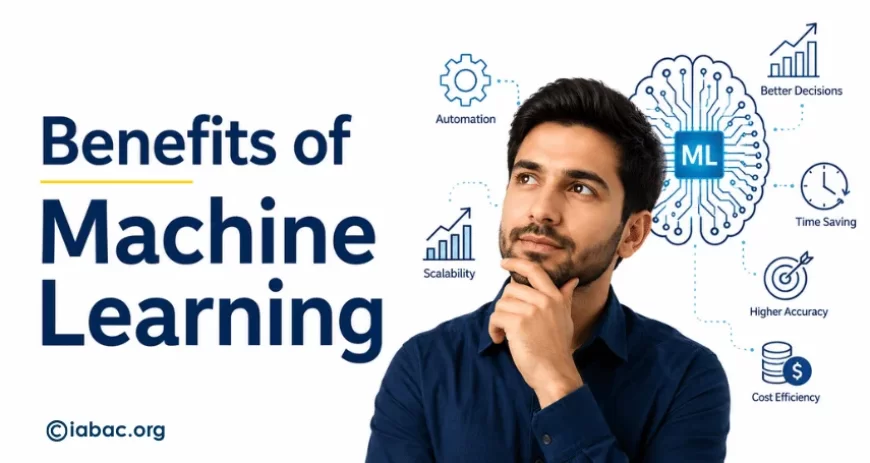
Quick Answer: Machine learning benefits include automating repetitive tasks, improving decision-making accuracy, detecting fraud, personalizing customer experiences, enabling predictive analytics, reducing operational costs, and accelerating innovation across industries like healthcare, finance, retail, and manufacturing.
What Is Machine Learning?
Machine learning (ML) is a branch of artificial intelligence (AI) that gives computer systems the ability to learn from data and improve their performance over time — without being explicitly programmed for every task.
Instead of following a fixed set of rules, machine learning algorithms identify patterns in data, make predictions, and adjust their outputs as they are exposed to more information.
Three Main Types of Machine Learning
|
Type |
How It Works |
Common Use Cases |
|
Supervised Learning |
Learns from labeled training data |
Spam detection, image classification, price prediction |
|
Unsupervised Learning |
Finds patterns in unlabeled data |
Customer segmentation, anomaly detection, topic modeling |
|
Reinforcement Learning |
Learns by trial and error with rewards |
Robotics, game AI, autonomous vehicles |
Key Machine Learning Concepts (Quick Glossary)
-
Algorithm: A mathematical procedure that a model uses to learn from data.
-
Model: The output of a trained ML algorithm that makes predictions.
-
Training Data: The dataset used to teach the model.
-
Feature: An individual measurable property used as input to the model.
-
Inference: Using a trained model to make predictions on new data.
Why Machine Learning Matters in 2026
The global machine learning market is growing at an extraordinary pace.
-
The global ML market was valued at USD 26.03 billion in 2023 and is projected to reach USD 225.91 billion by 2030, growing at a CAGR of 36.2% (Grand View Research).
-
Over 77% of devices in use today already feature some form of AI or ML.
-
Organizations that have adopted ML report an average productivity gain of 40% in automated processes.
-
By 2025, 95% of customer interactions are predicted to be handled without human agents, largely powered by ML-driven systems.
Machine learning matters because data is now the world's most valuable resource — and ML is the engine that converts raw data into actionable intelligence.
AI Overview Summary: Machine learning matters in 2026 because it enables businesses to process massive volumes of data, automate complex tasks, improve customer experiences, and make faster, more accurate decisions — all at a scale that would be impossible for humans alone.
Top 15 Benefits of Machine Learning
1. Automation of Repetitive Tasks
One of the most immediate benefits of machine learning is its ability to automate tasks that are time-consuming, repetitive, and error-prone when done by humans.
ML-powered automation goes far beyond rule-based automation (like macros or scripts). Machine learning systems can handle unstructured data — emails, images, voice, documents — and make intelligent decisions without constant human oversight.
Examples:
-
Automated data entry and document processing
-
Invoice scanning and validation in finance
-
Quality inspection in manufacturing using computer vision
-
Customer email sorting and response generation
Expert Tip: Companies that use ML-driven automation report reducing manual processing time by up to 70%, freeing their teams to focus on strategic, creative, and high-value work.
2. Improved Decision-Making Through Data Insights
Machine learning algorithms can analyze datasets of millions — or even billions — of data points in seconds, surfacing patterns and insights that humans simply cannot detect manually.
This gives businesses a significant competitive advantage: decisions are no longer based on gut instinct or limited samples, but on comprehensive, real-time data analysis.
Key Decision Areas Enhanced by ML:
-
Pricing optimization (retail, travel, e-commerce)
-
Inventory management
-
Hiring and HR analytics
-
Marketing budget allocation
-
Credit risk assessment
3. Highly Accurate Predictions and Forecasting
Machine learning models, especially those trained on large historical datasets, can generate predictions with a level of accuracy far beyond traditional statistical methods.
|
Forecasting Method |
Average Accuracy |
Speed |
|
Human Expert Judgment |
60–70% |
Slow |
|
Traditional Statistical Models |
70–80% |
Moderate |
|
Machine Learning Models |
85–97% |
Very Fast |
|
Deep Learning Models |
90–99%* |
Fast (after training) |
Depends on domain, data quality, and model architecture.
Real-World Use Cases:
-
Demand forecasting for supply chains (reduces overstock by 20–50%)
-
Weather and climate prediction
-
Predictive maintenance in industrial equipment
-
Sales forecasting for revenue planning
4. Continuous Learning and Self-Improvement
Unlike traditional software, which stays static until a developer manually updates it, machine learning models improve over time. As they process more data, they get better at their tasks — automatically.
This is the concept of online learning or continuous training, where models are retrained on new data at regular intervals.
Benefits of Continuous Learning:
-
Fraud detection systems adapt to new types of fraud in real time.
-
Recommendation engines get more accurate as users interact more.
-
Chatbots improve their language understanding with every conversation.
-
Predictive models stay relevant even as market conditions change.
5. Real-Time Fraud Detection and Cybersecurity
Financial fraud costs the global economy over $5.13 trillion annually (PwC). Machine learning has become the primary weapon against it.
ML models can analyze transaction patterns in milliseconds, flag anomalies, and block suspicious activity before any damage occurs — something that would take a human analyst hours or days.
How ML Detects Fraud:
-
Trains on historical transaction data (both fraudulent and legitimate).
-
Learns patterns of normal user behavior.
-
Scores each new transaction in real time.
-
Flags or blocks transactions that deviate significantly from established patterns.
Industries Benefiting:
-
Banking and financial services
-
Insurance
-
E-commerce
-
Healthcare billing
6. Personalized Customer Experiences
Personalization is no longer a luxury — it is an expectation. Machine learning makes it possible to deliver truly individualized experiences at scale.
ML algorithms analyze user behavior, preferences, purchase history, browsing patterns, and demographic data to serve highly relevant content, product recommendations, and offers.
Personalization ML in Action:
-
Netflix: ML-driven recommendations account for over 80% of content watched on the platform.
-
Amazon: Product recommendations generated by ML are responsible for 35% of total revenue.
-
Spotify: The Discover Weekly playlist uses ML to generate personalized music recommendations for 400+ million users.
7. Cost Reduction and Operational Efficiency
By automating workflows, improving accuracy, and optimizing resource allocation, machine learning significantly reduces operational costs.
Areas of Cost Savings:
|
Function |
ML Application |
Average Cost Savings |
|
Customer Support |
AI chatbots & virtual agents |
30–40% |
|
Supply Chain |
Demand forecasting & logistics |
15–20% |
|
Manufacturing |
Predictive maintenance |
10–25% |
|
IT Operations |
AIOps & anomaly detection |
20–30% |
|
Healthcare |
Diagnostic AI & admin automation |
25–35% |
8. Enhanced Healthcare Diagnostics and Drug Discovery
Machine learning is saving lives. ML models trained on millions of medical images can detect cancers, tumors, and diseases with an accuracy that rivals — and often surpasses — experienced radiologists.
Key Healthcare Benefits:
-
Diagnostic accuracy: Google's DeepMind AI detected over 50 types of eye disease with 94% accuracy — matching world-leading ophthalmologists.
-
Drug discovery: ML reduces drug discovery timelines from an average of 12 years to under 4 years in some cases.
-
Patient risk stratification: Hospitals use ML to identify high-risk patients before critical events occur.
-
Genomics: ML analyzes DNA sequences to predict genetic disease risk.
9. Natural Language Processing (NLP) Capabilities
Machine learning powers Natural Language Processing — the ability of machines to understand, interpret, and generate human language.
NLP has enabled a generation of applications that have transformed communication and content:
-
Virtual assistants: Siri, Alexa, Google Assistant
-
Chatbots: Customer service agents that handle thousands of queries per second
-
Language translation: Google Translate processes over 100 billion words per day
-
Sentiment analysis: Brands monitor customer opinions at scale
-
Content generation: AI writing tools and email assistants
10. Image and Video Recognition
Computer vision — a field of ML — allows machines to interpret and understand visual information from the world.
Applications:
-
Facial recognition for security and authentication
-
Quality control in manufacturing (detecting defects at sub-millimeter accuracy)
-
Medical imaging analysis (MRI, CT scans, X-rays)
-
Self-driving vehicle perception systems
-
Retail shelf monitoring and inventory tracking
-
Traffic management and surveillance systems
11. Competitive Advantage and Business Intelligence
Organizations that effectively leverage machine learning gain a structural competitive advantage. They can respond to market shifts faster, understand their customers more deeply, and optimize every business function with precision.
ML-Driven Competitive Advantages:
-
Faster time-to-insight from data
-
Better product development through customer data analysis
-
Dynamic pricing that maximizes revenue in real time
-
Hyper-targeted marketing with higher ROI
-
Smarter talent acquisition and workforce planning
12. Scalability Without Proportional Cost Increases
One of the most economically compelling benefits of machine learning is scalability. Once an ML model is trained and deployed, it can handle exponentially more work without requiring proportional increases in cost or headcount.
Example: A customer service chatbot powered by ML can handle 1,000 conversations simultaneously as easily as it handles 10 — with no additional staffing costs.
This is fundamentally different from human-driven processes, where scaling up requires hiring, training, and managing more people.
13. Anomaly Detection Across Systems
Machine learning excels at detecting when something is "off" — even in complex systems with thousands of variables.
Use Cases:
-
Network intrusion detection in cybersecurity
-
Equipment failure prediction in industrial IoT
-
Financial market irregularities
-
Energy consumption anomalies in smart grids
-
Quality defects in manufacturing production lines
14. Scientific Research Acceleration
Machine learning is accelerating the pace of scientific discovery across disciplines — from particle physics to climate science.
Notable Examples:
-
AlphaFold (DeepMind): Solved the 50-year-old protein folding problem, predicting the 3D structure of virtually all known proteins — a breakthrough that is accelerating medicine, biology, and materials science.
-
Climate modeling: ML models predict climate patterns with far greater resolution and accuracy than previous computational methods.
-
Astronomy: ML is helping astronomers analyze telescope data 1,000x faster than manual methods, discovering new exoplanets and galaxies.
15. Enabling New Business Models and Products
Perhaps the most transformative long-term benefit of machine learning is its power to create entirely new business models that were previously impossible.
New Business Models Enabled by ML:
-
Autonomous vehicles (transportation-as-a-service)
-
Precision agriculture (yield optimization through drone + satellite ML)
-
Predictive policing and public safety systems
-
Personalized education platforms
-
AI-first financial products (robo-advisors, credit scoring for the unbanked)
Benefits of Machine Learning by Industry
-
Early disease detection
-
Personalized treatment plans
-
Drug discovery acceleration
-
Hospital resource optimization
-
Remote patient monitoring
Finance and Banking
-
Credit risk modeling
-
Algorithmic trading
-
Fraud prevention
-
Regulatory compliance automation
-
Customer churn prediction
Retail and E-Commerce
-
Product recommendation engines
-
Dynamic pricing
-
Inventory forecasting
-
Visual search
-
Customer lifetime value prediction
Manufacturing
-
Predictive maintenance
-
Quality control via computer vision
-
Supply chain optimization
-
Energy consumption reduction
-
Production scheduling
Transportation and Logistics
-
Route optimization
-
Demand forecasting
-
Autonomous vehicle systems
-
Fleet management
-
Last-mile delivery optimization
Education
-
Adaptive learning platforms
-
Student performance prediction
-
Personalized curriculum design
-
Automated grading
-
Early dropout detection
Agriculture
-
Crop yield prediction
-
Soil health analysis
-
Pest and disease detection via drone imagery
-
Irrigation optimization
-
Weather-responsive planting schedules
Machine Learning Benefits vs. Traditional Programming
|
Dimension |
Traditional Programming |
Machine Learning |
|
How it works |
Explicit rules written by developers |
Learns patterns from data |
|
Adaptability |
Static; must be manually updated |
Improves over time automatically |
|
Data handling |
Struggles with large, unstructured data |
Excels with big, complex datasets |
|
Performance at scale |
Degrades without optimization |
Scales efficiently |
|
Complex pattern detection |
Limited |
Highly capable |
|
Development speed |
Fast for simple problems |
Requires data and training time upfront |
|
Transparency |
Fully transparent logic |
Can be a "black box" (explainability challenge) |
|
Best for |
Well-defined, rule-based tasks |
Pattern recognition, prediction, optimization |
Real-World Examples of Machine Learning Benefits
Case Study 1: Google Search
Google's search engine uses ML algorithms like RankBrain and BERT to understand the intent behind search queries — not just keywords. This has dramatically improved the relevance of search results, benefiting billions of users daily.
Case Study 2: Tesla Autopilot
Tesla uses ML-powered computer vision to process data from cameras and sensors, enabling semi-autonomous driving. The system continuously improves as the global fleet of Tesla vehicles sends anonymized driving data back to train the models.
Case Study 3: JPMorgan Chase — COiN Platform
JPMorgan Chase deployed an ML system called COiN (Contract Intelligence) that reviews commercial loan agreements. It processes in seconds what previously took lawyers 360,000 hours per year — with fewer errors.
Case Study 4: Airbnb Smart Pricing
Airbnb uses ML to provide hosts with dynamic pricing recommendations that account for local demand, seasonality, events, and competitor pricing — helping hosts earn more while keeping listings competitive.
Case Study 5: Zebra Medical Vision
Zebra Medical Vision developed ML models that analyze medical imaging scans to detect conditions including liver disease, cardiovascular disease, and osteoporosis — enabling earlier intervention at significantly lower diagnostic cost.
Challenges and Limitations of Machine Learning
No technology is without its challenges. Understanding these helps organizations deploy ML responsibly and effectively.
|
Challenge |
Description |
Mitigation Strategy |
|
Data Quality |
ML is only as good as its training data |
Invest in data governance and cleaning |
|
Bias and Fairness |
Models can learn and amplify human biases |
Use diverse datasets; conduct bias audits |
|
Explainability |
Complex models are difficult to interpret |
Use explainable AI (XAI) techniques |
|
Data Privacy |
ML requires large amounts of data |
Implement privacy-preserving ML methods |
|
High Initial Costs |
Infrastructure and talent are expensive |
Start with cloud-based ML services |
|
Talent Shortage |
Skilled ML engineers are in high demand |
Invest in training and certification programs |
|
Model Drift |
Models degrade over time as data changes |
Monitor performance; retrain regularly |
|
Regulatory Compliance |
AI regulations are evolving rapidly |
Engage compliance and legal teams early |
How to Start Leveraging Machine Learning in Your Organization
Step-by-Step Implementation Roadmap
Step 1: Define the Business Problem Identify a specific problem that can be solved with data-driven predictions or pattern recognition. Avoid vague goals — be specific about what you want to improve, and what success looks like.
Step 2: Audit Your Data ML requires quality data. Audit your existing data sources, identify gaps, assess data quality, and determine what additional data you may need to collect.
Step 3: Build or Buy? Decide whether to build a custom ML solution in-house, use pre-built ML APIs (like Google Cloud AI, AWS SageMaker, or Azure ML), or partner with an ML vendor.
Step 4: Assemble Your Team You will need data engineers, ML engineers or data scientists, domain experts, and stakeholders who can validate model outputs.
Step 5: Start Small — Pilot First Run a proof-of-concept on a narrow use case. Measure results rigorously. Use learnings to refine your approach before scaling.
Step 6: Deploy and Monitor Once validated, deploy the model into production. Set up monitoring dashboards to track performance, detect drift, and trigger retraining when needed.
Step 7: Scale and Iterate Expand to additional use cases. Build an organizational culture of data-driven decision-making. Continuously invest in improving model accuracy and expanding data infrastructure.
Best Practices for Maximizing ML Benefits
-
Start with a clear business objective — not a technology-first mindset.
-
Invest in data quality — garbage in, garbage out applies doubly in ML.
-
Choose interpretable models where decisions affect people — especially in healthcare, hiring, and lending.
-
Monitor model performance continuously — models degrade as the real world changes.
-
Build cross-functional teams — ML succeeds when data science works alongside domain experts and business stakeholders.
-
Document everything — model cards, data lineage, and experiment tracking are essential for governance and reproducibility.
-
Upskill your workforce — invest in ML literacy programs across the organization, not just for technical staff.
Common Mistakes to Avoid
-
Using ML when simpler methods suffice. Not every problem needs ML. Sometimes a well-designed rule engine or statistical model is faster, cheaper, and more interpretable.
-
Neglecting data preparation. Up to 80% of an ML project's time is spent on data preparation. Underinvesting here kills projects.
-
Training on biased data. If your historical data reflects past biases, your model will replicate and amplify them.
-
Ignoring model monitoring post-deployment. Many organizations deploy a model and forget it. Models must be monitored and retrained regularly.
-
Expecting instant results. ML projects have long timelines. Setting unrealistic expectations leads to premature project abandonment.
-
Skipping explainability. Particularly in regulated industries, you must be able to explain why a model made a decision.
Top Machine Learning Tools in 2025
|
Tool / Platform |
Type |
Best For |
Pricing |
|
TensorFlow |
Open-source framework |
Deep learning, production deployments |
Free |
|
PyTorch |
Open-source framework |
Research, NLP, computer vision |
Free |
|
Scikit-learn |
Open-source library |
Classical ML algorithms |
Free |
|
AWS SageMaker |
Cloud ML platform |
End-to-end ML lifecycle management |
Pay-per-use |
|
Google Vertex AI |
Cloud ML platform |
AutoML, custom training, deployment |
Pay-per-use |
|
Azure Machine Learning |
Cloud ML platform |
Enterprise ML, MLOps |
Pay-per-use |
|
DataRobot |
AutoML platform |
No-code ML for business users |
Enterprise pricing |
|
H2O.ai |
AutoML platform |
Automated modeling at scale |
Free + Enterprise |
|
Hugging Face |
ML model hub |
NLP, transformers, pre-trained models |
Free + API plans |
|
MLflow |
ML lifecycle tool |
Experiment tracking, model registry |
Free (open-source) |
Future Trends in Machine Learning
1. Generative AI Integration
Large language models (LLMs) and generative AI are increasingly being combined with traditional ML pipelines, enabling systems that can both analyze data and generate intelligent outputs.
2. Federated Learning
Federated learning allows ML models to train on decentralized data sources — on the device or within an organization's firewalls — without sharing raw data. This addresses major privacy concerns and enables ML in regulated industries.
3. Explainable AI (XAI)
As ML becomes embedded in high-stakes decisions (credit, healthcare, criminal justice), the demand for interpretable, explainable models will grow significantly.
4. Edge ML
Running ML models directly on edge devices (smartphones, IoT sensors, vehicles) rather than in the cloud enables real-time inference with low latency and reduced data transmission costs.
5. AutoML (Automated Machine Learning)
AutoML platforms are democratizing machine learning by automating the process of model selection, hyperparameter tuning, and feature engineering — making ML accessible to non-specialists.
6. Multimodal AI
Next-generation ML systems can process and reason across multiple types of data simultaneously — text, images, audio, video — enabling far more comprehensive and human-like understanding.
Frequently Asked Questions
1. What are the main benefits of machine learning?
The main benefits of machine learning include automating repetitive tasks, improving prediction accuracy, detecting fraud in real time, personalizing customer experiences, reducing operational costs, enabling faster decision-making, and accelerating innovation across industries.
2. How does machine learning benefit businesses?
Machine learning benefits businesses by improving operational efficiency, enabling data-driven decisions, reducing costs through automation, personalizing customer interactions, predicting market trends, and identifying risks before they become problems.
3. What industries benefit most from machine learning?
Healthcare, finance, retail, manufacturing, transportation, education, and agriculture are among the industries that benefit most from machine learning, though ML applications exist in virtually every sector.
4. Is machine learning the same as artificial intelligence?
No. Artificial intelligence (AI) is the broader field encompassing all techniques that enable machines to simulate human intelligence. Machine learning is a subset of AI — it is a specific approach where machines learn from data rather than being explicitly programmed.
5. What are the benefits of machine learning in healthcare?
In healthcare, machine learning benefits include earlier and more accurate disease diagnosis, accelerated drug discovery, personalized treatment plans, hospital resource optimization, predictive patient monitoring, and analysis of medical imaging.
6. How does machine learning improve customer experience?
Machine learning improves customer experience by enabling highly personalized product recommendations, intelligent chatbots, predictive customer service, targeted marketing, dynamic pricing, and real-time support — all tailored to individual user behavior and preferences.
7. What is the difference between machine learning and deep learning?
Deep learning is a subset of machine learning that uses artificial neural networks with many layers (hence "deep") to learn from very large datasets. Deep learning excels at image recognition, NLP, and speech recognition. Machine learning encompasses a broader set of algorithms, including simpler methods like decision trees and linear regression.
8. Can small businesses benefit from machine learning?
Yes. Small businesses can benefit from ML through affordable cloud-based ML tools (such as Google Cloud AutoML, AWS SageMaker, or Microsoft Azure ML), which require minimal technical expertise. Common SMB use cases include customer segmentation, sales forecasting, chatbots, and email personalization.
9. What skills are needed to work with machine learning?
Core ML skills include proficiency in Python, statistical foundations, data wrangling (Pandas, NumPy), ML frameworks (Scikit-learn, TensorFlow, PyTorch), data visualization, and model evaluation techniques. Domain expertise and communication skills are equally important.
10. How long does it take to implement a machine learning solution?
Implementation timelines vary widely. A simple proof-of-concept might take 4–8 weeks. A production-ready ML system for an enterprise use case typically takes 3–12 months, including data preparation, model development, testing, and deployment.
11. What is the biggest challenge in implementing machine learning?
Data quality and availability is consistently cited as the biggest challenge. Without clean, relevant, and sufficient training data, even the most sophisticated ML algorithms will produce poor results.
12. How does machine learning help in fraud detection?
ML fraud detection works by training models on historical transaction data to learn patterns of legitimate and fraudulent behavior. When new transactions occur, the model scores them in real time and flags or blocks those that deviate significantly from established patterns — far faster than any human review system.
13. What is AutoML and who is it for?
AutoML (Automated Machine Learning) platforms automate the ML model-building process — including data preprocessing, feature selection, algorithm choice, and hyperparameter tuning. It is designed for business analysts and domain experts who want to leverage ML without deep data science expertise.
14. How is machine learning different from traditional data analytics?
Traditional data analytics describes what happened in the past (descriptive analytics). Machine learning enables predictive analytics (what will happen) and prescriptive analytics (what should we do) — giving organizations the ability to act proactively rather than reactively.
15. How can I get certified in machine learning?
Several reputable certifications exist, including IABAC's AI and Machine Learning certifications, Google's Professional ML Engineer certification, AWS Certified Machine Learning — Specialty, Microsoft Certified: Azure AI Engineer Associate, and Coursera's Machine Learning Specialization by Andrew Ng (Stanford).
Key Takeaways
-
✅ Machine learning is a subset of AI that enables systems to learn from data and improve over time without explicit programming.
-
✅ The top benefits of ML include automation, improved prediction accuracy, fraud detection, personalization, cost reduction, and competitive advantage.
-
✅ ML benefits virtually every industry — from healthcare and finance to retail, manufacturing, education, and agriculture.
-
✅ ML systems continuously improve as they process more data, unlike traditional software which remains static.
-
✅ Key challenges include data quality, algorithmic bias, explainability, and the shortage of skilled talent.
-
✅ Organizations can begin their ML journey by identifying a clear business problem, auditing data, starting with a small pilot, and scaling gradually.
-
✅ The future of ML includes generative AI, federated learning, edge ML, AutoML, and multimodal AI systems.
-
✅ Certification in ML and AI can dramatically accelerate your career and help organizations build internal expertise.
The benefits of machine learning are not theoretical — they are being realized today by organizations of every size, in every industry, on every continent. From detecting cancer earlier to preventing financial fraud, from personalizing education to optimizing global supply chains, machine learning is quietly — and profoundly — improving the way the world works.
The question for any business or professional today is not whether to engage with machine learning, but how to do so effectively, ethically, and strategically.
Understanding the benefits, limitations, and best practices of machine learning is the first step. The next is building the knowledge and skills to put it into practice.
Call to Action
Ready to build your machine learning expertise?
IABAC offers globally recognized certifications in Artificial Intelligence and Machine Learning designed for working professionals, managers, and aspiring data scientists.