



























































What is Risk Management in Banking and How Does It Work?
How banks identify, measure, monitor and control risk — the five-step process, the four risk types, Basel III rules and the 2026 Endgame re-proposal.

Banks earn money by taking risks. They lend money that borrowers may not fully repay, invest in assets whose values fluctuate, and rely on customers and counterparties to meet their financial obligations. Without effective controls, these everyday activities could expose banks to significant losses.
Risk management in banking is the structured, continuous process by which banks identify, measure, monitor, and control the risks created by their business activities — combining governance, policy, analytical models, regulatory compliance, and technology to keep those risks within limits the bank can absorb.
Unlike most business functions, it is not purely internal: regulators supervise it closely, because the failure of a single bank can affect depositors, markets, and the wider economy.
That supervision is changing right now. In March 2026, US regulators rescinded their 2023 capital proposals and re-proposed the Basel III "Endgame" package on a materially different basis, while the EU and UK set their own divergent timelines. Banks are therefore managing risk against a regulatory framework that is actively being rewritten, which we cover in detail below.
This guide explains:
-
What risk management in banking means and why it differs from other industries
-
Why it matters to banks, regulators, and the wider economy
-
The five-step risk management process
-
The four major types of banking risk
-
The Basel III framework and where the 2026 Endgame re-proposal stands today
-
How analytics and AI are changing risk management
-
Career paths in banking risk management
What is Risk Management in Banking?
Risk management in banking is the ongoing process of identifying potential risks, evaluating their likely impact, and applying controls that keep those risks within acceptable levels.
Every banking activity introduces some form of risk. Whether issuing loans, processing transactions, investing in securities, or operating digital banking platforms, banks must continuously monitor their exposure and respond before problems become severe.
Why risk management is different in banking
Risk management exists in almost every industry, but banking operates under far stricter oversight. Banks cannot independently decide how much risk they are willing to accept.
International standards set by the Basel Committee on Banking Supervision (BCBS), together with national regulators such as the Federal Reserve, the Office of the Comptroller of the Currency (OCC), the Federal Deposit Insurance Corporation (FDIC), and the UK's Prudential Regulation Authority, define minimum requirements for capital, liquidity, governance, and risk reporting.
The core objective
At its core, banking risk management answers one question:
Can the bank continue operating if unexpected losses occur?
To answer it, banks continuously assess whether they hold enough capital and liquidity to withstand events such as large-scale loan defaults, sharp market declines, liquidity shortages, operational failures, cybersecurity incidents, and counterparty defaults.
Balancing growth against stability is the primary objective of every banking risk management programme.
Why Risk Management Matters
Poor risk decisions rarely affect only one institution. Banks are interconnected through lending relationships, payment systems, and financial markets, so a major failure can spread quickly across the sector, reducing confidence and disrupting economic activity.
This became clear during the 2007–09 Global Financial Crisis, which led regulators to strengthen global banking standards through the Basel III framework.
Effective risk management helps banks:
-
Reduce loan losses
-
Maintain adequate capital
-
Meet customer withdrawal demands
-
Detect fraud earlier
-
Strengthen cybersecurity
-
Improve regulatory compliance
-
Support sustainable growth
Rather than simply preventing losses, strong risk management lets banks make better lending and investment decisions while staying resilient.
The Risk Management Process
Risk management is a continuous cycle, not a one-time exercise. Most banks follow a structured five-step process.
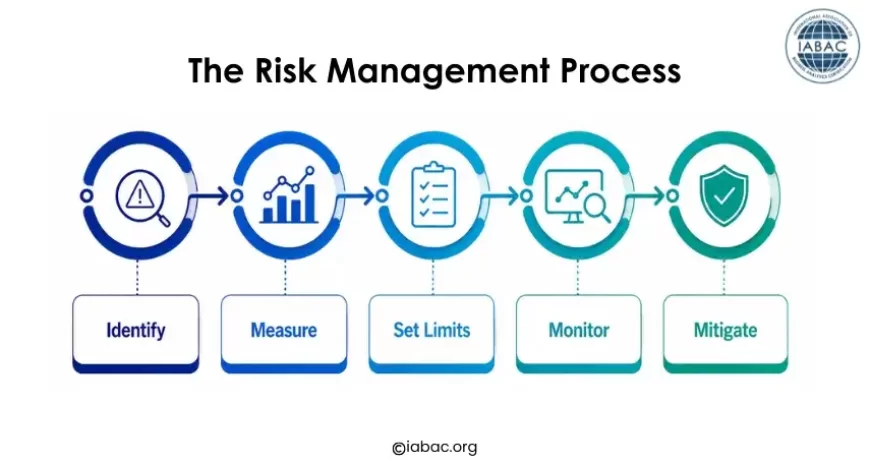
Process at a glance: Identify → Measure → Set Limits → Monitor → Mitigate → (repeat)
1. Risk identification
Banks assess every business activity, lending, treasury, trading, digital banking, payments, third-party vendors, and internal processes to determine where risk originates. Common sources include borrowers failing to repay, market fluctuations, cybersecurity threats, operational failures, regulatory non-compliance, and third-party service disruptions.
The earlier a risk is identified, the easier it is to manage.
2. Risk measurement
Once identified, banks evaluate each risk's likelihood and potential financial impact, using data analytics and statistical models to quantify exposure:
-
Probability of Default (PD) — the likelihood a borrower defaults
-
Loss Given Default (LGD) — the share of exposure lost if they do
-
Exposure at Default (EAD) — the amount at risk at the moment of default
-
Value at Risk (VaR) — potential loss on trading portfolios over a given period and confidence level
-
Liquidity ratios under both normal and stressed conditions
3. Risk appetite and risk limits
Every bank defines how much risk it is willing to accept in pursuit of its objectives. This is the Risk Appetite Framework, typically approved by the Board of Directors, and it sets limits such as maximum exposure to a single borrower, industry concentration caps, trading position limits, country exposure limits, liquidity thresholds, and capital buffer requirements.
4. Risk monitoring and reporting
Exposures are tracked continuously against approved limits using dashboards, automated alerts, management reporting, and regulatory returns — supported by portfolio reviews, stress testing, early-warning indicators, and internal audit. If limits are breached, management is notified so corrective action can follow.
5. Risk mitigation and control
Where risk exceeds acceptable levels, banks may tighten lending standards, diversify portfolios, hedge market exposures, increase capital reserves, improve operational controls, or exit high-risk segments.
Because banking risks evolve constantly, the cycle repeats rather than ending after one review.
Types of Risk in Banking
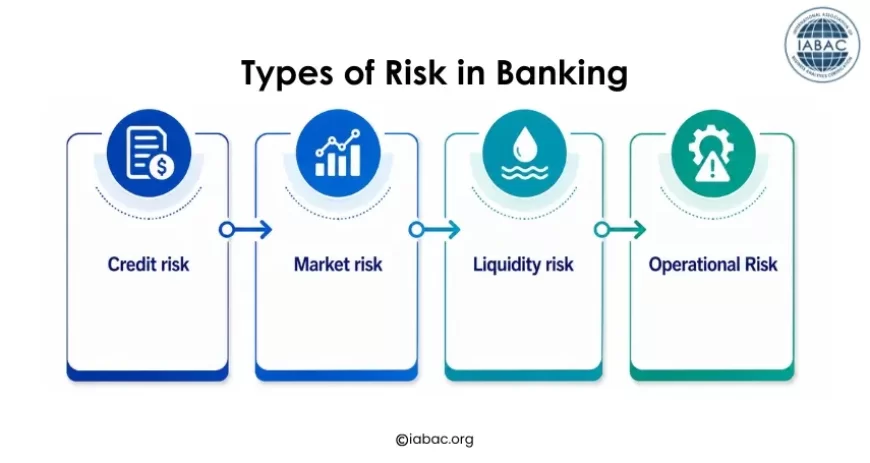
Four categories form the foundation of every banking risk framework.
|
Risk Type |
What It Means |
Common Examples |
Typical Mitigation |
|
Credit Risk |
Borrowers fail to repay loans or meet contractual obligations |
Loan defaults, corporate bankruptcies |
Credit assessment, collateral, diversification, provisioning |
|
Market Risk |
Losses caused by changes in market prices |
Interest rate moves, FX movements, equity declines |
Hedging, position limits, VaR, diversification |
|
Liquidity Risk |
Inability to meet short-term obligations |
Large withdrawals, funding shortages |
Liquidity reserves, LCR, diversified funding |
|
Operational Risk |
Losses from failed processes, people, systems, or external events |
Fraud, cyberattacks, system failures, human error |
Internal controls, cybersecurity, automation, business continuity |
Credit risk
The possibility that borrowers or counterparties fail to meet their obligations. Because lending is the primary revenue source for most commercial banks, credit risk is usually the largest component of overall risk. Banks manage it through credit scoring models, financial statement analysis, collateral evaluation, portfolio diversification, loan monitoring, and expected credit loss provisioning.
Market risk
Arises when market movements reduce the value of a bank's assets or trading positions — interest rates, foreign exchange, equity volatility, and commodity prices. Controlled through diversification, hedging, and quantitative monitoring such as VaR.
Liquidity risk
Occurs when a bank cannot meet short-term obligations without significant loss. If many customers withdraw deposits at once, the bank needs sufficient liquid assets to meet them.
After the financial crisis, Basel III introduced two binding liquidity standards:
-
Liquidity Coverage Ratio (LCR) — banks must hold enough high-quality liquid assets to cover 30 days of stressed net outflows.
-
Net Stable Funding Ratio (NSFR) — available stable funding must cover required stable funding over a one-year horizon.
Operational risk
Losses caused by failures in people, processes, systems, or external events. As banking becomes more digital, this category keeps expanding: cybersecurity breaches, internal fraud, payment failures, technology outages, human error, and vendor failures. Managed through governance, automation, cybersecurity frameworks, internal audit, and business continuity planning.
Other risks banks monitor
-
Compliance risk — failure to comply with laws and regulations
-
Reputational risk — damage to customer trust or brand
-
Strategic risk — poor business decisions or failure to adapt
-
Climate risk — physical and transition risks from climate change
-
Model risk — errors or weaknesses in the analytical and AI models used to make decisions
These increasingly overlap with the core four and are folded into enterprise-wide risk programmes.
The Banking Risk Management Framework
Most internationally active banks build their framework around the Basel Framework from the BCBS. Basel III sets minimum standards for capital adequacy, liquidity, leverage, risk-weighted assets, and governance.
Key Basel III minimums
|
Requirement |
Basel III minimum |
|
Common Equity Tier 1 (CET1) capital |
4.5% of risk-weighted assets |
|
Capital conservation buffer |
+ 2.5% (so 7% CET1 in practice) |
|
Total capital ratio |
8% of risk-weighted assets |
|
Leverage ratio |
3% (higher for global systemically important banks) |
|
Liquidity Coverage Ratio (LCR) |
≥ 100% |
|
Net Stable Funding Ratio (NSFR) |
≥ 100% |
Source: Basel Committee on Banking Supervision, Basel III framework. National regulators may apply higher requirements.
The Three Lines Model
Most banks organise risk governance using the Three Lines Model (previously known as the "Three Lines of Defence" — the Institute of Internal Auditors updated the name in 2020, though the older term is still widely used).
|
Line |
Responsibility |
|
First line |
Business units identify, own, and manage day-to-day risks |
|
Second line |
Independent risk and compliance teams set policy, monitor risk, and provide oversight |
|
Third line |
Internal audit independently evaluates whether controls and governance actually work |
Separating these responsibilities improves accountability and reduces the chance of uncontrolled risk-taking.
Basel III in 2026: Where the Endgame Stands
This is the most important live development in banking risk management, and the picture differs sharply by jurisdiction.
United States
On 19 March 2026, the Federal Reserve, OCC, and FDIC issued a re-proposed Basel III Endgame package and formally rescinded their 2023 proposals, which had drawn heavy industry and congressional opposition. The re-proposal marks a directional reversal: where the 2023 version would have significantly increased capital requirements, the agencies now expect overall system capital to modestly decrease — while remaining substantially above pre-crisis levels.
Key points for risk teams:
-
An Expanded Risk-Based Approach (ERBA) would apply to the largest banks (Category I and II), with a streamlined regime for smaller categories
-
The "dual stack" risk-weighted asset calculation would be replaced by a single-stack approach
-
The comment period closed on 18 June 2026; a final rule is expected to follow, with phased implementation anticipated across 2027–2028
European Union
The EU applies CRR3 from 1 January 2025, with a phased output-floor transition running through 2030. Implementation of the Fundamental Review of the Trading Book (FRTB) was postponed — first to January 2026, then to 1 January 2027.
United Kingdom
The Prudential Regulation Authority finalised the wider Basel 3.1 package for 1 January 2027, and deferred the FRTB Internal Model Approach to 1 January 2028.
What this means in practice
Basel was designed as a common global standard, but implementation has become genuinely uneven. Internationally active banks must now produce consistent capital results across jurisdictions that are calibrating and sequencing differently — which makes risk data quality, regulatory classification, and model governance more operationally demanding, not less.
For banks, risk management is no longer only about meeting a fixed rulebook. It is a strategic capability that has to absorb regulatory change as it happens.
The Role of Analytics and AI in Banking Risk Management
As banking becomes more digital, manual processes can no longer monitor risk in real time. Banks increasingly rely on advanced analytics, machine learning, and artificial intelligence to detect risk earlier, improve decisions, and strengthen compliance, supporting human expertise rather than replacing it.
Credit risk analytics
Modern models look beyond traditional credit scores to consider credit history, income and employment patterns, existing debt, transaction behaviour, industry performance, and macroeconomic conditions, enabling better-informed lending decisions.
Fraud detection
Banks process millions of transactions daily, so manual fraud detection cannot scale. AI systems continuously analyse transaction patterns to flag unusual spending, identity theft attempts, account takeover, payment fraud, and money-laundering indicators — in real time.
Stress testing and scenario analysis
Stress testing evaluates how a bank would perform under adverse conditions: recessions, rising interest rates, housing declines, large-scale defaults, liquidity shortages. A bank might simulate a severe slowdown to estimate expected defaults, capital adequacy after losses, liquidity availability, and profitability under stress — then use the results to guide capital planning.
Risk data aggregation
Accurate decisions depend on reliable data. Banks consolidate information from lending platforms, treasury systems, trading desks, payment infrastructure, and customer databases into a single consistent view — enabling faster reporting, better compliance, more accurate models, and clearer executive decision-making.
Human oversight remains essential
AI improves efficiency, but it does not replace judgment. Regulators require:
-
Human oversight of critical decisions
-
Model validation and independent review
-
Explainable AI models
-
Governance and audit trails
-
Ongoing model performance monitoring
Poorly designed or biased models become a source of risk in their own right. This is why model risk is now a recognised risk category, and why successful banks pair advanced technology with experienced risk professionals.
Common Challenges in Banking Risk Management
1. Constantly changing regulations. As the Basel III Endgame timeline above shows, frameworks shift — and diverge by jurisdiction. Keeping pace remains one of the industry's biggest challenges.
2. Data quality. Many banks still run legacy systems that scatter information across platforms, producing incorrect assessments, reporting errors, delays, and compliance gaps. Data governance remains a strategic priority.
3. Model risk. Poor assumptions, biased training data, or inadequate validation produce inaccurate results. Effective model governance requires independent validation, performance monitoring, periodic recalibration, and full documentation.
4. Cybersecurity threats. Phishing, ransomware, insider threats, payment fraud, and data breaches make cyber one of the fastest-growing operational risks.
5. Talent shortages. Employers need people who understand banking regulation and credit and market risk and data analytics and AI/ML. That combination remains hard to find.
6. Balancing growth and risk. Too conservative reduces lending and profitability; too aggressive threatens stability.
Future Trends in Banking Risk Management
-
Deeper AI integration across credit underwriting, fraud detection, portfolio monitoring, regulatory reporting, and early-warning systems — as decision support, not replacement.
-
Real-time risk monitoring, replacing periodic reporting with continuous dashboards, automated alerts, and predictive analytics.
-
Stronger regulatory expectations on capital adequacy, liquidity resilience, operational resilience, model governance, and risk data quality.
-
Enterprise-wide risk integration. A single cyberattack can simultaneously create operational risk, financial loss, compliance violations, and reputational damage — so risks are increasingly managed collectively rather than in silos.
-
Growing demand for analytics professionals who combine banking expertise, risk knowledge, statistical analysis, data visualisation, and AI literacy.
Key Takeaways
-
Risk management in banking helps institutions identify, measure, monitor, and control risks before they become major threats — through a continuous five-step cycle.
-
The four primary risk categories are credit, market, liquidity, and operational risk, increasingly joined by model, climate, and compliance risk.
-
Basel III provides the regulatory foundation for capital adequacy (CET1 ≥ 4.5% + 2.5% buffer), liquidity (LCR and NSFR ≥ 100%), and governance.
-
The Basel III Endgame is actively being rewritten: the US re-proposed in March 2026 with implementation expected 2027–28, the EU applies CRR3 with FRTB deferred to 2027, and the UK targets Basel 3.1 from 2027.
-
Analytics, AI, and real-time monitoring are transforming fraud detection, credit assessment, and enterprise risk — but human oversight and model governance remain mandatory.
Frequently Asked Questions
What are the four main types of risk in banking?
Credit risk (borrowers not repaying), market risk (losses from price movements), liquidity risk (inability to meet short-term obligations), and operational risk (failures in people, processes, systems, or external events such as fraud and cyberattacks).
What is the five-step risk management process in banking?
Identify risks across all business activities; measure their likelihood and financial impact; set risk appetite and limits; monitor exposures continuously against those limits; and mitigate risks that exceed acceptable levels. The cycle then repeats.
What is Basel III, and why does it matter?
Basel III is the international regulatory framework developed by the Basel Committee on Banking Supervision after the 2007–09 financial crisis. It sets minimum standards for capital (CET1 of at least 4.5% of risk-weighted assets plus a 2.5% conservation buffer), liquidity (LCR and NSFR of at least 100%), leverage, and governance — designed to keep banks solvent through periods of stress.
What is the difference between the LCR and the NSFR?
The Liquidity Coverage Ratio measures whether a bank holds enough high-quality liquid assets to survive 30 days of stressed outflows. The Net Stable Funding Ratio measures whether its funding is stable enough over a one-year horizon. Both carry a 100% minimum.
Is the Basel III Endgame in force yet?
Not in the US. Regulators re-proposed the package on 19 March 2026 and rescinded their earlier 2023 proposals; the comment period closed on 18 June 2026, and a final rule is expected with phased implementation across 2027–2028. The EU has applied CRR3 since January 2025 (with FRTB deferred to 2027), and the UK targets Basel 3.1 from January 2027.
Does AI replace risk professionals in banking?
No. AI improves speed and scale in fraud detection, credit scoring, and monitoring, but regulators require human oversight of critical decisions, independent model validation, explainability, and audit trails. Poorly governed models are themselves a recognised source of risk.
What is the Three Lines Model?
A governance structure separating risk responsibilities: business units own day-to-day risk (first line), independent risk and compliance teams set policy and provide oversight (second line), and internal audit independently tests whether controls work (third line).
Building a Career in Banking Risk Management
Modern risk roles increasingly sit at the intersection of banking knowledge and data skills. A structured path combining risk analysis, banking fundamentals, predictive analytics, business intelligence, and real-world case studies can prepare you for roles such as:
-
Risk Analyst
-
Credit Risk Analyst
-
Financial Analyst
-
Compliance Analyst
-
Risk Consultant
Explore IABAC's Certified Business Analytics Specialist – Banking programme to build hands-on knowledge of banking analytics, predictive modelling, and data-driven decision-making for financial services.
This article is for educational purposes and does not constitute financial, legal, or regulatory advice. Regulatory requirements vary by jurisdiction and change frequently; consult your regulator or a qualified compliance professional for guidance specific to your institution.