



























































What is fraud detection in banking industry?
Fraud detection in banking identifies and prevents scams using AI, analytics, and real-time monitoring to protect customers and financial systems.


Fraud detection in banking refers to the tools, methods, and processes that banks use to detect and prevent dishonest or illegal activities involving customer accounts and financial transactions. Simply said, it's how banks identify suspicious activity, such as a strange login, a strange transfer, or a fake new account, and take appropriate action before money or data is lost.
Fraud detection is important because banks handle other people's money and trust. Good detection protects customers, reduces bank losses, and ensures that the whole financial system runs properly.
Why is fraud detection important?
Fraud costs customers and banks a lot of money and reduces trust. If a bank fails to prevent fraud, consumers may lose money, close accounts, or switch banks. Banks are based on regulations to prevent fraud and money laundering, and poor controls can result in penalties and legal issues. Regulators also keep a careful eye on banks.
Beyond money and regulations, fraud detection safeguards client privacy and reputation. A successful fraud might result in stolen identities, destroyed credit scores, or months of recovery for victims. For this reason, banks spend money on people and systems whose only job is to identify suspicious activity early.
Types of fraud banks are facing
Banks deal with different kinds of fraud. Here are the standard ones, explained simply:
-
Account takeover (ATO): A fraudster gets someone’s login details and acts like the real owner to transfer money or change account details.
-
Card fraud: Stolen card numbers or cloned cards are used to buy things.
-
New account fraud / synthetic identity: Criminals create fake identities or mix real and fake data to open accounts for scams or money laundering.
-
Phishing and social engineering: Scams that trick people into giving credentials or authorizing transactions.
-
Payment fraud: Fake invoices, unauthorized transfers, or scams that convince staff to move money (e.g., business email compromise).
-
Internal fraud: Dishonest employees abusing their access.
Banks must watch for all these kinds of activity, because fraudsters adapt quickly.
How fraud detection works
Fraud detection blends three main elements:
-
Data collection. Banks gather transaction data, login details, device info, geolocation, customer history, and more.
-
Rules and analytics. Simple rules (for example, “no transfers above X without review”) flag obvious red flags. Analytics look for unusual patterns by comparing current actions with past behaviour.
-
Human review and action. Alerts are triaged by fraud analysts who investigate and decide whether to block a transaction, freeze an account, or contact the customer.
Modern fraud detection systems combine automation (scanning millions of actions in real time) and human judgment (reducing false alarms). The goal is to avoid real fraud while reducing inconvenience for honest customers.
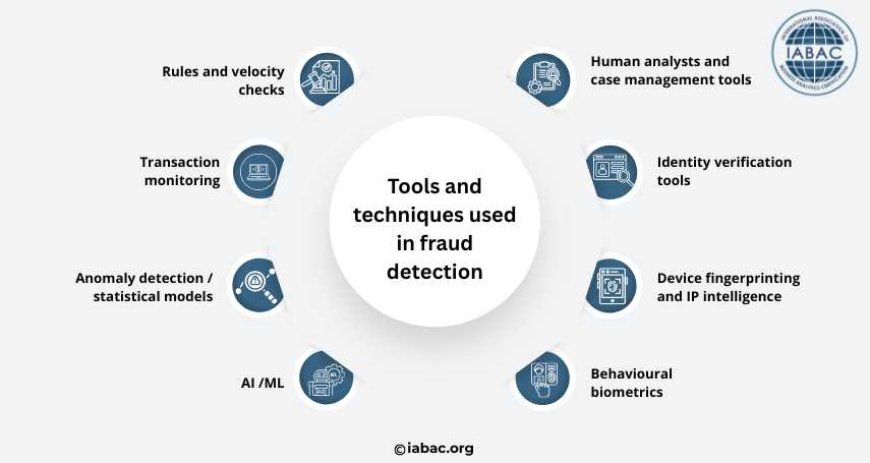
Tools and techniques used in fraud detection
Banks use a mix of older and newer tools. Here are the main ones, explained plainly:
-
Rules and velocity checks: These are “if-then” checks. Example: if a card is used in two countries within one hour, flag it. They’re fast and easy to understand, but alone, they’re not flexible.
-
Transaction monitoring: Constantly watching payments and transfers for odd patterns like unusual amounts, destinations, or timing.
-
Anomaly detection / statistical models: These spot behaviour that doesn’t fit a customer’s normal pattern, like sudden big transfers or logins from a new country.
-
Machine learning and AI: ML looks at huge amounts of past data and learns patterns of fraud vs. normal activity. It can combine many signals to give a risk score for each action. ML makes detection adaptive as criminals change tactics.
-
Behavioural biometrics: Instead of just checking a password, systems watch how a person types, swipes, or moves the mouse. If the behaviour doesn’t match the real user, the system can ask for extra checks.
-
Device fingerprinting and IP intelligence: These techniques look at the device and network used to access accounts. If a login comes from a suspicious device or VPN, it raises a flag.
-
Identity verification tools: For new accounts or high-risk actions, banks verify IDs and documents, often using AI to check if a document is real.
-
Human analysts and case management tools: People still review complex alerts. Case tools help investigators track evidence and decisions.
Combining these techniques helps banks detect many kinds of fraud faster and with fewer false alarms.
Real-time vs batch detection: what’s the difference?
-
Real-time detection checks transactions as they happen. If a payment looks risky, it can be blocked immediately. This is critical for card payments and instant transfers.
-
Batch detection reviews large volumes of data periodically (for example, overnight) and finds patterns that took time to appear. It’s useful for complex schemes or money-laundering detection.
Both are needed. Real-time prevents immediate losses; batch analysis uncovers longer-term fraud rings and patterns.
Challenges banks face in fraud detection
Even with powerful tools, fraud detection is difficult. Key challenges include:
-
False positives: Alerting on legitimate customer behaviour annoys customers and wastes investigators’ time. Balancing sensitivity is crucial.
-
Evolving fraud tactics: Fraudsters continually change methods. Systems must adapt quickly.
-
Data silos: Fraud teams need many data sources (payments, customer history, device data). When data is scattered, detection is weaker.
-
Regulatory and privacy limits: Banks must follow data protection laws while trying to use as much relevant data as possible.
-
AI risks: While ML is powerful, models can be biased or opaque. Banks must ensure fair, explainable systems and keep human oversight.
The future of fraud detection
A few big trends are already changing how banks detect fraud:
-
AI and machine learning are everywhere. ML helps the detection of subtle patterns and speedier response. But it must be utilized carefully and with human oversight.
-
Behavioural and technological signals become increasingly important. Device intelligence and behavioural biometrics provide more effective methods of identifying fraudulent individuals without disturbing customers.
-
Real-time decision-making allows instant payments. As the use of rapid payment systems grows, fraud detection must be immediate to prevent funds from leaving accounts.
-
Partnerships and data sharing. Banks and vendors partner to share fraud signals (for example, device intelligence or suspicious accounts) because broader data improves detection. Recent industry partnerships aim to combine behavioural analytics with transactional platforms to block fraud faster.
-
New threats from advanced AI. Deepfake voices and synthetic identities are making some legacy authentication (like voiceprint) unsafe. Industry leaders are warning banks to update verification methods quickly.
These trends indicate that fraud detection systems will continue to get better, faster, and more integrated.
Practical tips for learners and small banks
If you’re studying fraud detection or building a small fraud program, start here:
-
Understand the basics: Learn about the rules, velocity checks, and transaction flow.
-
Collect the correct data: Even simple signals (transaction patterns, login location, device information) are effective.
-
Begin with rules, then add ML: Rules are simple and easy to implement. When you have sufficient labeled data, add machine learning.
-
Track the model's performance: Keep track of false positives and negatives, and retrain models regularly.
-
Focus on explainability: Understanding and explaining why a consumer was alerted by the system is essential, especially in banking.
-
Human-in-the-loop: Always involve analyst evaluation in high-risk decisions.
These steps help you build effective detection while keeping customers happy.
Fraud detection in banking is a mix of technology, rules, and people, all aimed at spotting and stopping dishonest actions quickly and fairly. It’s an active, constantly changing field where learning how systems work and why they fail is as important as mastering algorithms.
If you want a practical certification to support a career in Business analytics in banking and fraud detection, consider the Business Analytics Specialist Banking certification for skills in analytics for the banking domain.