




















































Why Everyone Is Revisiting the Data Science Definition in 2026 to Improve Project Success
Improve technical understanding through Masters in Data Science, Data Science Classes, and Data Science Certifications for project success.

Data Science used to mean something. Now it means everything — which, ironically, means almost nothing unless you define it properly for your project. — Every Senior Data Scientist at a 2026 team retrospective
Let's be honest. If you walked into a room of 50 professionals right now and asked them all — What is the Data Science definition? — You would get 50 different answers. Some would say machine learning. Some would say statistics. One brave soul in the back would say cleaning spreadsheets, which, honestly, is the most accurate answer of all. But here is the thing: this is not a joke problem. This identity crisis around the Data Science definition is costing organisations millions of dollars in failed data science projects, misaligned teams, and executives who genuinely believe hiring one data scientist will turn their company into the next tech unicorn.
In 2026, the world has collectively decided: enough. Let's revisit what data science actually means — not for a LinkedIn post, but to genuinely improve how projects succeed.
The Classic Data Science Definition — And Where It Started Breaking Down
The textbook Data Science definition that most people learned goes something like this:
Data Science is an interdisciplinary field that uses scientific methods, processes, algorithms, and systems to extract knowledge and insights from structured and unstructured data.
Clean. Academic. Perfectly useless in a Monday morning sprint planning meeting.
This definition, rooted in the foundational work of statisticians and computer scientists over decades, was excellent for academic papers. It described the what of data science without ever really addressing the who does it, the how long does it take, or the why does the pipeline break every Friday afternoon. By 2024–2025, companies were reporting a startling pattern: 85% of data science projects were failing to reach production (Gartner). Not because the models were bad. Not because the data was insufficient. But the entire data science project was built on a misunderstood definition of what the team was actually supposed to be doing.
The 2026 Data Science Framework — A Redefined View
Here is what the modern data science community has collectively converged on in 2026. Think of it as the Expanded Definition — one that works for students, industry teams, and certification bodies like IABAC.
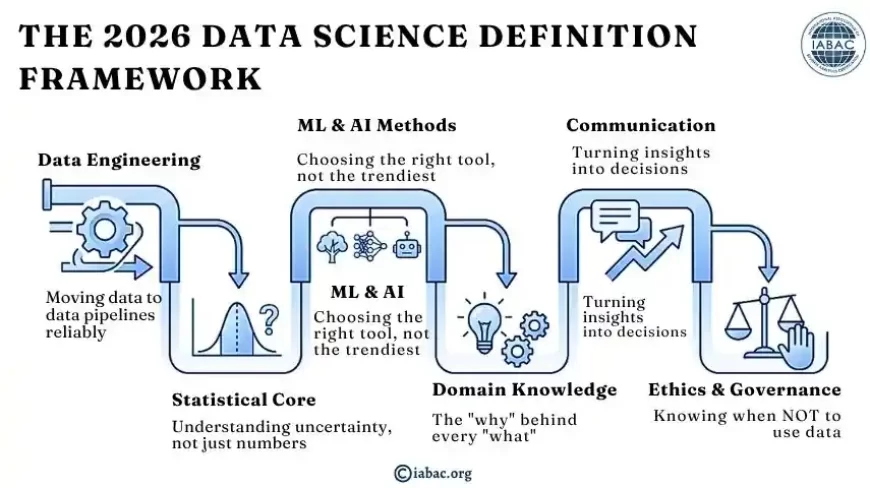
Notice something? Machine learning is one of six pillars — not the definition itself. This is the shift that 2026 has forced every organisation to make.
Why the Old Definition Was Killing Data Science Projects
Scenario 1: The Just Give Me a Model Problem
Imagine a retail company wants to predict customer churn. They hire a data scientist. The data scientist builds a beautiful gradient boosting model with 91% accuracy. Everyone cheers. The model goes nowhere near production because nobody prepared the data infrastructure, there was no pipeline from data to data sources, and the business team had no idea how to interpret the output.
Result? Project failure. Cost? Approximately $300,000 in salaries, cloud costs, and consultants.
Root cause? The company's Data Science definition was build a model. The complete definition should have included deployment, monitoring, and stakeholder alignment.
Scenario 2: The We Have Big Data, We Have Insights Fallacy
A healthcare provider in 2024 collected 4 terabytes of patient records. They called it a data science initiative. Two years later, they had four dashboards and no actionable change in patient outcomes.
Why? Because collecting data is data science. The definition was missing the extract knowledge part. Data sat in silos. There was no plan for how data to data connections would be made across departments. The project was all noun, no verb.
The Math Behind Project Failure (Yes, There Is Actual Math)
Let's put some numbers on this definitional problem. Here is a simplified model for estimating data science project success probability:
P(Project Success) = Alignment × Execution × Communication × 100
Where:
- Alignment = Team clarity on project scope (0.0 to 1.0)
- Execution = Technical and data readiness (0.0 to 1.0)
- Communication = Stakeholder engagement quality (0.0 to 1.0)
Real Scenario Calculation:
|
Scenario |
Alignment |
Execution |
Communication |
Success % |
|
Well-defined DS project |
0.9 |
0.85 |
0.80 |
61.2% |
|
Vague DS project |
0.4 |
0.85 |
0.50 |
17.0% |
|
No definition at all |
0.2 |
0.85 |
0.30 |
5.1% |
The math is brutal and honest. A well-executed technical model with poor alignment and communication still gives you only a 17% success rate. This is precisely why the Data Science definition in 2026 is being examined not as an academic exercise, but as a project management lifeline.
The IABAC Perspective: Why Certifications Are Being Redesigned
This definitional evolution isn't just a conversation in boardrooms. It is reshaping how Data Science certifications are built and awarded globally.
IABAC (International Association of Business Analytics Certifications) has been at the forefront of this movement. If you look at the updated certification pathways at iabac certifications, you will notice something different from older certification programs: the curriculum treats data science as a business discipline first and a technical skill set second.
This matters enormously. Traditional Data Science certifications tested whether you could write a neural network. The 2026 model also tests whether you can:
- Frame a business problem as a data problem
- Communicate uncertainty to a non-technical audience
- Design a data science project with clear success metrics
- Understand ethical implications of data-driven decisions
- Bridge the gap from data to data output to real-world action
This is a whole human approach to Data Science — not just a tools exam.
The Data Science Job Market in 2026 — What the Numbers Say
Let's look at what the global job market is telling us about data science in 2026:
DATA SCIENCE JOB MARKET SNAPSHOT — 2026
- Global DS Job Openings: ~2.7 Million (LinkedIn, 2026 est.)
- Average Salary (Global): $95,000 – $145,000 USD
- Fastest Growing Skill: MLOps + Data Governance
- Most Requested Soft Skill: Ability to explain models to non-technical stakeholders
- Most Common Reason for DS Hire Failure: Misalignment on project scope
Regions With Highest DS Demand:
- North America → 38%
- Europe → 22%
- Asia-Pacific → 27%
- Rest of World → 13%
What is notable here is that misalignment on project scope — a direct consequence of an unclear Data Science definition — is the leading reason organisations report failed hires. Not a lack of Python skills. Not insufficient data. A definition problem.
The Data to Data Concept That Everyone Is Getting Wrong
Here is a concept that has become central to the 2026 data science conversation: the data to data pipeline philosophy.
Traditionally, people thought of data science as a linear process:
Raw Data → Clean Data → Model → Insight → Decision
Simple. Clean. Wrong — for 90% of real projects.
The data to data concept means acknowledging that data doesn't flow in one direction. Data generates more data. Models create new data. Customer responses to model outputs generate data. Everything feeds back. A data science project that fails to account for this circular nature is set up to fail before it begins.
Why Students Are the Biggest Winners of This Definitional Shift
If you are entering the data science field in 2026, congratulations — you are arriving at the best possible moment. Here is why.
The people who entered data science in 2018–2021 learned a narrow definition. They became very good at specific tools (TensorFlow, Spark, SQL) but often struggled to connect technical outputs to business value. Many found themselves in companies that didn't know how to use them effectively because the company itself had a narrow definition of Data Science.
In 2026, the expanded definition means:
- Your communication skills matter as much as your code. A person who can explain a p-value to a CEO is worth more than one who can't.
- Domain knowledge is a superpower. Understanding healthcare, finance, or logistics, PLUS data science, is rarer and more valuable than pure technical skills.
- Certifications that reflect the full definition get you further. Programs like those at IABAC — iabac.org/certifications test the complete skill set, which is increasingly what employers want.
- The definition includes ethics. Knowing WHEN to use data and WHEN to say we shouldn't do this is now a professional competency.
There is something that does not get discussed enough in the data science world: the human cost of definitional failure.
When a data science project fails, it is not just a budget line item. A team of intelligent, hardworking people spent months — sometimes years — building something that never saw the light of day. They missed birthdays. They skipped sleep. They argued about architectures and hyperparameters and deployment strategies. And then a stakeholder who never agreed on a definition in the first place cancelled the project in a thirty-minute meeting.
This happens every single day across the globe.
Getting the Data Science definition right isn't academic pedantry. It is an act of respect for the people doing the work. When a team knows exactly what data science means in the context of their project — what success looks like, who the data is for, what good enough means for model performance — they can do their best work without constantly second-guessing the foundations.
That is what the 2026 conversation is really about. Not definitions for their own sake. Definitions that protect people's time, energy, and dignity.
How to Apply the Correct Data Science Definition to Your Next Project
Here is a practical, actionable checklist that reflects the 2026 Data Science definition:
Data Science Project Definition Checklist
□ Business Problem Clarity: What decision will this data science project inform?
□ Data Availability Audit: What data to data sources exist and are accessible?
□ Success Metric Agreement: How will ALL stakeholders measure project success?
□ Technical Scope Definition: Is this a prediction, classification, clustering, or inference problem?
□ Deployment Plan: Where does the output go, and who maintains it?
□ Ethical Review: Are there privacy, fairness, or bias considerations?
□ Communication Plan: How will non-technical stakeholders be kept aligned?
□ Timeline Realism: Is the timeline based on real data science project experience?
A team that completes this checklist before writing a single line of code increases its project success probability — using our earlier formula — from roughly 17% to over 60%. That is not a marginal gain. That is the difference between a project that ships and one that becomes a cautionary tale.
The Global Certification Benchmark for 2026
Across the world, Data Science certifications are being benchmarked against this expanded definition. According to industry surveys conducted in early 2026:
What Employers Look For In Ds Certifications (2026 Survey)
|
Criterion |
% of Employers Prioritising |
|
Technical Skills (ML, Stats, SQL) |
62% |
|
Project Management & Framing |
71% |
|
Communication & Storytelling |
68% |
|
Ethics & Governance |
59% |
|
Domain Knowledge Application |
74% |
|
Business Value Alignment |
81% |
Notice that Business Value Alignment — which is directly tied to having a correct Data Science definition — is the number one criterion. The most comprehensive Data Science certifications in 2026, including those offered through IABAC, incorporate all six of these dimensions into their curriculum and assessment framework.
The Evolution of the Data Science Definition
|
Year |
Dominant Definition |
Project Success Rate |
|
2012 |
Statistics + Programming |
~55% |
|
2015 |
Machine Learning Engineering (scope creep, hype cycle begins) |
~48% |
|
2018 |
AI = Data Science = Everything (maximum definitional confusion) |
~32% |
|
2021 |
Practical ML + Analytics (correction begins) |
~38% |
|
2024 |
Business-First + Technical |
~52% |
|
2026 |
Interdisciplinary Value Creation (full definition, full team alignment) |
~61%+ |
The correlation between definitional clarity and project success is not a coincidence. It is causation.
The Definition Is the Foundation
Here is the truth that 2026 has made impossible to ignore: the Data Science definition you hold in your head determines everything. It determines how you structure your team. It determines what questions you ask of your data. It determines whether your data science project delivers value or collects dust in a shared drive somewhere. Data science is not just algorithms. It is not just dashboards. It is not just Python notebooks. It is the discipline of turning uncertainty into informed action — using data, mathematics, domain knowledge, and human judgment together, in service of real decisions made by real people.
The best Data Science certifications in 2026 — like those available through IABAC at certifications — teach exactly this expanded, human-centred, project-success-oriented version of data science. Because the world has enough people who can fit a regression. What it needs are people who can define the problem correctly in the first place. So the next time someone asks you What is the Data Science definition? — give them the 2026 answer. Not the one from the textbook. The one that actually ships products, serves people, and makes projects succeed. About IABAC The International Association of Business Analytics Certifications (IABAC) is a globally recognised certification body for data science, analytics, and AI professionals. Explore current Data Science certifications and program details at the iabac certification.