













































The Truth About Data Science Courses Nobody Talks About?
Understand what makes learning effective through Masters in Data Science, Data Science Classes, and Data Science Certifications for career growth.

Every year, millions of hopeful people type the same three words into a search bar: learn data science. What comes back is a wall of course pages, each one promising a six-figure salary, a dream job offer, and apparently a whole new personality — all in twelve weeks. I have spent years deep inside the world of data science education, and I want to sit down with you and have an honest conversation about what those shiny landing pages quietly leave out.
This is not a post to scare you away from Data science. Honestly, it is the opposite. Data science is one of the most genuinely exciting, well-paying, and intellectually satisfying careers a person can build in 2025. The global data science and analytics market is expected to cross $322 billion by 2026, and companies in every industry — from hospitals to banks to sports teams — are hiring people who can make sense of their data. The opportunity is absolutely real. But the gap between finishing a course and landing a job is much wider than most course providers will ever admit. That gap is exactly what we need to talk about.
The Dream They Sell vs. The Reality You Get
Picture this. You finish a 12-week data science course. You have watched 80 hours of video. You have written your first Python script. You survived a Jupyter notebook that crashed three times before it finally drew a simple graph. You feel like a completely new person. Then you open a job board, search for fresher data science jobs, and stare at job descriptions asking for three years of work experience, five different tools, and apparently a published research paper. The confusion hits hard. This gap is not an accident. The course industry runs on sign-ups, not success stories. Marketing teams test headlines like "Zero to Data Scientist in 8 Weeks" because people click on them. Nobody tests "You Will Spend 18 Months Trying Before Your First Real Job." That headline tells the truth far more honestly, and yet it would empty a course page in minutes.
According to a 2023 LinkedIn Workforce Report, only about 38–42% of people who complete a standalone online data science course land a role directly related to data science within 12 months. The rest either move to related roles, take more courses, or walk away. That number does not appear on course homepages. It absolutely should. "The course certificate is the beginning of your credential, not the end of your learning. Anyone who tells you otherwise is selling something." — From IABAC's Career Transition Framework
What the Curriculum Quietly Skips
Most data science courses are built around tools, not problems. You learn Python. You learn how to clean a table. You build a model on a perfectly clean dataset that somebody else already prepared for you. The model works. You feel amazing. Then on your first day at a real company, someone hands you a database export with 47 columns, 30% missing values, three different date formats, and a column named something like col_X_FINAL_v3_USE_THIS. Welcome to actual data science.
The gap between "course data" and "real work data" is enormous. Experienced professionals will tell you that 60–80% of their actual working time goes into cleaning data, building pipelines, and talking to colleagues — not building models. Yet most courses dedicate maybe 10–15% of their content to those exact things. The numbers simply do not add up.
Where a Data Scientist Actually Spends Their Time (Industry Survey, 2024):
|
Task |
% of Working Time |
|
Data Cleaning and Preparation |
57% |
|
Talking to Stakeholders |
16% |
|
Building and Testing Models |
13% |
|
Deploying and Monitoring Models |
9% |
|
Research and New Ideas |
5% |
Based on 1,200 practitioner responses across North America, Europe, Asia-Pacific, and India
This is why moving from data to data — from classroom understanding to real working practice — takes deliberate effort that goes well beyond any single course. A genuinely good learning path closes that gap on purpose, with messy real data, live projects, and guidance from people who have actually shipped products that real businesses use.
Certifications: Worthless Badges or Golden Tickets?
Certifications might be the most argued-about topic in all of data science education. Half the internet says they are useless pieces of paper that no employer cares about. The other half says they are the key to everything. The honest answer is somewhere in the middle — and which certification matters far more than whether to certify at all.
There is a real difference between a certification that tests whether you watched the videos and one that checks whether you can actually do the work. The first one is basically a receipt. The second one is a proper credential. When you are looking at Data Science Certification, ask yourself three things: Does this test applied skills or just memory? Is it recognized by employers where I want to work? Does the organization behind it have a real standing in the global analytics community?
This is exactly where a body like IABAC (iabac.org) is worth paying attention to. Their Data Science Certifications are built around applied learning, so what you demonstrate actually maps to what employers need. You can browse their full certification options at iabac.org/certifications and their specific data science programme at iabac.org/data-science-certification. A 2024 survey found that job postings requiring a named analytics certification grew by 34% between 2021 and 2024. But here is the important detail — that growth was mostly in mid-level roles, not entry-level ones. For fresher data science jobs, your project work and portfolio carry more weight than any certificate. The certification matters more when you are going for your second or third role and competing against people with similar experience.
The Math Part Nobody Warned You About
Let's talk about statistics and mathematics — the subjects that data science courses either skip entirely or throw at you so fast in week one that half the class disappears by week two.
Here is the good news: you do not need a mathematics degree to become a working data professional. But you do need an understanding that goes deeper than knowing which function to call in Python.
Take the confusion matrix. Almost every course introduces it. Almost none explain why a model that always predicts the most common outcome can score 95% accuracy while being completely useless. The formula is simple:
Accuracy = (TP + TN) / (TP + TN + FP + FN)
F1 Score = 2 × (Precision × Recall) / (Precision + Recall)
F1 Score punishes models that cheat on imbalanced data. Plain Accuracy does not.
If you build a fraud detection model that flags zero transactions as fraud, it will score 98% accuracy — and catch exactly zero fraudsters. Understanding why F1 Score, ROC-AUC, and precision-recall curves exist, and when to use each one, is the difference between a data scientist and someone who runs code they copied without understanding it. Both call themselves data scientists. Only one survives a presentation to a business team.
Your Project Portfolio Is Your Real Ticket In
Here is the uncomfortable truth that all the certification debate tends to push aside: for most fresher data science jobs, your personal project portfolio is the single most important thing you have. Not your degree. Not your completion badge. Your projects — what you built, what problem you actually solved, how clearly you explained the result, and whether your code is readable by another human being.
A strong project portfolio should include at least three types of work:
- An end-to-end supervised learning project — from raw data all the way through to a model, evaluation, and a simple way to show the results.
- A SQL and storytelling project — showing you can query real data and explain the numbers in plain language that a non-technical person can actually use.
- A domain-specific project — pick one industry you want to work in, like healthcare, finance, retail, or logistics, and solve a problem that industry actually cares about.
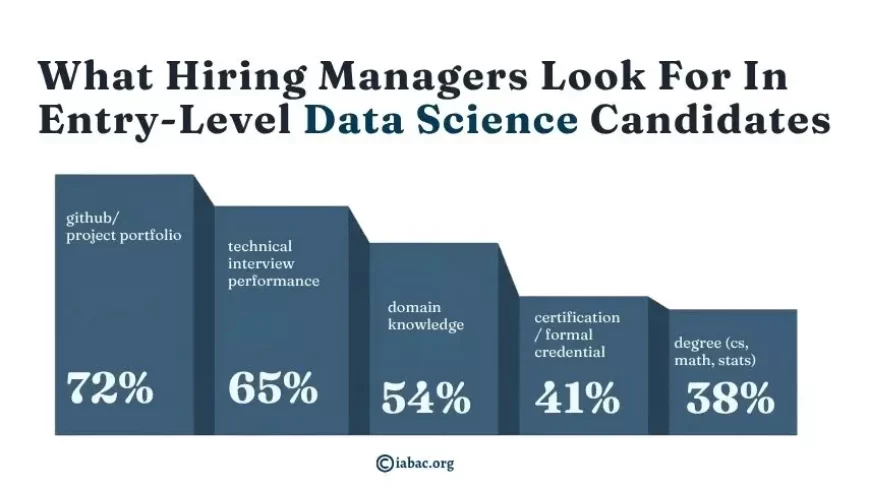
What Hiring Managers Look For in Entry-Level Data Science Candidates (2024):
|
Evaluation Factor |
% of Hiring Managers Who Prioritize It |
|
GitHub / Project Portfolio |
72% |
|
Technical Interview Performance |
65% |
|
Domain Knowledge |
54% |
|
Certification / Formal Credential |
41% |
|
Degree (CS, Math, Stats) |
38% |
Survey of 680 hiring managers across Asia-Pacific, Europe, and North America
A portfolio beats formal credentials by a significant margin. That does not mean certifications do not matter — they are increasingly valuable for career progression — but the person who spends six months building three real projects will almost always beat the person who collects five completion certificates and builds nothing.
The Skills That Actually Get You Hired
An analysis of more than 50,000 data science job postings in 2024 showed a very consistent pattern. The top technical skills are no surprise. But the communication and business skills — and how heavily companies weight them — might catch you off guard.
|
Skill |
% of Job Postings Requiring It |
|
Python and SQL |
88% |
|
Machine Learning |
74% |
|
Data Visualisation |
68% |
|
Communication with Non-Technical Teams |
61% |
|
Cloud Platforms |
55% |
|
Statistical Thinking |
49% |
The ability to explain your findings to people who are not data professionals appears in 61% of all data science job postings. That is higher than cloud tools and almost as high as machine learning itself. It is also the skill that most courses ignore almost completely, because it is genuinely hard to teach through video. And yet it is the skill that decides whether your analysis drives an actual business decision or sits in a folder nobody opens.
Salary: What the Numbers Actually Look Like
Let's talk about the number that appears in every data science advertisement: the salary. Yes, senior data scientists at large technology companies earn very well. Entry-level data analysts at smaller companies in different parts of the world earn quite different numbers. The salary picture globally is wide, and flattening it into one optimistic headline is not honest.
Global Data Science Salaries by Experience Level (2024 Estimates):
|
Role / Experience |
India (₹ LPA) |
Europe (€K/year) |
USA ($K/year) |
Southeast Asia ($K/year) |
|
Fresher / Junior (0–1 yr) |
4–8 |
30–45 |
55–75 |
18–30 |
|
Data Scientist (2–4 yr) |
10–22 |
50–75 |
90–130 |
35–55 |
|
Senior Data Scientist (5–8 yr) |
24–45 |
75–110 |
130–180 |
60–90 |
|
Lead / Principal (8+ yr) |
45–90+ |
100–145 |
160–250+ |
85–130 |
The career growth is real and genuinely attractive. But the starting point is what it is, and expecting senior-level pay at the beginning only leads to early frustration — which pushes people out of a career that would have eventually rewarded them very well.
What a Good Learning Path Actually Looks Like
If I were putting together the best possible data science learning path for someone starting fresh today, based on everything I know about how hiring works and how people actually learn, it would look like this:
Phase 1 — Foundations (Months 1–3): Python basics, SQL, and descriptive statistics. Build two small data analysis projects. No machine learning yet. Seriously, resist the urge.
Phase 2 — Core Skills (Months 4–7): Supervised and unsupervised learning, feature engineering, model evaluation, and data visualisation. Finish one proper end-to-end project and put it on GitHub where people can see it.
Phase 3 — Credentialing and Specialisation (Months 8–12): Pursue a recognized credential to make your skills official. IABAC's data science programme at iabac.org/data-science-certification is built specifically for this stage. At the same time, pick one area to go deeper — natural language processing, time series, computer vision, or something else you genuinely find interesting.
Phase 4 — Job-Ready Portfolio (Months 10–14): Three strong projects, a clean GitHub profile, a domain-specific case study, and active participation in the data science community.
This takes 12 to 18 months done properly. Anyone selling you the same result in 8 weeks is selling you 8 weeks of content — not 8 weeks of growth. The content is useful. The growth takes time, practice, and the particular kind of frustration that only comes from working on a problem you genuinely care about solving.
The Emotional Side Nobody Talks About
Here is something career advice almost never addresses: learning data science is emotionally harder than it is technically hard. The technical content is learnable. The emotional side — the imposter syndrome, the three-day debugging session, the model that performs worse after a full week of improvements, the comparison with everyone else who seems to be moving faster — is where most people actually give up.
There is a well-known pattern in skill learning called the valley of despair. You start with excitement because you do not yet know how much you do not know. You pick up some skills and feel brilliant. Then you discover how deep the subject actually goes, and everything falls apart for a while. Many people decide at this point that they are simply "not built for data science." The people who make it through are not necessarily smarter. They are more patient. They found a structured path. They built something, even if it was imperfect.
The most reliable predictor of success in data science is not your math background or your programming history. It is your willingness to build something a little ugly, put it on GitHub, and keep going anyway.
How to Choose the Right Course or Certification
Given everything above, here is a simple checklist for evaluating any data science education programme — whether it is an online course, a bootcamp, or a certification from a body like IABAC:
- Does it use real, messy data? If every dataset is pre-cleaned and perfectly formatted, that is a warning sign.
- Does it test what you can do, not just what you remember? Knowledge quizzes produce knowledge. Applied assessments produce skills.
- Is the credential recognised in the market where you want to work? Check actual job postings, not the course's own testimonials page.
- Is there a community and mentorship component? Learning alone is significantly slower than learning with others and access to practitioners.
- Does it end with a portfolio-ready project? The course output should be something you can show an employer.
- What career support exists after certification? A badge without any career infrastructure is decoration, not a pathway.
IABAC's approach to data science education, available at iabac data science certification, was built with these exact criteria in mind — connecting what you learn directly to what employers actually need. Their broader catalogue at iabac certifications covers the full range of analytics disciplines with the same applied focus.
Data science is worth it. The work is interesting, the pay is good, the career grows over time, and the ability to turn messy information into clear decisions is genuinely valuable in any industry, anywhere in the world. Fresher data science jobs are real and growing. Good Data Science Certifications from credible bodies carry real weight. The skills are learnable by almost anyone who is genuinely curious and willing to do the work. But the path is longer than the ads suggest. It is more emotionally bumpy than the syllabi acknowledge. And it depends far more on what you build than what you watch. The truth that nobody talks about is not that data science courses are bad. Many of them are very good. The truth is that a course is one ingredient, not the whole meal. You still have to cook. And the people who understand that — who treat datascience as a practice they are building rather than a product they are buying — are the ones who look back a year from now completely surprised at how far they have actually come.
Start building. The data is waiting.