



















































Do US Employers Accept IABAC Certification in 2026?
Do US employers accept IABAC certification in 2026? Learn how employers view it, where it helps, and how to present it effectively.

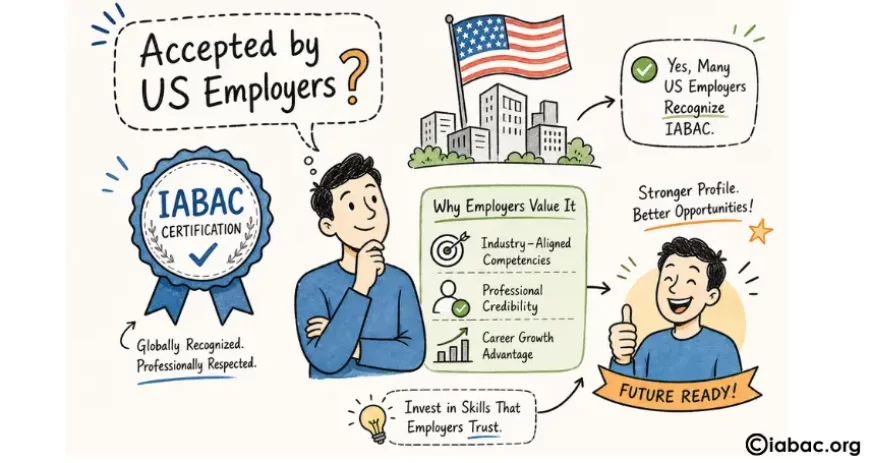
Is IABAC certification recognized by US employers in 2026? That's the question thousands of professionals holding this credential want answered, and it deserves a careful response rather than a reflexive yes or no. The honest answer depends on the employer, the industry, the role, and how you frame the credential when it lands in front of a recruiter. What follows is the evidence, the genuine gaps, industry-specific context, and a practical guide to maximizing IABAC's impact on your US job search this year.
The core of IABAC's credibility with US employers rests on something most US-based certification providers don't have: grounding in the European Commission's Edison® Data Science Framework. That gives IABAC certifications a structured, government-linked competency map rather than a loosely assembled course badge. For the right employer profile, multinational firms, cross-border operations, high-compliance industries, that distinction matters significantly.
What "Employer Recognition" Actually Means, and Why the Question Is More?
Accreditation vs. Recognition: Not the Same Thing
Most professionals conflate these two concepts and end up asking the wrong question. Formal accreditation, ANSI or NCCA approval in the US, is a certification body's stamp of process quality. Employer recognition is whether a hiring manager trusts that the credential signals real competence. A certification can carry strong employer recognition without formal US accreditation, and vice versa. For data science and analytics roles specifically, most employers evaluate skills fit, not accreditation lineage.
IABAC does not currently hold ANSI or NCCA accreditation. What it does hold is alignment to a formal, internationally developed competency framework backed by the European Commission. For a growing segment of US employers, particularly at multinational firms and enterprises with cross-border operations, that distinction carries real weight when evaluating candidates from diverse professional backgrounds.
Is IABAC Certification Recognized by US Employers in 2026? Here's How Screening Actually Works
Hiring in 2026 runs through three layers: ATS keyword filtering, recruiter pattern-matching, and hiring manager judgment. According to LinkedIn's 2025 Workforce Report, skills-based hiring has grown fastest in AI and analytics disciplines, meaning recruiters now prioritize whether a credential is verifiable, maps to real job competencies, and comes from a body they can quickly research. The brand recognition of Google or IBM still wins at the ATS stage for many large employers, but that's not where all hiring decisions are made.
When a credential clears the first filter and reaches a hiring manager at a mid-to-large enterprise, the question shifts from "have I heard of this?" to "does this demonstrate structured, applicable knowledge?" That's where IABAC's framework alignment becomes a meaningful differentiator, provided you present the credential correctly.
The Edison® Framework: Why It Gives IABAC Certification Real Credibility with US Multinationals
What the Edison® Framework Actually Signals to an Employer?
The Edison® Data Science Framework, developed under the European Commission, is a structured cross-border competency standard. It maps data science roles to specific skill levels, domain knowledge areas, and professional profiles across five broad competence groups: data science analytics, data science engineering, data management, domain knowledge and expertise, and scientific methods. Unlike platform-specific badges from software vendors or loosely structured online courses, IABAC certifications align to a defined competency architecture with measurable, mapped outcomes.
For a US hiring manager at a multinational firm evaluating candidates with internationally diverse backgrounds, this structure answers a precise question: "What exactly does this person know, at what level, and in which domain?" That's a question most generic online certificates can't answer cleanly.
Where Multinational US Employers Pay Attention?
The employer profiles most likely to value an IABAC credential include US subsidiaries of European multinationals, global consulting firms operating across regulatory environments, and US enterprises with international data teams and cross-border compliance requirements. In finance, healthcare, and enterprise technology, organizations increasingly look for credentials with cross-border validity because their data teams operate across jurisdictions with different standards. In 2026, hiring at these firms, financial centers like New York, life sciences hubs like Boston, enterprise tech clusters in the Bay Area, reflects this pattern: they want professionals who can operate in global matrix environments and bring structured, internationally portable expertise.
Industry-by-Industry: Where IABAC Certification Carries the Most Weight in US Hiring
Finance and Healthcare: Where Domain-Specific Credentials Make the Biggest Difference?
These are the two industries where IABAC's vertical-specific certifications have the clearest differentiation from generic alternatives. US finance employers hiring for risk analytics, compliance modeling, fraud detection, and forecasting value credentials that signal domain-specific application of data skills, not just broad machine learning familiarity. The same logic applies in healthcare, where clinical analytics, population health modeling, and AI model governance are growing hiring priorities at health systems, insurers, and pharma companies.
IABAC's Finance Analytics and Healthcare AI specializations map directly to these needs. A candidate presenting an IABAC Healthcare AI certification at a Boston-area hospital system or a pharma multinational is offering something a generic data analytics certificate doesn't: evidence of domain-specific, structured competency rather than general analytical exposure. That specificity gets noticed by hiring managers who understand what the role actually demands.
Tech and Data Engineering Roles
In US tech hiring, vendor-neutral credentials function as supplemental signals rather than primary qualification markers. Hands-on project work, GitHub repositories, published models, and Kaggle portfolios carry significant weight alongside any certification. IABAC certifications in data science and AI are viewed favorably by tech recruiters when paired with demonstrable applied skills, because the framework-aligned competency structure adds credibility that a course completion certificate doesn't.
Recruiters at larger tech firms and enterprise software companies increasingly pattern-match for competency evidence, and IABAC's domain-agnostic framework fits that evaluation model well, particularly for roles where cross-functional data fluency matters more than familiarity with a single vendor's stack.
Where Recognition Is Still Limited, and Why It's Worth Knowing?
Early-stage US startups, SMEs without international operations, and domestic-only employers with no prior exposure to international certification bodies will not immediately recognize the IABAC name. In these contexts, Google, IBM, and Microsoft credentials carry far more immediate brand weight at the resume screening stage. This isn't a knock on the credential's quality, it's a straightforward reflection of brand familiarity within a specific market segment. Knowing this in advance lets you make smarter decisions about how to complement your IABAC certification rather than relying on it alone.
IABAC vs. Google, IBM, and Microsoft Certifications: An Honest Comparison for US Job Seekers
Where Well-Known Brand Certificates Still Win?
Google Data Analytics, IBM Data Science Professional, and Microsoft Azure certifications benefit from immediate brand recognition in US job markets. ATS systems at large US employers are far more likely to surface these keywords during first-pass screening. For entry-level roles where name recognition drives shortlisting decisions, these credentials hold a measurable advantage. If the primary goal is maximum first-pass recruiter recognition in a generalist US market, Google and IBM currently lead on that single metric, and that's an honest assessment worth making.
Where IABAC Has a Strategic Advantage?
IABAC's edge lies in vendor neutrality, cross-border portability, and structured competency depth. For mid-career professionals targeting senior analytics roles, multinational employers, or domain-specific positions in high-compliance industries, an IABAC credential signals something fundamentally different from a platform badge: structured, framework-aligned expertise rather than familiarity with one vendor's ecosystem. It also separates you from the hundreds of thousands of generic certificate holders competing in the same applicant pools.
The strongest strategic approach in 2026 is a combined credential stack: a brand-name certificate for signal power at the ATS stage, and an IABAC certification for competency depth and global portability at the hiring manager stage. Think of this as a trust triangle, institutional credibility through IABAC, platform familiarity through a recognized vendor credential, and applied evidence through your portfolio. Each element does different work at a different stage of the hiring process.
- Vendor neutrality: IABAC certifications aren't locked to any one platform or tech stack, which matters when applying across different enterprise environments.
- Global portability: The Edison® framework gives credential relevance across US, European, and Asia-Pacific markets for professionals targeting international careers.
- Domain specialization: Vertical-specific certifications in Finance, Healthcare, HR, and Marketing address role-specific needs that generic vendor certificates don't.
How to Present Your IABAC Credential to US Recruiters Effectively?
Framing the Edison® Competency Standard on Your Resume and LinkedIn
The key to presenting an IABAC credential to a US recruiter who may not immediately recognize the body is translating the certification into outcomes, not just listing the credential name. Specify the competency level, the domain, and the skills mapped to the certification. Include the Edison® Data Science Framework by name in your credential description, because that phrase signals international standards alignment to any recruiter at a multinational firm who encounters it. Always include the verification link from IABAC's credential registry so the credential can be confirmed instantly.
On LinkedIn, use the certification description field to connect the competency framework to the specific skills and domains relevant to your target role. A finance analyst holding an IABAC Finance Analytics certification should describe it in terms of risk modeling, data-driven decision-making, and regulatory analytics, connecting the framework to the job language the hiring manager uses every day.
Combining IABAC with Portfolio Work and Complementary Credentials
No credential performs best in isolation. Pair your IABAC certification with a visible project portfolio on GitHub, Kaggle, or Tableau Public, domain-specific work experience, and, if budget allows, one widely recognized vendor credential. This is the trust triangle in practice: institutional credibility through IABAC, platform familiarity through Google or IBM, and applied evidence through your portfolio. For employers across enterprise tech, financial services, and healthcare, this stack consistently outperforms any single line on a resume because it addresses all three evaluation layers simultaneously.
Is IABAC Certification Worth Pursuing for US Career Goals in 2026?
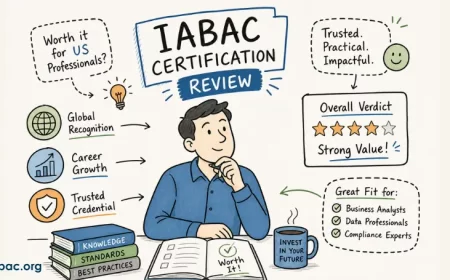
So, is IABAC certification recognized by US employers in 2026? Yes, in specific, meaningful contexts. Multinational firms with European operations or cross-border data teams, and enterprise employers in finance, healthcare, and technology are the clearest examples where IABAC's Edison® framework alignment translates to genuine hiring credibility. It is not universally recognized the way Google or IBM badges are, and that's an honest limitation worth knowing before you pursue it.
What distinguishes IABAC is structural credibility that generic online course certificates simply don't carry. As skills-based hiring becomes the dominant evaluation model in US analytics and AI recruitment, a shift already well underway according to SHRM's 2025 talent acquisition data, professionals who hold domain-specific, internationally portable credentials are increasingly well-positioned. For professionals targeting senior roles, domain-specific positions, or employers with international scope, IABAC certification belongs in your professional toolkit.
Explore IABAC's full certification pathways at the official IABAC portal, where you can verify credentials, review the competency framework alignment, and identify which specialization maps most directly to your target role. Position it precisely within your overall profile, and the employers who matter most will see exactly what it signals.