
























































How to Start a Data Science Roadmap From Scratch?
Learn how to start a data science roadmap from scratch with essential skills in Python statistics data analysis machine learning and real world projects.

Every day, millions of people interact with data without even realizing it. When you order food through an app, watch a movie recommended by a streaming service, or receive a product suggestion while shopping online, there is usually a data science system working behind the scenes. But here is the interesting part: every one of those intelligent systems was built by someone who once started from the beginning. No coding experience. No advanced mathematics knowledge. Just curiosity and determination.
This is where the idea of a data science roadmap becomes important. A roadmap provides a structured path that helps learners move from basic knowledge to advanced skills in Data Science. Instead of randomly watching tutorials and hoping everything makes sense, a roadmap gives direction and purpose. Many professionals today begin their careers by following a clear data science roadmap, supported by structured learning and Data Science Certifications offered by organizations such as IABAC through its global platform at iabac.org.
This guide explains how to begin that journey step by step, even if someone has never written a single line of code before.
Understanding Data Science
Before starting the roadmap, it helps to understand what Data Science actually means.
Data science is the practice of collecting, cleaning, analyzing, and interpreting large volumes of data in order to uncover patterns, generate insights, and support decision-making.
A data scientist does not just analyze numbers. They combine mathematics, statistics, programming, and business understanding to solve real-world problems.
Data science helps organizations:
- Predict customer behavior
- Detect fraud
- Improve healthcare outcomes
- Optimize supply chains
- Automate decision-making
The field has grown rapidly because companies generate massive amounts of data every second.
Why a Data Science Roadmap Is Important
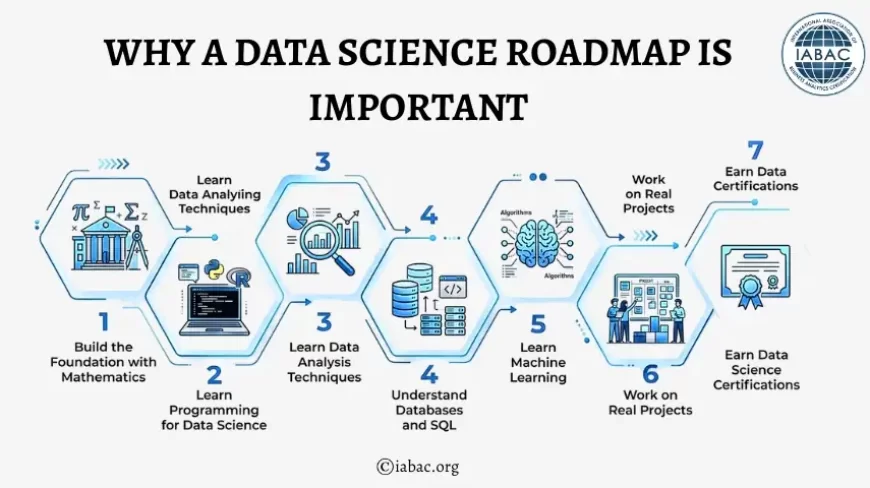
Learning data science without a plan can feel like trying to assemble a complicated puzzle without knowing what the final image looks like. One moment you are learning Python, the next moment someone tells you to study neural networks, and suddenly statistics appears like a surprise exam you never prepared for.
A structured data science roadmap helps learners focus on the right topics at the right time.
A clear roadmap helps with:
- Understanding the correct learning sequence
- Avoiding confusion from too many resources
- Building skills step by step
- Preparing for professional Data Science Certifications
- Improving job readiness
With a proper roadmap, the learning process becomes much more manageable.
Step 1: Build the Foundation with Mathematics
Mathematics forms the backbone of Data Science. Fortunately, becoming comfortable with math concepts does not require becoming a mathematician.
The key areas include:
- Linear algebra
- Probability
- Statistics
- Basic calculus
One important mathematical concept used in machine learning is matrix representation.
Matrix Representation
Datasets are often represented in matrix form.
X=x11x21x31x12x22x32x13x23x33
Each row represents an observation or record.
Each column represents a feature or variable.
Understanding this concept helps when working with machine learning algorithms.
Step 2: Learn Programming for Data Science
Programming allows data scientists to work with large datasets and automate analysis tasks.
Python is one of the most popular programming languages used in Data Science.
Some essential Python libraries include:
- NumPy for numerical computing
- Pandas for data manipulation
- Matplotlib for data visualization
- Scikit-learn for machine learning
Many learners initially feel nervous about programming. It is completely normal. The first few weeks may involve small victories like printing “Hello World” or successfully loading a dataset. Those small wins eventually build confidence.
Step 3: Learn Data Analysis Techniques
Once programming basics are clear, the next step in the data science roadmap is data analysis.
Data analysis includes:
- Data cleaning
- Handling missing values
- Detecting outliers
- Performing exploratory data analysis
- Creating visualizations
One commonly used statistical formula is the mean.
Mean=N∑X
Where:
-
represents the sum of values
-
represents the number of observations
Understanding such statistical calculations helps in interpreting data correctly.
Step 4: Understand Databases and SQL
Data rarely comes in perfectly organized files ready for analysis. Instead, it is stored in databases.
Structured Query Language (SQL) is used to retrieve and manipulate data stored in relational databases.
Common SQL operations include:
- SELECT queries
- Filtering with WHERE conditions
- Joining multiple tables
- Aggregating data using functions like SUM, AVG, COUNT
SQL skills are essential in most Data Science and analytics roles.
Step 5: Learn Machine Learning
Machine learning is where data science becomes truly powerful.
Machine learning allows systems to learn patterns from data and make predictions.
Common machine learning algorithms include:
- Linear regression
- Logistic regression
- Decision trees
- Random forests
- Clustering algorithms
A simple linear regression model can be expressed as:
Y=mX+b
Where:
- ( m ) is the slope
- ( b ) is the intercept
Machine learning models use such mathematical relationships to make predictions.
Step 6: Work on Real Projects
Knowledge becomes valuable only when it is applied.
Working on projects helps learners:
- Understand real-world problems
- Improve problem-solving skills
- Build a professional portfolio
- Demonstrate practical expertise
Projects may include:
- Predicting housing prices
- Analyzing customer purchase behavior
- Detecting fraudulent transactions
- Forecasting sales trends
Projects are often required during professional Data Science Certifications programs as well.
Step 7: Earn Data Science Certifications
Completing structured Data Science Certifications helps learners validate their skills.
Certifications demonstrate that a professional has completed standardized training and passed rigorous assessments.
Global certification bodies such as IABAC, available at iabac.org, offer certification programs designed to prepare professionals for real-world analytics and data science roles.
These programs typically include:
- Hands-on projects
- Case studies
- Practical exams
- Industry-relevant tools
Certifications can help professionals stand out in competitive job markets.
Common Challenges in Following a Data Science Roadmap
While the journey into Data Science is exciting, it also comes with several challenges.
- Information Overload: There are thousands of tutorials, courses, and books available. Beginners often struggle to decide where to start.
- Difficulty with Mathematics: Statistics and linear algebra can initially feel intimidating.
- Programming Frustrations: Errors in code can take hours to debug, which can test patience.
- Lack of Practical Experience: Many learners focus on theory without building real projects.
- Motivation Challenges: Learning data science requires consistency and long-term dedication.
The good news is that these challenges are common and can be overcome with structured learning and practice.
Career Opportunities After Completing a Data Science Roadmap
Professionals who complete a structured data science roadmap and earn relevant Data Science Certifications gain access to a wide range of career opportunities.
Common roles include:
|
Job Role |
Average Global Salary Range |
|
Data Analyst |
$60,000 – $90,000 |
|
Data Scientist |
$90,000 – $140,000 |
|
Machine Learning Engineer |
$100,000 – $150,000 |
|
Business Intelligence Analyst |
$70,000 – $110,000 |
|
AI Specialist |
$110,000 – $160,000 |
Actual salaries depend on location, experience, and industry.
Technology companies, financial institutions, healthcare organizations, and retail businesses all hire data science professionals.
Future Scope After Following a Data Science Roadmap
The future of Data Science looks extremely promising.
Several global trends are increasing demand for data science professionals.
- Growth of Artificial Intelligence: AI applications rely heavily on data science techniques.
- Explosion of Data: Organizations generate more data every year through digital platforms and connected devices.
- Automation and Predictive Systems: Companies use predictive analytics to automate decision-making.
- Industry Expansion: Data science is now used in healthcare, finance, education, marketing, sports analytics, and many other industries.
Reports suggest that the global data science market continues to grow significantly each year, creating strong demand for skilled professionals.
A Reality Check for Beginners
Starting a data science roadmap can feel overwhelming at times.
There will be moments when a machine learning model refuses to cooperate. There will be days when a dataset looks more confusing than a puzzle with missing pieces.
Sometimes the computer works perfectly. Sometimes it seems like the computer is personally offended by your code.
This is completely normal.
Every experienced data scientist once stared at a screen wondering why their code produced an error message longer than their entire program.
Progress happens slowly but steadily.
Beginning a journey into Data Science from scratch may appear challenging, but it is absolutely achievable with the right guidance and persistence. A structured data science roadmap provides a clear learning path—from mathematical foundations and programming skills to machine learning and professional certification. Building practical experience, working on projects, and earning globally recognized Data Science Certifications through organizations such as IABAC at iabac.org can significantly strengthen career opportunities.
As businesses continue to depend on data-driven insights, professionals with strong analytical skills will remain in high demand across industries worldwide. The journey into data science starts with curiosity, grows through learning, and eventually transforms into a powerful career built on knowledge, persistence, and the ability to turn data into meaningful insights.