




















































Why More Professionals Are Choosing Global Certification?
See why professionals choose global certification to strengthen practical skills and validate industry knowledge in AI, data science, and analytics roles.

Many people reach a stage in their career where they start asking important questions.
Am I learning the right skills?
How do I stand out in job applications?
What can help me move into better roles or higher-paying jobs?
This is where global certifications start appearing in conversations among students, professionals, and even training institutes.
A degree gives you foundational knowledge. But employers often want something more proof that you can apply skills in real work situations. Certifications help fill that gap.
Global certifications are designed to validate skills using industry standards that are recognized beyond a single country or institution.
Because of that, many professionals see them as a practical step toward improving their career options.
Let’s understand what global certifications are, why people choose them, and who can benefit from them.
What Is a Global Certification?
A global certification is a professional credential issued by an international certification body. It confirms that the person who earned it has completed training and passed an assessment based on industry standards.
Unlike a local certificate issued by a college or a training institute, a global certification is meant to be recognized by employers across different regions.
These certifications are often designed with input from industry professionals, academic experts, and training partners.
For example, organizations such as the International Association of Business Analytics Certifications offer certification programs in areas like artificial intelligence, data science, and business analytics.
The goal is straightforward: help professionals prove their knowledge and skills in fields where companies are actively hiring.
Why Certifications Matter for Employers
Employers usually evaluate candidates based on three things:
-
Education
-
Experience
-
Demonstrated skills
Degrees and work experience are important, but they do not always show whether a person understands the latest tools or technologies.
Certifications help bridge that gap.
When employers see a recognized certification on a resume, it signals that the candidate has completed structured learning and passed a formal evaluation.
This does not guarantee that someone will be hired, but it does make the profile easier to trust.
For recruiters who review hundreds of resumes every week, certifications often help identify candidates who have taken extra steps to improve their skills.
Why Professionals Choose Global Certifications
People pursue certifications for different reasons. For some, it is about entering a new field. For others, it is about improving their position in the job market.
Here are some of the most common motivations.
Learning Skills That Are Actually Used in Jobs
Many degree programs focus heavily on theory. While that knowledge is valuable, employers often want practical skills.
Certifications usually focus on applied learning. Training programs may include case studies, practical exercises, or real-world scenarios that reflect how work happens inside companies.
This makes certifications attractive for learners who want to build job-ready knowledge.
Strengthening a Resume
When someone applies for a job, their resume competes with many others.
Adding a recognized certification can make a resume look more complete.
It tells the recruiter that the candidate invested time in structured learning and completed a recognized program.
For fresh graduates especially, certifications can help show initiative and commitment to professional development.
Entering Growing Technology Fields
Many professionals use certifications as a way to enter fast-growing areas such as:
-
Artificial Intelligence
-
Business Analytics
-
Machine Learning
-
Data Engineering
These fields attract interest because companies across industries are adopting data-driven decision making.
Learning the basics of these areas through certification programs can help professionals understand how technology is used in real business environments.
Career Transition
Not everyone starts their career in the field they want to stay in.
Someone working in operations, testing, or support might decide to move into analytics or AI.
Certifications can help make that transition smoother by providing structured learning and a recognized credential.
While experience still matters, certifications can help demonstrate that a person has taken the effort to build new skills.
Personal Confidence
Another reason people pursue certifications is confidence.
Learning something new and successfully completing an exam or assessment can give professionals a stronger sense of direction.
It shows them that they are capable of understanding complex subjects and applying them.
This confidence often carries into interviews and workplace discussions.
Who Should Consider Global Certifications?
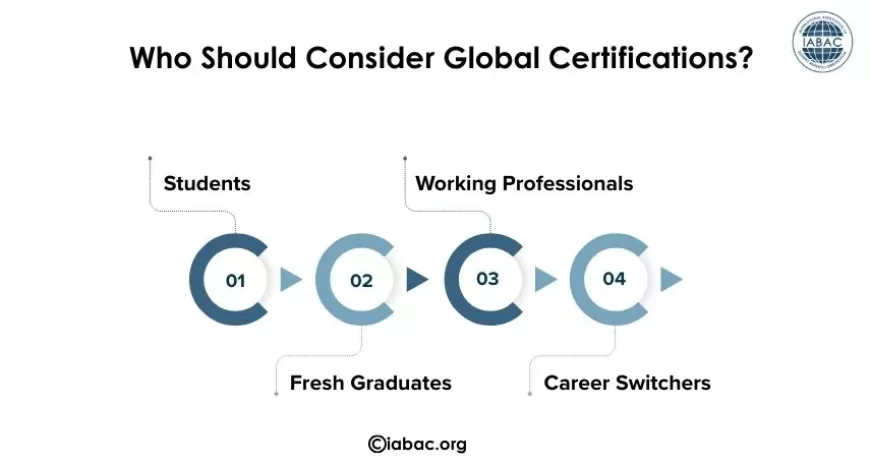
Global certifications are not limited to one type of learner. Different groups find value in them for different reasons.
Students
Students sometimes feel that their academic programs do not fully cover emerging technologies.
Certifications can help them explore fields such as analytics, AI, or machine learning before entering the workforce.
This can give them an advantage during campus placements or early job applications.
Fresh Graduates
Graduates who are entering the job market for the first time often face strong competition.
A certification can help strengthen their profile and demonstrate that they have developed additional skills beyond their degree.
For many graduates, certifications also provide direction about which career path they want to pursue.
Working Professionals
Professionals who already have experience sometimes pursue certifications to update their skills.
Technology and business practices change quickly. Certifications provide a structured way to learn new concepts and tools.
They also signal to employers that the individual is serious about professional growth.
Career Switchers
People from non-technical backgrounds sometimes want to move into technical roles.
Certifications can introduce them to important concepts and help them understand whether the field suits their interests.
While it takes time and practice to build expertise, certifications often serve as the starting point.
What Makes a Certification Valuable?
Not all certifications carry the same weight.
Before choosing one, it is helpful to evaluate a few factors.
Recognition
A certification issued by a known organization tends to have stronger credibility.
Employers are more likely to recognize the value of certifications that follow industry standards.
Structured Curriculum
Good certification programs include well-organized learning paths.
This might involve modules, practical assignments, and assessments designed to test understanding.
A structured approach helps learners progress step by step.
Practical Learning
Programs that include case studies, projects, or hands-on exercises are often more useful than those based only on theory.
Practical work helps learners understand how knowledge is applied in real situations.
Assessment or Examination
An evaluation process is an important part of certification.
It ensures that the person receiving the credential has actually demonstrated their knowledge.
This is what gives certifications their credibility.
Certifications and Salary Expectations
Many people search for certifications because they want higher salaries.
Certifications can help improve job prospects, but they should not be seen as a guarantee of high pay.
Salary levels usually depend on several factors:
-
practical skills
-
work experience
-
the company hiring
-
interview performance
-
location and industry demand
Certifications support these factors by strengthening a candidate’s profile.
When combined with projects and real work experience, they can help professionals qualify for better roles.
The Role of Certification Organizations
Certification bodies develop programs that align with industry needs.
Organizations such as the International Association of Business Analytics Certifications work with training partners and industry professionals to design certification frameworks.
Training providers then deliver courses that prepare learners for certification assessments.
This structure allows professionals to learn from instructors while still earning credentials from recognized organizations.
Final Thoughts
Global certifications are not a replacement for education or experience.
Instead, they act as a supporting layer that strengthens a professional’s profile.
They help learners develop structured knowledge, demonstrate commitment to skill development, and communicate their expertise more clearly to employers.
For students, certifications can open doors to emerging fields.
For professionals, they can support career transitions or skill upgrades.
And for employers, certifications offer a way to identify candidates who have taken their learning seriously.
Choosing the right certification and combining it with real-world practice can make a meaningful difference in long-term career growth.