


















































The Rise of Agentic Analytics in Business Intelligence
Agentic analytics is transforming business intelligence with autonomous AI agents, real-time insights, smarter decisions, and evolving analytics careers.

Agentic analytics is a fundamental change in the way businesses use data, how insights are generated, and most importantly, what the role of a business analyst looks like going forward.
For years, the job of a business analyst or BI professional revolved around building dashboards, running reports, writing SQL queries, and presenting findings to decision-makers. That model worked. But it is changing fast.
AI agents are now capable of doing much of that work autonomously. They can monitor data, detect patterns, generate insights, and even trigger actions all without waiting for a human to ask the right question. This is the era of Agentic Analytics, and it is already here.
What Exactly Is Agentic Analytics?
Agentic Analytics is an approach to data analysis where autonomous AI agents independently explore data, generate insights, and take context-aware actions with minimal human intervention. Instead of a business analyst manually pulling a report every Monday morning, an AI agent continuously monitors the data, detects when something changes, explains why it happened, and recommends what to do next in real time.
The word "agentic" comes from the concept of "agency"—the ability to act independently toward a goal. When combined with analytics, it produces a system that does not just sit and wait to be queried. It thinks, reasons, and acts on its own.
The difference is stark:
-
Traditional BI: A dashboard is built. Someone looks at it. A question is asked. A report is run. A decision is made. The whole cycle takes hours or days.
-
Agentic Analytics: The AI agent monitors data continuously, spots a problem, explains the root cause, recommends a fix, and alerts the right person all before the morning stand-up.
How Did We Get Here? The Evolution of Business Analytics
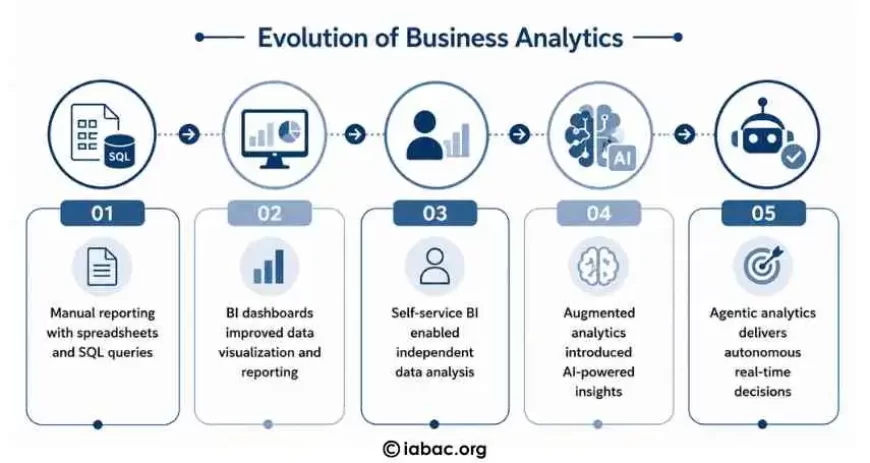
To truly appreciate where the industry is heading, it helps to understand how business analytics has evolved. This is not a sudden jump; it is a progression that has been building for over a decade.
-
Stage 1 — Manual Reporting: Analysts wrote SQL queries and produced static reports in Excel. Everything was manual, slow, and reactive.
-
Stage 2 — BI Dashboards: Tools like Tableau, Power BI, and QlikView transformed how data was visualized. Dashboards made data accessible, but humans still had to interpret everything.
-
Stage 3 — Self-Service BI: Non-technical business users could explore data independently. Analytics became more democratized but still reactive.
-
Stage 4 — Augmented Analytics: AI and machine learning started assisting analysts. Tools could auto-generate insights, flag anomalies, and suggest next steps. Humans were still in control, but AI was doing more of the heavy lifting.
-
Stage 5 — Agentic Analytics: AI agents now operate autonomously. They do not just assist; they think, reason, plan, and act. The analyst's role shifts from executing analysis to overseeing and strategically directing AI agents.
The industry is firmly in Stage 5 right now, and the pace of adoption is accelerating rapidly in 2026.
How Does Agentic Analytics Actually Work?
Agentic analytics operates through a continuous multi-step reasoning and action loop. Understanding this framework is important for any analytics professional navigating this shift.
-
Ingest: The AI agent continuously collects data from multiple sources: databases, APIs, CRM systems, ERP platforms, marketing tools, and more.
-
Analyze: It detects patterns, trends, anomalies, and performance shifts using AI models and statistical reasoning.
-
Explain: It translates findings into plain-language insights, telling not just what happened but why it happened.
-
Recommend: It generates data-driven recommendations for specific actions the business should take based on the analysis.
-
Act: In advanced setups, it can automatically trigger workflows, send alerts, update forecasts, or initiate business processes without waiting for human instruction.
This continuous loop runs 24 hours a day, 7 days a week.
What makes this even more powerful is the use of technologies like Large Language Models (LLMs) for natural language understanding, Retrieval Augmented Generation (RAG) for grounding insights in real business data, and semantic layers that ensure the AI agent understands business metrics and logic correctly.
Agentic Analytics vs Traditional BI: The Key Differences
The contrast between traditional BI and agentic analytics is significant and worth understanding in detail. It shows exactly how the landscape is shifting and what new expectations look like for analytics professionals.
-
Traditional BI is reactive and query-driven. It depends on human initiative at every step: knowing what question to ask, building the query or dashboard, interpreting the output, and taking the insight to a decision-maker. Time to insight can range from hours to days.
-
Agentic Analytics is proactive and AI-driven. The system continuously monitors data without being prompted. It surfaces insights automatically, explains them in plain language, and in many cases triggers the appropriate response or recommendation directly. Time to insight drops from hours to minutes or seconds.
For instance, imagine an e-commerce company noticing a sudden conversion drop at 2 AM. In a traditional BI setup, analysts may not identify the issue until the next morning after manually reviewing dashboards and reports.
An agentic analytics system, however, detects the anomaly instantly, identifies that a recent mobile app update caused checkout failures, and automatically alerts the engineering team before revenue losses escalate.
|
Features |
Traditional BI |
Agentic Analytics |
|
Approach |
Reactive, query-driven |
Proactive, AI-driven |
|
Insight Generation |
Static dashboards and reports |
Continuous, automated insight generation |
|
User Interaction |
Requires SQL or dashboard setup |
Natural language and conversational queries |
|
Time to Insight |
Hours or days |
Near real-time continuous analysis |
|
Decision Support |
Humans interpret and act |
AI agents recommend or trigger actions |
|
Automation Level |
Mostly manual |
Autonomous insight discovery |
The user interaction model changes significantly as well. In traditional BI, technical skills like SQL, Python, DAX, and Tableau are required to extract value from data.
In agentic analytics, users interact through natural language, fundamentally changing who can access analytics and how.
How Does Agentic Analytics Work With Existing BI Tools?
A common concern is whether agentic analytics replaces existing tools and infrastructure. The answer is no; it builds on top of them.
AI agents connect directly to existing platforms' data warehouses, lakehouses, and BI environments, continuously querying live data and feeding insights back into existing dashboards and workflows. Tools like Tableau and Power BI are enhanced, not replaced.
For this to work effectively, the underlying data architecture must be clean, connected, and governed. The key requirements include:
-
Data Modeling: Well-structured, consistent data models that agents can navigate accurately
-
Reliable Data Pipelines: Continuously updated data flows ensuring agents work with current information
-
Semantic Layers: Standardized business logic so agents understand what the numbers mean in a business context
-
Governance Frameworks: Clear access controls and compliance guardrails within which agents operate responsibly
Industries Already Using Agentic Analytics in 2026
Agentic analytics is not a future concept. It is already being deployed across industries right now. According to a 2025 PwC survey, 79% of organizations say AI agents are already being adopted in their companies — underscoring how quickly the technology is moving into the mainstream.
1. Financial services and banking are leading adoption. AI agents continuously monitor millions of transactions for fraud detection, analyze credit risk in real time, and generate regulatory compliance reports automatically.
Traditional reporting systems often identified fraudulent behavior only after losses occurred. Agentic analytics changes that by enabling detection and response in near real time.
2. Retail and e-commerce organizations are using agentic analytics for dynamic pricing optimization, customer churn prediction, inventory management, and conversion rate analysis.
AI agents analyze customer journeys, segment them by device type and geography, detect issues like checkout failures caused by app updates, and recommend immediate fixes that would previously take analysts two to four hours.
3. Healthcare and pharmaceuticals are deploying AI agents for patient readmission prediction, clinical trial optimization, and operational efficiency. Compliance agents ensure data handling meets privacy standards such as HIPAA and GDPR while reasoning agents analyze clinical and behavioral data simultaneously.
4. Manufacturing and supply chain organizations use agentic analytics for predictive maintenance, demand forecasting, and logistics optimization. AI agents monitor sensor data, equipment performance metrics, and maintenance records to detect anomalies and recommend maintenance scheduling before failures occur.
5. Marketing and advertising teams leverage AI agents for campaign performance optimization, audience segmentation, and real-time budget allocation, moving from manual campaign analysis to autonomous marketing intelligence.
What This Means for Business Analytics Careers
Agentic Analytics is not going to eliminate business analytics jobs. But it is fundamentally changing what those jobs require. According to Deloitte, 25% of companies using generative AI are already piloting agentic AI in 2025, and this is expected to rise to 50% by 2027.
The professionals who understand how AI agents work, who can govern them, interpret their outputs, validate their reasoning, and connect their insights to business strategy will be in extremely high demand. Here is how specific roles are evolving:
1. Business analysts are moving from data gatherers and report builders to AI oversight specialists and insight validators. The value comes from the ability to ask better questions, challenge AI outputs, and translate analytical findings into business decisions.
2. BI Developers are evolving from dashboard builders to analytics architects. Building static dashboards is becoming commoditized. The future of BI development involves designing semantic layers, building agentic workflows, and ensuring data governance frameworks that AI agents can operate within reliably.
3. Data analysts are shifting from reactive analysts to proactive intelligence strategists. Instead of responding to ad hoc requests, data analysts in the agentic era design the monitoring systems, set up alerting logic, and define what the AI agents should be watching for.
4. Analytics managers are becoming AI governance leads. Managing a combination of human analysts and AI agents, ensuring accuracy, ethics, compliance, and strategic alignment, is a more sophisticated skill set than managing traditional analyst teams alone.
The New Skills That Are Becoming Essential in the Agentic Analytics Era
The skill requirements in business analytics are shifting meaningfully. Here are the capabilities that are becoming non-negotiable:
1. Understanding AI agent architecture is the foundation. Not at the level of a machine learning engineer, but understanding how AI agents are structured, how they reason, what their limitations are, and how to work with them effectively is now core analytics literacy.
2. Data governance and AI governance skills are commanding premium value. As AI agents operate autonomously on business data, ensuring they access the right data, follow compliance rules, and produce auditable outputs becomes critical. Professionals who understand governance frameworks are highly valued.
3. Prompt engineering and natural language interaction are the new querying skills. Just as SQL was the language of traditional BI, the ability to craft effective prompts and interact with AI systems through natural language is becoming a fundamental analytics skill.
4. Business acumen combined with AI literacy is the combination that makes professionals truly irreplaceable. AI can analyze data. What it cannot fully replicate is understanding business context, organizational dynamics, stakeholder priorities, and strategic nuance the way a seasoned business analytics professional can.
5. Critical thinking and AI output validation are increasingly important. AI agents can and do make mistakes, misinterpreting context, applying flawed reasoning, or producing outputs that seem plausible but are incorrect. The ability to critically evaluate AI outputs, spot errors, and validate recommendations is an essential skill.
6. Data storytelling and visualization remain critical. Even in an agentic world, humans need to communicate insights to stakeholders. Translating complex AI-generated findings into clear, compelling narratives and visuals is a skill that AI cannot fully replace.
The Emerging Career Opportunities Agentic Analytics Is Creating
The demand for professionals who understand agentic analytics is growing faster than the supply. Several new and evolved roles are emerging right now:
-
Agentic Analytics Specialist: professionals who design, deploy, and manage AI agent workflows for business analytics
-
AI Governance Analyst: professionals responsible for ensuring AI agents operate ethically, accurately, and in compliance with regulations
-
Business Intelligence Architect (AI-era): BI Analyst who design modern analytics infrastructure supporting both human analysts and AI agents
-
Analytics Strategy Consultant: professionals who advise organizations on transitioning from traditional BI to agentic analytics systems
-
Data Storytelling and Insights Communicator: professionals who translate AI-generated insights into strategic narratives for C-suite audiences
These roles did not exist in their current form three years ago. They are being created by the shift to agentic analytics and the organizational need to manage, govern, and extract strategic value from autonomous AI systems.
The agentic era does not diminish the importance of business analytics as a profession. It elevates it, demanding deeper expertise, broader skills, and a strong foundational understanding of both business and AI systems.
This is precisely why a business analytics certification has become more relevant than ever. It validates not just technical knowledge but the strategic, governance, and decision-making capabilities that organizations need from analytics professionals working alongside increasingly autonomous systems.
The professionals who combine real-world domain expertise with business analytics knowledge will be the ones leading this transformation, not just adapting to it.
Here are the reference links
1. PwC — 79% stat https://www.pwc.com/us/en/tech-effect/ai-analytics/ai-agent-survey.html
2. Deloitte — 25% / 50% stat https://www.deloitte.com/global/en/about/press-room/deloitte-globals-2025-predictions-report.html
3. Bloomberg Intelligence — $1.3 trillion stat https://www.bloomberg.com/company/press/generative-ai-to-become-a-1-3-trillion-market-by-2032-research-finds/