
















































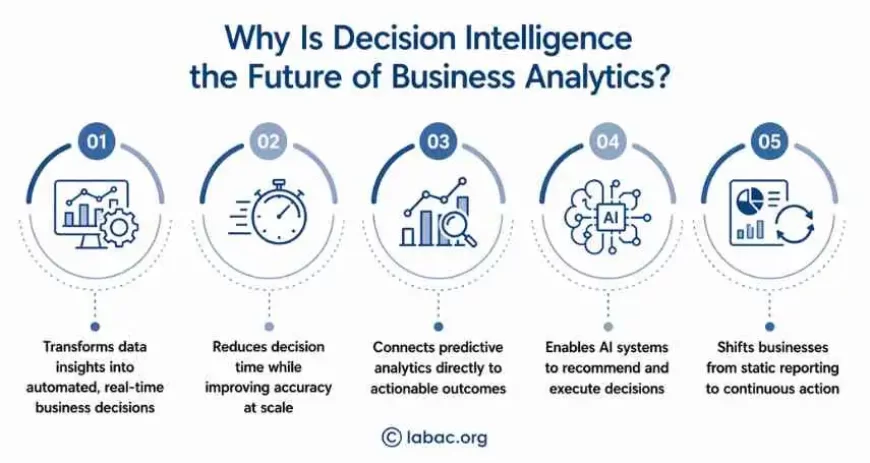
Why is Decision Intelligence the future of business analytics?
Decision intelligence is transforming business analytics with AI-driven decisions, real-time insights, and automation, helping companies act faster and smarter.

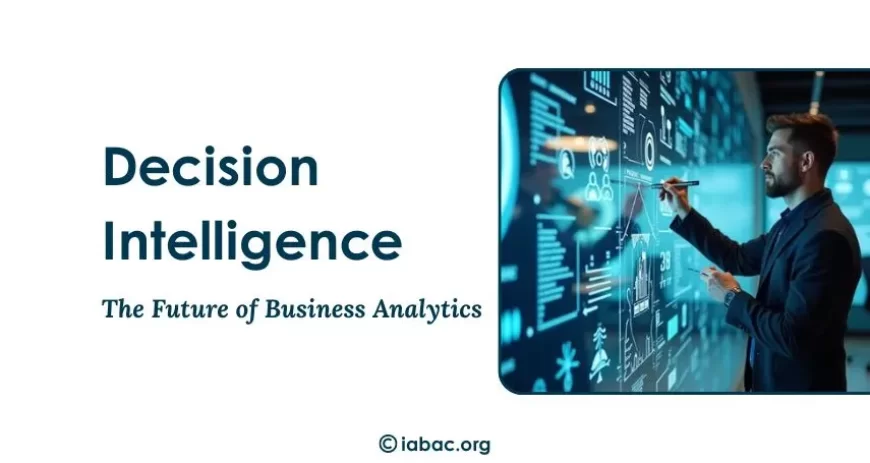
Decision intelligence is not just a term used at tech conferences. It's quietly becoming the operating system behind how smart companies make every major business call, from pricing strategies to supply chain pivots to customer retention.
If you've been watching the business analytics space, you've likely noticed a shift. Traditional dashboards and reports are not enough. Businesses need systems that don't just surface data; they need systems that act on it. That's exactly what decision intelligence delivers.
Let's break down why decision intelligence in business analytics is the defining shift of 2026.
What is decision intelligence and why does it matter now?
Decision intelligence (DI) is the discipline that combines data science, AI, behavioral science, and decision theory to improve, scale, and automate the way organizations make decisions.
Unlike traditional business analytics, which answers what happened, decision intelligence answers, "What should we do about it?" It bridges the gap between insight and action.
According to Gartner's inaugural 2026 Magic Quadrant for Decision Intelligence Platforms, DI platforms have matured well beyond early adoption, now recognized as a widely used strategic enabler accessible to organizations regardless of their size, geographic footprint, or industry vertical.
That's not analyst hype; it's a formal market designation that signals enterprise-grade maturity.
How It Differs from Conventional Analytics
Traditional analytics gives you a rearview mirror. Decision intelligence gives you a GPS.
Here's the practical difference:
-
Descriptive analytics tells you sales dropped 18% last quarter
-
Predictive analytics says sales may drop again next month
-
Decision intelligence recommends exactly what to do, adjusting pricing, shifting budget, re-engaging a specific customer segment, and in many cases, executes it
Why 2026 Is the Tipping Point
The convergence of large language models, real-time data pipelines, and cloud-scale compute has made DI deployable at scale for the first time. The vast majority of Global 500 companies are projected to have embedded decision intelligence into their core operations by 2026, with decision logging becoming a standard organizational practice.
Decision Intelligence in Business Analytics: How It Transforms the Workflow
Replacing Static Reporting with Dynamic Decision Flows
In most organizations, analysts spend the majority of their time preparing reports and only a fraction of it actually influencing decisions. Decision intelligence flips that ratio by embedding decision logic directly into data pipelines, surfacing prioritized recommendations rather than raw numbers.
Stakeholders stop asking "what does this mean?" and start asking "what's next?"
The Gartner Signal: A Dedicated Market Has Arrived
The clearest signal that DI has matured beyond buzzword status? Gartner published its first-ever Magic Quadrant dedicated to decision intelligence platforms in January 2026, evaluating vendors on their ability to combine decision modeling, AI-driven augmentation, automation, and governance at scale.
The creation of a dedicated MQ means the market has matured enough for formal vendor evaluation, a milestone that rarely happens until enterprise budgets start flowing.
The Business Benefit: Speed Without Sacrificing Accuracy
One of the core decision intelligence benefits for businesses is the ability to make high-frequency, high-stakes decisions at machine speed without losing analytical rigor.
For a retail business making thousands of micro-decisions a day on pricing, promotions, and inventory, manual review is a bottleneck. DI removes that bottleneck entirely.
AI-Driven Decision-Making: The Engine Behind Decision Intelligence
How AI Powers the Decision Layer
AI-driven decision-making is the technical backbone of decision intelligence. Machine learning models evaluate historical patterns, real-time signals, and probabilistic outcomes to score every possible decision path and then recommend or automate the best one.
Modern DI platforms use a combination of the following:
-
Reinforcement learning for continuous optimization
-
Natural language interfaces for analyst interaction
-
Causal AI to separate correlation from causation
-
Agentic AI for autonomous multi-step execution
According to Gartner's August 2025 announcement, 40% of enterprise applications will be integrated with task-specific AI agents by the end of 2026, up from less than 5% in 2025. These agents are decision intelligence in action.
Case Study: JPMorgan Chase's Contract Intelligence (COIN)
JPMorgan's COIN (Contract Intelligence) platform uses AI-driven decision-making to review commercial loan agreements, a task that previously consumed 360,000 hours of lawyer and loan officer time annually.
The system now completes the same work in seconds with fewer errors and has helped reduce loan-servicing mistakes previously caused by human error across 12,000 new contracts per year.
That's not just efficiency. It's a fundamental redesign of the decision-making workflow.
The Risk: Over-Automation Without Oversight
AI-driven decisions can fail when models encounter data they weren't trained on. Decision intelligence done right always includes human-in-the-loop checkpoints for high-level decisions. Automation without governance is liability, a principle now being codified into law with the EU AI Act.
Predictive Analytics for Business Decisions: The Foundation You Can't Skip
Why Prediction Must Come Before Decision
You can't build a decision intelligence layer without solid predictive analytics for business decisions underneath it. “Prediction is the input; the decision engine is the output.”
Most organizations have predictive capability but lack the connective tissue between the prediction and the action. That gap is where value leaks out.
How DI Closes the Prediction-to-Action Gap
Decision intelligence wraps prediction inside a decision context. Instead of giving a marketing team a churn probability score and leaving them to figure out the response, a DI system:
-
Predicts which customers are at risk
-
Scores the cost-effectiveness of each possible retention action
-
Recommends the optimal intervention per customer segment
-
Executes the campaign or flags it for human review
Organizations say AI is enabling their innovation, and companies that redesign workflows around AI rather than simply bolting it on are the ones seeing measurable EBIT (earnings before interest and taxes) impact.
The lesson: connecting prediction to action is where the competitive advantage actually lives.
Challenge: Data Quality Is Still the Bottleneck
Even the most sophisticated DI framework collapses on bad data. Most enterprises have significant inconsistencies in CRM data, event tracking, and financial records that silently poison model outputs.
Before scaling DI, you need a data governance strategy, not after.
Decision Intelligence vs Business Analytics: Understanding the Upgrade
The Key Distinctions
The decision intelligence vs business analytics debate is one I encounter constantly. Here's how I frame it:
|
Dimension |
Business Analytics |
Decision Intelligence |
|
Primary output |
Insights & reports |
Decisions & actions |
|
Time orientation |
Retrospective |
Forward-looking |
|
Human role |
Interprets data |
Reviews or approves decisions |
|
Technology layer |
BI tools, SQL, dashboards |
AI models, causal graphs, automation |
|
Speed |
Days to weeks |
Real-time to minutes |
|
Scalability |
Limited by analyst capacity |
Scales with compute |
Why Analytics Isn't Going Away, It's Evolving
Business analytics isn't obsolete. It evolves into the foundation of decision intelligence. Every DI system depends on clean, well-structured analytical data underneath it.
Think of it as a stack: Advanced busines analytics provides the fuel, and decision intelligence provides the engine.
Who's Already Making the Shift?
The boundary between human, machine, and organizational intelligence is blurring rapidly, with AI systems no longer just supporting businesses but "collaborating as partners." Companies that treat this as a transformation catalyst, not a tooling upgrade, are setting the pace.
The Business Benefits of Decision Intelligence: ROI That Justifies the Investment
Faster, More Consistent Decisions at Scale
Manual decisions are slow and inconsistent. A senior analyst and a junior analyst looking at the same data will reach different conclusions. A decision intelligence system applies consistent logic every single time at any scale.
For financial institutions processing millions of applications, this consistency isn't a nice-to-have. It's a regulatory and competitive necessity.
Key Decision Intelligence Benefits for Businesses
Here are the benefits generating the most measurable ROI:
-
Reduced decision latency: From days to milliseconds in operational contexts
-
Bias reduction: Systematic logic removes cognitive biases from recurring decisions
-
Decision auditability: Every recommendation is traceable, making compliance far easier
-
Resource optimization: Teams shift from decision execution to decision design and governance
-
Scenario modelling: DI systems can simulate thousands of scenarios before committing to one
Quantified Impact
Kellton finds that organizations implementing AI-powered decision systems report a 50–70% reduction in decision time for complex strategic decisions and accuracy improvements of 25–40% compared to traditional methods, with an additional 15–30% reduction in costs associated with poor decisions.
Implementation Challenges: What Most Companies Get Wrong
The Organizational Resistance Problem
The hard part is usually not the technology. Culture is. Most DI implementations stall not because the models fail but because managers don't trust automated recommendations enough to act on them.
Building trust requires transparency: show stakeholders why a recommendation was made, not just what it is. Explainable AI (XAI) tools are essential here.
Technical Debt in Legacy Systems
Many enterprises run analytics on fragmented data stacks: Salesforce here, SAP there, and a legacy ERP somewhere in between. Putting these systems together into a single decision layer is not easy and is often not given enough thought in project plans.
Start with one high-value, well-scoped decision domain like customer churn or inventory reorder before attempting enterprise-wide DI deployment.
The Skills Gap
Decision intelligence requires hybrid talent combining data science, decision theory, and domain expertise. Companies with the most AI maturity invest more heavily in AI talent, mitigate more AI-related risks, and report stronger financial returns, making the talent investment non-optional.
The Future of Decision Intelligence: What's Coming Next
Autonomous Decision Networks
The next frontier is multi-agent decision networks, where multiple AI agents collaborate across business functions in real time. Gartner predicts that by 2027, one-third of agentic AI implementations will combine agents with different skills to manage complex tasks within application and data environments autonomously.
An inventory agent, a pricing agent, and a logistics agent communicating in real time to optimize end-to-end supply chain decisions without human intervention at the operational layer is no longer science fiction.
The Decision Intelligence Market Is Exploding
The market itself backs the trend. According to Grand View Research cited by Cogility, the global decision intelligence market was valued at $15.22 billion in 2024 and is projected to reach $36.34 billion by 2030, a CAGR of 15.4%. MarketsandMarkets puts the 2030 projection even higher at $50.1 billion.
Frequently Asked Questions (FAQ)
How is decision intelligence different from business analytics?
Business analytics tells you what happened and why. Decision intelligence goes further; it tells you what to do about it and, in many cases, executes that action automatically. The key difference is the shift from insight to action.
What are the main benefits of decision intelligence for businesses?
The core benefits include faster decision-making, reduced cognitive bias, better scalability, decision auditability, and the ability to simulate and compare decision scenarios before committing. Research shows AI-powered decision systems can reduce decision time by 50–70% and improve accuracy by 25–40%.
Is decision intelligence only for large enterprises?
No. While early adoption was dominated by large companies with data science teams, no-code platforms and cloud-native tools have made DI accessible to mid-market businesses. Gartner's 2026 Magic Quadrant notes DI is now a "strategic enabler for organizations of any size."
What technologies power decision intelligence systems?
DI platforms typically combine machine learning, causal AI, natural language processing, optimization engines, and real-time data pipelines. They evaluate vendors across the full decision lifecycle: modeling, orchestration, monitoring, and governance.
How do I start implementing decision intelligence in my organization?
Start by identifying one high-value, well-scoped decision that currently relies on manual analysis. Build a DI proof of concept in that domain, measure the outcome, and scale from there. Ensure data governance is solid before expanding.
Decision Intelligence Is Not the Future; It's the Present
Decision intelligence isn't a distant evolution of business analytics. It's happening right now, in organizations across every industry.
The companies winning in 2026 aren't just better at collecting data. They're better at acting on it faster, more consistently, and at a scale no human team could match.
If you're still running strategy on static dashboards and quarterly reports, you're not just behind the curve. You're leaving measurable competitive advantage on the table.
Start small. Pick one decision domain. Build a proof of concept. Then scale.
And if you want to lead that shift professionally, a Certified Business Analytics Expert certification can help you build the foundation needed to drive intelligent, data-driven decisions at scale.
The transition from analytics to decision intelligence is the most important capability investment your business can make this decade.