

















































Top 10 Business Analytics Trends in 2026 That Are Shaping the Future
Stay ahead with the top 10 business analytics trends in 2026, from AI-driven insights and real-time analytics to data democratization and cloud innovation.

Business analytics has never moved this fast. What once took weeks of data crunching now happens in seconds, and what once required entire teams of analysts can now be triggered by a single prompt.
In 2026, the line between data and decision-making is thinner than ever, and organizations that understand where analytics is heading are the ones writing the rules for everyone else.
Here are the ten trends that are shaping the future of business analytics in 2026.
1. AI-Augmented Analytics Is Now the Default
AI-augmented analytics refers to the use of artificial intelligence to automatically analyze data, surface patterns, and generate insights without requiring users to manually dig through datasets. Think of it as having an intelligent assistant embedded inside the analytics platform that does the heavy lifting before you even know what question to ask.
In 2026, this has become the standard operating mode for businesses of all sizes, not just tech giants. According to Searchlab, the share of businesses actively using AI has come close to doubling in just three years, climbing from 34% in 2023 to 67% in 2026, a pace that reflects how quickly AI-augmented tools have moved from experimental to essential.
- Platforms like Microsoft Fabric, Tableau with Einstein AI, and ThoughtSpot Sage have made natural language querying the norm
- Executives and frontline managers can now interact with data by simply typing a question in plain English
- AI models automatically flag anomalies, generate summary reports, and recommend follow-up questions
- Organizations are seeing faster time-to-insight and reduced dependency on dedicated analyst teams for routine reporting
The shift is not just technical. It is cultural. When anyone in an organization can ask a data question and get a meaningful answer instantly, the entire pace of decision-making accelerates.
2. Real-Time Analytics Has Replaced the Weekly Report
Real-time analytics is the ability to process, analyze, and act on data as it is generated, rather than waiting for it to be collected, cleaned, and reported in a batch at the end of the day or week. If predictive analytics tells you what might happen, real-time analytics tells you what is happening right now.
The weekly dashboard is quietly becoming obsolete. Businesses now expect data to flow continuously, and decisions are increasingly made on live data streams rather than historical snapshots.
- Retailers are adjusting pricing dynamically based on live demand signals
- Banks and fintech companies use real-time streams to detect and block fraud as it happens
- Healthcare providers monitor patient vitals and trigger alerts without any delay
- Logistics companies reroute deliveries instantly based on live traffic and weather data
- Marketing teams track campaign performance as it unfolds and shift budgets in real time
Streaming platforms like Apache Kafka, Apache Flink, and cloud-native solutions from AWS and Google Cloud have matured significantly, making real-time pipelines far more accessible without prohibitive infrastructure costs.
Batch processing is not disappearing, but real-time analytics is now the benchmark for operational intelligence in high-stakes industries.
3. Predictive and Prescriptive Analytics Are Merging
Predictive analytics answers the question "what will happen?" while prescriptive analytics answers "what should we do about it?" For years, these were treated as separate capabilities requiring different tools and teams. In 2026, they are increasingly delivered together as a single, unified output.
Modern analytics platforms do not just forecast a drop in customer retention. They simultaneously recommend specific interventions, rank them by expected impact, and in many cases initiate automated responses without waiting for a human to act.
The financial weight behind this convergence is significant: according to Fortune Business Insights, the predictive analytics market stood at $27.56 billion in 2026 and is on a trajectory to cross $116 billion by 2034, driven largely by businesses moving from standalone forecasting into integrated decision systems.
- Companies like DataRobot, Alteryx, and IBM Watson offer closed-loop analytics systems where the gap between prediction and action is nearly eliminated
- In supply chain management, this shift is preventing billions in waste annually by allowing for proactive instead of reactive decision-making.
- Sales teams receive not just pipeline forecasts but prioritized action lists for which deals to focus on and why
- HR platforms detect attrition risk and immediately recommend retention strategies for individual employees
Businesses that have moved beyond descriptive and diagnostic analytics into this predictive-prescriptive model are operating with a fundamentally different level of strategic clarity than those still relying on static reports.
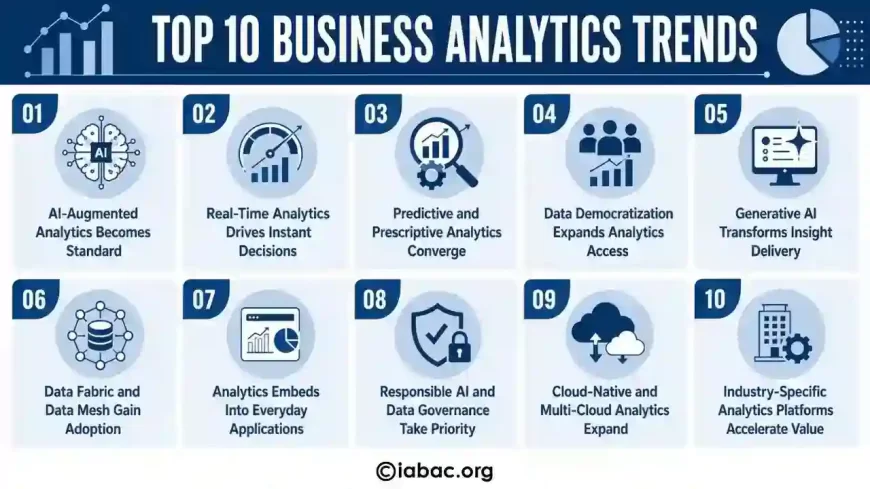
4. Data Democratization Is Changing Who Owns Insights
Data democratization is the process of enabling all employees (not just data teams) to work with, analyze, and act on data independently. Instead of waiting days for a report from IT, marketing managers or operations leads can extract their own insights with tools designed for non-technical users.
This shift is one of the most culturally significant changes in analytics right now. Through Refonte Learning, Gartner estimates that by 2026, 90% of people consuming analytics content will also actively be creating their own analyses and visualizations using AI-powered tools. The model of specialists producing insights will be reversed completely.
It is being enabled by several converging forces:
- Self-service BI tools with drag-and-drop interfaces like Power BI, Looker, and Qlik
- Low-code and no-code analytics platforms that remove the need for SQL or Python knowledge
- Embedded analytics built directly into CRM, ERP, and marketing platforms
- Company-wide data literacy programs that teach employees how to interpret and use data responsibly
The risk that comes with democratization is governance. When everyone has access to data and the tools to analyze it, the chance of misinterpretation increases.
This has driven parallel investment in data cataloging, lineage tracking, and role-based access controls that make democratization safe as well as scalable.
The goal is not just more people using data, but more people using it correctly.
5. Generative AI Is Creating a New Layer of Analytics
Generative AI in analytics refers to AI systems that do not just process data but actively produce outputs from it, such as written summaries, auto-generated charts, executive briefings, and scenario simulations. It bridges the gap between raw numbers and human-readable intelligence.
In 2026, generative AI tools will be embedded directly into analytics workflows, transforming how insights are communicated across organizations. What was once a time-consuming back-and-forth between business teams and analysts is now a matter of typing a question and receiving a fully formed, visual response in seconds.
- Google Gemini integrated with Looker allows users to describe a business question in plain language and receive a full analytical response with charts and written commentary
- OpenAI models connected to internal dashboards can draft executive summaries from live data in seconds
- C-suite reporting is shifting from dense spreadsheets to AI-generated narratives that highlight what matters most
- Sales teams run competitive analysis without analyst support by querying AI-powered dashboards directly
- HR and marketing teams generate trend summaries and performance reports in the same interface they use for everything else
Generative AI is not replacing analytics. It is making analytics outputs more consumable, faster to produce, and accessible to people who previously had no way to engage with data on their own.
6. Data Fabric and Data Mesh Architectures Are Going Mainstream
Data fabric and data mesh are two architectural approaches that solve the same fundamental problem: data in large organizations is scattered across dozens of systems, stored in silos, and incredibly difficult to unify.
Data fabric uses AI and metadata to intelligently connect these sources without moving them. Data mesh takes a decentralized approach where individual business teams own and publish their own data as a product, governed by shared company-wide standards.
In 2026, both are being adopted as complementary strategies rather than competing philosophies. The choice between them is less about which is better and more about what the organization's size, structure, and governance maturity actually calls for.
- Large enterprises are leaning into data mesh to give domain teams autonomy while maintaining consistent governance
- Mid-market companies are using data fabric to build connective tissue across existing tools without a full architectural overhaul
- The monolithic data warehouse is no longer the only analytics architecture – effectively, it’s the end of an era
- Distributed, federated data models are now the foundation for scalable business intelligence in modern organizations
Instead of waiting months for IT to integrate a new data source into a central warehouse, business teams can publish and consume data products independently while still meeting company-wide quality and security standards.
7. Analytics Is Embedding Itself Into Business Applications
Embedded analytics refers to analytics capabilities built directly into the software products people use every day, rather than sitting in a separate BI tool that requires users to switch context and log in separately. The insight is delivered right where the decision needs to be made.
This is rapidly changing both how software products are built and how business users experience data.
Nucleus Research, cited by market.us, found that businesses with mature BI adoption practices recorded an average return of 112% on their analytics investment and recovered their initial costs in under two years, a payback profile that has accelerated executive appetite for embedding analytics deeper into everyday workflows.
- Salesforce dashboards surface predictive deal scores directly within the CRM pipeline view
- HR platforms show attrition risk scores alongside employee records without leaving the system
- Supply chain tools display demand forecasts within the same interface used to place purchase orders
- Finance platforms show budget variance alerts inline, inside the budgeting tool itself
Software vendors are building embedded analytics into their products using white-labeled BI components from providers like Sisense, Logi Analytics, and Cumul.io.
The result is that analytics becomes invisible in the best possible sense: it is simply part of how the product works, and users benefit from it without thinking of it as a separate data activity.
8. Ethics, Fairness, and Responsible AI in Analytics
Responsible AI in analytics means that the models and systems that enable data-driven decisions are fair, transparent, explainable, and accountable.
As analytics systems take on more and more roles in high-stakes areas such as hiring, lending, healthcare triage, and policy decisions, the question of whether those systems are making decisions for the right reasons has become urgent.
In 2026, responsible analytics frameworks are regulatory requirements in many parts of the world, not optional additions.
According to Integrate.io, data governance has risen to the top of the priority list for the majority of data leaders, with regulatory penalties in some cases reaching over a billion euros for a single compliance failure, a reality that has made ethical AI framework investment non-negotiable for any organization operating at scale.
- The EU AI Act, which came into full force in 2025, has created direct compliance obligations for how analytics models are built, validated, and documented
- Similar regulations are emerging in the United States, India, and across Southeast Asia
- Bias detection and mitigation is now a standard step in model development across regulated industries
- Explainability requirements mean decisions made by AI-driven analytics must be understandable and challengeable by affected individuals
- Privacy-preserving techniques like federated learning and differential privacy allow analytics to run without exposing sensitive personal data
Organizations that are building unaccountable AI-driven analytics systems face regulatory penalties, reputational damage, and operational risk. Responsible analytics is not just an ethical position; it is a business necessity.
9. Cloud-Native and Multi-Cloud Analytics Are the New Standard
Cloud-native analytics refers to analytics systems built specifically to run in cloud environments, taking full advantage of elastic compute, managed services, and pay-as-you-go pricing.
A multi-cloud strategy means running these workloads across two or more cloud providers rather than being locked into a single vendor.
The conversation has matured from "Should we move to the cloud?" to "How do we optimize our multi-cloud analytics architecture?"
Integrate.io reports that more than half of organizations have already moved the bulk of their workloads to cloud environments, with cloud infrastructure spending projected to keep growing at close to 29% annually through 2027, a rate that reflects how central cloud has become to modern analytics operations.
- Most large organizations now run analytics workloads across AWS, Azure, and Google Cloud simultaneously
- Snowflake, Databricks, and Google BigQuery have built robust cross-cloud capabilities that allow unified analytics regardless of where the underlying data lives
- Data residency requirements and regulatory compliance are major drivers for multi-cloud adoption in sectors like banking and healthcare
- FinOps practices are now being applied directly to analytics workloads to ensure cloud spending stays aligned with business value
The organizations managing multi-cloud analytics well are those that combine technical flexibility with rigorous cost governance, treating cloud spend on data processing and compute as a business investment that must deliver measurable returns.
10. Industry-Specific Analytics Platforms Are Outpacing General Solutions
Vertical analytics refers to platforms built specifically for the data models, regulatory requirements, workflows, and KPIs of a particular industry, rather than general-purpose BI tools that need to be configured from scratch.
The difference is similar to buying a vehicle designed for specific terrain versus modifying a standard one to handle the same conditions.
Businesses are increasingly choosing vertical platforms because they deliver faster value with far less setup time.
According to Mordor Intelligence, the healthcare and life sciences segment is among the fastest growing within business analytics, expanding at a CAGR above 9%, driven largely by industry-specific platforms built to handle the complexity of clinical data, compliance requirements, and population health management that no general-purpose tool can address out of the box.
- Healthcare analytics platforms natively handle HL7/FHIR (Fast Healthcare Interoperability Resources) data standards, clinical trial analysis, and population health metrics right out of the box
- Retail analytics tools come pre-built for inventory optimization, basket analysis, and omnichannel attribution without months of customization
- Financial services platforms include built-in regulatory reporting, risk modeling, and fraud analytics aligned with compliance requirements
- Manufacturing analytics solutions integrate directly with IoT sensors and MES systems for real-time production efficiency tracking
These platforms are shortening time to value significantly because the data connectors, metrics, and dashboards that matter most to a specific industry already exist. Organizations spend far less time building and far more time acting on insights.
How Businesses Are Building Analytics-Ready Teams in 2026
Having the right technology is only part of the equation. The organizations seeing the strongest returns from their analytics investments are those that have deliberately built teams and cultures where data-driven thinking is the norm, not the exception.
- Dedicated data literacy programs are being rolled out company-wide across sales, HR, operations, and finance teams
- Analytics centers of excellence are being established to set standards and govern the responsible use of AI-driven tools
- Cross-functional analytics squads bring together domain experts, data engineers, and business analysts to solve specific business problems
- Chief Data Officers now sit at the executive table with direct influence over product, operations, and strategy
Building an analytics-ready team is not a one-time project. It is an ongoing investment in people, processes, and culture that compounds over time.
The Bigger Picture Behind These Trends
As industry-specific platforms raise the bar for what analytics can deliver, they are also raising the bar for the people working with them. Every trend, from AI-augmented analytics to vertical platforms, is reshaping what businesses expect from their teams and the professionals they hire. Business analytics certifications can help you build all the skills needed to confidently adapt to these trends and stay relevant in a rapidly shifting industry. The shift from retrospective reporting to predictive, prescriptive, and automated intelligence is not a future possibility; it is the present reality for organizations already winning with data.
Businesses that invest in the right capabilities, build data-driven cultures, and govern their systems responsibly will hold a lasting competitive edge.
For professionals, combining technical fluency with business acumen and structured learning is what separates those who work with data from those who drive decisions with it.
The direction is clear: deeper, faster, smarter, and more human-centered than ever before.