


























































What Is Embedded Analytics and Why It's Booming
Embedded analytics brings dashboards and insights directly into applications, helping businesses improve decisions, user adoption, efficiency, and growth.

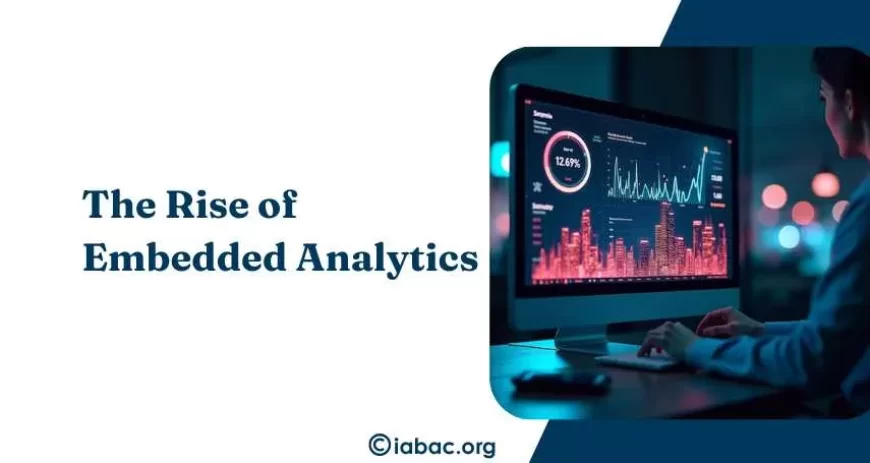
Data is everywhere, but insight is still rare. Every business today collects mountains of information from customer interactions, sales transactions, marketing campaigns, and internal operations. Yet most of that data sits locked away in spreadsheets, standalone dashboards, or BI tools that nobody outside the analytics team ever opens. This is the exact gap that embedded analytics is designed to close.
Instead of forcing users to leave their everyday applications to check a separate reporting tool, embedded analytics brings the charts, dashboards, and insights directly into the software people already use. It is quietly becoming one of the most important shifts in how organizations think about data, and adoption is accelerating fast.
What Is Embedded Analytics, Exactly?
Embedded analytics refers to the practice of integrating data visualization, reporting, and business intelligence features directly inside another application, rather than keeping analytics as a separate, standalone product.
In simple terms, once you have logged into a CRM and seen a sales performance dashboard built right into the homepage or opened a project management tool and noticed a chart tracking your team's velocity without switching to another app, you've already experienced embedded analytics in action.
A few defining characteristics set it apart from traditional analytics:
- It works directly inside the application: Users can view reports, dashboards, and insights without leaving the software they use every day.
- It connects through APIs and development tools: businesses can use APIs and SDKs to add analytics features seamlessly into their existing applications.
- It supports both employees and customers: companies can provide real-time insights to internal teams as well as external users without requiring a separate analytics platform.
- It delivers insights based on the user's current task: Instead of showing generic reports, embedded analytics presents relevant data that helps users make decisions within their workflow.
This is fundamentally different from the old model where "doing analytics" meant exporting data, opening a separate BI tool, building a report, and then circling back to your actual work. Embedded analytics collapses that entire cycle into a single, continuous experience.
How Embedded Analytics Actually Works
At a technical level, embedded analytics platforms typically sit on top of a company's existing data infrastructure and connect to the host application through APIs. The architecture usually involves a few core layers working together.
- First, there's the data layer, where information from databases, data warehouses, cloud storage, or third-party systems gets pulled in and prepared for analysis.
- Second is the semantic or modeling layer, which translates raw, technical data into business-friendly terms and structures so the numbers actually make sense to a non-technical user.
- Third is the visualization layer, the dashboards, charts, and reports that get rendered inside the host application's interface.
- Finally, there's the integration layer, the APIs and SDKs that stitch all of this directly into the look, feel, and navigation of the parent software.
What makes this approach powerful is that it doesn't require the end user to understand any of this complexity. They simply open their CRM, ERP, or internal portal, and the relevant insights are already there, styled to match the rest of the application, often even personalized based on their role or permissions.
Why Businesses Are Adopting Embedded Analytics So Quickly
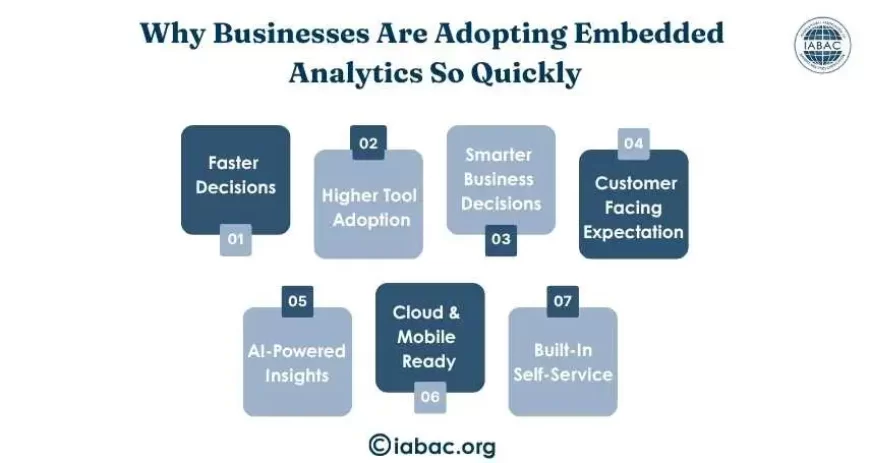
The shift toward embedded analytics isn't just a trend, it's a response to real operational pain points that companies have struggled with for years. Here's why adoption is accelerating across industries.
1. Decisions need to happen faster than ever
Customers expect instant responses, markets shift overnight, and waiting days for a report to be pulled from a separate system is simply too slow. By embedding analytics directly into operational software, organizations report reducing decision latency by 38–45%, allowing teams to act on insights in the moment rather than after the fact.
2. Standalone BI tools create problems and low adoption
Businesses spend a lot of money on BI platforms, but the majority of employees never use them. According to Global Growth Insights, over 68% of companies are now shifting from standalone BI tools to embedded solutions specifically to improve user experience and real-time access to insights.
When analytics live where the work already happens, usage naturally goes up because there's no extra step, no extra login, and no extra tool to remember.
3. It directly supports better business decisions
Why do business leaders invest in embedded analytics? Ask them and you’ll get a remarkably consistent answer.
According to Reveal, 39% of organizations say making better business decisions is the top priority for embedded analytics and BI, while 36% point to uncovering trends and patterns faster as a key priority.
These aren't vanity metrics; they reflect a genuine shift in how companies want data to function: as a constant input into daily decisions, not an occasional report reviewed once a quarter.
4. Customer-facing analytics has become a competitive expectation
Analytics is no longer only important for internal teams. Customers using SaaS and other digital products also want access to dashboards, reports, usage metrics, and performance insights directly within the application.
Many software products now allow customers to view their own data and performance reports directly within the application. This has become a standard feature that users expect. Companies that do not offer these capabilities may find it harder to compete with businesses that provide easy access to data and insights.
5. AI and machine learning are making embedded insights smarter
Embedded analytics is no longer limited to static charts and historical reports. According to Global Growth Insights, integration with machine learning models is becoming standard, with over 58% of platforms now supporting predictive analytics, meaning embedded dashboards can highlight not just what happened but what's likely to happen next.
Trends like agentic analytics and semantic layers combined with generative AI are reshaping the space further, pushing embedded analytics from passive reporting toward proactive, even autonomous, decision support.
6. Cloud and mobile demands are reshaping deployment choices
The way teams work has changed, and embedded analytics has had to keep pace. Cloud deployment models dominate with 64% market share, reflecting the broader move toward scalable, subscription-based infrastructure. At the same time, mobile-optimized embedded dashboards are being adopted by 56% of organizations, since decision-makers increasingly expect to check key metrics from a phone, not just a desktop.
7. Self-service capability is now a baseline expectation
Nobody wants to file a ticket with IT just to tweak a report. The demand for self-service analytics features has surged, with 66% of users preferring platforms that support intuitive user interfaces and custom reporting functionalities. Embedded analytics platforms are built with this expectation baked in, giving end users the ability to filter, customize, and explore data on their own terms.
Industry-Specific Adoption Patterns
Different sectors are embracing embedded analytics for slightly different reasons, shaped by their own operational realities.
Healthcare and manufacturing have emerged as particularly strong adopters. These sectors are adopting embedded analytics largely to improve clinical outcomes and boost operational productivity.
- In healthcare, that might mean embedding patient outcome dashboards directly into electronic health record systems.
- In manufacturing, it often looks like real-time production metrics surfaced inside the same software floor managers already use to track output.
Supply chain and ERP/CRM applications are also leading the charge from a functional standpoint.
According to precedence, the supply chain management segment contributed the highest market share of 35% in 2025, while the ERP/CRM segment is expected to expand at the fastest CAGR going forward. This makes intuitive sense: these are exactly the systems where operational decisions happen constantly and where having data baked directly into the workflow saves the most time.
Regionally, adoption isn't evenly distributed either. Data Brain says North America currently holds the largest market share at 38%, followed by Europe at 28% and Asia-Pacific at 24%. However, the Asia-Pacific region is expected to be one of the fastest-growing regions for embedded analytics, driven by rapid digitalization and an increasing emphasis on data-driven decision-making across emerging economies.
The Business Case: Tangible Benefits Beyond the Buzzword
It's worth pausing on why this matters beyond market statistics. For businesses actually implementing embedded analytics, the benefits tend to show up in a few practical ways.
Stronger product stickiness
For SaaS companies, embedding analytics into the product itself can become a genuine differentiator and retention driver, since customers who rely on in-app insights are less likely to churn.
Reduced operational overhead
Teams no longer need to maintain separate reporting infrastructure or train employees on a second tool just to view data.
Faster onboarding for new hires
When dashboards live inside familiar software, new employees don't need separate training sessions just to understand how to pull a report.
Improved compliance and accuracy
Regulatory reporting automation enabled by embedded analytics has been shown to improve compliance accuracy by 33%, which matters enormously in regulated industries like finance and healthcare.
New revenue opportunities
Many ISVs (Independent software vendors) now monetize embedded analytics as a premium feature tier, turning what used to be a cost center into a revenue stream.
Where Embedded Analytics Is Headed
Six major trends are currently reshaping the industry: agentic analytics, semantic layers paired with generative AI, real-time streaming, composable architecture, AI-native experiences, and customer-facing analytics becoming a baseline expectation rather than a premium add-on.
Together, these point toward a future where embedded analytics isn't just about displaying historical data but about systems that can interpret, recommend, and, in some cases, act on insights with minimal human intervention.
It's also worth noting how seriously organizations are planning around this shift. Most of the organizations plan to expand into new markets in 2026 and plan to build new applications to take on new projects, much of which will likely involve embedded data capabilities as a core component rather than an afterthought.
Embedded analytics represents a fundamental shift in how organizations use data, bringing insights directly into the applications where decisions are made every day.
As adoption grows across industries, businesses are recognizing the value of faster decision-making, improved user experiences, and greater operational efficiency.
Organizations that embrace embedded analytics can gain a stronger competitive advantage while making better use of their data assets.
For professionals looking to stay relevant in this evolving landscape, a business analytics certification can help build the practical skills needed to work effectively with modern analytics-driven technologies.