

























































What Is Online Analytical Processing (OLAP)? A Practical Guide for Modern Analytics
Master OLAP: multidimensional analytics, cube types, and why it powers modern BI in 2026. Fast queries, smarter decisions, and deeper business insights.


Key Highlights
-
OLAP is designed for fast, multidimensional analysis of business data.
-
It powers many business intelligence and reporting systems.
-
OLAP cubes organize data across dimensions such as time, geography, and product.
-
OLAP differs significantly from OLTP systems that handle day-to-day transactions.
-
Common OLAP operations include drill-down, roll-up, slice, dice, and pivot.
-
Modern cloud platforms have evolved OLAP rather than replaced it.
-
Successful OLAP implementations depend heavily on proper data modeling and governance.
-
OLAP will remain a core component of enterprise analytics in 2026.
What Is Online Analytical Processing (OLAP)?
Online Analytical Processing (OLAP) is a technology used to perform fast, multidimensional analysis of business data.
The term was popularized by database pioneer Edgar F. Codd, who helped establish foundational principles for analytical systems.
Unlike transactional databases that record individual business events, OLAP systems are optimized for answering analytical questions such as:
-
Which region generated the highest profit last quarter?
-
How has customer retention changed over five years?
-
Which products perform best during seasonal demand peaks?
OLAP supports business intelligence, strategic planning, forecasting, performance management, and executive reporting by allowing users to explore data across multiple dimensions simultaneously.
Why OLAP Matters
Businesses rarely make decisions using a single data point. They need context.
For example:
A retailer may want to analyze:
Revenue → By Product → By Region → By Month → By Customer Segment
OLAP enables this level of multidimensional analysis without requiring analysts to write increasingly complex queries for every new question.
How OLAP Works
At its core, OLAP organizes data into structures optimized for analytical exploration.
Key Components
1. Facts: Facts are measurable business events.
Examples:
-
Revenue
-
Sales quantity
-
Profit
-
Inventory levels
2. Dimensions: Dimensions provide context to facts.
Examples:
-
Time
-
Geography
-
Product
-
Customer
3. Measures: Measures are calculations performed on facts.
Examples:
-
Total sales
-
Average order value
-
Gross margin
4. Hierarchies: Hierarchies allow users to move between summary and detail levels.
Example:
Year → Quarter → Month → Day
Understanding the OLAP Cube
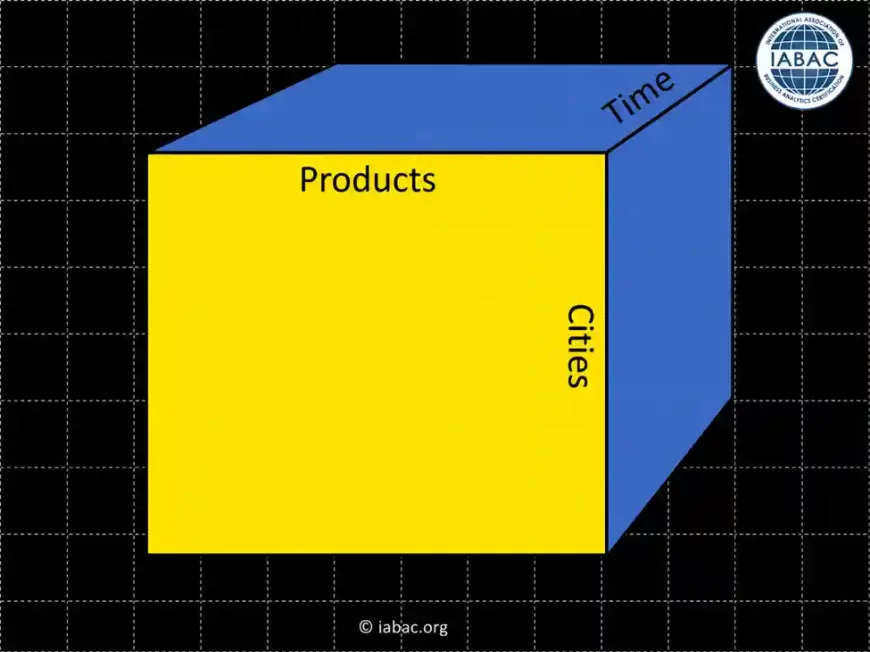
Despite the name, an OLAP cube is not always a literal cube. It is a multidimensional data structure that enables rapid analytical queries.
For example,
A sales cube might contain:
-
Time Dimension
-
Product Dimension
-
Region Dimension
With:
-
Revenue Measure
An executive can instantly view:
-
Revenue by region
-
Revenue by product
-
Revenue by month
-
Revenue by region and product combined
Without repeatedly restructuring data.
One of the biggest misconceptions is that OLAP cubes are primarily visualization tools. They are actually performance optimization mechanisms that pre-organize and aggregate data to accelerate analytical queries.
How OLAP Data Flows
Raw Data Sources
↓
ETL / Data Integration
↓
Data Warehouse
↓
OLAP Engine
↓
OLAP Cube
↓
BI Dashboards & Reports
↓
Business Decisions
OLAP Server Architecture Explained
A typical OLAP server architecture includes several layers.
-
Data Sources: CRM systems, ERP platforms, e-commerce databases, spreadsheets, and operational applications.
-
ETL Layer: Extracts, transforms, and loads data into analytical repositories.
-
Data Warehouse: Serves as the centralized source of truth.
-
OLAP Engine: Processes multidimensional queries and aggregations.
-
BI Layer: Provides dashboards, reports, and self-service analytics.
Why Architecture Matters
In real-world projects, performance issues are often caused by poor upstream data design rather than the OLAP engine itself. Teams frequently focus on visualization while overlooking data modeling, governance, and aggregation strategies.
Core OLAP Operations Every Analyst Should Know
|
Operation |
Purpose |
|
Drill Down |
Move from summary to detailed data |
|
Roll Up |
View higher-level summaries |
|
Slice |
Filter one dimension |
|
Dice |
Filter multiple dimensions |
|
Pivot |
Rotate perspectives for analysis |
|
Drill Through |
Access detailed source records |
Example
A marketing analyst notices declining conversions.
They may:
-
Slice by campaign
-
Dice by region and channel
-
Drill down to weekly data
-
Pivot by customer segment
This process often reveals patterns that traditional reports miss.
Types of OLAP Systems
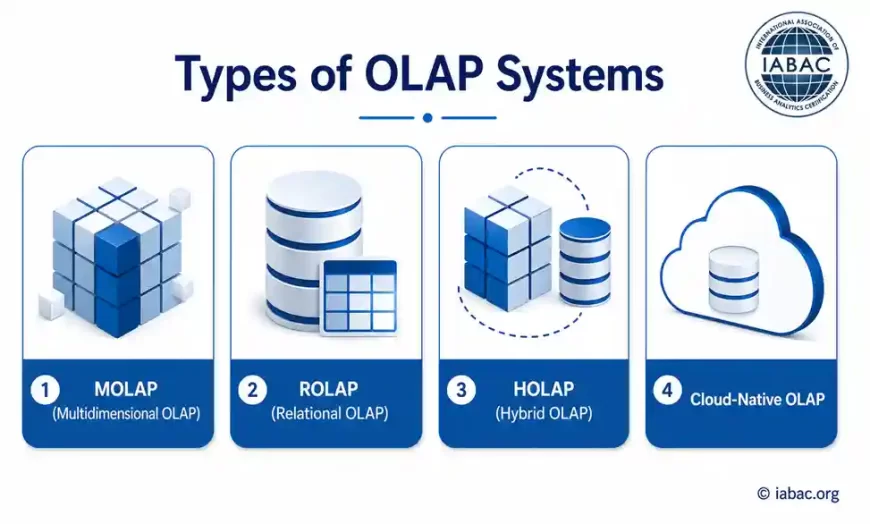
1. MOLAP (Multidimensional OLAP): Stores data in multidimensional cubes.
Best for: High-speed analysis.
2. ROLAP (Relational OLAP): Uses relational databases.
Best for: Large datasets.
3. HOLAP (Hybrid OLAP): Combines MOLAP and ROLAP capabilities.
Best for: Balancing scalability and performance.
4. Cloud-Native OLAP: Modern cloud warehouses increasingly deliver OLAP-like capabilities without traditional cube management.
Practical Applications of OLAP Across Industries
Retail
-
Product performance analysis
-
Seasonal demand forecasting
-
Inventory optimization
Finance
-
Profitability analysis
-
Risk monitoring
-
Budget planning
Healthcare
-
Resource utilization analysis
-
Patient outcome reporting
Manufacturing
-
Supply chain visibility
-
Production efficiency tracking
Marketing
-
Customer segmentation
-
Campaign attribution analysis
Successful analytics programs rarely fail because of technology. They fail because organizations cannot establish consistent business definitions for metrics such as revenue, customer acquisition cost, or profitability.
OLAP can expose data quality problems; it does not automatically solve them.
Professionals responsible for interpreting these metrics often benefit from formal business analytics training programs that cover reporting frameworks, KPI design, and evidence-based decision-making.
Benefits and Limitations of OLAP
Benefits
-
Fast analytical query performance
-
Improved decision-making
-
Better trend identification
-
Enhanced reporting capabilities
-
Self-service business intelligence support
Limitations
-
Complex implementation
-
Data modeling expertise required
-
Maintenance overhead
-
Potential latency between operational and analytical systems
-
Infrastructure costs for large environments
Organizations should evaluate whether they need multidimensional analysis or merely reporting. Not every reporting challenge requires a sophisticated OLAP environment.
How OLAP Has Evolved in Modern Analytics
Many OLAP guides focus on architectures and technologies that became popular in the early 2000s. While the core principles remain the same, modern analytics environments have evolved significantly.
OLAP Has Evolved, Not Disappeared: Cloud data warehouses increasingly incorporate OLAP principles directly into analytical engines.
Semantic Layers Matter More Than Cubes: Many organizations now focus on consistent business metrics rather than traditional cube management.
AI Is Changing Analytics Consumption: AI-powered BI assistants increasingly generate queries and insights automatically. However, they still depend on structured analytical models underneath.
Hidden Risk: Metric Inconsistency: The biggest challenge in enterprise analytics today is not query performance. It is ensuring that every department calculates business metrics the same way.
Is OLAP Still Relevant in 2026?
Yes. While traditional cube-centric implementations have declined in some environments, OLAP principles remain fundamental to modern analytics.
Many cloud platforms continue to rely on:
-
Aggregations
-
Multidimensional modeling
-
Analytical optimization
-
Business metric frameworks
The technology has evolved, but the underlying need for rapid analytical exploration remains unchanged.
When Should Organizations Use OLAP?
Consider OLAP when:
✓ Large historical datasets require analysis
✓ Decision-makers need multidimensional reporting
✓ Performance of analytical queries matters
✓ Self-service BI is a strategic goal
Consider alternatives when:
✘ Analytics requirements are minimal
✘ Real-time transactional access is the primary objective
✘ Data maturity and governance are still immature
Takeaway
Online Analytical Processing (OLAP) remains one of the foundational technologies behind modern business intelligence. Its ability to support multidimensional data analysis, accelerate complex queries, and enable strategic decision-making continues to make it valuable across industries.
The organizations extracting the most value from OLAP today are not necessarily those building the largest cubes. They are the ones combining strong data governance, effective data warehousing practices, consistent business metrics, and modern analytics architectures.
For professionals building careers in analytics, data science, and business intelligence, understanding OLAP concepts remains essential because many modern platforms still rely on the same analytical principles, even when the technology stack looks different.
FAQ
What is Online Analytical Processing (OLAP)?
OLAP is a technology that enables fast, multidimensional analysis of business data for reporting, forecasting, and decision-making.
What is an OLAP cube?
An OLAP cube is a multidimensional structure that organizes data for rapid analytical querying.
What is the difference between OLAP and OLTP?
OLAP supports analysis, while OLTP supports transaction processing.
What is an OLAP database?
An OLAP database is optimized for analytical workloads rather than transactional operations.
What are the major OLAP operations?
Drill-down, roll-up, slice, dice, pivot, and drill-through.
Is OLAP part of business intelligence?
Yes. OLAP is a core technology used in many business intelligence environments.
What industries use OLAP?
Retail, finance, healthcare, manufacturing, telecommunications, and marketing.
What are the different types of OLAP?
MOLAP, ROLAP, HOLAP, DOLAP, and cloud-native OLAP architectures.
Is OLAP still relevant today?
Yes. Modern analytics platforms continue to use OLAP principles even when traditional cubes are not visible to users.
Can OLAP be used with cloud data warehouses?
Yes. Most modern cloud analytics ecosystems incorporate OLAP concepts and analytical optimization techniques.