


























































The Hidden Risks of Not Following the Data Science Life Cycle
Skipping the data science life cycle can lead to poor models, unclear goals, unreliable results, and costly mistakes in analytics projects.


Think about the last time you tried to put together a piece of furniture without the instruction sheet. You had all the parts. You had the tools. You were confident. And then, forty minutes later, you had two left-side panels, three screws that did not belong anywhere, and something that looked nothing like the picture on the box.
That is exactly what happens when a data science project skips the data science life cycle.
The data is there. The talent is there. The budget is there. But without a clear, structured process from start to finish, the whole thing quietly falls apart — and most of the time, nobody even realizes it is happening until the damage is already done.
Research into data quality shows that poor data costs businesses in the United States alone approximately $3.1 trillion every year. And a large part of that loss does not come from bad data alone. It comes from teams working without structure, jumping between stages, skipping important steps, and making decisions without a solid foundation. This blog walks through the specific, real, and costly risks that show up when organizations run data science projects without following the data science life cycle. These are not imaginary problems. They happen every day, in companies of all sizes, in every part of the world.
What the Data Science Life Cycle Actually Does
Before going into the risks, it helps to understand what the data science life cycle is protecting you from in the first place.
The data science life cycle is a structured process with eight clear stages:
Each stage exists for a reason. Each one catches specific problems before they become expensive disasters. When you skip a stage or rush through it, you do not save time. You borrow trouble from the future and pay it back with interest.
Risk 1: Solving the Wrong Problem Entirely in Your Data Science Project
This is the most painful risk of all — and it is completely invisible until you are already deep into the project.
When teams skip the Business Understanding stage of the data science life cycle, they go straight to collecting data and writing code. They are busy. They are productive. They are going in the completely wrong direction.
A realistic scenario in a data science project: A logistics company wants to improve delivery performance. The data team, without a formal problem definition, assumes the issue is route optimization. They spend four months building a route-efficiency model. When they present it, the operations manager says: "That is interesting, but what we actually needed was a way to predict delivery failures before they happen so we can call customers in advance."
Four months. Gone.
The numbers behind this risk: Industry research consistently shows that 60% of data science projects never reach deployment. A large share of those failures trace back to the very first stage — a mismatch between what the business needed and what the team actually built.
When the data science life cycle is followed properly, the Business Understanding stage forces everyone to agree — in writing — on what success looks like before a single dataset is opened.
Risk 2: Building on Broken Data in Your Data Science Project
Here is a fact that surprises many people outside the field: most data that exists inside a company is not clean, not complete, and not consistent. Global data quality studies show that 95% of organizations report that their data has some form of quality problem.
When teams skip the Data Collection and Data Preparation stages of the data science life cycle, they feed broken information into their models and wonder why the results make no sense.
Raw Dataset Example (Before Cleaning)
|
Order ID |
Customer Age |
Revenue |
Order Date |
Data Issue |
|
1001 |
34 |
540.00 |
2024-01-05 |
Valid record |
|
1002 |
NULL |
1,200.00 |
Jan 5, 2024 |
Missing age and inconsistent date format |
|
1001 |
34 |
540.00 |
2024-01-05 |
Duplicate record |
|
1003 |
200 |
-99.00 |
05/01/24 |
Invalid age, negative revenue, |
|
1004 |
29 |
NULL |
2024-01-06 |
Missing revenue |
Dataset After Proper Data Preparation
|
Order ID |
Customer Age |
Revenue |
Order Date |
Cleaning Action |
|
1001 |
34 |
540.00 |
2024-01-05 |
Kept as-is |
|
1002 |
31* |
1,200.00 |
2024-01-05 |
Age estimated and date standardized |
|
1004 |
29 |
— |
2024-01-06 |
Revenue marked as missing for |
When broken records enter a model without being cleaned, the model learns the wrong patterns. It is like teaching someone to drive using a car with the steering wheel on backwards. They will pass the practice test and crash immediately in real traffic.
Metric to know: Data scientists who follow the full data science life cycle properly spend 60 to 80% of their project time on data collection and preparation alone. That is not because it is enjoyable. It is because the cost of skipping it is far greater than the time it takes.
Risk 3: Missing Critical Patterns Before Data Science Modeling Begins
Exploratory Data Analysis — EDA — is the stage where a data science team reads the data before trying to predict from it. It is the difference between a doctor who examines a patient before prescribing medication and one who just guesses.
When EDA is skipped in a datascience project, teams miss patterns that would have completely changed their approach.
A practical example:
In a retail data science project, a team skipped EDA and went straight to building a sales prediction model. Their model kept performing poorly. Later, when someone finally looked at the data distribution, they found this:
Sales Distribution (Units Sold Per Week)
- 0–50 units | ████████████████████████████████████ 72%
- 51–200 units | █████████ 18%
- 201–1,000 units | ███ 7%
- 1,000+ units | █ 3%
The data was heavily skewed. The model was being trained on an unbalanced dataset without any adjustment. Three weeks of EDA would have shown this immediately. Instead, the team spent two months building and rebuilding models that were always going to underperform.
What EDA catches that skipping it misses:
- Heavily skewed distributions that need transformation
- Strong correlations between input features that create redundancy
- Hidden clusters in customer behavior
- Data that looks clean but has logical errors (a product sold before it was manufactured, for example)
Risk 4: Choosing the Wrong Data Science Model for the Job
When teams skip proper EDA and jump into modeling, they often pick an algorithm based on familiarity rather than fit. This is the equivalent of using a hammer for every job — including the ones that need a screwdriver.

The bias-variance tradeoff is a core concept in data science that explains why model choice matters so much:
Total Prediction Error = Bias² + Variance + Irreducible Noise
- Bias² → Error from wrong assumptions (model too simple)
- Variance → Error from sensitivity to training data (model too complex)
- Goal → Find the model that minimizes the total of both
When this balance is not considered — which happens when modeling is rushed or the life cycle is not followed — models either perform badly on new data or fail to capture the pattern at all.
Risk 5: Measuring Success the Wrong Way in Data Science
This risk is quieter than the others, but just as damaging. It happens when a team uses the wrong metric to decide whether their model is working.
The most common mistake in a data science project? Using accuracy as the only measure — especially when the dataset is imbalanced.
Why accuracy alone fails in data science:
Imagine a medical data science project where the goal is to detect a rare disease that affects 2% of the population. A model that simply predicts "no disease" for every single patient would achieve 98% accuracy. It would also miss every real case.
Model Performance Comparison (Disease Detection):
|
Performance Metric |
Model A |
Model B |
|
Accuracy |
98% |
91% |
|
Precision |
0% |
84% |
|
Recall (Sensitivity) |
0% |
79% |
|
F1-Score |
0% |
81% |
|
AUC-ROC |
0.50 |
0.93 |
Model A looks better on paper. Model B is actually useful.
When the data science life cycle is skipped and evaluation criteria are not agreed upon before modeling begins, teams celebrate the wrong wins and ship models that fail in production — sometimes in situations where the consequences are serious.
Risk 6: The Deployment Gap — Data Science Projects That Never Ship
This is the risk that wastes more money in data science than almost any other. A team builds a model. It performs well in testing. And then nothing happens. It never goes into production.
According to global industry surveys, only 22% of machine learning models that are built ever get deployed into real use. That means roughly 78 out of every 100 data science projects produce something that sits on a laptop and never helps anyone.
Why does this happen? Because when teams skip the deployment planning stage of the data science life cycle, deployment becomes an afterthought. Nobody has figured out how it will connect to the existing system. Nobody has checked whether the infrastructure can support it. Nobody has written the documentation a different team would need to maintain it.
Common reasons a data science project model never ships:
|
Common Reason for Deployment Failure |
Frequency Reported |
|
No clear deployment plan from the beginning |
41% |
|
Technical incompatibility with existing systems |
33% |
|
Stakeholder confidence lost during the project |
27% |
|
No clear ownership after the model is handed over |
24% |
|
Documentation too weak for operational handover |
19% |
Every one of these problems is preventable. All of them are addressed when the full data science life cycle is followed from day one.
Risk 7: Model Decay — When Data Science Results Stop Being Right
Even when a data science project successfully deploys a model, the risk does not go away. Models get worse over time. This is called model drift, and it is one of the most overlooked problems in the field.
When the monitoring stage of the data science life cycle is ignored, nobody notices when the model starts producing wrong answers — until those wrong answers cause a real problem.
The four types of model drift in data science:
|
Drift Type |
What Changes Over Time |
Real-World Example |
|
Data Drift |
The distribution of input features shifts |
The average customer age or geographic |
|
Concept Drift |
The relationship between input variables |
Consumer spending behavior changes |
|
Prediction Drift |
The distribution of model predictions |
Forecasted prices become consistently |
|
Label Drift |
The definition or meaning of the |
The definition of “fraud” expands to |
A concrete case in a data science project: A bank deployed a credit risk model in early 2019. It worked well. Then, in 2020, economic conditions changed significantly across the world. The patterns the model had learned from historical data no longer reflected reality. Loan defaults were being missed or incorrectly flagged — not because the model was badly built, but because the world it was built to predict had changed.
Without a monitoring stage built into the data science life cycle, nobody catches this drift until real financial damage has already occurred.
Risk 8: No Record, No Repeat — Data Science Projects That Cannot Be Rebuilt
One of the quieter but very real risks of skipping the data science life cycle is that the project becomes a one-time, unrepeatable event.
When there is no documentation — no record of which data was used, which transformations were applied, which model was chosen and why — the project cannot be audited, improved, or rebuilt by another team.
In regulated industries like finance, healthcare, and insurance, this is not just a technical problem. It is a legal one.
Regulatory requirements that depend on documentation in data science:
|
Regulation / Standard |
Region |
Primary Requirement for |
|
General Data Protection |
Europe |
Organizations must be able to |
|
SR 11-7 |
United States |
Requires comprehensive model |
|
Health Insurance Portability |
United States |
Mandates secure data handling |
|
Monetary Authority of |
Singapore |
Requires model governance |
|
Reserve Bank of India |
India |
Emphasizes traceability, governance, |
Following the data science life cycle builds documentation naturally at each stage. Skipping it means rebuilding from scratch — or worse, being unable to explain a decision to a regulator.
Risk 9: Team Breakdown — When a Data Science Project Loses Its People
This risk is almost never talked about in technical discussions, but it causes real damage: when data science projects have no structure, the people working on them burn out, lose direction, and eventually leave.
When there is no clear life cycle to follow, every meeting becomes a debate about what to do next. Every decision gets revisited. Every milestone gets moved. The team works harder and harder while making less and less progress.
Surveys across technical professions consistently show that unclear project expectations are among the top reasons skilled professionals leave their roles. In data science specifically, where projects can run for months without producing visible output, the absence of a clear structure is one of the fastest ways to lose talented people.
When the data science life cycle is in place, everyone on the team knows exactly where the project is, what stage comes next, and what a successful outcome looks like at each point. That clarity reduces frustration, improves collaboration, and keeps good people around long enough to finish what they started.
The Cost of Skipping the Data Science Life Cycle — By the Numbers
Here is a summary of what the research says about the price of unstructured data science work:
|
Risk Area |
Estimated Cost or Business Impact |
|
Poor data quality |
Organizations in the United States are estimated to lose |
|
Models that never reach production |
Around 78% of developed machine learning |
|
Data science project failure |
Roughly 60% of data science projects fail to |
|
Incorrect problem definition |
Typically results in 4–6 months of wasted |
|
Undetected model drift |
Can reduce model accuracy by as much as 40% over time |
|
Lack of documentation |
Rebuilding or transferring the solution may |
These are not edge cases. They are the norm when data science projects are run without following the data science life cycle.
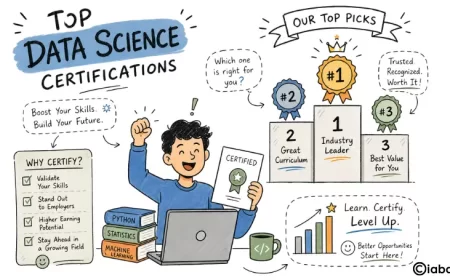
How Data Science Certifications Help Reduce These Risks
One of the most practical ways organizations reduce these risks is by building teams with certified professionals who already understand the full data science life cycle — not just the modeling part.
A certified data science professional has:
- Documented training across every stage of the data science life cycle
- Practice applying structured processes to real data science projects
- The vocabulary to communicate with both technical and business stakeholders
- A recognized credential that signals professional standards to employers globally
IABAC (International Association of Business Analytics Certifications) offers globally recognized data science certifications built around the real needs of working data science teams. IABAC's programs are designed to cover the complete data science life cycle — from business problem definition all the way through to model monitoring and maintenance.
Whether you are building a career in data science or leading a team that runs data science projects, IABAC certifications are built to match what companies actually need.
To see the full range of certification options available, visit https://iabac.org/certifications. IABAC is recognized in countries across Asia, Europe, the Americas, Africa, and beyond — making its certifications genuinely global in value.
What Good Looks Like — A Data Science Project Done Right
Here is a brief comparison to show the difference between a project that follows the data science life cycle and one that does not:
|
Project Stage |
With a Structured Data Science Life Cycle |
Without a Structured Life Cycle |
|
Business Understanding |
Objectives are clearly defined, |
Teams assume they understand |
|
Data Collection |
Data sources, permissions, and |
Data is gathered reactively and |
|
Data Preparation |
Cleaning rules and transformation |
Data is cleaned manually with |
|
Exploratory |
Patterns, anomalies, and assumptions |
Often skipped to save time, increasing the risk of hidden issues |
|
Modeling |
Multiple algorithms are tested and |
The team uses a familiar |
|
Evaluation |
Success metrics are defined before |
Metrics are selected only |
|
Deployment |
Production requirements are |
Deployment is treated as |
|
Monitoring |
Dashboards and alerts are |
No one monitors the |
Project Outcomes
|
Outcome Metric |
With Life Cycle |
Without Life Cycle |
|
Time to |
Typically 30–50% faster due to structured |
Frequently delayed and, in many |
|
Deployment Rate |
Much higher likelihood of reaching |
Industry surveys suggest only a |
|
Model Lifespan |
Continuously maintained, monitored, and improved |
Performance degrades |
|
Business |
Strong alignment with stakeholder |
Commonly results in frustration |
The difference is not subtle. It is the difference between a data science project that produces lasting value and one that produces a presentation nobody acts on.
The Risks Are Real, and the Fix Is Clear
The risks of not following the data science life cycle are not theoretical. They are measured in wasted months, undeployed models, wrong decisions, regulatory trouble, and frustrated teams.
The good news is that none of these risks are complicated to avoid. They all share the same solution: follow the process. Go through each stage with care. Define the problem before touching the data. Clean the data before building the model. Agree on success metrics before evaluating results. Plan for deployment before the model is finished. Monitor after launch.
That is the data science life cycle. It is not a constraint on creativity. It is the structure that makes good data science possible.
For anyone who wants to demonstrate that they understand this process — and can apply it across real data science projects — data science certifications from a respected body like IABAC are the clearest way to show that.
Visit https://iabac.org/certifications to explore your options and take the next step in building a data science career built on strong foundations.