

















































Impact of AI and Analytics Fusion on Business Analytics Careers
See how AI and analytics fusion is changing business analytics careers, influencing job roles, required skills, and long-term career paths across industries

The field of business analytics is evolving. The line between artificial intelligence and traditional analytics has nearly disappeared, and professionals who treat these as separate skill sets are already falling behind. AI and analytics fusion is reshaping how organizations interpret data, forecast outcomes, and make decisions at speed, and this shift is rewriting the job description of every business analyst and analytics manager across industries.
This convergence is not a future trend to prepare for someday. It is happening in hiring patterns, job descriptions, tool stacks, and salary structures right now. Organizations that once hired business analysts purely to build dashboards or document requirements are now expecting those same professionals to interpret AI-generated outputs and translate algorithmic recommendations into business strategy.
What AI and Analytics Fusion Actually Means
AI and analytics fusion refers to the merging of traditional business analytics practices, such as requirements gathering and reporting, with AI capabilities like predictive modeling, natural language processing, and automated pattern recognition.
Instead of analysts manually building every report from scratch, AI systems now handle data cleaning, anomaly detection, and initial insight generation, while business analysts focus on interpreting these outputs to drive business decisions.
Key components of this fusion include:
- Automated data preparation: AI tools now clean, structure, and merge datasets in a fraction of the time manual processes once required
- Predictive and prescriptive analytics: Moving beyond "what happened" to "what will happen" and "what should we do about it"
- Natural language querying: Business users can ask questions in plain English and receive AI-generated visualizations and summaries
- Real-time decision support: AI models continuously update recommendations without waiting for scheduled reporting cycles
- Embedded analytics: AI-powered insights delivered directly inside operational tools like CRMs, ERPs, and marketing platforms rather than separate BI dashboards.
The numbers reflect how quickly this is moving.
Gartner predicts that by 2027, 50% of all business decisions will be influenced by AI, which signals how embedded these tools are becoming in everyday decision-making rather than staying confined to specialized data science projects.
On the hiring side, LinkedIn's 2026 Jobs on the Rise report named AI Engineer the fastest-growing job title in the US, with postings up 143% year-over-year.
PwC's analysis of job postings across six continents found AI is splitting the labor market into two tracks, where skills like judgment and leadership are becoming more valuable, not less.
The fusion isn't just adding new tools. It's redrawing the line between what a machine should do and what a person should own.
How This Fusion Is Changing the Business Analyst Role
The traditional business analyst job description centered on gathering requirements, documenting processes, and producing reports for stakeholders. That description is rapidly expanding, and in many organizations, it is being rewritten entirely.
Business analysts are now expected to work alongside AI systems rather than instead of them. This means
- Interpreting what an AI-generated forecast actually means for the business,
- Recognizing when an output looks reasonable on the surface but doesn't fit the operational context
- Communicating these insights to stakeholders in language that drives action.
A business analyst who cannot interpret an AI output and turn it into a clear recommendation is at a significant disadvantage compared to one who can.
The role is shifting in several concrete ways:
- Analysts spend less time on manual data wrangling and more time on interpreting AI outputs to drive business decisions
- Stakeholder communication now includes explaining what an AI-generated insight means for strategy, not just what the insight says
- Cross-functional collaboration with data science and engineering teams has become a core expectation rather than an occasional task
- Decision-making timelines have compressed, requiring analysts to interpret AI outputs quickly without sacrificing business relevance
- Reporting has shifted from static documentation to ongoing interpretation as AI systems generate continuous updates
Companies are not necessarily looking for business analysts who can build AI models from scratch. They are looking for analysts who can take what an AI system produces and turn it into a decision the business can act on.
The New Skill Demands Reshaping Hiring
Job postings for business analyst roles have visibly changed over the past few years. Where a listing once asked for Excel proficiency and basic SQL, many now reference AI literacy and experience working with AI-augmented tools for business reporting and decision support.
This does not mean every business analyst needs to become a data scientist. It means the baseline expectation has risen, and the gap between analysts who adapted early and those who did not is widening quickly.
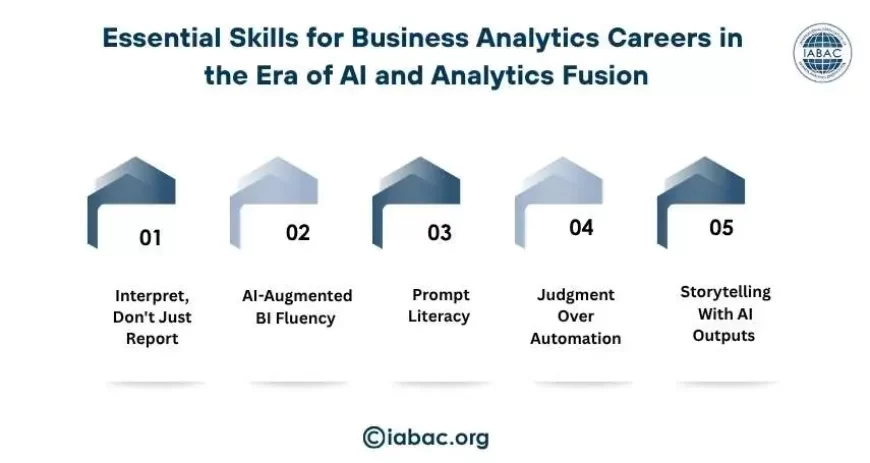
Skills now in highest demand include:
- The ability to interpret AI outputs and translate them into clear, actionable business decisions
- Experience with AI-augmented BI platforms used for day-to-day business reporting
- Prompt literacy for using generative AI tools to accelerate analysis and reporting
- Business judgment strong enough to know when an AI output needs more context before it reaches stakeholders
- Data storytelling skills that turn AI-generated outputs into narratives leadership can act on
- Familiarity with how AI-driven recommendations fit into existing business processes and decision-making structures
Career Opportunities Created by This Convergence
While some discussions around AI in analytics focus on job displacement, the more accurate picture for business analytics professionals is role transformation paired with genuine expansion in certain career paths. New job titles and specializations have emerged directly from this fusion, and they did not exist in this form a few years ago.
Emerging and expanding roles include:
- AI-augmented business analysts who specialize in interpreting AI outputs to drive business decisions across departments
- Analytics translators who sit between data science teams and business leadership, converting AI-generated findings into actionable strategy
- Decision intelligence specialists who combine business analytics and AI-driven insight to guide complex organizational choices
- Embedded analytics consultants who help companies integrate AI-driven insights directly into their operational software so business teams can act on them faster
- Business analysts specializing in AI-driven forecasting, who focus specifically on interpreting predictive outputs for budgeting, planning, and resource allocation
These roles often command higher compensation than traditional analyst positions because they require a hybrid skill set that is genuinely scarce. Professionals who can take an AI output and turn it into a confident business decision are positioned as connectors within their organizations, and connectors tend to be harder to replace.
The expansion also extends into industries that previously had limited analytics maturity. Healthcare, manufacturing, and logistics are adopting AI-analytics fusion rapidly, creating demand for business analysts who can interpret AI outputs within the operational realities of these sectors.
Why Adaptability Matters More Than Technical Mastery Alone
A common misconception is that surviving this shift requires becoming a machine learning engineer.
In reality, most organizations need far more business analysts who can interpret AI outputs and apply them to real business problems than they need additional technical AI specialists.
The differentiator is not deep technical mastery but the ability to adapt, ask the right questions, and turn AI outputs into business decisions.
Professionals who are adapting successfully tend to share certain habits:
- They actively experiment with AI tools relevant to their industry rather than waiting for formal training
- They focus on what an AI output means for the business rather than treating it as a final answer
- They strengthen communication skills alongside technical ones, since translating AI insights into decisions is now a competitive advantage
- They stay engaged with how their specific industry is applying AI to business analytics, since use cases vary significantly across sectors
- They treat certification and structured learning as a way to validate skills employers are actively screening for
This adaptability mindset matters because the tools themselves will keep changing. The specific AI platform a business analyst uses today may be replaced within two years. What remains valuable is the underlying capability to interpret AI outputs and drive business decisions regardless of which tool delivers the insight.
Industries Leading the Adoption Curve
Not every sector is adopting AI-analytics fusion at the same pace, and understanding where the demand is concentrated helps business analysts target their career moves more effectively.
Sectors currently driving the most aggressive adoption include:
- Financial services, where business analysts interpret AI-driven risk and forecasting outputs to guide planning decisions
- Retail and e-commerce, where business analysts use AI-generated demand predictions to guide inventory and merchandising decisions
- Healthcare, where business analysts interpret AI-assisted operational outputs to improve patient flow and resource planning
- Manufacturing, where business analysts use AI-driven predictive outputs to guide supply chain and operational decisions
- Technology and SaaS companies, where business analysts interpret AI-generated user behavior outputs to guide product and growth decisions
Professionals targeting these industries should expect AI literacy to be assessed directly in interviews, often through case studies that require interpreting an AI output and recommending a business decision rather than discussing analytics theory in the abstract.
Practical Steps for Analysts Navigating This Shift
Understanding that change is happening is one thing. Acting on it requires a clear, practical approach rather than vague intentions to "learn AI someday."
A focused path forward typically includes:
- Auditing current skill gaps against job descriptions in your target industry, paying close attention to AI-related requirements
- Gaining hands-on exposure to at least one AI-augmented analytics platform relevant to your field
- Building a portfolio project that demonstrates interpreting an AI output and turning it into a business recommendation
- Pursuing structured certification that validates both business analysis competency and the ability to work with AI-driven outputs
- Strengthening stakeholder communication skills, since the ability to turn AI-driven insights into decisions is increasingly what separates senior analysts from junior ones
The fusion of AI and analytics is not eliminating business analytics careers. It is raising the bar for what a valuable business analyst looks like, while simultaneously creating new, often better-compensated roles for professionals who can interpret AI outputs and drive business decisions.
Building structured competency now, rather than reacting once the gap becomes obvious in job rejections, positions business analysts to lead this shift instead of catching up to it.
Professionals serious about staying ahead of this transition can explore business analytics certification programs and align business analysis foundations with the AI interpretation skills employers are actively prioritizing.