














































How to Become a Certified Business Analysis Professional in 2026
Become a Certified Business Analytics Professional in 2026 with AI-driven skills, global certification, career growth, and high-paying analytics roles.

The business world runs on decisions. And increasingly, the best decisions are not made on gut instinct or boardroom experience alone; they are made by people who know how to read data, interpret patterns, and turn numbers into strategy.
That is exactly what a certified business analytics professional does.
But here is what is changing fast: the role has evolved. It is no longer enough to build a report or maintain a dashboard.
Organizations today need analytics professionals who can work with AI-powered tools, navigate complex stakeholder environments, communicate insights to non-technical leadership, and drive measurable business outcomes. The bar has been raised, and so has the reward.
Certification is how you prove you have crossed that bar. It is the professional signal that tells employers, before you walk into the room, that you know what you are doing.
What Does a Certified Business Analytics Professional Actually Do?
A Certified Business Analytics Professional is more than a person who runs Excel reports or builds BI dashboards.
-
They translate raw business data into actionable strategies that directly impact revenue, operations, and growth.
-
They bridge the gap between technical teams and business stakeholders, making sure data insights lead to real decisions.
-
They identify business problems before they become business crises, using predictive models and trend analysis.
-
They leverage AI and automation tools to accelerate analysis and deliver insights at scale.
-
They are involved in requirements gathering, stakeholder analysis, KPI design, solution evaluation, and performance tracking across sectors like BFSI, healthcare, retail, IT, e-commerce, and manufacturing.
In India and the USA, the role is embedded in every Fortune 500 company, every top tech startup, and every government initiative involving data-driven policy. The Certified Business Analytics Professional is the person organizations cannot afford to not have.
The 7-Step Roadmap to Becoming a Certified Business Analytics Professional in 2026
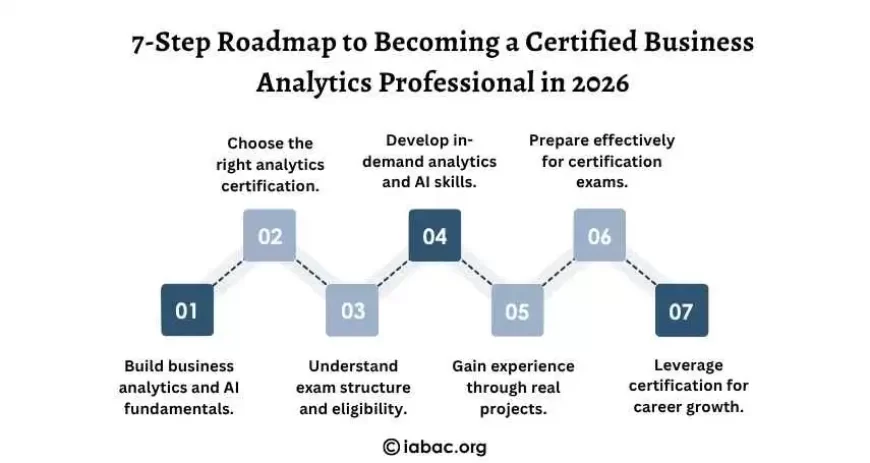
Step 1: Build Your Foundation in Business Analytics
Before pursuing certification, it is important to establish a foundational understanding of how business analytics works. This includes concepts like
-
Descriptive analytics (what happened)
-
Diagnostic analytics (why it happened)
-
Predictive analytics (what will happen)
-
Prescriptive analytics (what should we do)
Many of today's most successful certified professionals come from backgrounds in commerce, engineering, management, finance, and even the arts. What matters is your ability to ask the right business questions and use data to answer them.
In 2026, foundational knowledge also requires a working understanding of AI-assisted analytics and how tools like Microsoft Copilot, Tableau AI, and generative BI platforms are reshaping how analysts work. Getting comfortable with these tools early puts you ahead of 90% of candidates.
Step 2: Choose the Right Certification — And Choose It Strategically
Not all business analytics certifications are built the same. Here is how to think about it based on where you are in your career:
-
Freshers and students (0–2 years experience): Look for certifications that are accessible, globally recognized, and cover both business analytics fundamentals and analytics tools.
-
Mid-career professionals (3–7 years of experience): You need a certification that adds strategic credibility and demonstrates you can lead analytics-driven initiatives.
-
Senior professionals and leaders (7+ years): Expert-level certifications focused on AI integration, enterprise analytics, and strategic decision-making are the differentiators at this stage.
The key in 2026 is to choose a certification that reflects current market needs, not just traditional business analysis frameworks from a decade ago.
Employers in 2026 want more than analysts who capture and document requirements; they want professionals who can achieve business objectives, manage risks, and drive stakeholder alignment across the technology and business divide.
Step 3: Understand the Exam Structure and Eligibility Requirements
One of the biggest reasons professionals delay certification is confusion around eligibility; people assume they need years of experience, specific degrees, or expensive prerequisites before they can even apply.
In most cases, that assumption holds them back unnecessarily. Business analytics certifications are structured across multiple levels, so there is a valid pathway available regardless of where you are in your career.
What to look for when evaluating any certification's exam structure:
-
Clarity of curriculum: Are the knowledge areas clearly defined and aligned with what employers actually look for?
-
Exam format: Is it available online, proctored remotely, and flexible enough to fit around your schedule?
-
Recognition and verifiability: Can the credential be independently verified by employers and shared on professional platforms like LinkedIn?
-
Relevance to current industry needs: Does the curriculum reflect modern analytics practice, including data storytelling, AI-assisted decision-making, and business intelligence frameworks?
Understanding these parameters before you register ensures you invest your time and money in a certification that genuinely moves your business analytics career forward, not just one that adds a line to your resume
Step 4: Develop the In-Demand Skills of a 2026 Business Analytics Professional
Certification alone is not enough. The market rewards professionals who combine their credentials with real-world, applied skills. In 2026, the following skill clusters are non-negotiable for a certified business analytics professional:
-
Data Analysis and Visualization: Proficiency in tools like Power BI, Tableau, or Google Looker Studio for turning raw data into business narratives.
-
AI and Machine Learning Basics: You do not need to code AI models, but understanding how AI-driven insights work and how to interpret and act on them is now a baseline expectation.
-
SQL and Data Querying: The ability to extract, clean, and manipulate data from relational databases remains one of the highest-value skills in the analytics job market.
-
Statistical Thinking: Regression analysis, hypothesis testing, and forecasting applied to business problems, not just academic exercises.
-
Business Communication and Stakeholder Management: The ability to present complex data findings to non-technical audiences in a clear, persuasive, and actionable format.
-
Agile and Project Management Principles: Most analytics projects today run on Agile frameworks. Understanding sprint cycles, backlog prioritization, and iterative delivery makes you a significantly more effective analyst.
-
Generative AI Prompt Engineering for Analytics: In 2026, knowing how to leverage ChatGPT, Claude, Gemini, and Copilot for data summarization, insight generation, and report automation is a genuine competitive advantage.
Step 5: Gain Practical Experience Through Real Projects
Certification paired with practical experience is what converts a credential into a career accelerator. Here is how to build that experience even before you land your first analytics role:
-
Work on open datasets from platforms like Kaggle, data.gov, or the Government of India's Open Data portal and build end-to-end case studies.
-
Volunteer your analytics skills to small businesses, NGOs, or college projects to generate real outcomes you can showcase.
-
Participate in business analytics competitions and hackathons, increasingly common in both India (IIMs, IITs) and the USA (Deloitte, Accenture, and McKinsey host regular challenges).
-
Build a portfolio of 3–5 analytics projects that demonstrate your ability to define a business problem, collect and analyze data, and recommend a strategic action.
Employers, whether they are a startup or a financial firm, care deeply about what you have done, not just what paper you hold.
Step 6: Prepare for Your Certification Exam Effectively
Strategic exam preparation is what separates those who pass on the first attempt from those who don't. Here is a preparation framework that works:
-
Allocate dedicated study time: A minimum of 6–8 weeks works well for most candidates. If you are balancing a full-time job, extend that to 10–12 weeks to avoid burnout and retain what you study.
-
Study the official curriculum structure thoroughly: Understand the knowledge areas, competency frameworks, and the types of scenario-based questions you will face.
Do not just read; actively take notes and summarize each section in your own words.
-
Practice with mock tests and timed simulations: This is where most candidates lose valuable marks. They know the content but are not prepared for the exam format, the time pressure, or the way questions are framed.
-
Join online communities and study groups: LinkedIn groups, Reddit threads, and analytics-focused Discord servers are excellent for peer learning, sharing resources, and staying motivated through the preparation phase.
-
Revisit real-world case studies: The best exam preparation is not just theoretical. Working through business problems that mirror what the exam tests builds both confidence and practical thinking.
Step 7: Leverage Your Certification to Accelerate Your Career
Getting certified is the beginning of your journey, not the destination. Here is how to turn your certification into tangible career growth:
-
Update your LinkedIn profile immediately: Add your digital badge, list the knowledge areas covered, and update your headline to reflect your certified status. Recruiters actively filter for certified professionals, and this is the fastest way to get on their radar.
-
Optimize your resume for ATS: Add your certification with the specific business analytics skills and knowledge areas it covers. Applicant tracking systems scan for keywords, and a well-documented certification significantly improves your chances of getting past the first filter.
-
Target the right job titles: Business Analyst, Data Analyst, Analytics Consultant, Business Intelligence Analyst, Strategy Analyst, and Product Analyst are all roles where a business analytics certification carries direct weight.
-
Know where the demand is: In India, top hiring companies include TCS, Infosys, Wipro, Deloitte, Accenture, Amazon India, Flipkart, and PhonePe. In the USA, Google, Microsoft, JPMorgan Chase, McKinsey, and Salesforce are among the most active hirers of certified analytics professionals.
-
Use your certification as a salary negotiation anchor: Certified professionals consistently command 20–30% higher packages than their non-certified peers. Do not undersell what the credential represents.
Business Analytics Career Scope in India vs USA in 2026
India
The business analytics job market in India is experiencing strong growth in 2026. The rise of fintech, healthtech, edtech, and D2C e-commerce has created serious demand for professionals who can sit at the intersection of data and business strategy.
Cities like Bengaluru, Hyderabad, Pune, Mumbai, and Delhi NCR remain the primary hiring hubs, with remote analytics roles growing steadily as well.
On compensation, according to Glassdoor, the average business analyst salary in India stands at ₹9 LPA. Entry-level roles typically start between ₹5–7 LPA, while senior professionals with 5+ years of experience in domains like BFSI, consulting, and technology earn ₹15 LPA and above. At top MNCs and product companies, senior certified analysts can reach ₹20–25 LPA depending on specialization.
USA
The US remains the strongest market for business analytics talent globally. According to Glassdoor, the average business analyst salary in the USA is around $107,000 per year, with typical ranges falling between $84,000 and $137,000 depending on industry, experience, and location.
Cities like San Francisco, New York, Chicago, Austin, and Seattle lead in compensation. Remote-first roles have opened strong opportunities across smaller cities as well.
American employers increasingly treat certification as a hiring prerequisite for analytics roles above entry level.
Why Choose IABAC for Your Business Analytics Certification
IABAC (International Association of Business Analytics Certifications) is built around one core idea: that certification should reflect what the industry actually demands, not what it demanded a decade ago.
-
Globally Recognized: IABAC certifications are respected across 15+ countries and aligned with international business analytics standards, giving your credential genuine weight with employers worldwide.
-
AI-Era Curriculum: The curriculum is designed around modern analytics practice, covering AI-augmented decision-making, data storytelling, business intelligence frameworks, and strategic analytics skills that employers are actively hiring for right now.
-
Accessible Across Career Stages: From foundational to expert level, there is a certification pathway for every stage of your career.
-
Flexible Online Delivery: Take your exam from anywhere in the world without physical test centers or membership prerequisites.
-
No Excessive Experience Requirements: The certification validates what you know and what you can do, making it genuinely accessible to both early-career professionals and seasoned practitioners.
Top 5 Industries Hiring Certified Business Analytics Professionals in 2026
-
Banking, Financial Services & Insurance (BFSI): Risk analytics, fraud detection, credit scoring, and investment analytics are driving massive demand in India and the USA.
-
Technology & SaaS: Product analytics, user behavior analysis, revenue forecasting, and go-to-market strategy analytics are core to every tech company.
-
Healthcare & Pharma: Clinical data analysis, hospital operations analytics, drug efficacy reporting, and patient outcome prediction are high-growth niches.
-
Retail & E-Commerce: Customer segmentation, demand forecasting, supply chain analytics, and personalization engines are powered by certified analytics professionals.
-
Consulting & Professional Services: Management consulting firms, strategy consultancies, and boutique advisory firms are some of the highest-paying employers for certified analytics professionals.
Ready to Become a Certified Business Analytics Professional? The path is clear. The demand is there. The only thing left is the decision to start. IABAC's Business Analytics Certification gives you the globally recognized credential, the 2026-aligned curriculum, and the career-ready skills to stand out in the analytics job market.