



























































What Is the ETL Process and Why Is It So Important Today?
Learn what the ETL process is and why it is important for extracting, transforming, and loading data into reliable analytics systems.


Every day, huge amounts of information are created when people search online, shop, watch videos, use apps, or make payments. But raw information by itself is not useful. It is often messy, repeated, or incomplete. Before companies can use it for reports or decision-making, it must be cleaned and organized.
This is where the ETL Process (Extract, Transform, Load) comes in. It is one of the most important parts of working with large amounts of information in modern systems.
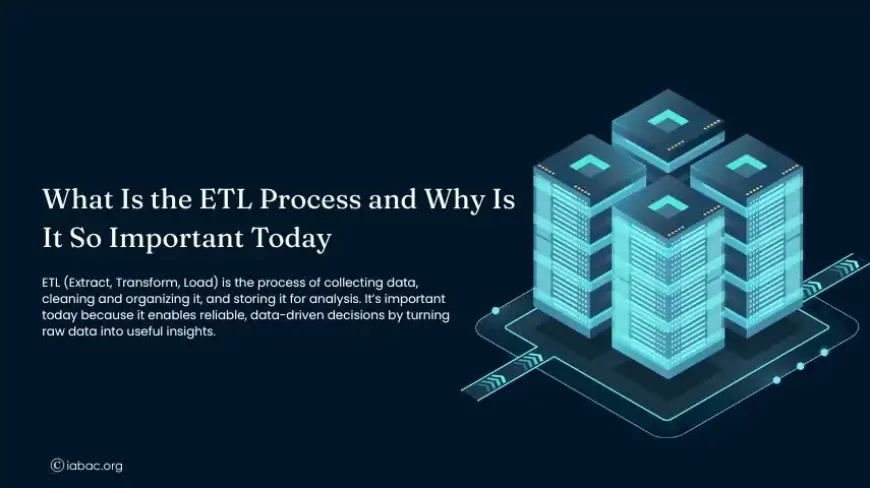
ETL helps take raw information from different places, clean it, and store it in one place so it can be used for analysis, reports, and building smart systems.
What Does ETL Mean?
ETL stands for:
- E – Extract
- T – Transform
- L – Load
It is a step-by-step method used to move information from many sources into one central system, such as a data warehouse or cloud storage.
Simple meaning:
ETL means collecting raw information, cleaning it, and storing it in a structured way so it becomes useful.
Why ETL Is Needed
Companies collect data from many different places, and each source stores information in its own format.
For example, data comes from websites, mobile apps, online payment systems, customer support tools, and marketing platforms. All this information is mixed, unorganized, and often not ready to use directly. This is where the ETL Process (Extract, Transform, Load) becomes important. ETL helps bring all this scattered data together in one place. First, data is collected from different systems. Then it is cleaned, corrected, and converted into a common format so it becomes consistent and useful. After that, it is stored in a central system where it can be used for reports and analysis.
Without ETL, data would stay separated in different tools, making it difficult to understand overall performance. ETL also helps remove errors, duplicate records, and missing values, which improves data quality.
Because of this, roles like Data Engineer focus heavily on building and maintaining ETL pipelines using different ETL tools, ETL software, and ETL platform solutions. ETL is also a key part of modern data science career paths, especially for those working with ETL data, analytics, and reporting systems.
Imagine a company that collects information from:
- Websites
- Mobile apps
- Online payments
- Customer support systems
- Marketing platforms
All this information comes in different formats. Some is text, some numbers, some incomplete, and some repeated.
|
Without ETL:
|
|
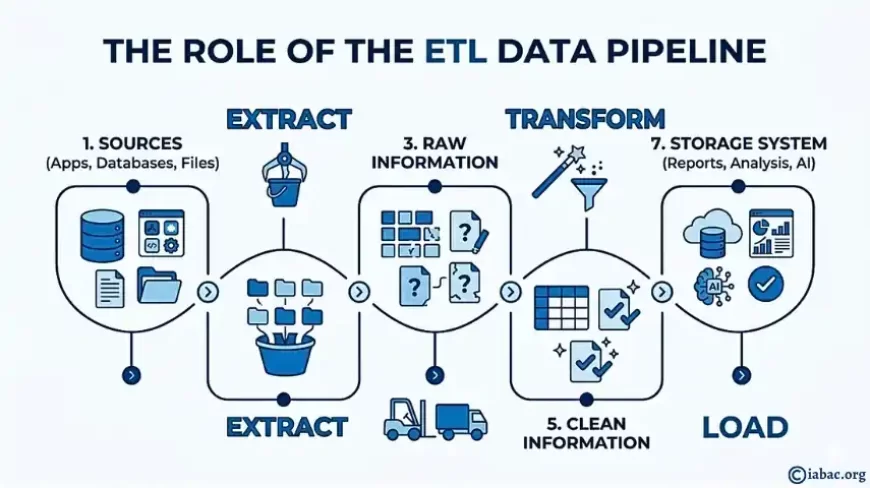
Step 1: Extract (Collecting Information)
The first step is collecting information from different places.
These sources can include:
- Databases (like SQL systems)
- Excel files
- APIs from apps
- Emails and logs
- Text files and JSON files
At this stage, nothing has changed. The goal is only to bring everything together.
Example:
A retail company collects:
- Sales records from stores
- Online purchase data
- Customer feedback
- Website activity logs
All this is pulled into one system.
Step 2: Transform (Cleaning and Fixing Information)
This is the most important step.
Raw information is usually messy. It may contain:
- Duplicate entries
- Missing values
- Different formats for the same thing
- Errors in spelling or structure
So, it must be cleaned and made consistent.
Common tasks in this step:
- Removing repeated records
- Fixing missing values
- Changing formats (dates, currency, text)
- Sorting information
- Combining multiple sources
- Applying simple business rules
Example:
|
Raw Information |
Cleaned Version |
|
“usa”, “U.S.” |
United States |
|
100 USD |
₹83,000 |
|
blank value |
0 or “Not Available” |
This step makes sure everything follows one standard.
Step 3: Load (Storing Information)
After cleaning, the information is stored in a system where it can be used.
This system can be:
- Data warehouse
- Cloud storage
- Data lake
There are two main ways to load data:
1. Full Load
All information is loaded again from the beginning.
2. Incremental Load
Only new or updated information is added.
Incremental loading saves time and system resources.
Why ETL Matters
ETL is important because it helps turn raw information into something useful.
1. Better Organization: Everything is stored in one place instead of many scattered systems.
2. Cleaner Information: Errors, duplicates, and missing values are reduced.
3. Faster Reports: Teams can get answers quickly without checking multiple systems.
4. Helps Decision Making: Managers can understand trends and patterns more clearly.
5. Supports Advanced Systems: Machine learning models and analytics tools need clean input.
ETL vs ELT
Sometimes, instead of transforming before loading, systems load first and transform later.
|
Method |
Meaning |
|
ETL |
Clean before storing |
|
ELT |
Store first, clean later |
Modern cloud systems often use both methods depending on need.
ETL Tools Used in Real Work
Many tools help automate this process so humans don’t have to do everything manually.
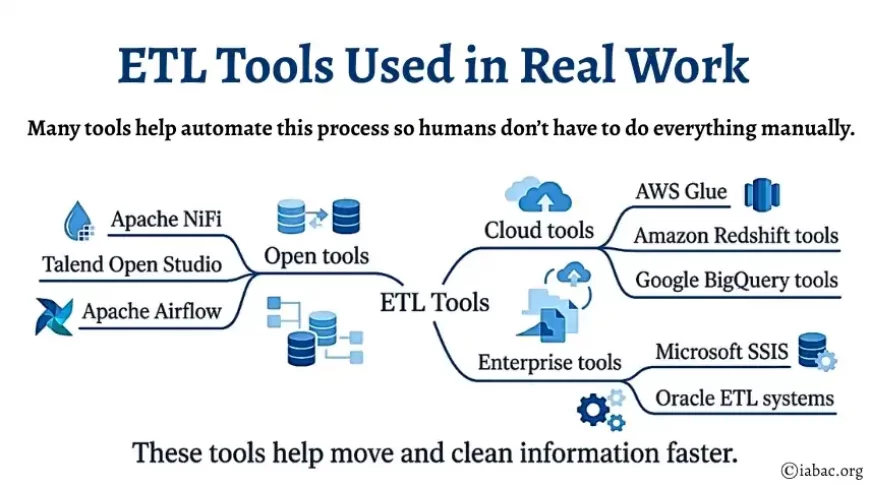
Open tools:
- Apache NiFi
- Talend Open Studio
- Apache Airflow
Cloud tools:
- AWS Glue
- Amazon Redshift tools
- Google BigQuery tools
Enterprise tools:
- Microsoft SSIS
- Oracle ETL systems
These tools help move and clean information faster.
ETL Testing
ETL testing is an important step before companies use any processed data for reports or decision-making.
It helps make sure the data is correct, complete, and reliable after it goes through the ETL process (Extract, Transform, Load).
During ETL testing, teams verify several things:
- They check whether all data has been transferred properly from the source system to the target system without any loss or duplication.
- They also confirm that the data remains accurate after cleaning and transformation, meaning values are not changed incorrectly during processing.
- Another key part is checking for missing records. Testers make sure no important data is left out during the movement or transformation steps.
- They also validate calculations, such as totals, averages, or derived fields, to ensure they are producing the correct results.
- Even a small error in ETL can affect the final reports and lead to wrong business decisions. That’s why ETL testing is essential to maintain data quality and trust in analytics systems.
ETL in Career Growth
ETL skills are important for people working in:
- Data engineering
- Data analysis
- Machine learning systems
Common job roles:
- Data Engineer
- ETL Developer
- Data Analyst
- Data Architect
These roles are in demand because companies depend heavily on organized information systems.
Data Engineer Skills Related to ETL
To work with ETL, these skills are often needed:
- SQL (for databases)
- Python (for processing)
- Cloud systems
- ETL tools
- Understanding of pipelines
Many professionals follow a data engineer roadmap that starts with ETL basics.
ETL in Data Science Work
Data science work depends on clean information. Without ETL:
- Models give poor results
- Predictions become unreliable
- Analysis becomes confusing
With ETL:
- Information becomes usable
- Models improve
- Insights become clearer
This is why ETL is part of many data science certifications and training programs.
Simple Example of ETL Impact
Imagine a system with 1,000,000 records:
- 80,000 are duplicates
- 50,000 are incomplete
- 20,000 have wrong formats
After ETL:
- 850,000 clean records remain
This shows how much cleaner and more useful information becomes after processing.
ETL in Cloud Systems
Modern systems use cloud platforms for ETL work.
Example process:
- Information stored in cloud storage
- The ETL tool processes it
- Clean data goes to the analytics system
Cloud tools make the process faster and easier to scale.
Common Problems in ETL
Even though ETL is powerful, some issues can happen:
1. Poor Quality Input: If the input is bad, the output will also be bad.
2. Slow Processing: Large information sets can take time.
3. Storage Issues: Too much information can overload systems.
4. System Limits: Older systems may not handle large volumes.
Solutions to Improve ETL
Companies improve the ETL process by following these points:
- Using cloud systems to store and process large amounts of data in a faster and more flexible way.
- Running tasks in parallel so multiple ETL steps happen at the same time and save processing time.
- Cleaning data early in the ETL flow to reduce errors and improve accuracy in final results.
- Automating workflows to reduce manual work and make the ETL Process more consistent.
- Using better ETL tools and ETL software to improve performance, monitoring, and reliability.
Simple Real-Life Comparison
Think of ETL like preparing food:
- Raw vegetables = raw information
- Washing and cutting = cleaning and transforming
- Cooking = final processing
- Serving = final reports
Without preparation, the food (or data) is not useful.
Future of ETL
The future of ETL is moving in a strong and simple direction with major improvements in how data is handled:
- ETL systems are becoming faster, allowing data to move and process in less time.
- They are becoming more automatic, reducing the need for manual work in data pipelines.
- ETL is shifting more toward cloud-based systems, making storage and processing easier and more scalable.
- ETL tools are getting better connected with AI systems, helping in smarter data handling and predictions.
- Companies are focusing on real-time processing, so reports are generated instantly instead of waiting hours or days.
The ETL process is one of the most important parts of working with information today. It helps turn messy raw data into something meaningful and useful. Without ETL, businesses would struggle to understand what is happening in their systems. With ETL, everything becomes clearer, organized, and ready for action. It is also an important part of careers in data engineering and analytics. Anyone interested in working with information systems should understand how ETL works.
Training programs like those from IABAC certifications help build strong skills in this area and prepare learners for real industry work.