


























































MLOps Roadmap 2026: A Complete Beginner-to-Professional Guide
Learn the key stages of MLOps, from machine learning fundamentals and cloud tools to deployment, monitoring, automation, and production workflows in 2026.


Machine Learning Operations, or MLOps, has become one of the most valuable skills in the modern AI ecosystem. As more companies move from experimenting with machine learning to using it in real business systems, the need for professionals who can manage deployment, monitoring, automation, and scaling has grown quickly.
Data scientists are often responsible for building models, but MLOps professionals make sure those models actually work in production. They help models move from notebooks and experiments into real applications that are reliable, secure, maintainable, and scalable. This guide is designed as a complete roadmap for anyone who wants to learn MLOps in 2026, starting from the basics and moving step by step toward a professional level.
What is MLOps?
MLOps stands for Machine Learning Operations. It is a set of practices that combines several important fields, including:
- Machine Learning
- DevOps
- Data Engineering
- Cloud Computing
- Software Engineering
The main purpose of MLOps is to automate and manage the complete machine learning lifecycle. That lifecycle usually includes:
- Data collection
- Data preparation
- Model training
- Testing
- Deployment
- Monitoring
- Maintenance
- Continuous improvement
Without MLOps, many machine learning models stay stuck in the development stage. They may perform well in a notebook or lab environment, but they never become useful in a real business setting. With MLOps, those models can be deployed properly, monitored continuously, and updated whenever needed so they continue delivering value.
Why Learn MLOps in 2026?
In 2026, AI adoption is no longer limited to research teams or experimental projects. Businesses across industries are actively using AI in production, and they need professionals who can make those systems dependable and efficient.
MLOps is important because organizations now need people who can:
- Deploy machine learning models efficiently
- Automate AI workflows
- Manage large-scale AI systems
- Monitor model quality and performance
- Reduce manual work in machine learning operations
- Ensure AI systems remain reliable over time
MLOps professionals also work closely with many different teams, such as:
- Data Scientists
- Data Engineers
- DevOps Engineers
- Cloud Engineers
- Software Developers
This makes MLOps one of the most flexible and high-demand career paths in technology. It is a strong choice for anyone who enjoys working at the intersection of AI, software, and infrastructure.
Step 1: Understand the Core Principles of MLOps
Before learning tools and platforms, it is important to understand the ideas that guide MLOps. These principles shape how machine learning systems are designed and maintained.
- Reproducibility: Reproducibility means that experiments can be repeated and produce the same or very similar results. This is important because machine learning projects often involve many experiments, and teams need to know which version of code, data, and parameters produced a certain result.
- Automation: Automation reduces the need for manual work. In MLOps, many tasks such as model training, testing, deployment, and monitoring should be automated as much as possible. This improves speed and reduces errors.
- Scalability: Scalability means that the system can handle more data, more users, and more traffic without breaking down. As AI applications grow, MLOps systems must be designed to scale smoothly.
- Collaboration: MLOps improves collaboration between data scientists, engineers, and operations teams. Instead of working in isolated environments, teams can work together using shared tools, pipelines, and workflows.
- Continuous Improvement: Machine learning models are not static. Data changes over time, business needs change, and model accuracy can decline. MLOps supports regular updates so models remain useful and effective.
Step 2: Learn What MLOps Actually Involves
MLOps is not just one tool or one process. It is a complete ecosystem made up of several connected parts.
Version Control
Version control is used to track changes in:
- Code
- Data
- Models
- Configurations
Popular tools include:
- Git
- GitHub
- DVC
Version control helps teams collaborate, compare different versions, and keep track of experiments. In machine learning, this is especially important because projects can change often and involve many moving parts.
CI/CD for Machine Learning
CI/CD means Continuous Integration and Continuous Delivery. In MLOps, CI/CD helps automate important steps like:
- Code testing
- Model validation
- Pipeline execution
- Deployment
Common tools include:
- GitHub Actions
- GitLab CI/CD
- Jenkins
- CML (Continuous Machine Learning)
CI/CD makes machine learning workflows faster and more reliable. Instead of manually running every step, teams can automate their delivery pipeline.
Orchestration
Orchestration means coordinating multiple machine learning tasks in the correct order. It helps manage workflows such as:
- Data preparation
- Training jobs
- Evaluation steps
- Model deployment
Orchestration is valuable because machine learning workflows often involve many dependent steps. With orchestration, everything runs in the right sequence with less manual effort.
Experiment Tracking
Machine learning projects usually involve many experiments. Teams need to keep track of what was tested, what worked, and what failed.
Experiment tracking records things like:
- Hyperparameters
- Training metrics
- Model versions
- Dataset versions
- Training runs
Popular tools include:
- MLflow
- Weights & Biases
- Neptune
Tracking experiments helps teams compare results and make better decisions based on evidence.
Data Lineage
Data lineage refers to the history of data. It shows where data came from, how it was changed, and how it was used.
This is important for:
- Compliance
- Debugging
- Data quality
- Transparency
If a model produces a strange result, data lineage helps teams trace the issue back to its source.
Model Training and Serving
Training is the process of building a machine learning model using data. Serving is the process of making that model available to users or applications through APIs or production systems.
The focus in production is on:
- Reliability
- Speed
- Scalability
- Consistent performance
A well-trained model is not enough. It must also be delivered efficiently to the systems that depend on it.
Monitoring and Observability
Once a model is deployed, the work is not finished. It must be monitored continuously to make sure it still performs well.
Important metrics include:
- Accuracy
- Latency
- Data drift
- Model drift
- Resource usage
Monitoring helps teams detect problems early, before they affect users or business outcomes.
Step 3: Master Programming Fundamentals
Programming is one of the most important foundations of MLOps. A strong MLOps engineer should be comfortable writing and understanding code across several environments.
Python
Python is the primary language for machine learning and MLOps. It is widely used because it is readable, flexible, and supported by many libraries.
You should learn:
- Data structures
- Functions
- Object-oriented programming
- Working with APIs
- Common Python libraries
Python is used throughout the machine learning lifecycle, from data preparation to deployment.
SQL
SQL is essential for working with structured data. Since most machine learning projects depend on data stored in databases or warehouses, SQL is a must-have skill.
Important SQL concepts include:
- SELECT statements
- Joins
- Aggregations
- Window functions
- Database optimization
A strong understanding of SQL helps you extract, analyze, and prepare data efficiently.
Bash
Bash scripting is useful for automation in Linux-based systems. Many MLOps environments run on Linux, so knowing Bash makes it easier to manage files, run commands, and automate tasks.
It is helpful for:
- Deployment scripts
- Server automation
- System administration
- Workflow execution
Go (Optional)
Go is not required for beginners, but it can be very useful in advanced cloud-native and infrastructure-focused MLOps roles. It is commonly used in modern DevOps tools and services.
Step 4: Learn Version Control Systems
Version control is essential for organized and collaborative development. In MLOps, it is not only about storing code but also about managing experiments and machine learning assets.
Git
Git is the most widely used version control system. You should understand:
- Repositories
- Branches
- Merging
- Pull requests
- Conflict resolution
Git helps you keep track of changes and work safely across teams.
GitHub
GitHub is a platform built around Git repositories. It provides:
- Code hosting
- Collaboration tools
- Pull request workflows
- CI/CD integrations
GitHub is often used to manage machine learning projects and deployment pipelines.
DVC
DVC, or Data Version Control, extends Git for machine learning use cases. It helps version:
- Large datasets
- Model files
- Experiment outputs
DVC is especially useful when working on projects where data and model versions matter just as much as code versions.
Step 5: Learn CI/CD for MLOps
CI/CD is one of the most important parts of modern MLOps workflows. It reduces manual work and makes machine learning delivery more reliable.
GitHub Actions
GitHub Actions helps automate:
- Testing
- Building
- Deployment
It is widely used because it fits naturally into GitHub-based workflows.
GitLab CI/CD: GitLab CI/CD provides integrated DevOps pipeline features and is useful in teams that already use GitLab for source control and automation.
Jenkins: Jenkins is a long-standing automation server used in many enterprise environments. It is flexible and can support complex workflows.
CML: CML, or Continuous Machine Learning, is designed specifically for automating machine learning workflows, making it a valuable tool in MLOps projects.
Step 6: Build Strong Machine Learning Fundamentals
A good MLOps professional must understand how machine learning works. You do not need to become a research scientist, but you should know the basics well enough to support production systems.
Mathematics and Statistics
Learn the core concepts behind machine learning, including:
- Probability
- Linear algebra
- Statistics
- Hypothesis testing
These subjects help you understand how models work and how to evaluate them properly.
Machine Learning
You should understand:
- Supervised learning
- Unsupervised learning
- Feature engineering
- Model evaluation
This knowledge helps you know what a model is doing and how to improve it.
Deep Learning
Deep learning is used in many modern AI systems. Study:
- Neural networks
- CNNs
- RNNs
- Transformers
These architectures are widely used in computer vision, NLP, and other AI applications.
Model Evaluation
A model is only useful if it performs well. Common evaluation metrics include:
- Accuracy
- Precision
- Recall
- F1 score
- ROC-AUC
Knowing how to interpret these metrics is critical for production ML systems.
Tools
Some widely used machine learning tools include:
- Scikit-learn for classical ML
- TensorFlow for deep learning
- PyTorch for research and production AI
- MLflow for tracking experiments and managing models
Step 7: Learn Cloud Computing
Cloud computing is a major part of MLOps because many machine learning systems run in cloud environments. Cloud platforms make it easier to store data, deploy models, and scale infrastructure.
Major Cloud Providers
|
AWS Popular services include:
|
Microsoft Azure Popular services include:
|
|
Google Cloud Platform (GCP) Popular services include:
|
Cloud-Native ML Services These services help teams with:
|
Learning cloud tools is essential for anyone who wants to work in production AI environments.
Step 8: Learn Infrastructure as Code
Infrastructure as Code, or IaC, is the practice of managing infrastructure through code instead of manual configuration. It makes deployments more consistent and easier to repeat.
Benefits of IaC
- Faster deployments
- Consistent environments
- Fewer configuration errors
- Easier scaling
Common Tools
- Terraform
- Ansible
Terraform is used for provisioning cloud resources, while Ansible is often used for configuration and automation.
Step 9: Learn Containerization
Containerization helps applications run the same way in different environments. This is extremely useful in MLOps because machine learning applications often move between local systems, test environments, and production servers.
Docker
Docker is one of the most important tools in MLOps. Learn:
- Images
- Containers
- Dockerfiles
- Docker Compose
Docker helps package machine learning applications so they are portable and easy to deploy.
Kubernetes
Kubernetes is used to manage containers at scale. It is a major skill for production MLOps roles.
Important Kubernetes concepts include:
- Pods
- Services
- Deployments
- Scaling
- Load balancing
Kubernetes is widely used in large-scale AI systems because it helps manage reliability and performance.
Step 10: Learn Data Engineering Fundamentals
MLOps and data engineering are closely connected. A machine learning model depends on clean, well-organized, and reliable data pipelines.
Important Data Engineering Areas
- Data pipelines
- Data lakes
- Data warehouses
- Data ingestion architecture
Data Engineering Tools
- Apache Spark for large-scale processing
- Apache Kafka for real-time streaming
- Apache Flink for stream processing and real-time analytics
Understanding data engineering gives you a stronger foundation for building real-world AI systems.
Step 11: Learn Orchestration and Deployment
Machine learning systems in production need automated workflows. Orchestration tools help schedule and manage these workflows properly.
Apache Airflow
Airflow is widely used for scheduling and automating workflows.
Kubeflow
Kubeflow is a machine learning platform built on Kubernetes. It is especially useful for creating scalable ML pipelines.
Benefits of Orchestration
- Automated pipelines
- Better workflow management
- Scalable deployment
- Reduced manual work
Step 12: Learn Monitoring and Observability
Monitoring is one of the most important responsibilities in MLOps. A deployed model can lose quality over time, so monitoring helps catch problems early.
Common Tools
- Prometheus for collecting system metrics
- Grafana for visual dashboards
What to Monitor
- CPU usage
- Memory usage
- API performance
- Model drift
- Prediction quality
Monitoring ensures that models continue to work well after deployment.
Step 13: Explore Edge AI
Edge AI refers to machine learning models that run directly on devices instead of only in the cloud. This is useful when low latency, offline capability, or device-level processing is required.
Examples of Edge AI Devices
- Smartphones
- IoT devices
- Cameras
- Embedded systems
Popular Technologies
- TensorFlow Lite
- PyTorch Mobile
- NVIDIA Jetson
Edge AI is becoming more important as AI applications spread into mobile and embedded environments.
Step 14: Learn Explainable AI (XAI)
As AI becomes more widely used, businesses want to understand how models make decisions. Explainable AI, or XAI, helps make model behavior more transparent.
Popular Tools
- LIME
- SHAP
Why XAI Matters
- Builds trust
- Supports compliance
- Improves decision-making
- Helps teams understand model behavior
Explainability is especially important in finance, healthcare, and other sensitive industries.
Recommended Learning Path
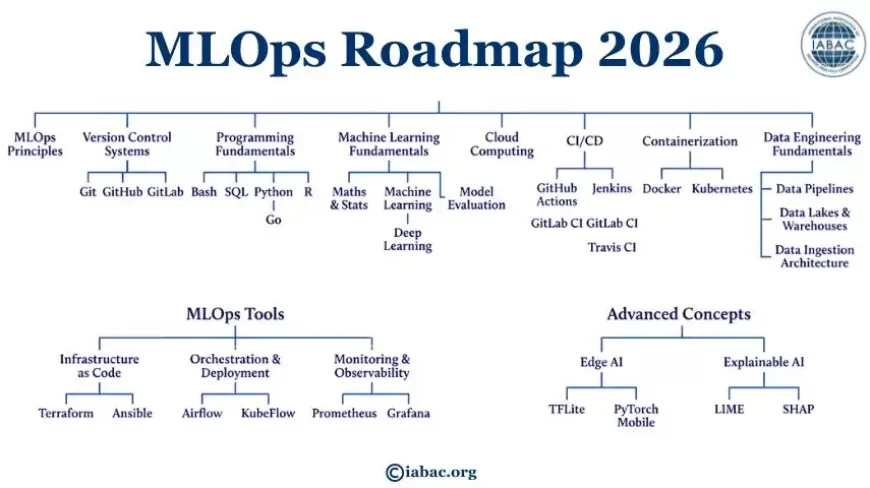
A practical learning path for MLOps in 2026 could look like this:
Start with:
- Python and SQL
- Git and GitHub
- Machine learning basics
- Docker
- Cloud computing
- CI/CD concepts
- Kubernetes
- Data engineering basics
- Terraform and Ansible
- Airflow and Kubeflow
- Monitoring tools
- Explainable AI
- Edge AI
Finally, move into:
- End-to-end MLOps projects
- Production-ready deployment workflows
- Real-world model monitoring systems
This sequence helps you build knowledge gradually instead of trying to learn everything at once.
MLOps Projects for Practice
The best way to learn MLOps is by building real projects.
Beginner Projects
- Deploy a model using Flask
- Build a Dockerized ML application
- Create a GitHub Actions deployment pipeline
Intermediate Projects
- Automated training pipeline
- Airflow-based workflow automation
- Kubernetes deployment for a model
Advanced Projects
- Real-time prediction system using Kafka
- End-to-end MLOps platform
- Multi-cloud ML deployment
- Model monitoring dashboard
These projects help you apply your skills and build a portfolio that shows real capability.
MLOps Career Opportunities in 2026
MLOps skills can lead to many different job roles, such as:
- MLOps Engineer
- Machine Learning Engineer
- AI Infrastructure Engineer
- Platform Engineer
- DevOps Engineer
- Cloud Engineer
- Data Engineer
- AI Operations Specialist
Industries Hiring MLOps Professionals
- Banking
- Healthcare
- Retail
- Manufacturing
- Telecommunications
- E-commerce
- Artificial Intelligence companies
Because MLOps connects many technical areas, it opens the door to several career directions.
MLOps is no longer an optional skill in the AI industry. As more companies move machine learning from research to production, they need professionals who can manage the full lifecycle of AI systems. To build a strong MLOps career in 2026, focus on learning step by step. Start with programming and machine learning fundamentals, then move into cloud computing, containerization, CI/CD, orchestration, monitoring, and explainable AI. Along the way, build projects that reflect real production use cases. With the right roadmap and consistent practice, you can develop the skills needed to work on modern AI systems and grow into a successful MLOps professional.