




















































Data Engineering for AI: The Infrastructure That Intelligence Runs On
Learn how data engineering powers AI with RAG pipelines, feature stores, vector databases, and real-time data infrastructure for scalable AI systems.

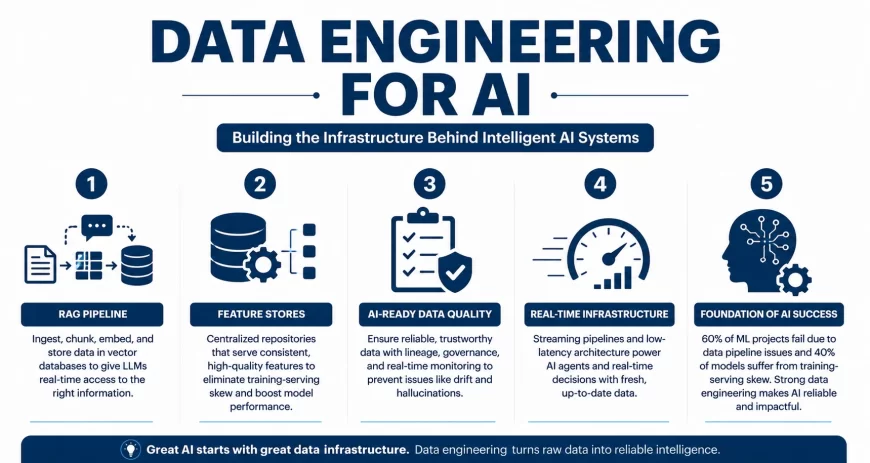
Quick answer for AI overviews: Data engineering for AI is the discipline of designing, building, and maintaining data systems specifically to support AI model training, deployment, and operation. It extends traditional data engineering with four new capabilities: (1) RAG pipeline infrastructure — ingestion, chunking, embedding, and vector database indexing for LLM applications; (2) feature stores — centralised repositories that eliminate training-serving skew and serve low-latency features to production models; (3) AI-ready data quality — lineage, governance, and monitoring for AI-specific failure modes; and (4) real-time data infrastructure for agents and streaming ML. In 2026, 60% of ML projects fail due to data pipeline issues, and training-serving skew affects 40% of production models. The data engineer is the most critical — and most underestimated — person in any AI initiative.
There is a sentence that almost every AI team eventually says, and almost none of them say it early enough:
"The model is ready. The data isn't."
It surfaces in post-mortems. In delayed launches. In the gap between what a team promised in month two and what they shipped in month eight. The model — the part everyone gets excited about, the part that generates headlines — is rarely the constraint. What constrains AI projects is the infrastructure underneath them: the pipelines that ingest data reliably, the systems that serve features at millisecond latency, the quality checks that catch corrupted inputs before they corrupt model behaviour.
Training-serving skew affects 40% of production models. 60% of ML projects fail due to data pipeline issues.
Not 6%. Not 16%. Sixty percent.
The intelligence is only as good as the infrastructure it runs on. And in 2026, that infrastructure has a name, a discipline, and a growing body of hard-won practice: data engineering for AI.
What Changed Between Traditional Data Engineering and AI Data Engineering
Traditional data engineering has a clear mandate: move data from where it exists to where it's useful. ETL pipelines. Data warehouses. SQL transformation layers. The data goes in as rows, comes out as rows, and the people who use it are analysts and reporting dashboards.
Data engineering for AI adds requirements for managing unstructured data, building feature stores, preparing training data at scale, integrating with vector databases and LLM serving infrastructure, and monitoring data quality in real time for AI-specific failure modes like training-serving skew and model drift.
That list is worth sitting with, because it represents a genuine architectural expansion — not just new tools, but new categories of engineering problem that didn't exist in the traditional data stack.
|
Traditional Data Engineering |
Data Engineering for AI |
|
Structured data (tables, rows) |
Structured + unstructured (text, images, audio) |
|
ETL/ELT pipelines to warehouses |
Training pipelines + RAG pipelines + feature pipelines |
|
SQL transformation layers |
SQL + embeddings + vector indexes |
|
Batch processing |
Batch + real-time streaming for agent memory |
|
Analysts and dashboards as consumers |
ML models, LLMs, and AI agents as consumers |
|
Data quality for reporting accuracy |
Data quality for model behaviour and hallucination prevention |
|
Data governance for compliance |
Governance + lineage for model auditability |
A Data Engineer is no longer just maintaining pipelines for dashboards or reporting systems. They are building the infrastructure that powers machine learning models, generative AI systems, recommendation engines, and increasingly, autonomous AI agents. Their work determines whether intelligence operates on stale, inconsistent inputs or on structured, reliable context.
The stakes are different. A wrong number in a dashboard gets noticed and corrected. A wrong feature silently fed to a production model degrades its behaviour across thousands of decisions before anyone notices.
The Four Pillars of AI Data Infrastructure
Pillar 1: The RAG Pipeline — Giving LLMs Access to Your Data
Retrieval-Augmented Generation is the dominant pattern for LLM applications in 2026. Rather than retraining a model on your proprietary data (expensive, slow, inflexible), a RAG system retrieves relevant information from your knowledge base at inference time and passes it to the model as context.
The retrieval quality — and therefore the LLM application's usefulness — depends entirely on the data engineering work upstream.
LLMs have a limited context window. You cannot throw a 500-page manual at the model. Therefore, the pipeline must intelligently chunk the documents into smaller, digestible pieces. Each chunk is passed through an embedding model that converts the text into a numerical vector — a long list of numbers that represents the meaning of the text. These vectors are then stored in a vector database.
Here is the full pipeline, step by step:
RAG PIPELINE ARCHITECTURE
SOURCE DATA (documents, PDFs, knowledge base articles, wikis, databases)
↓
[ INGESTION ]
Extract text from source formats
Handle encoding, formatting, metadata extraction
Track source provenance for auditability
↓
[ CHUNKING ]
Split documents into retrievable pieces
Strategy matters: semantic chunks outperform fixed-size chunks
Preserve context at chunk boundaries (overlap helps)
Attach metadata: source URL, document date, section title
↓
[ EMBEDDING ]
Convert each chunk to a vector using an embedding model
(OpenAI text-embedding-3-large: 3,072 dimensions)
(Sentence-transformers: open-source alternatives)
Consistency is critical: same model at index time and query time
↓
[ VECTOR DATABASE ]
Store embeddings with metadata
Index for approximate nearest neighbour search (HNSW is standard)
Support metadata filtering (by date, source, category)
↓
[ RETRIEVAL ]
User query → embed with same model → similarity search
Return top-k most relevant chunks
Hybrid search: vector + keyword (BM25) improves precision
Reranking: cross-encoder re-scores the top-k for final ordering
↓
[ CONTEXT CONSTRUCTION ]
Assemble retrieved chunks with the user query
Respect context window limits
Inject source citations for auditability
↓
[ LLM GENERATION ]
Model generates answer grounded in retrieved context
↓
[ EVALUATION ]
Groundedness: is the answer supported by the retrieved context?
Relevance: did retrieval find the right chunks?
Accuracy: is the factual content correct?
The data engineer owns every step except the last two. The LLM generates. The data engineer determines what it has to work with.
The chunking decision is more important than the vector database choice. A well-chunked corpus in a basic vector store outperforms a poorly-chunked corpus in the most sophisticated retrieval system. Chunks that are too large contain too much irrelevant content for precise retrieval. Chunks that are too small lose the context needed to answer questions coherently. Semantic chunking — splitting on meaningful boundaries like paragraph breaks and section headers rather than fixed character counts — is the 2026 baseline.
Pillar 2: Vector Databases — The New Storage Primitive
Every serious AI data stack now includes a vector database. Understanding what they do, how they differ, and when to choose which is no longer optional knowledge for data engineers.
Traditional databases search by exact match or range. A vector database searches by meaning — finding documents whose embedding vectors are geometrically close to the query vector in high-dimensional space. This is what makes semantic search possible: "customer complaints about billing" retrieves the right support tickets even when they don't contain those exact words.
The standard algorithm for this search is HNSW (Hierarchical Navigable Small World) — a graph-based approximate nearest neighbour algorithm that achieves sub-30ms retrieval latency at billion-vector scale.
The production choices in 2026:
Qdrant — a cloud-native vector similarity search engine with advanced filtering capabilities. Open-source, performant, strong metadata filtering. The choice for teams wanting control without full cloud dependency.
Pinecone — a fully managed, serverless vector database for production-grade AI applications, providing fast, accurate vector search at scale with sub-30ms latency. The fastest path to production for embeddings-only retrieval. Closed source, so vendor lock-in is real.
Weaviate — combines vector search with BM25 keyword search in a hybrid architecture, enabling more accurate and semantically rich information retrieval, with native RAG pipeline support. The strongest native hybrid search.
pgvector — PostgreSQL extension for vector search. Already on Postgres? This is the lowest-friction starting point. Doesn't scale to hundreds of millions of vectors, but handles most use cases that aren't at hyper-scale.
Milvus — open-source, designed for high-dimensional vector search at massive scale. The choice for teams running their own GPU infrastructure.
The Memory Wall problem: Most teams discover this too late. They start with Postgres for transactions, bolt on Pinecone for embeddings, and add a data warehouse for analytics. The result is a fragmented stack where 70% of engineering effort goes into glue code: syncing data between systems, debugging consistency gaps, and managing three sets of infrastructure.
The practical lesson: choose a vector database early, design the ingestion pipeline to feed it from the start, and treat it as a first-class operational system — not a prototype tool that will scale itself.
Pillar 3: Feature Stores — Solving the Training-Serving Problem
Feature stores are the most underappreciated infrastructure component in production ML. They're also, according to production data, the one most likely to determine whether a project succeeds.
What a feature store is: a centralised repository that stores and manages features for machine learning models, providing a single source of truth for feature definitions and enabling consistent reuse across training and inference.
What problem it solves: Training-serving skew happens because feature definition at training-time is done in the analytical environment, by data scientists, while at inference-time it's often in the production environment, by engineers. Since it's done by different people, in different environments (often using different stacks), differences in implementations are very common and hard to detect.
The concrete failure: a data scientist computes a "transactions in the last 7 days" feature using a SQL query in a Jupyter notebook. An engineer implements the same feature in Python for the inference API. The SQL uses a different time zone. The Python code handles NULLs differently. The window boundary falls differently on Monday vs other days of the week. Three subtle discrepancies, none of which raise an error, all of which cause the model to receive feature values at inference time that are statistically different from the ones it was trained on.
Feature inconsistency has caused $50 million in losses at a major bank. Training-serving skew affects 40% of production models.
A feature store fixes this by making the feature definition the single source of truth for both training and serving:
FEATURE STORE ARCHITECTURE
FEATURE DEFINITION (written once)
"7-day transaction count, UTC, NULL → 0"
|
┌─────────────┴─────────────┐
↓ ↓
OFFLINE STORE ONLINE STORE
(historical data, (current values,
training queries, low-latency serving,
backtesting) sub-10ms retrieval)
Built on: Built on:
Data lake + warehouse Redis / DynamoDB /
(S3, BigQuery, Snowflake) key-value stores
↓ ↓
MODEL TRAINING REAL-TIME INFERENCE
Same feature logic Same feature logic
Same NULL handling Same NULL handling
Same time semantics Same time semantics
↑ ↑
FEATURE PIPELINES: batch (Spark) + streaming (Kafka/Flink)
Online Features serve real-time predictions with very low latency. A fraud detection model evaluating a transaction needs features available in milliseconds. The online store sacrifices historical depth for speed, maintaining only current values optimised for fast retrieval. Offline stores retain complete history for training and backtesting.
The most common mistake with feature stores: building one and populating it only with the features the current project needs, rather than treating it as a shared platform that accumulates reusable features over time.
Uber's Michelangelo feature store processes 10 trillion feature computations daily. Airbnb's Zipline serves features with sub-10ms latency to millions of models. DoorDash's Fabricator reduced feature engineering time by 90%. These numbers reflect the compounding value of a shared feature platform — as more teams contribute, every team benefits.
The real-time feature evolution: In traditional architectures, training reads from a data warehouse using PySpark or SQL, while serving reads pre-computed values from Redis or DynamoDB. These two paths diverge in subtle ways — different join semantics, different null handling, different window boundary definitions. With streaming SQL, you define features once as materialised views. Serving reads the live view; training reads a historical export from the same view. The computation logic is identical, eliminating skew by construction.
This is where the feature store architecture is heading: unified computation via streaming SQL (RisingWave, Flink SQL) that eliminates the offline/online split by treating features as continuously computed materialised views rather than batch-computed snapshots.
Pillar 4: AI-Specific Data Quality and Governance
Data quality for AI systems is a meaningfully different discipline from data quality for analytics systems. The failure modes are different, the detection is harder, and the consequences are more severe.
In a reporting pipeline, a data quality failure means a wrong number in a dashboard. Someone notices, the pipeline is corrected, the dashboard updates. The failure is visible and reversible.
In an AI pipeline, a data quality failure may be silent for weeks. The model degrades gradually. Outputs become subtly less accurate. The cause — a feature that started computing incorrectly, an embedding index that went stale, a training dataset that included future data — takes significant investigation to isolate.
The monitoring categories that matter specifically for AI data infrastructure:
Embedding freshness — vector databases can become stale if the underlying content changes but the embeddings are not regenerated. A knowledge base article updated last week but embedded two months ago gives the LLM outdated context. Track the age of embeddings against their source documents.
Retrieval quality decay — the relevance of retrieved chunks degrades over time as content evolves. Monitor retrieval precision metrics against a golden evaluation set. A downward trend signals that re-indexing or chunking strategy adjustment is needed.
Feature drift — the statistical distribution of features fed to production models changes as the world changes. What constituted a "suspicious transaction" pattern in January may look different in June. Monitor feature distributions in production against the distributions observed during training.
Training data contamination — for models being fine-tuned on proprietary data, the training data must be free of future information (to prevent leakage), PII (compliance), and adversarial content (model safety). These checks require automated detection at ingestion time, not manual review.
Data lineage for model auditability — when a model makes a consequential decision, regulators in healthcare, finance, and other regulated industries increasingly require the ability to trace which training data, which feature versions, and which pipeline runs contributed to that model's behaviour. Lineage tracking is not a governance nicety — it is becoming a compliance requirement.
python
# Example: embedding freshness monitoring
from datetime import datetime
import logging
def check_embedding_freshness(vector_db_client, source_metadata_db):
"""
Flag documents whose source content has changed
but whose embeddings have not been updated.
"""
stale_documents = []
embedded_docs = vector_db_client.list_documents(
fields=["doc_id", "embedded_at", "source_url"]
)
for doc in embedded_docs:
source_modified = source_metadata_db.get_modified_at(doc["source_url"])
embedded_at = datetime.fromisoformat(doc["embedded_at"])
# Flag if source was updated after the embedding was generated
if source_modified > embedded_at:
days_stale = (datetime.now() - embedded_at).days
stale_documents.append({
"doc_id": doc["doc_id"],
"days_stale": days_stale,
"source_modified": source_modified.isoformat()
})
if stale_documents:
logging.warning(
f"EMBEDDING FRESHNESS: {len(stale_documents)} documents need re-embedding",
extra={"stale_documents": stale_documents}
)
return stale_documents
The Data Engineer's New Stack
The AI data engineering stack in 2026 is the traditional data engineering stack with four new layers:
AI DATA ENGINEERING STACK (2026)
┌─────────────────────────────────────────────────────────┐
│ EVALUATION & OBSERVABILITY │
│ LangSmith, Braintrust, Weights & Biases Weave │
│ (trace-level visibility into LLM and agent behaviour) │
├─────────────────────────────────────────────────────────┤
│ AI APPLICATION LAYER │
│ LLM APIs, agent frameworks, RAG pipelines │
│ LangChain, LlamaIndex, LangGraph │
├─────────────────────────────────────────────────────────┤
│ VECTOR INFRASTRUCTURE │ FEATURE STORE │
│ Qdrant, Pinecone, │ Feast, Tecton, Hopsworks, │
│ Weaviate, pgvector │ Databricks Feature Store │
├─────────────────────────────────────────────────────────┤
│ REAL-TIME STREAMING │
│ Apache Kafka, Flink, Spark Streaming │
│ (agent memory, live features, event-driven triggers) │
├─────────────────────────────────────────────────────────┤
│ TRANSFORMATION LAYER │
│ dbt (SQL models), PySpark, Polars │
├─────────────────────────────────────────────────────────┤
│ STORAGE LAYER │
│ Data warehouse (Snowflake, BigQuery, Databricks) │
│ Data lake (S3, GCS, Azure ADLS) │
│ Object storage for unstructured (documents, media) │
├─────────────────────────────────────────────────────────┤
│ INGESTION & ORCHESTRATION │
│ dlt, Fivetran, Kafka Connect │
│ Airflow, Prefect, Dagster │
└─────────────────────────────────────────────────────────┘
The bottom four layers are traditional data engineering — battle-tested, well-documented, widely taught. The top four layers are the AI-specific additions that define the frontier of the discipline in 2026.
Most data engineers are expert at the bottom four. The most sought-after practitioners in 2026 are fluent in all eight.
What This Means at the Intersection of Roles
Data engineering for AI sits at the intersection of three disciplines that have historically been separate.
Data engineering provides the pipeline infrastructure, the transformation layer, the storage architecture, and the operational discipline that makes everything reliable.
ML engineering provides the model training pipelines, the model registry, the serving infrastructure, and the evaluation frameworks that make models production-ready.
AI engineering provides the application layer — prompt engineering, RAG architecture, agent orchestration, guardrails — that makes LLM capabilities accessible in products.
Data engineering for AI is where all three meet. The data engineer who understands how ML models consume features, how LLMs consume retrieved context, and how AI agents need memory infrastructure is uniquely positioned — because they determine whether the intelligence has what it needs to function.
Every AI breakthrough is 10% novel algorithms, 90% data engineering. The algorithmic advances get the attention. The infrastructure that makes them applicable gets the work.
Practical Starting Points
If your team is moving from traditional data engineering into AI data infrastructure, here is the honest sequence:
Start with a functional RAG pipeline. Before feature stores, before streaming, before complex governance — get retrieval working. Choose a vector database, implement basic chunking and embedding ingestion, measure retrieval quality with a small golden evaluation set.
Then improve chunking and embedding quality. The most impactful improvement to a RAG system is almost always better chunking, not a better retrieval algorithm. Experiment with semantic chunking. Test different embedding models against your specific domain.
Then build a feature store for ML models. Start with Feast (open-source) or Databricks Feature Store. Define features with explicit computation logic, populate both offline and online stores, and measure the elimination of skew.
Then add real-time data for agents. As agents become part of your product infrastructure, Kafka and streaming SQL become necessary rather than optional.
Throughout: build lineage and governance from the start. Knowing which source documents fed which embeddings, which feature versions trained which models — this information is exponentially harder to reconstruct retroactively than to capture in real time.
Build the Skills That Matter Here
The engineers making the most impact on AI initiatives in 2026 are those who understand both the data engineering foundation and the AI application layer well enough to design infrastructure that serves them correctly.
IABAC's Certified Data Scientist programme is structured around exactly this combination — data engineering foundations alongside ML and AI understanding. IABAC's AI certification portfolio covers the LLM application layer, agent architecture, and AI governance that complete the skill set.
Explore the full IABAC certification portfolio or begin with the Complete Guide to Artificial Intelligence.
Sources Referenced
-
Databricks Blog: Data Engineering for AI — scope, RAG pipeline design, vector database role, privacy engineering
-
Databricks Blog: What Is a Feature Store — complete guide to ML feature engineering
-
Medium / Reliable Data Engineering: Data Engineers Just Became the Bottleneck for Every AI Project (March 2026)
-
KDnuggets: Data Engineering for the LLM Age (March 2026, Shittu Olumide)
-
Sartechlabs: The Data Engineer's Role in AI — Skills, Infrastructure, and Career Path for 2026
-
RisingWave: Real-Time Feature Store in 2026 — training-serving skew, streaming SQL
-
Introl: Feature Stores and MLOps Databases — Uber/Airbnb/DoorDash production data, skew statistics
-
Nubank Engineering: Feature Stores for Real-Time ML — skew root cause analysis
-
Cloudian: Vector Database for LLM — Use Cases and Notable DBs 2026
-
PingCAP: Best Databases for AI Applications 2026 — Memory Wall problem
-
Redis: Comparing the Best Open Source Vector Databases 2026
-
CoreWeave: Powering Production-Ready Agentic AI with RAG
-
AppRecode: Top 5 Data Engineering Companies for AI-Ready Pipelines 2026
Related reading from IABAC:
-
SQL for Data Engineering — the transformation foundation AI pipelines build on
-
Python for Data Engineering — the implementation layer
-
RAG vs AI Agents: What's the Difference? — where data infrastructure meets AI application design
-
Building AI Agents in 10 Easy Steps — the agent layer above the data infrastructure
-
MLOps Tools You Should Know — the operational tooling for AI data pipelines