
























































IABAC vs Google Analytics: Which Certification Is Right for You?
IABAC and Google Analytics certifications to find the right fit for your career goals, skills, and professional growth needs.

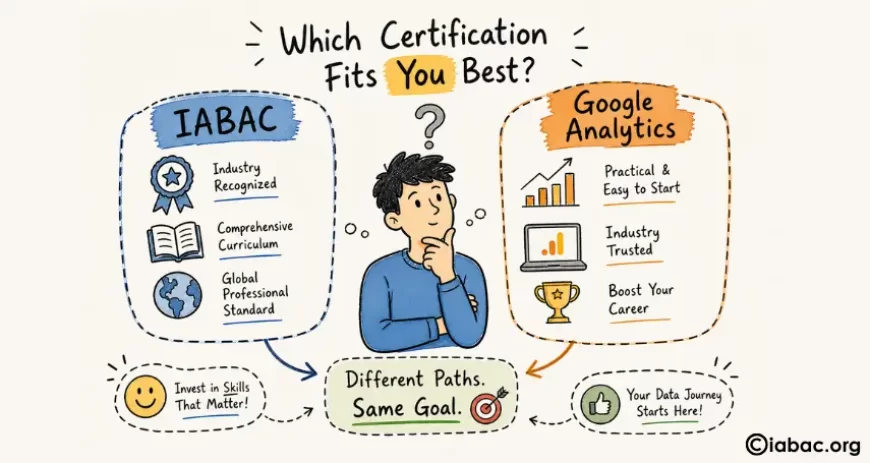
When comparing IABAC vs Google Analytics certifications, the difference isn't just curriculum, it's philosophy. The Google Data Analytics Professional Certificate is engineered for speed: build foundational skills, produce a portfolio piece, land a first analyst role. IABAC's analytics certifications are built around something else entirely: a structured competency framework backed by the European Commission's Edison® Data Science standard, designed to validate professional-level skills rather than introduce them. Both are legitimate credentials. But choosing the wrong one for your career stage may cost you time, money, and momentum, depending on where you are professionally and where you're headed.
This data analyst certificate comparison cuts through the noise. You'll get a clear breakdown of curriculum depth, real costs, employer recognition, hands-on outcomes, and a direct answer on which credential fits which career profile. No diplomatic "it depends." Just the information you need to choose well.
What each program actually teaches
IABAC's curriculum: analytics theory meets competency depth
IABAC's data analytics certification covers the full analytical stack: the CRISP-DM model, all four analytics types (descriptive, diagnostic, predictive, and prescriptive), univariate and bivariate analysis, regression, correlation, and statistical thinking applied to real business problems. The curriculum isn't just a list of topics. It's mapped to the Edison® Data Science Framework's competency levels, which means completing it demonstrates mastery at a defined, government-recognized professional standard rather than just finishing a course sequence.
Broader IABAC tracks extend further into machine learning concepts, data ethics, BI tools, and domain-specific applications depending on the specialization you choose. The program is structured around assessed competency, so the credential you earn reflects what you can do, not just what you completed.
Google's 8-course approach: workflow first, tools second
Google's program follows a fixed eight-course sequence: from asking good business questions through data cleaning, SQL querying, R programming, visualization in Tableau, and a capstone case study. The structure is consistent, well-paced, and clearly designed to produce a job-ready analyst who can handle the day-to-day workflow of an entry-level role.
The practical tool exposure is real and valuable. You'll leave with hands-on experience in spreadsheets, SQL, R, and data storytelling. Statistical depth is moderate, machine learning is barely touched, and the credential reflects course completion rather than assessed competency. For its intended audience, that's not a flaw; it's the design.
Cost and time: what you're actually committing to
Breaking down IABAC's fee structure
IABAC's upfront cost typically runs between ₹18,000 and ₹25,000 when you combine the exam fee (₹8,000 to ₹15,000) with training costs (₹10,000 and up), figures you can verify directly on IABAC's program pages at iabac.org. That's a higher initial investment than Google's certificate in most cases. The ongoing cost structure is different, however: certification renewal carries no cash fee. Instead, IABAC requires 30 CPD credits over its renewal cycle, meaning the commitment to staying current is about professional development rather than recurring payments. Check IABAC's current renewal terms for the precise CPD reporting window that applies to your certification level.
For professionals who plan to hold and use the credential long-term, this model works in their favor. The upfront cost is higher, but maintaining the credential is built into the expectation of ongoing learning, not a subscription bill.
IABAC vs Google Analytics: what each credential actually costs over time
Coursera charges approximately $49 USD per month for access to the Google Data Analytics Professional Certificate in the US; confirm current pricing on Coursera's program page for the Google Data Analytics Professional Certificate, as rates are localized. Total cost depends entirely on how quickly you finish. Complete it in one month and you've spent $49. Stretch it to six months and you're at $294. Most learners working around ten hours per week finish in three to six months, putting the realistic cost range between $147 and $294.
Google's certificate is cheaper if you move quickly. That's a genuine advantage for career switchers on a tight budget who need to validate foundational skills fast. The trade-off is credential depth and long-term portability, which matters more the further you advance.
Recognition, accreditation, and global portability
Google's name recognition in entry-level job postings
Google's certificate carries stronger brand recognition in mainstream US entry-level data analyst job postings. Employers recognize it as a signal of foundational analytics training and entry-level readiness, and Google's employer consortium, which connects certificate graduates to hiring pipelines through a network of participating companies, provides real pipeline access. That visibility is a genuine advantage for someone entering the field with no prior analytics experience.
The honest caveat: neither certificate alone drives hiring decisions. According to workforce analytics research, US employers consistently weigh SQL proficiency, portfolio projects, and real-world experience more heavily than any single certificate. The Google credential opens doors; it doesn't guarantee what's behind them.
Why IABAC's Edison® alignment changes the portability equation
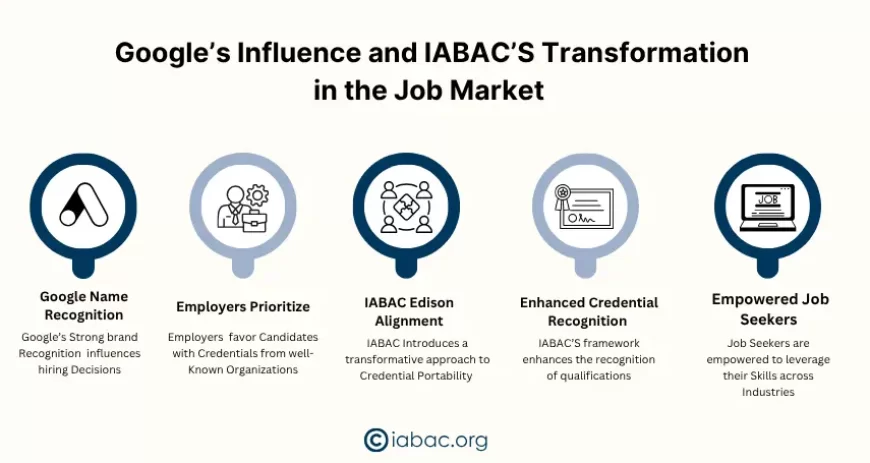
This is where the comparison shifts. IABAC's certification framework is tied to the European Commission's Edison® Data Science standard and the European Qualifications Framework (EQF), a mapping documented on IABAC's official site and in published EDISON Data Competences resources. That gives it a government-backed competency structure that vendor-issued certificates, including Google's, simply don't carry. For professionals working in multinational organizations, targeting roles across markets, or building credentials with international reach, this distinction is meaningful.
Google's certificate signals "this person completed Google's analytics curriculum." IABAC's credential signals "this person demonstrated competency at a defined level within a recognized international framework." Those are fundamentally different professional signals. IABAC's Authorized Training Partner and Accredited Corporate Partner networks, spanning universities, corporates, and training institutions globally, further reinforce the institutional credibility behind the credential. For professionals who need their certifications to travel beyond the US job market, IABAC's framework portability offers structural advantages that course-completion certificates are not architecturally built to provide.
Hands-on experience and what you walk away with
Google's capstone and portfolio output
Google requires a full end-to-end case study as a capstone, as outlined in the program's Course 8 description. You ask a business question, prepare and clean data, analyze it, build visualizations, and present findings as a business recommendation. The result is a concrete, portfolio-ready artifact, typically a published case study or GitHub-hosted analysis, that demonstrates the analyst workflow to a prospective employer. This is Google's clearest practical advantage, especially for candidates who have no prior analytics work to show. For official details on the certificate and its intended outcomes, see Google's Data Analytics certificate page.
Portfolio pieces matter enormously at the entry level. Many candidates without formal experience struggle to show employers what they can do. Google's capstone structure addresses that problem directly, which explains much of its appeal for career switchers.
IABAC's assessment model and what the credential actually certifies
IABAC uses a rigorous, proctored assessment process rather than a course-completion model. You earn the credential by demonstrating competency at a defined framework level, not by finishing modules. For mid-career professionals or domain specialists formalizing their existing expertise, this distinction can carry significant weight in enterprise hiring and academic contexts where assessed credentials are expected over completion-based ones.
IABAC also offers domain-specific certification tracks covering Finance, Healthcare, HR, Marketing, Manufacturing, and more. A healthcare administrator or finance manager can earn a credential that directly validates their ability to apply analytics within their field, rather than holding a generic certificate disconnected from their professional context. Fewer general-purpose certificate programs include formally assessed, domain-specific tracks mapped to a recognized competency framework, and that specificity is a meaningful differentiator for working professionals. For further reading on business-focused credential pathways, see the IABAC overview on business analytics careers and certification.
Choosing the right credential for your career goals
When Google Data Analytics is the right starting point
Google's certificate makes the most sense for career switchers with no analytics background, recent graduates who need an affordable entry point quickly, and professionals building foundational tool skills in spreadsheets, SQL, and R. If your primary goal is to land a first analyst role with a recognized signal and a portfolio piece to show, Google delivers that pathway efficiently.
The program is also well-suited for professionals who want to test whether analytics is the right direction before committing to a deeper credential path. At under $300, the financial risk is low and the practical output is tangible. If you're still deciding which credential aligns with your timeline and experience, IABAC's guidance article on choosing the right data analytics certification is a helpful next step.
When IABAC is the stronger long-term investment
IABAC is the better fit for mid-career professionals formalizing their expertise, domain specialists seeking role-specific AI and analytics credentials, and anyone building a professional profile with international reach. The Edison® framework alignment connects the certification to a recognized competency standard, not just a course curriculum. That matters in senior hiring, enterprise L&D programs, and global academic environments where credential structure is evaluated seriously.
For professionals at multinationals operating across multiple markets, holding a credential that maps to a recognized European Qualifications Framework level represents a different category of professional signal than a vendor-issued certificate, particularly in regions where EQF alignment carries institutional weight. IABAC's certification also scales with your career: as you move into advanced specializations or management-level analytics roles, the framework-based credentialing path grows with you in a way that a course-completion certificate, by design, does not. For more on careers, certification pathways, and learning, see IABAC's Careers, Certification & Learning overview.
IABAC vs Google Analytics, which fits your career?
If you're entering analytics for the first time and need a fast, affordable credential with practical tool skills and a portfolio piece, Google Data Analytics is a solid starting point. It delivers what it promises: foundational analyst readiness with real brand recognition in the US job market.
If you're a working professional, a domain specialist, or someone building credentials with serious long-term value, IABAC offers something qualitatively different: a structured, globally portable credential backed by a government-recognized competency framework. The upfront investment is higher. The credential depth, institutional credibility, and international portability are higher too. Those aren't comparable trade-offs; they're different tools for different career stages.
In the IABAC vs Google Analytics decision, the right answer comes down to where you stand today and how far you need your credential to reach. IABAC's certifications are built for professionals who want more than a certificate, they want a career credential that scales across roles, markets, and years. If that's the profile you're building toward, IABAC publishes its full certification tracks and Edison® framework mapping at iabac.org. The credential you earn now should still be opening doors for you a decade from now.