














































Best AI Certifications for Managers Without Coding Skills
The best AI certifications for managers without coding skills. Explore beginner-friendly programs for leadership and career growth.

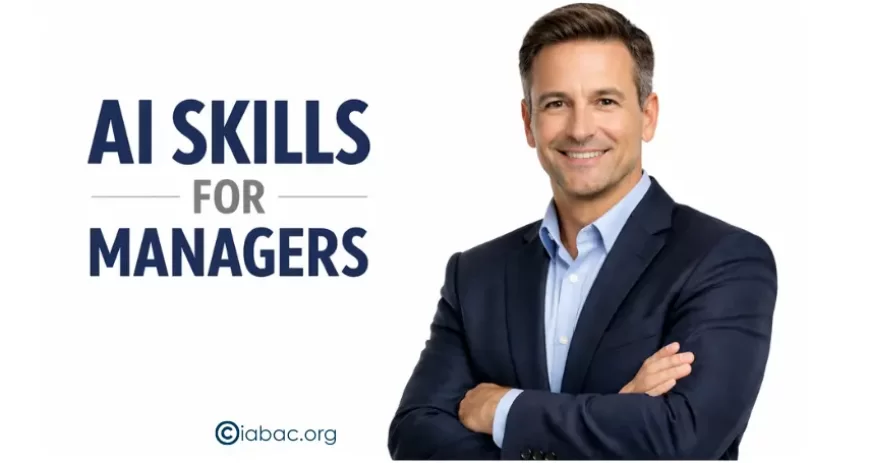
Most AI certification programs are built for engineers and developers, not for the managers who actually decide where AI gets deployed, how vendors get evaluated, and whether adoption goes responsibly or sideways. If you've started researching credentials and found yourself buried in Python tutorials and neural network diagrams, the programs are the problem, not you. AI certifications for managers exist precisely to close this gap, and the strongest ones are built around decisions, not code.
The assumption that you need programming skills to earn a credible AI credential is wrong, and it's costing managers real career leverage. There are structured, assessment-based programs built specifically around the decisions managers actually make: where to deploy AI, how to evaluate vendor proposals, how to govern adoption responsibly, and how to measure ROI on AI investments. Several of these programs, including IABAC's manager-focused certification aligned with the EU Edison® Data Science Framework, carry genuine employer recognition and verifiable credentialing.
This article covers the strongest options available in 2026, what each one actually proves, how they're assessed, and how to match the right credential to your specific role and career stage.
What AI competency for managers actually looks like
The skills that matter when you don't write code
AI competency for a manager has nothing to do with building neural networks. It's about understanding what AI systems can and can't do, identifying where AI creates business value in your specific domain, and making informed decisions about adoption, risk, and governance. A strong certification validates exactly these capabilities, not your ability to tune a model.
The competency domains that matter most are decision-support literacy, AI ethics and governance, use-case evaluation, and stakeholder communication around AI initiatives. These are the skills that separate managers who can lead AI transformations from those who can only observe them. The EU Edison® Data Science Framework, developed as part of a European Commission-backed academic initiative, formalizes these domains across five proficiency levels, from foundational understanding through management and strategist-level expertise, giving certified managers a recognized vocabulary for describing what they know.
Why most generic AI courses fall short
The market is flooded with introductory AI content, but introductory isn't the same as manager-ready. A weekend course explaining what machine learning is rarely covers the applied judgment needed to evaluate an AI vendor proposal, set meaningful KPIs for an AI initiative, or lead a team through a responsible rollout. The programs worth your time are built around applied decision-making, not concept memorization.
The key distinction is between a completion certificate and a proctored credential. Completing a course proves you watched the material. Passing a proctored, competency-based assessment proves you understood it well enough to apply it under examination conditions. Employers and hiring managers increasingly recognize this difference, and it matters when you're competing for roles that require credible AI leadership rather than basic awareness.
Top AI Certifications for Managers in 2026
IABAC Certified AI Professional: the framework-aligned standout
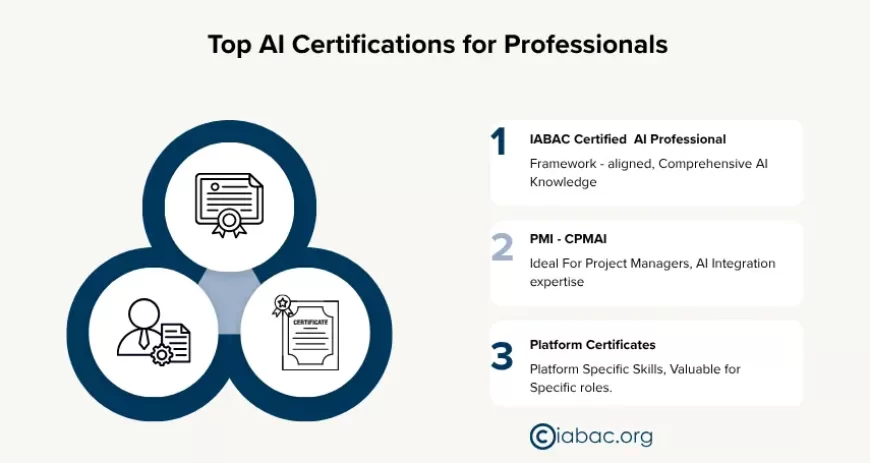
IABAC's AI certification for managers is aligned with the EU Edison® Data Science Framework, a competency standard developed as part of a European Commission-backed initiative. That alignment matters because the credential maps to a structured, externally referenced skill taxonomy rather than a proprietary rubric that an individual vendor created. The program covers AI strategy, data ethics, model governance, and business decision support, tested through a formal proctored assessment.
IABAC's Edison® alignment is among the strongest differentiators in this comparison. For managers in multinational organizations, or those seeking a credential with genuine global portability, this is a highly substantive option. The competency language the Edison® framework provides is recognized in hiring and procurement conversations across North America, Europe, and APAC, which reduces translation friction when credentials need to travel across markets.
PMI-CPMAI: the strongest choice for project and program managers
The PMI Certified Professional in Managing AI is the most targeted option for project and program managers who govern AI project delivery. It addresses AI lifecycle management, risk assessment, stakeholder communication, and adoption frameworks from a delivery perspective. At $699 for PMI members and $899 for non-members, it carries a premium price, but it earns the brand recognition PMI commands in project-heavy industries and regulated sectors.
PMI-CPMAI is worth serious consideration if your daily work centers on managing AI transformation timelines, cross-functional team coordination, and delivery governance. It sits alongside an existing PMP rather than replacing it, and it's built for managers who need structured governance language around AI project delivery rather than general AI fluency.
Platform certificates worth knowing
Google AI Essentials, AWS Certified AI Practitioner ($100), and Microsoft Azure AI Fundamentals (AI-900, $99) are accessible entry points for managers working inside organizations standardized on those platforms. Each covers AI fundamentals, responsible AI principles, and practical use cases without requiring programming skills. Preparation typically takes between 6 and 20 hours depending on prior exposure, making them achievable alongside a full management schedule.
Their value is real but bounded. These credentials build platform literacy, not independent AI management judgment. They work well as complements to a competency-mapped credential like IABAC's, not as standalone career investments for managers seeking serious advancement. If you earn one, treat it as a foundation layer, not the primary credential on your resume.
Which credential fits your specific management role
Product managers and program managers
Product managers need to evaluate AI features, write AI-informed requirements, and work credibly alongside engineering teams. An AI certification program for product managers like IABAC's AI Certified Executive Program covers the strategic and governance dimensions most relevant to that work: use-case evaluation, AI ethics, business value framing, and data-driven decision support. Complementary training options aimed specifically at product roles include the IBM AI Product Manager Professional Certificate and recognized product credentials such as the Pragmatic Institute Product Management Certification.
These two credentials serve different functions. A product manager asked "should we build this AI feature and what should it accomplish?" is solving a different problem than a program manager asking "how do we deliver this AI initiative on time and within governance requirements?" The right credential depends on which question you answer most often in your current role.
L&D managers and executives
Learning and development managers overseeing AI upskilling programs need a credential that validates both AI fluency and the structured competency language required to design meaningful training pathways. A standards-backed certification like IABAC's gives L&D leaders the vocabulary to communicate training ROI to leadership and to build certification pathways that align with recognized global competency standards rather than internal rubrics with limited external currency.
IABAC also publishes practical resources for managers and L&D teams, for example the AI Skills for Everyone webinar, which discusses scalable approaches to building AI capability across an organization. For executives, the goal is strategic AI literacy: knowing enough to challenge vendor claims, set governance expectations, and align AI investments with business goals. A proctored, non-vendor credential carries more weight in the boardroom than a completion badge from a free course. Executives who hold framework-aligned credentials can engage AI transformation conversations from a position of documented competency rather than accumulated intuition alone.
How these certifications are assessed and what employers verify
Proctored exams vs. course completion badges
A completion certificate from a self-paced online course and a proctored credential from a recognized certification body are not the same thing to an employer. Proctored assessments validate that a specific individual demonstrated specific competencies under controlled conditions. When employers use verification portals to confirm a credential, they're checking for exactly this distinction, and it affects how seriously your credential is taken in a hiring conversation. For background on how verifiable credentials work in enterprise settings, see Microsoft's guidance on verifiable credentials.
IABAC uses a formal proctored assessment model, which is why its credential functions as verifiable proof of competency rather than proof of attendance. Platform certificates from Google, AWS, or Microsoft are verifiable too, but they reflect platform familiarity. In enterprise hiring and procurement contexts, HR teams and L&D directors increasingly run credential verification before advancing candidates, and framework-aligned proctored credentials consistently clear that bar.
What the EU Edison® framework actually validates
The Edison® framework defines AI and data science competency across five proficiency levels, from technical foundations through management and strategist-level expertise. When a certification aligns to this framework, each skill area maps to a defined proficiency level that employers in multinational organizations can reference directly. Your credential comes with a built-in competency language that hiring managers don't need to interpret or validate through additional screening.
This reduces friction in global job markets and enterprise procurement scenarios. If you're pursuing a senior AI leadership role in a multinational company or building credibility across markets, the Edison® alignment gives your credential a recognized reference point that vendor-issued certificates typically don't provide. It's the difference between a credential that explains itself and one that requires an explanation.
Career outcomes managers report after earning an AI credential
Organizational credibility and internal visibility
The most immediate outcome managers describe after earning a verified AI credential is credibility: the ability to walk into an AI vendor conversation, a board presentation, or a planning session and engage with documented authority. In hiring conversations, managers with structured AI credentials report being assigned to AI governance committees, task forces, and transformation steering groups more often than peers without formal AI validation. The credential signals a serious, verifiable investment in the domain.
This visibility accelerates internal mobility. Managers with AI credentials are increasingly competitive for roles labeled "AI Product Lead," "AI Transformation Manager," and "Head of AI Adoption", all of which carry compensation premiums over standard management positions. The credential opens doors that aren't accessible to managers with comparable experience but no formal AI validation.
Compensation and promotion velocity
According to the 2025 Global Knowledge IT Skills and Salary Report, certified technology professionals see salary growth in the range of 15% to 30% within 6 to 12 months of earning a credential, particularly when they apply those skills in active projects. The more consequential outcome for most managers, though, is promotion velocity. AI-credentialed managers enter leadership pipelines faster than peers in equivalent roles without credentials, and the ROI tends to show up in career progression before it shows up in base compensation adjustments.
Managers who pursue standards-backed credentials report that the structured competency language also improves how they present themselves in internal role discussions and performance reviews. They can describe what they know, at what proficiency level, in terms that HR and senior leadership can map directly to organizational needs, rather than asking decision-makers to take their word for it.
Choosing AI Certifications for Managers: a decision checklist
If you need a globally portable, framework-backed credential that validates AI management competency independent of any vendor's platform, IABAC is a strong starting point. The Edison® alignment, proctored assessment format, and domain coverage across AI strategy, governance, and business decision support make it a substantive choice for managers focused on AI leadership. If your role centers specifically on project or program delivery for AI initiatives, add PMI-CPMAI to your evaluation list. If your organization runs on AWS, Google Cloud, or Azure, a vendor-specific certificate adds useful day-to-day platform fluency, but it shouldn't replace a competency-mapped credential as your primary career investment.
These two credentials serve different functions and there are many options to compare. For a broader survey of certification options and how they map to different roles, see Upwork's guide to AI certifications. Most candidates complete the certification within six to eight weeks through structured self-study, and the proctored exam can be scheduled online at your convenience. The goal isn't to collect a badge. It's to build the specific knowledge that changes how you lead in an AI-enabled environment, and to hold a credential that proves it to every hiring manager, procurement lead, and executive sponsor who asks.
Review IABAC's certification page to explore the competency domains in their manager-focused AI program and confirm alignment with your role and industry.