











































What Is Agentic RAG and How Does It Work?
Agentic RAG uses autonomous AI agents with retrieval-augmented generation to build smarter systems that plan, retrieve, reason, and act on complex tasks.

Retrieval-augmented generation changed how AI systems access information. But as use cases grew more complex, a newer and more capable approach emerged: agentic RAG.
It takes everything RAG does well and layers autonomous reasoning on top, enabling AI systems to do far more than just fetch and generate.
Unlike traditional RAG, agentic RAG can plan across multiple steps, use external tools, evaluate its own outputs, and adapt in real time, making it a far more capable foundation for building intelligent, production-ready AI systems.
Let's see what agentic RAG is and what it is capable of.
What Is RAG, and Why Did It Need an Upgrade?
Before unpacking agentic RAG, it helps to understand what standard RAG does and where it falls short.
Traditional RAG works in a straightforward loop. A user submits a query, the system retrieves relevant documents from an external knowledge base, and a large language model (LLM) uses that retrieved context to generate a response.
This approach solved a significant limitation of LLMs: their knowledge is frozen at the time of training. By pulling in external documents at estimation time, RAG systems can answer questions about recent events, private data, or domain-specific content that the model was never trained on.
For many tasks, this works well. But standard RAG has real limitations worth noting:
- It only retrieves and generates once, and if something crucial is overlooked during the initial retrieval, it is unable to change course.
- It cannot handle tasks that require information from multiple sources to be synthesized in a specific order.
- It has no mechanism to take action based on what was retrieved.
That is where agentic RAG enters the picture.
What Is Agentic RAG?
Agentic RAG is an advanced AI architecture that combines retrieval-augmented generation with autonomous, goal-directed agents.
Instead of a single, linear retrieve-then-generate pipeline, these systems use one or more AI agents that can plan, reason, retrieve information iteratively, use tools, and take actions, all in service of completing a complex task.
The "agentic" part refers to the autonomous, multi-step reasoning behavior of the system. An AI agent in this context is not just a model generating text. It is an entity that can:
- Decide what to do next based on intermediate results
- Evaluate whether a step succeeded or needs to be retried
- Adjust its approach dynamically as the task evolves.
- Keep working toward a goal until it is achieved or a stopping condition is met
In this system, the agent controls the retrieval process rather than being a passive recipient of it. It can decide to retrieve information multiple times, from different sources, using different queries, and in different sequences, depending on what the task demands.
How Does Agentic RAG Work?
The mechanics of agentic RAG differ substantially from standard RAG. Here is how the core process unfolds.
Planning the Task
When a user submits a query or assigns a task, the agent does not immediately jump to retrieval.
It first analyzes the request and forms a plan.
This might involve breaking the task into sub-goals, identifying what types of information are needed, and determining the order in which steps should be executed.
For a question like "Summarize the key differences between our Q1 and Q2 financial reports and flag any anomalies," the agent would recognize this as a multi-step task requiring:
- Retrieval from two separate documents
- Side-by-side comparison of financial data
- Anomaly detection and analysis
- A structured, summarized output
It builds a plan accordingly before taking a single action.
Iterative Retrieval
Unlike standard RAG, which retrieves once, this system retrieves as many times as needed. After each retrieval step, the agent evaluates what it received and decides whether it has enough to proceed or whether it needs to go back and retrieve more.
If the first retrieval returns documents that are partially relevant but miss a key detail, the agent reformulates its query and tries again. This iterative retrieval loop is one of the most important features of agentic RAG.
It dramatically improves the quality and completeness of information the system works with before generation begins.
Tool Use and External Actions
Agentic Retrieval Augmented Generated systems are typically equipped with a broad set of tools beyond simple vector store retrieval. These commonly include:
- Web search for live, up-to-date information
- Database queries for structured data access
- API calls to connect with external services
- Code executors for running calculations or scripts
- File readers and writers for document processing
The agent decides which tool to use at each step based on what the task requires, making it far more versatile than standard RAG.
Reasoning and Self-Evaluation
At each step, the agent reasons about its own progress. It checks whether the information retrieved is sufficient, whether completed sub-goals are correct, and whether the overall plan needs revision. This self-evaluation loop is what gives agentic RAG its robustness.
Some implementations use explicit reasoning frameworks like ReAct (Reasoning and Acting), where the model alternates between internal reasoning traces and external action calls.
Others use chain-of-thought or tree-of-thought prompting to break down complex tasks into manageable steps.
Generation and Output
Once the agent has gathered everything it needs, it generates a final response. Because the generation is grounded in multiple, carefully retrieved sources that have been validated through iterative reasoning, the output is typically more accurate, complete, and contextually appropriate than what a standard RAG or standalone LLM would produce.
Single-Agent vs. Multi-Agent Agentic RAG
Agentic RAG systems can be built with one agent or many, and the distinction matters significantly for how they handle complexity.
Single-Agent Systems
In a single-agent setup, one agent handles the entire task: planning, retrieval, tool use, reasoning, and generation. This is simpler to build and works well for tasks that are complex but not so broad that they require parallel workstreams.
A single agent querying multiple knowledge sources in sequence, synthesizing findings, and producing a structured output is a typical single-agent workflow.
Multi-Agent Systems
Multi-agent agentic Retrieval Augmented Generated introduces a network of specialized agents, each responsible for a specific function. A common architecture includes:
- An orchestrator agent that manages the overall workflow and delegates sub-tasks
- Retrieval agents that specialize in pulling from specific knowledge bases
- Analysis agents that handle calculations, comparisons, or data processing
- Output agents that format and deliver the final result
This architecture is particularly powerful for enterprise-scale tasks. It also enables parallelism: instead of retrieving from one source at a time, multiple agents can work simultaneously, significantly reducing latency for complex queries.
Key Components of an Agentic RAG System
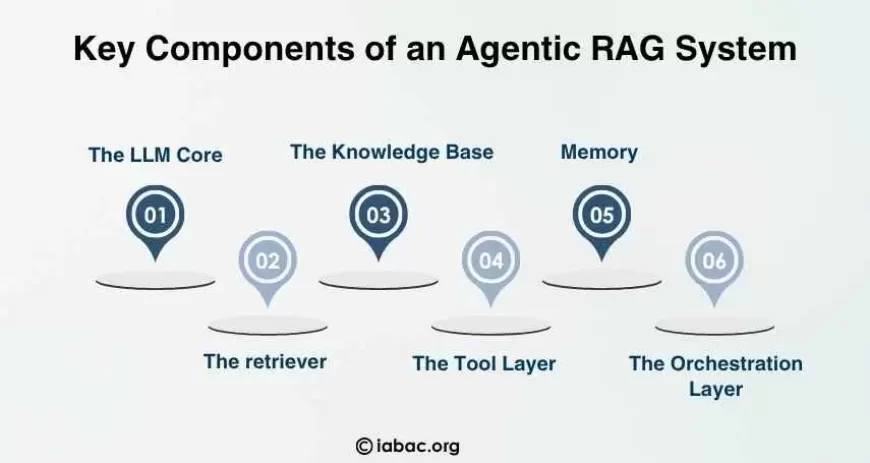
Several core building blocks work together to make agentic RAG function effectively.
The LLM Core
The LLM Core sits at the center of the agent's reasoning. It generates plans, evaluates results, formulates retrieval queries, and produces final outputs. The quality of the LLM directly influences how well the agentic system performs overall.
The retriever
The retriever handles the actual fetching of information from knowledge sources. In most implementations, this involves embedding models and vector databases that store document blocks as dense vectors and retrieve the most semantically similar ones for a given query.
The Knowledge Base
The Knowledge Base is the repository from which the agent retrieves information. It can include:
- Internal documents and PDFs
- Structured databases and data warehouses
- Wikis, knowledge management systems, and codebases
- External web sources, depending on the tool configuration
The Tool Layer
The Tool Layer is what visually differentiates the two architectures.
Tools expand what the agent can do beyond retrieval, allowing it to search the web, run code, call APIs, read or write files, and query structured databases within a single workflow.
Memory
Memory allows the agent to retain information across steps. Short-term memory stores the context of the current task, while long-term memory can persist user preferences, past interactions, or frequently needed facts across sessions.
The Orchestration Layer
The Orchestration Layer governs how the agent sequences its actions, evaluates intermediate results, and decides when the task is complete.
Frameworks like LangChain, LlamaIndex, AutoGen, and CrewAI are commonly used to build and manage this layer.
Agentic RAG vs. Standard RAG: A Clear Comparison
| Feature | Standard RAG | Agentic RAG |
| Retrieval | Single pass | Iterative, multi-step |
| Planning | None | Explicit task planning |
| Tool use | Limited | Broad tool Integration |
| Actions | Generate only | Retrieve, reason, act |
| Complexity handled | Simple queries | Multistep, complex tasks |
| Autonomy | Low | High |
| Error correction | None | Self-evaluation loops |
Real-World Applications of Agentic RAG
The versatility of agentic RAG makes it applicable across a wide range of industries and use cases.
Enterprise Knowledge Management
Large organizations deal with enormous volumes of internal documentation, from HR policies and legal contracts to engineering specifications and financial reports.
These systems can retrieve relevant documents, synthesize information across multiple sources, flag inconsistencies, and produce structured summaries, all with minimal manual intervention.
Customer Support Automation
This approach enables support systems to handle complex, multi-turn customer queries. Instead of returning a generic answer, the agent can retrieve account-specific information, check order status via an API call, and generate a personalized, accurate response tailored to the individual customer's situation.
Research and Competitive Intelligence
Analysts can use these systems to gather information from multiple sources simultaneously, including internal reports, databases, and live web data.
The agent synthesizes findings and produces structured briefs, dramatically reducing the time required for manual research.
Software Development Assistance
In coding environments, agentic RAG agents can:
- Retrieve relevant documentation and codebase context
- Run tests and evaluate error outputs
- Iterate on solutions based on feedback loops
- Produce working code grounded in actual project context
- Healthcare and Legal
In regulated industries, these systems can retrieve case law, clinical guidelines, or patient records, reason through relevance, and generate carefully cited outputs that support professionals in decision-making without replacing their judgment or expertise.
Challenges and Limitations
Agentic Retrieval Augmented Generation is powerful, but it comes with real challenges that teams need to account for.
The delay is a genuine concern. Because agentic systems involve multiple retrieval and reasoning steps, they are slower than single-pass RAG or direct LLM generation. This can be a drawback in time-sensitive or real-time applications.
Cost scales with complexity. More steps mean more LLM calls, more tool invocations, and higher compute costs. Optimizing agent workflows to minimize unnecessary steps is an active and ongoing area of engineering work.
Reliability introduces new failure modes even as it reduces others. While retrieval grounding reduces hallucination compared to standalone LLMs, an agent might still:
- Retrieve irrelevant documents due to a poorly formed query
- Misinterpret the retrieved content during reasoning
- Take incorrect actions based on faulty intermediate conclusions
Evaluation difficulty is a structural challenge. Because agentic system behavior is dynamic and multi-step, traditional metrics like retrieval precision or BLEU (Bilingual Evaluation Understudy) scores are insufficient. Evaluating the quality of plans, intermediate steps, and final outputs requires more sophisticated and often custom-built frameworks.
Safety and control become critical considerations when agents can take real-world actions. Poorly scoped agents can access data they should not, take unintended actions, or enter reasoning loops that waste resources.
Guardrails, scope limitations, and human-in-the-loop checkpoints are essential design requirements, not optional additions.
The Road Ahead
Agentic retrieval-augmented generation is changing how AI systems handle complex, real-world tasks.
As LLMs get better, retrieval systems get faster, and orchestration frameworks become easier to use, agentic RAG will become more reliable and more accessible to a wider range of teams and businesses.
The direction is clear: AI systems that do not just respond to questions but actively work through problems, pull in the right information, and deliver outputs grounded in real, current data.
Agentic RAG is one of the core architectures powering that shift.
For professionals looking to stay ahead, building a solid understanding of agentic RAG is becoming increasingly valuable. Many AI and machine learning certification programs now cover agentic systems, RAG pipelines, and LLM orchestration as part of their core curriculum. Earning a relevant AI certification can help validate that knowledge and open doors across engineering, product, and data roles where these skills are in high demand.