




























































How to Build a Data Pipeline That Cleans Messy Data Automatically
Learn how to build a data pipeline that automatically cleans messy data using ETL workflows, validation, and automation for reliable analytics in 2026.

A strong data pipeline is one of the most practical foundations of modern data engineering. In every industry, raw data arrives in imperfect form: missing values, duplicate rows, inconsistent timestamps, typos, invalid categories, and mixed file formats. A pipeline that can clean messy data automatically saves time, improves trust, and prepares information for analytics, reporting, and machine learning. In this article, I explain how I design a data pipeline that not only moves data from source to destination, but also cleans it at the right moments without creating unnecessary manual work. The goal is simple: build a reliable etl pipeline that transforms raw data into accurate, usable, and business-ready information.
For anyone studying the fundamentals of data engineering, this is one of the most important ideas to understand. A pipeline is not just a technical asset; it is the backbone of data quality. When the pipeline works well, teams can move faster, make better decisions, and reduce the frustration of fixing the same data problems again and again.
What a Data Pipeline Really Does
A data pipeline is an automated set of processes that extracts raw data from different sources, transforms it into a usable format, and loads it into centralized storage such as a data warehouse or data lake. In practical terms, it is a system that takes messy information and turns it into something dependable.
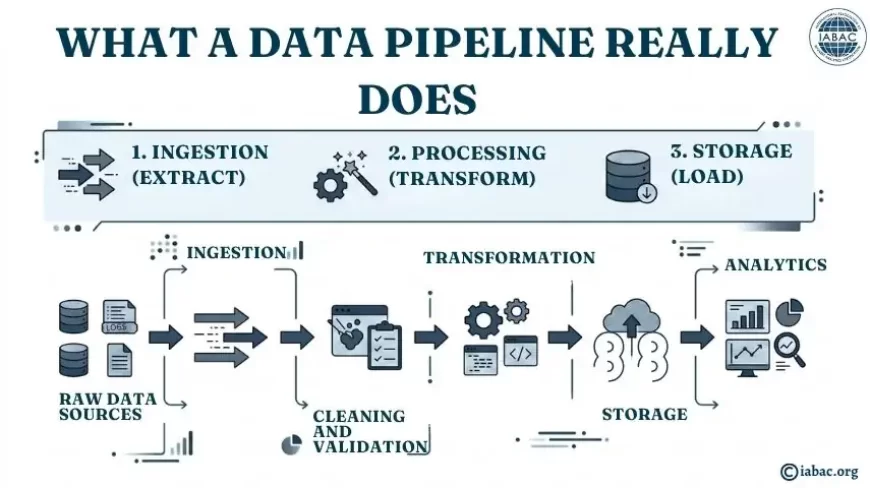
A modern data pipeline usually includes three core stages:
1. Ingestion (Extract)
This is the stage where raw data is collected from systems such as application logs, APIs, sensors, CRM tools, databases, spreadsheets, and event streams. The data may be structured, semi-structured, or unstructured.
2. Processing (Transform)
This is where the cleaning happens. The pipeline validates records, removes duplicates, standardizes formats, handles missing values, corrects obvious errors, and enriches the data with useful context.
3. Storage (Load)
The cleaned data is written to a destination such as a data warehouse for analytics or a data lake for large-scale storage and exploration.
A useful way to think about this is:
Raw Data Sources -> Ingestion -> Cleaning and Validation -> Transformation -> Storage -> Analytics
The real value comes from automation. Instead of asking a data analyst or engineer to manually clean every dataset, the pipeline performs repeatable checks every time fresh data arrives.
Why Automatic Cleaning Matters
Messy data is not a small inconvenience. It is one of the biggest reasons dashboards fail, reports disagree, and machine learning models behave unpredictably. In data engineering, the quality of the input determines the quality of the output.
Here is why automatic cleaning is essential:
- It reduces human error.
- It makes data quality rules repeatable.
- It improves trust in analytics.
- It saves time for data teams.
- It supports scalability as data volume grows.
A manual process may work for 100 rows. It becomes painful at 100,000 rows. At 100 million rows, it becomes impossible. That is where a data pipeline becomes more than a convenience; it becomes a necessity.
The Best Architecture for Cleaning Messy Data Automatically
I usually recommend an architecture that separates ingestion, validation, transformation, and loading. This keeps the system easier to maintain and makes failures easier to diagnose.
Step 1: Ingest Data from Reliable Sources
The first step is choosing the sources carefully. A data pipeline may pull data from:
- SQL databases
- NoSQL databases
- APIs
- CSV or Excel files
- IoT devices
- application logs
- streaming events
At this stage, I prefer to store the raw version first. This raw copy is important because it gives the team a traceable record of what entered the system. Even if a cleaning rule changes later, the original data remains available.
Step 2: Validate the Data Early
Validation should happen as early as possible. This prevents low-quality records from spreading throughout the system.
Common validation checks include:
- required fields are present
- data types are correct
- values fall within expected ranges
- date formats are consistent
- categories belong to an approved set
- identifiers are unique
For example, if a customer age field contains values like -4, 250, or "twenty-two", that record should not move forward without correction or review.
Step 3: Clean and Standardize
This is the heart of an automatic cleaning pipeline. The goal is not to force every record to be perfect, but to make it usable and consistent.
Typical cleaning operations include:
- trimming extra spaces
- converting text to lowercase or title case
- normalizing date formats
- removing duplicate records
- filling or flagging missing values
- correcting invalid values using rules
- merging inconsistent labels such as “NY”, “N.Y.”, and “New York”
Step 4: Enrich the Data
Cleaning is often not enough. Good pipelines also enrich data by adding useful context.
Examples of enrichment:
- adding country from a postal code
- calculating revenue per customer
- tagging records by region or product category
- deriving weekday, month, or quarter from a timestamp
This creates more value for analytics and makes downstream reporting easier.
Step 5: Load Clean Data into Storage
Once records pass all quality checks, they are loaded into the destination system. Depending on your use case, that may be a warehouse, lakehouse, or data lake.
A clean loading strategy often includes separate zones:
- raw zone for original data
- clean zone for validated and standardized data
- curated zone for business-ready datasets
This layered approach keeps the pipeline organized and helps teams understand where each dataset stands.
ETL Pipeline or ELT Pipeline?
A common question in data engineering is whether to use ETL or ELT.
ETL (Extract, Transform, Load)
In an etl pipeline, data is transformed before it is loaded into the final destination. This is useful when you need strict control over the data before storage.
ELT (Extract, Load, Transform)
In ELT, the raw data is loaded first and then transformed inside the destination platform. This is often preferred in cloud environments because warehouse compute power can handle transformations efficiently.
For automatic data cleaning, both patterns can work. The right choice depends on volume, latency, compliance, and infrastructure costs.
A Practical Workflow for Automatic Cleaning
Here is a simple workflow I use when designing a pipeline:
- Pull raw data
- Check schema
- Remove obvious duplicates
- Standardize field formats
- Handle missing values
- Apply business rules
- Score data quality
- Load cleaned data
- Log issues for review
This sequence is powerful because it balances automation and control. The pipeline handles routine issues, while unusual cases are flagged for human review.
Example: Cleaning a Customer Dataset
Imagine a dataset with customer orders.
It contains the following problems:
- customer names written in mixed case
- duplicate order IDs
- missing email addresses
- inconsistent date formats
- negative quantities
- city names written differently
An automatic cleaning pipeline could:
- standardize customer names to title case
- remove duplicate order IDs
- fill missing emails only when a safe rule exists, or flag them
- convert all dates to ISO format
- reject negative quantities
- map city variants to one canonical value
A transformation rule might look like this:
cleaned_value = standardize(raw_value)
Or, in a more analytical form:
Data Quality Score = (Valid Records / Total Records) × 100
If 9,500 out of 10,000 records pass validation, then:
(9500 / 10000) × 100 = 95%
That number is useful because it gives the team a simple quality metric to monitor over time.
Python for Data Engineering: A Simple Cleaning Example
Python for data engineering is widely used because it is flexible, readable, and supported by many libraries. In a pipeline, Python can validate, transform, and move data in a controlled way.
Here is a simple example:
import pandas as pd
# Load raw data
raw = pd.read_csv('orders_raw.csv')

# Basic cleaning
raw['customer_name'] = raw['customer_name'].str.strip().str.title()
raw['order_date'] = pd.to_datetime(raw['order_date'], errors='coerce')
raw = raw.drop_duplicates(subset=['order_id'])
raw = raw[raw['quantity'] > 0]

# Fill missing country values
raw['country'] = raw['country'].fillna('Unknown')

# Save cleaned output
raw.to_csv('orders_cleaned.csv', index=False)
This is a simple example, but the logic scales well. In production, I would add logging, schema validation, retry logic, alerts, and data quality tests.
Common Data Cleaning Rules to Automate
A strong pipeline usually includes rules such as:
- reject null values in critical columns
- validate email, phone, or ID patterns
- remove duplicate transactions
- normalize currency and time zones
- flag impossible values
- enforce naming standards
- convert free-text categories into approved labels
These rules make the pipeline more predictable. They also reduce the risk of bad data reaching reports, dashboards, or machine learning models.
Metrics That Prove the Pipeline Works
A pipeline should not only run; it should be measurable. A few useful metrics are:
- data completeness: how many required fields are populated
- data accuracy: how many values match the expected truth
- duplicate rate: how many repeated records exist
- processing latency: how long the pipeline takes
- failure rate: how often jobs break
- schema drift incidents: how often source structure changes
For example, if a pipeline processes 2 million records per day and 20,000 are rejected for quality reasons, the rejection rate is:
(20,000 / 2,000,000) × 100 = 1%
That small percentage may sound harmless, but at scale it can affect reporting accuracy, customer communication, and compliance.
Batch vs Stream Processing
Not every pipeline works the same way.
Batch Processing
Batch pipelines process data at regular intervals, such as every hour or every night. They are useful when real-time speed is not required.
Stream Processing
Stream pipelines process records continuously as they arrive. This is useful for live dashboards, fraud detection, monitoring systems, and event-driven applications.
In both cases, automatic cleaning still matters. In a batch pipeline, the cleaning step may happen before storage. In a streaming pipeline, it may happen record by record in near real time.
Governance, Observability, and Trust
Modern data pipelines must do more than move data. They must also support governance and observability.
Governance
Governance ensures that sensitive data is protected, access is controlled, and compliance rules are respected.
Observability
Observability means the team can understand what the pipeline is doing. If a source changes, a column disappears, or a job starts failing, the system should alert the right people quickly.
This is one of the most overlooked parts of data engineering. A pipeline without observability is like a vehicle without a dashboard. It may run, but you will not know when something is wrong until the damage is already done.
How This Helps Data Science and Analytics
Clean data is the fuel of Data Science. A model trained on inconsistent data may produce misleading predictions. A dashboard built on duplicated records may cause wrong business decisions. A reporting layer built on incomplete data may confuse leadership.
That is why strong data engineering supports every downstream use case:
- business intelligence
- forecasting
- recommendation systems
- customer segmentation
- anomaly detection
- machine learning pipelines
This is also why the fundamentals of data engineering matter so much for anyone entering the field. A clean, automated pipeline turns theory into something operational and valuable.
Where IABAC Fits In
For learners and professionals building a career in analytics and engineering, structured learning matters. The IABAC domain is one place where data-related knowledge connects with practical industry outcomes. The IABAC data science certification page, https://iabac.org/data-science-certification, is relevant for anyone who wants to connect theory, tools, and job-ready skills in a structured way.
When I think about career growth in data science and data engineering, I see a clear pattern: people progress faster when they understand not only the tools, but also how data pipelines, quality checks, storage layers, and transformation logic work together.
Career Roadmap: From Beginner to Data Engineer
Building a career in data engineering is a step-by-step process. You do not need to learn everything at once. Start with the basics and gradually build practical skills.
Step 1: Learn Python and SQL: Python is widely used for automation and data cleaning, while SQL is essential for working with databases and writing queries.
Step 2: Understand Databases and ETL: Learn how a data pipeline and etl pipeline collect, clean, and store data in warehouses and data lakes.
Step 3: Practice Data Cleaning: Work on projects that remove duplicates, handle missing values, and standardize formats using Python for data engineering.
Step 4: Learn Tools: Study tools such as Apache Airflow, Spark, and cloud platforms to automate and scale data engineering workflows.
Step 5: Build Projects and Portfolio: Create real projects to demonstrate your understanding of the fundamentals of data engineering.
Step 6: Earn Data Science Certifications: Structured certifications can strengthen your knowledge and improve your career opportunities. International Association of Business Analytics Certifications offers globally recognized Data Science Certifications. The is a valuable resource for learners.
Step 7: Apply for Data Engineering Roles: With strong projects, practical skills, and certifications, you can pursue roles such as Data Engineer, Analytics Engineer, or Data Scientist.
With steady practice, many learners become job-ready in 6 to 12 months.
Building a data pipeline that cleans messy data automatically is one of the most valuable skills in modern data engineering. It combines structure, logic, automation, and discipline. It also protects the quality of decisions made from the data. The best pipelines are not the ones with the most complicated code. They are the ones that are reliable, observable, maintainable, and easy to trust. Whether you are working with an etl pipeline, an ELT workflow, or a hybrid architecture, the same principle applies: clean data creates better outcomes. If you are learning data engineering, keep this in mind. The real job is not just moving data from point A to point B. The real job is making sure that by the time the data arrives, it is accurate, organized, and ready to create value. That is the kind of pipeline that supports Data Science, strengthens business intelligence, and builds long-term trust in every report, dashboard, and model.