



























































What Is Apache Spark Data Processing? A Complete Beginner's Guide
Learn what Apache Spark is, how it processes big data faster, and why it's essential for modern data engineering with this simple beginner's guide.

Introduction
If you've spent any time around data engineering or big data, you've almost certainly heard of Apache Spark. It's one of the most widely used tools for processing large volumes of data quickly. But if you're new to the field, the terminology and architecture can feel overwhelming. This guide breaks down what Apache Spark is, how it works, and why it matters in plain language.
What Is Apache Spark?
Apache Spark is an open-source, distributed computing system designed to process large datasets quickly. "Distributed" means the work is spread across many computers (called a cluster) instead of relying on a single machine. This lets Spark handle datasets far too large or tasks far too slow for one computer to manage alone.
Spark was originally developed at UC Berkeley and later donated to the Apache Software Foundation. It was built as a faster alternative to an earlier big data tool called Hadoop MapReduce, which processes data in stages that repeatedly write to disk. Spark instead does most of its work in memory (RAM), which makes it significantly faster for many workloads, often 10 to 100 times faster than MapReduce, depending on the task.
Why Does Data Processing at Scale Need Special Tools?
Imagine you have a spreadsheet with 50 rows. Excel handles that instantly. Now imagine a dataset with 50 billion rows spread across thousands of files. A single computer, no matter how powerful, would take an impractical amount of time to process that or simply run out of memory.
Distributed processing frameworks like Spark solve this by:
-
Splitting data into smaller chunks
-
Distributing those chunks across multiple machines
-
Processing each chunk in parallel
-
Combining the results back together
This "divide and conquer" approach is the foundation of big data processing.
Core Concepts in Apache Spark
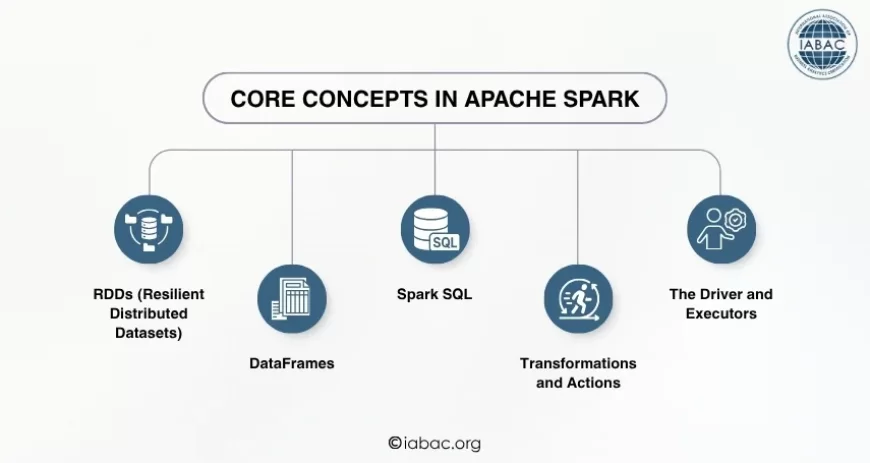
1. RDDs (Resilient Distributed Datasets)
RDDs are Spark's original core data structure — a collection of data spread across a cluster that Spark can process in parallel. They're "resilient" because Spark can automatically recover lost data if a machine in the cluster fails, without you having to write special error-handling code.
While RDDs are still part of Spark's foundation, most modern Spark code uses higher-level abstractions built on top of them.
2. DataFrames
DataFrames are Spark's more user-friendly way of organizing data, similar to a table in a database or a spreadsheet, with rows and named columns. If you've used pandas in Python or data frames in R, the concept will feel familiar. DataFrames make it easier to filter, aggregate, and transform data using readable code, and Spark can optimize how that code runs behind the scenes.
3. Spark SQL
Spark SQL lets you query data using standard SQL syntax, even though the data might be spread across a massive distributed cluster. This is especially useful for analysts and engineers who are already comfortable with SQL but need to work at a much larger scale than a traditional database allows.
4. Transformations and Actions
Spark operations fall into two categories:
-
Transformations (like filtering or mapping data) describe what should happen to the data, but Spark doesn't execute them immediately.
-
Actions (like counting rows or saving results) trigger Spark to actually perform the computation.
This "lazy evaluation" approach lets Spark look at your entire chain of operations and optimize the execution plan before running anything — often skipping unnecessary work.
5. The Driver and Executors
Every Spark application has:
-
A driver program, which coordinates the work and keeps track of what needs to happen
-
Executors, which are processes running on the cluster's machines that actually do the data processing and report results back to the driver
Think of the driver as a project manager assigning tasks, and the executors as the team members doing the actual work in parallel.
What Can You Do With Spark?
Apache Spark isn't limited to one type of task. Its ecosystem includes several specialized components:
-
Spark SQL: Querying structured data
-
Spark Streaming / Structured Streaming: Processing real-time data as it arrives (e.g., live sensor data, transaction feeds)
-
MLlib: Building and training machine learning models at scale
-
GraphX: Analyzing graph-structured data, like social networks
This makes Spark a general-purpose engine rather than a tool built for just one job.
Common Use Cases
-
ETL pipelines: Extracting, transforming, and loading data between systems
-
Real-time analytics: Processing streaming data like clickstreams or IoT sensor readings
-
Machine learning at scale: Training models on datasets too large for a single machine
-
Log and event processing: Analyzing massive volumes of application or server logs
-
Data lake processing: Cleaning and organizing raw data stored in systems like Amazon S3 or HDFS
How Spark Fits Into the Bigger Picture
Spark doesn't work entirely on its own. It typically relies on:
-
A cluster manager (like Kubernetes, YARN, or Spark's own built-in manager) to allocate computing resources
-
A storage system (like HDFS, Amazon S3, or a data lake) to read from and write data to
Spark handles the processing, while these other systems handle resource management and storage.
Spark vs. Hadoop MapReduce: A Quick Comparison
|
Feature |
Apache Spark |
Hadoop MapReduce |
|
Processing speed |
Faster (in-memory processing) |
Slower (disk-based processing) |
|
Ease of use |
Higher-level APIs, more readable code |
More verbose, lower-level code |
|
Real-time processing |
Supported (Structured Streaming) |
Not natively supported |
|
Built-in library (MLlib) |
Requires separate tools |
It's worth noting Spark and Hadoop aren't strictly competitors — Spark can run on top of Hadoop's storage system (HDFS) and often complements rather than fully replaces Hadoop-based infrastructure.
Getting Started: A Simple Example
Here's a small taste of what Spark code looks like using PySpark (Spark's Python API):
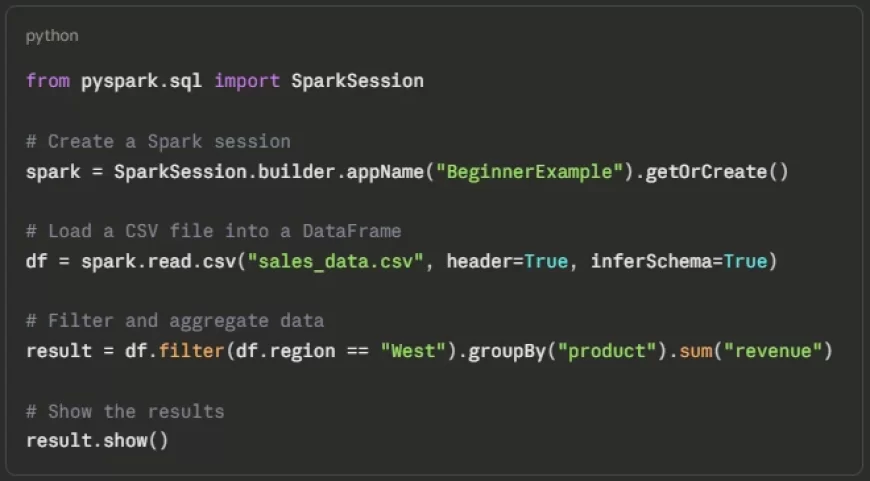
Even though this code might run across dozens or hundreds of machines behind the scenes, you write it almost as simply as you would with a single-machine tool like pandas.
Key Takeaways
-
Apache Spark is a distributed computing framework built for processing large-scale data quickly.
-
It processes data primarily in memory, making it much faster than older disk-based tools like Hadoop MapReduce for many tasks.
-
Core building blocks include RDDs, DataFrames, and Spark SQL.
-
Spark supports batch processing, real-time streaming, machine learning, and graph analysis — all within one unified framework.
-
It's widely used in industries dealing with massive datasets, from tech companies to finance to healthcare.
Where to Go Next
If you want hands-on experience, a great next step is installing Spark locally (or using a managed platform like Databricks, which was founded by Spark's original creators) and working through small exercises with PySpark or Spark SQL on a sample dataset. Understanding the fundamentals covered here will make those first hands-on steps much easier to follow.