


























































Data Engineering Starts with Databases
Learn how data engineering starts with databases, builds reliable data pipelines, and powers analytics, AI, and business intelligence.

Every dashboard you look at, every machine learning model that gets trained, and every business report that lands in an executive's inbox depends on data being collected, cleaned, and made usable. That behind-the-scenes work is data engineering. It's a field that often goes unnoticed by the rest of the business, but without it, none of the flashier data science and analytics work would be possible.
This guide walks through what data engineering actually involves, the skills it requires, and how it fits into the broader data ecosystem.
What Does a Data Engineer Actually Do?
At its core, data engineering is about building and maintaining the systems that move data from where it's created to where it's needed — reliably, efficiently, and at scale.
That includes:
-
Talking to databases — writing queries, designing schemas, and understanding how data is stored and retrieved
-
Building data pipelines — automated processes that extract data from one place, transform it, and load it somewhere else (commonly known as ETL or ELT)
-
Ensuring data quality — catching duplicates, missing values, and inconsistencies before they cause problems downstream
-
Optimizing performance — making sure large datasets can be processed and queried without slowing everything to a crawl
-
Maintaining infrastructure — keeping the systems data flows through up and running, secure, and scalable
Databases: The Starting Point
Databases are usually where the data engineering journey begins. Most data engineers work with two broad categories:
-
Relational (SQL) databases — like PostgreSQL, MySQL, or SQL Server, which organize data into structured tables with defined relationships. These are the backbone of most transactional systems, like an e-commerce platform tracking orders and customers.
-
Non-relational (NoSQL) databases — like MongoDB, Cassandra, or DynamoDB, which handle less structured or rapidly changing data, often at very high volume or speed.
A data engineer needs to know how to query these systems efficiently (SQL is a non-negotiable skill), design schemas that make sense for how the data will be used, and understand tradeoffs like normalization versus denormalization.
From Databases to Data Pipelines
Talking to a database is just the beginning. Real data engineering work is about connecting many data sources together — databases, APIs, log files, third-party services — and building reliable pipelines that move and transform that data.
A typical pipeline might:
-
Extract data from a production database, an API, or a stream of events
-
Transform it — cleaning up formatting, joining it with other datasets, aggregating it, or filtering out bad records
-
Load it into a destination system, like a data warehouse, where it's ready for analysis
This is where tools like Apache Spark, Apache Airflow, dbt, and cloud services like AWS Glue or Google Dataflow come into play. Each tool solves a different part of the puzzle — Spark for large-scale processing, Airflow for scheduling and orchestrating pipelines, dbt for transforming data already in a warehouse.
Data Warehouses and Data Lakes
Once data has been extracted and transformed, it usually lands in one of two types of systems:
-
Data warehouses (like Snowflake, BigQuery, or Redshift) store structured data optimized for fast querying and reporting.
-
Data lakes (often built on cloud storage like Amazon S3) store raw or semi-structured data in its original form, giving more flexibility for different types of downstream use, including machine learning.
Many organizations now use a hybrid approach — a "lakehouse" — that combines the flexibility of a data lake with the structure and performance of a warehouse.
Why Data Engineering Matters
Without solid data engineering, everything downstream suffers:
-
Data scientists spend most of their time cleaning messy data instead of building models
-
Business dashboards show inaccurate or outdated numbers
-
Machine learning models get trained on flawed data, leading to unreliable predictions
-
Teams lose trust in the data itself, which undermines data-driven decision-making altogether
Good data engineering is largely invisible when it's working well — nobody notices a pipeline that runs smoothly every night. It becomes very visible when it breaks.
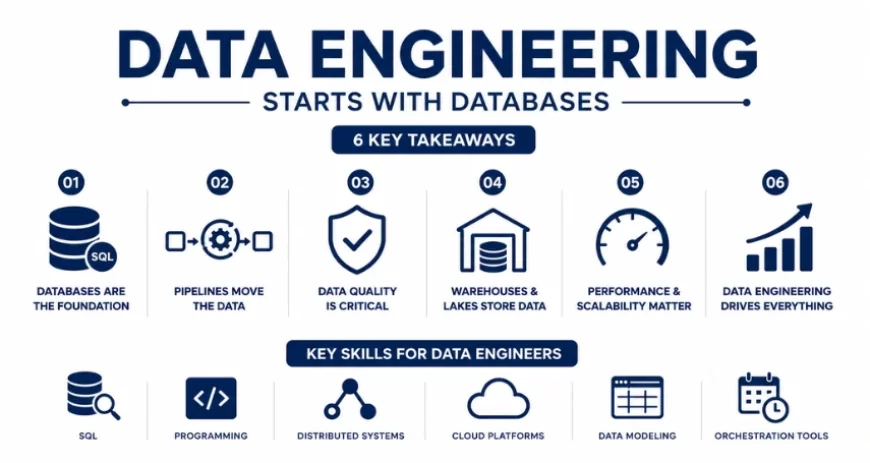
Key Skills for Data Engineers
-
SQL — the universal language for querying and manipulating data
-
Programming — usually Python or Scala, for writing pipeline logic
-
Distributed systems knowledge — understanding tools like Spark and how data processing scales across machines
-
Cloud platforms — familiarity with AWS, Google Cloud, or Azure, since most modern data infrastructure lives in the cloud
-
Data modeling — designing schemas and structures that make data easy to use and understand
-
Orchestration tools — like Airflow or Dagster, for scheduling and managing complex pipelines
Data Engineering vs. Data Science: What's the Difference?
It's a common point of confusion. In short:
-
Data engineers build and maintain the infrastructure and pipelines that make data available and reliable.
-
Data scientists use that data to build models, run analyses, and generate insights.
Think of data engineers as building the roads and data scientists as driving on them. Without well-built roads, the driving doesn't go very far.
Getting Started in Data Engineering
If you're looking to break into the field, a good starting path looks like:
-
Get comfortable with SQL and relational database design
-
Learn Python, since most pipeline tooling is Python-based
-
Understand the basics of distributed processing (tools like Spark)
-
Get hands-on with a cloud platform's data services
-
Build a small end-to-end project — pull data from an API, clean it, and load it into a database or warehouse
Data engineering is the foundation that everything else in the data world is built on. It starts with something as fundamental as talking to databases, but it extends into building robust, scalable systems that move and shape data across an entire organization. It's not always the most visible work, but it's often the most essential.