


























































Worried About Competition? Becoming a Certified MLOps Engineer Might Be Key
A certified MLOps engineer gains skills in model deployment automation and monitoring helping professionals stay competitive in modern data driven teams.


The job market today feels like a crowded stadium where everyone is running toward the same goal—but only a few know the exact direction. If you’ve ever scrolled through job listings and thought, “How is everyone already so skilled?”—you’re not alone. The competition is real, growing, and honestly… a little intimidating.
But here’s the truth most people miss: competition is not the problem—lack of direction is.
And this is where becoming a Certified MLOps Engineer can quietly (but powerfully) change your career path.
Let’s break this down in a way that actually makes sense—no jargon overload, no confusing theory—just real clarity.
The Reality: Why Competition Feels So High
Every year, thousands of people enter the field of data science and AI. They complete Data Science Certifications, enroll in a machine learning engineer course, and build basic models.
But here’s the twist:
Most stop at model building
Very few learn model deployment and scaling
And companies? They don’t just want models sitting in Jupyter notebooks.
They want:
- Models that work in real-time
- Systems that don’t crash at 2 AM
- Pipelines that run without human babysitting
This gap between learning and real-world application is exactly where mlops engineering comes in.
What is MLOps (And Why It Matters More Than You Think)
MLOps (Machine Learning Operations) is the bridge between data science and production.
Think of it like this:
- Data scientists build the brain
- MLOps engineers make sure the brain actually works in the real world
Without machine learning operations, even the best models are useless.
Simple Example
You build a model that predicts customer churn with 92% accuracy. Great!
But then:
- It doesn’t update with new data
- It breaks when traffic increases
- No one knows how to deploy it
Result? The company doesn’t use it.
This is why companies are now actively looking for:
- mlops engineer
- machine learning ops engineer
- ml ops engineer
The Growing Demand for MLOps Engineers
The demand for mlops engineers has exploded globally.
Here’s what companies are dealing with:
- Increasing data volume
- Need for real-time AI decisions
- Pressure to scale AI systems
Global Trend Insight
- Over 60% of AI projects fail to reach production
- Companies lose millions due to poor deployment strategies
- MLOps roles are among the fastest-growing tech roles globally
That means one thing:
If you learn mlops skills, you automatically move into a less crowded, high-demand space.
The Career Equation (That Most People Ignore)
Let’s simplify career growth into a formula:

Most people focus only on certifications.
Smart professionals add:
- Real-world ml pipelines
- Hands-on mlops tools
- Deployment knowledge
That’s where the difference happens.
What Does an MLOps Engineer Actually Do?
A machine learning ops engineer is responsible for making machine learning models reliable, scalable, and production-ready.
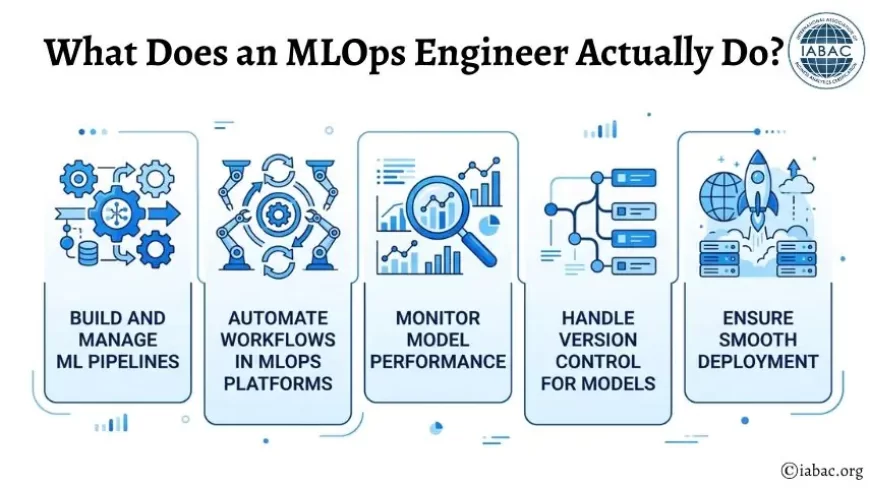
Key Responsibilities
- Build and manage ml pipelines
- Automate workflows in mlops platforms
- Monitor model performance
- Handle version control for models
- Ensure smooth deployment
Tools You’ll Work With
Some popular mlops tools include:
- Docker
- Kubernetes
- CI/CD pipelines
- Cloud platforms
- Model monitoring systems
This is not just theory—this is what companies use daily.
Why a Certified MLOps Engineer Stands Out
Anyone can say they “know ML.”
But a Certified MLOps Engineer proves:
- You understand real-world systems
- You can handle production-level challenges
- You are job-ready
This is especially important in a crowded market.
The Trust Factor
Recruiters often see:
- 100+ resumes with similar Data Science Certifications
But only a few show:
- Strong mlops engineering skills
- Real deployment experience
Guess who gets shortlisted?
The Emotional Side (Yes, It Matters)
Let’s be honest.
Learning tech skills isn’t just about knowledge—it’s about confidence.
You might feel:
- “Am I too late?”
- “Everyone is ahead of me”
- “What if I choose the wrong path?”
Here’s the reality:
The market is crowded at the beginner level
It is wide open at the specialized level
Choosing ml ops is like stepping onto a less crowded highway.
Real-World Example: Two Career Paths
Person A
- Completed a machine learning engineer course
- Built 5 models
- No deployment knowledge
Person B
- Completed a mlops course
- Built models + deployed them
- Worked with mlops platform tools
Outcome
Person A struggles to explain real-world impact.
Person B confidently says:
I built and deployed a scalable pipeline handling real-time data.
Who do you think gets hired?
Understanding ML Pipelines (The Backbone of MLOps)
An ml pipeline is the step-by-step process of building, deploying, and maintaining a model.
Basic Pipeline Flow
- Data collection
- Data preprocessing
- Model training
- Model evaluation
- Deployment
- Monitoring
Without proper pipelines, everything becomes messy.
Growth Representation
Your learning curve in machine learning operations often looks like this:

Where:
- x = effort and learning
- y = career growth
At first, growth feels slow. Then suddenly, it accelerates.
That’s exactly how mlops skills work in real life.
Why MLOps is the Future of AI Careers
AI is no longer experimental—it’s operational.
Companies need:
- Stable systems
- Automated workflows
- Continuous model improvement
This is why operations machine learning is becoming critical.
Industry Shift
Earlier:
- Focus = building models
Now:
- Focus = deploying and scaling models
This shift is creating huge opportunities for:
- mlops engineers
- machine learning ops engineers
How an MLOps Course Changes Your Career Path
A well-structured mlops course teaches you:
- End-to-end mlops engineering
- Working with real mlops tools
- Building production-ready systems
- Managing machine learning operation workflows
This is very different from traditional learning.
Skills You Gain from MLOps Courses
Technical Skills
- Automation
- Pipeline creation
- Cloud deployment
- Monitoring systems
Practical Skills
- Problem-solving
- System thinking
- Real-world debugging
Career Skills
- Confidence in interviews
- Ability to explain real projects
- Industry-ready mindset
Why IABAC Certification Matters
When it comes to structured learning and global recognition, platforms like IABAC (International Association of Business Analytics Certifications) offer strong credibility.
A certification from https://www.iabac.org helps you:
- Validate your mlops skills
- Gain industry recognition
- Stand out globally
And most importantly—it aligns your learning with real-world requirements.
Common Mistakes to Avoid
Let’s save you from some pain.
- Only focusing on theory
- Ignoring deployment
- Not learning mlops tools
- Skipping real projects
Instead:
✔ Build real ml pipelines
✔ Practice on real datasets
✔ Learn system design
The Confidence Shift After Learning MLOps
Before:
- I know machine learning…
After:
- I can build, deploy, and maintain ML systems at scale.
That one sentence changes everything.
Global Career Opportunities
The beauty of mlops engineering is that it is:
- Location-independent
- High-paying
- In demand across industries
From startups to large enterprises, everyone needs:
- Reliable AI systems
- Scalable solutions
Competition is Not Your Enemy
Competition only feels scary when:
- You’re doing the same thing as everyone else
The moment you specialize:
- The crowd disappears
- Opportunities increase
Becoming a Certified MLOps Engineer is not just about learning a skill—it’s about choosing a smarter path.
If you’re feeling stuck, overwhelmed, or worried about competition, take a step back and ask:
“Am I learning what everyone else is learning?”
“Or am I building skills that companies actually need?”
Because the difference between struggling and succeeding is often just one decision.
And choosing mlops might just be that decision.