

















































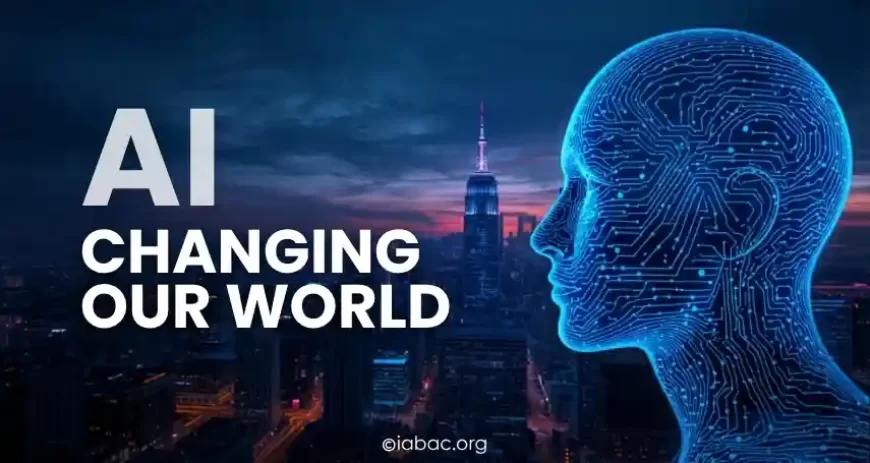
How AI Is Changing Our World and what the Future Could look like?
AI is already part of your daily life. See how it’s changing work, learning, and health and what the future may look like for everyone.

Last week, my friend got a message from his bank before he even noticed something was wrong. The message said: "We noticed unusual activity on your account and have blocked it for safety." A machine had spotted the problem faster than any human could.
That is artificial intelligence, or AI, working quietly in the background of our daily lives. Most of us use it every single day without even realizing it.
So what exactly is AI, and how is it changing the world around us? Let's break it down in plain, simple language, no complicated words, no confusing explanations.
First Things First: What Is AI, Really?
Think of AI like a very smart assistant that learns from experience. You teach it by showing it thousands of examples, and over time, it starts making smart decisions on its own.
For example, when Netflix suggests a show you might like, that's AI. When your phone unlocks by recognizing your face, that's AI. When Google Maps tells you there's traffic ahead and offers a faster route, that's AI too.
It's not magic. It's not science fiction. It's just a very fast, very smart computer system that has been trained to solve specific problems, and it's already all around us.
AI Is Changing How We Work
Think about the boring tasks you do at work every day — copying data from one place to another, answering the same customer questions over and over, sorting through hundreds of emails. AI can now handle most of that.
Companies big and small are using AI tools to handle repetitive and time-consuming tasks. Customer service chatbots, for instance, can respond to hundreds of customers at once — something that used to require large teams of people.
Does this mean AI is going to take everyone's job? Not exactly. Think of it this way, when calculators were invented, people thought accountants would lose their jobs. Instead, accountants became more powerful because they could do more in less time. AI is doing the same thing today.
The people who will do best in this new world are those who learn how to work with AI, not against it.
AI Is Changing Healthcare — In a Big Way
Here's something that really surprised me when I first read about it. Doctors in some hospitals are now using AI to look at X-rays and scan results. And in some cases, the AI is catching problems that human eyes might have missed.
AI isn't replacing doctors — it's giving them a second pair of eyes. It can go through thousands of patient records in seconds and flag anything unusual. This means doctors can focus more on talking to patients and making decisions, while AI handles the heavy reading and number-crunching.
Your smartwatch is part of this story, too. The little device on your wrist now tracks not just your steps, but your heart rate, sleep quality, oxygen levels, and even stress patterns. AI looks at all that data and can warn you if something seems off, sometimes before you even feel sick.
That's not scary. That's genuinely life-saving.
AI Is Changing How Our Kids Learn
Remember how school felt like one teacher trying to teach 40 students at the same speed, even though every student learns differently? AI is starting to fix that.
AI-powered learning tools can now create a study plan that fits you specifically. If you're struggling with math but are good at writing, it adjusts. If you learn better through videos than reading, it adjusts for that, too. It's like having a personal tutor who's always available and never gets tired.
For students preparing for competitive exams or learning new skills online, AI tools are making education cheaper, faster, and more personal than it has ever been.
AI Is Changing Our Daily Routine — Without Us Noticing
Here's a fun experiment. Tomorrow morning, count how many times AI touches your day.
Your alarm wakes you up: AI has learned your sleep pattern and picked the best time.
You check your email: AI has already filtered the spam.
You open YouTube: AI picks videos it thinks you'll enjoy.
You search on Google: AI figures out what you really meant to ask.
You order food online: AI suggests your favourite restaurant.
AI has quietly become the invisible assistant running in the background of everything we do. And most of the time, we don't even say thank you.
Should We Be Worried About AI?
This is the question everyone is asking, and it's a fair one.
Yes, AI will change certain jobs. Some roles that involve repetitive tasks like data entry, basic customer support, or simple document review will be done by machines in the future. That's just the truth.
But history has a good lesson for us here. Every time a big technology changed the world, the printing press, electricity, and the internet, people were afraid of losing their livelihoods. What actually happened? New jobs were created. New industries were born. People who adapted thrived.
The same will happen with AI. The question is not whether AI will change your world. It already is. The real question is: Are you ready for it?
What Does the Future Look Like?
The future of AI is closer than we think. It’s not about robots taking over — it’s about smarter tools helping us in everyday life. Here’s what we can expect:
-
Smarter Homes
Your home may adjust lighting, temperature, and even order groceries automatically based on your habits. -
Self-Driving Transportation
Cars, buses, and delivery vehicles will increasingly run on AI, making travel safer and giving you more free time during commutes. -
Personalized Healthcare
Wearables and health apps will track your body continuously and alert you early about potential health issues. -
AI-Powered Education
Students will learn at their own pace with customized lessons, instant feedback, and interactive learning tools. -
Work That Focuses on Creativity
Routine and repetitive tasks will be automated, allowing people to focus more on strategy, ideas, and problem-solving. -
Smarter Cities
Traffic signals, energy use, and public services will be optimized using AI to reduce congestion and save resources. -
Better Farming and Food Production
Farmers will use AI to predict weather, monitor soil, and improve crop yields with less waste. -
Faster Scientific Discoveries
Researchers will use AI to develop medicines, study climate change, and solve complex global challenges faster. -
AI Becoming Invisible
Just like electricity today, AI will quietly run in the background without us thinking about it.
The future doesn’t look like machines replacing humans. It looks like humans working smarter with intelligent tools.
What Can You Do Right Now?
You don't need to be a computer engineer to benefit from AI. You just need to stay curious and keep learning. Here are a few simple things you can start doing today:
→ Start using AI tools like ChatGPT, Gemini, or Claude in your daily work to save time.
→ Read and watch content about how AI is being used in your industry.
→ Focus on building skills that machines can't replace — empathy, creativity, leadership, and critical thinking.
→ Consider getting certified in AI to stand out in your career.
Speaking of certifications, if you want a globally recognized credential that proves you understand AI, check out the AI Certification a great way to future-proof your career and show the world you're ready for what's coming.
AI isn't taking over the world. It isn't a villain from a movie. It's a tool — and like every tool ever invented, the way it changes our world depends entirely on how we choose to use it.
Right now, in hospitals, classrooms, offices, and homes all over the world, AI is helping people do more, learn more, and live better. It's not perfect. It still makes mistakes. It still needs humans to guide it.
But here's the thing — the world is changing whether we're ready or not. The best thing any of us can do is learn, adapt, and stay curious.
Because the future doesn't belong to machines. It belongs to the people who know how to work with them.