


















































I Used AI Daily but Missed the Generative AI Foundation
Using AI daily but still confused? Learn why generative AI foundation matters and how to improve your results step by step.

Over the past couple of years, I’ve worked with teams, freelancers, and even students who actively use AI tools every single day.
They write content faster. They automate tasks. They experiment with prompts.
But there’s always a moment where things slow down.
The results become inconsistent. Outputs feel generic. And eventually, frustration kicks in.
When I look closer, the pattern is almost always the same: they’re using AI, but they don’t really understand it.
If that sounds familiar, you’re not alone.
Where Things Start to Break
I remember working with a content team that had fully integrated AI into their workflow.
On paper, everything looked efficient. They were producing more content than ever before. Turnaround time had dropped significantly.
But performance didn’t improve.
Traffic stayed flat. Engagement didn’t move. Some articles even performed worse than before.
At first, they assumed it was a content quality issue. Then they blamed the tools.
But neither was the real problem.
The actual issue was much deeper; they had skipped the generative AI foundation.
They knew how to use AI, but not how it worked. And that difference started to show in their results.
The Gap Most People Don’t Notice
Using AI feels intuitive. You type something, you get a response. It feels almost like a conversation.
But behind that simplicity is a system built on patterns, probabilities, and data.
Most people never pause to think about that.
They assume AI understands context the way humans do. They expect consistent outputs without realizing that AI generates responses based on patterns it has learned, not true understanding.
According to McKinsey, generative AI could contribute up to $4.4 trillion annually to the global economy.
What this tells us is simple: this technology is powerful, but only if we know how to use it properly.
Without that understanding, you’re only scratching the surface.
What Generative AI Foundation Really Means in Practice
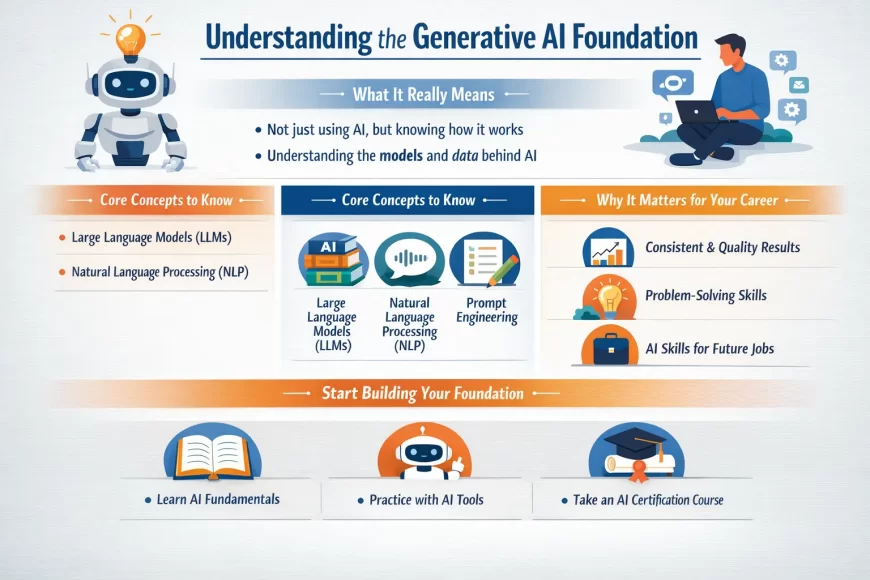
When I talk about generative AI foundations, I’m not referring to complex equations or deep technical theory.
I’m talking about clarity.
Understanding that tools like ChatGPT are built on large language models (LLMs) that depend on natural language processing and transformer architectures.
Understanding that these systems don’t “know” answers, they predict them.
Understanding that your prompt shapes the output more than you think.
Once you grasp these basics, something shifts.
You stop guessing.
You start controlling.
Why Results Feel Inconsistent Without It
One of the most common frustrations I hear is this:
“Sometimes AI gives great results, sometimes it doesn’t. I don’t know why.”
There’s always a reason.
In most cases, it comes down to how the input is structured and how well the user understands the system behind it.
I’ve seen professionals spend hours tweaking prompts without realizing they’re missing the core issue they don’t understand how generative AI works.
According to Ahrefs, more than 90% of content gets no organic traffic.
For someone using AI, this means producing content is easy but producing effective content requires deeper understanding.
Without that, you’re just generating volume, not value.
The Subtle Difference That Changes Everything
There’s a clear shift I’ve noticed when someone moves from using AI casually to understanding it properly.
They stop asking basic questions like:
-
“What prompt should I use?”
-
“Why is this output bad?”
Instead, they start thinking in a completely different way:
-
“What context am I missing here?”
-
“How can I guide the model better?”
-
“What structure will improve this output?”
That shift doesn’t happen from using tools more.
It happens from understanding the AI foundation concepts behind them.
What Most Beginners Get Wrong
In my experience, beginners don’t fail because AI is difficult.
They struggle because they start in the wrong place.
They jump directly into tools without building any base.
They don’t take time to understand:
-
how generative AI models are trained
-
what role training data plays
-
why outputs can be biased or repetitive
-
how prompt engineering actually works
This leads to confusion.
And over time, that confusion turns into frustration.
According to the World Economic Forum, AI and data literacy are becoming essential skills across industries.
This means the expectation is changing; knowing how to use tools is no longer enough.
You need to understand them.
What Actually Works (From Experience)
When I guide someone who feels stuck with AI, I don’t start with tools.
I slow things down.
We focus on building a simple but strong understanding of:
-
AI fundamentals
-
how generative models function
-
how prompts influence outputs
Then we apply that knowledge in real scenarios.
This approach works consistently.
Because once the foundation is clear, everything else becomes easier tools, workflows, even career decisions.
A Quick Reality Check
There’s something important you should know.
Even with a strong understanding, AI is not perfect.
It can:
-
generate incorrect information
-
reflect biases from training data
-
produce confident but wrong answers
According to Gartner, many organizations still struggle to scale AI effectively due to gaps in understanding and implementation.
This applies at an individual level too.
Understanding AI doesn’t eliminate errors, but it helps you recognize and correct them.
The Career Impact Most People Overlook
One of the biggest differences I’ve seen in the industry is this:
People who understand AI grow faster.
Not because they know more tools, but because they know how to think.
They can:
-
adapt to new tools quickly
-
solve problems more effectively
-
create better outputs consistently
This is where real opportunities come from.
Not from using AI, but from understanding it.
Where Structured Learning Makes a Difference
This is exactly where structured learning platforms like IABAC play a role.
Instead of focusing only on tools, the emphasis is on connecting:
-
foundational concepts
-
real-world applications
-
practical skills
From what I’ve seen, professionals who follow this approach don’t just learn faster; they apply better.
And that’s what creates long-term value.
The Shift That Changes Everything
If you take one thing from this, let it be this:
Using AI is not the same as understanding AI.
It’s easy to mistake activity for progress.
But real progress starts when you slow down and build your foundation.
One Practical Step You Can Take Today
Spend just one hour understanding how generative AI actually works.
Not tutorials. Not tools.
Just the basics:
-
how models are trained
-
how prompts influence output
-
why results vary
That one step will change how you use AI moving forward.
Using AI every day can make you feel productive.
But if you don’t understand what’s happening behind the scenes, you’ll always hit a limit.
I’ve seen people spend months using AI tools without real improvement. Not because they lacked effort, but because they skipped the foundation.
Once you understand how generative AI works even at a basic level, your approach changes. Your prompts improve. Your results become more consistent. And most importantly, you start using AI with intention, not guesswork.
If you feel stuck right now, don’t look for better tools.
Take a step back and build your generative AI foundation. That’s what actually moves you forward.