























































Why Coding Alone Doesn’t Make You a Data Scientist
Coding skills alone do not make someone a data scientist; statistics, business understanding, and analytical thinking are also essential.

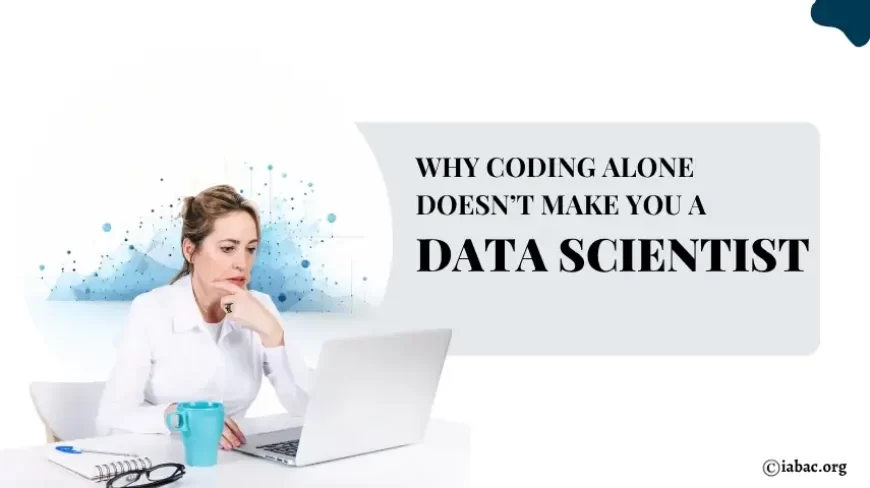
Today, many people think that learning programming languages like Python or R is enough to become a data scientist. Coding is important, but it is only one part of the full picture.
A successful data scientist needs more than just programming skills. They also need:
- Strong problem-solving ability
- Good understanding of business or industry needs
- The ability to study and understand information
- Clear communication skills
Coding helps you collect data, clean it, and build models. But without understanding what the data means or how to explain the results, even good code has limited value. The best data scientists know how to combine technical knowledge with clear thinking and practical understanding. This is why many professionals choose structured learning and Data Science Certifications—because they teach not only coding, but also the other important skills needed for real success.
For many beginners, the journey into data science starts with a simple plan:
“First, I’ll learn Python. Then I’ll become a data scientist.”
Weeks pass.
Tutorials pile up.
Syntax blurs together.
And slowly, doubt creeps in.
If coding is the key to data science, why does it still feel unclear?
The truth is uncomfortable but important:
Coding alone doesn’t make you a data scientist.
It never did.
The Biggest Misunderstanding About Data Science
One of the most common misunderstandings about data science is that it is primarily a programming job. While coding is involved, data science is not about how many lines of code you can write or how complex your scripts look.
At its core, data science is about:
- Understanding problems
- Asking the right questions
- Working with imperfect data
- Finding patterns
- Communicating insights clearly
Coding supports these tasks—but it does not replace them.
Many learners spend months perfecting syntax without understanding why they are doing what they’re doing. This often leads to burnout, confusion, and the feeling that data science is “too hard,” when in reality, the learning path was simply misaligned.
What Data Scientists Actually Do
In real industry environments, data scientists do far more thinking than coding.
A typical data science workflow involves:
- Understanding business goals
- Identifying relevant data sources
- Cleaning and validating data
- Exploring patterns and trends
- Building and testing models
- Explaining results to non-technical teams
- Supporting decisions with evidence
Notice something important here.
Coding appears as one step, not the entire process.
Many successful data scientists write relatively simple code, but apply it in powerful ways because they understand the context and purpose behind the analysis.
Why Strong Coders Still Fail in Data Science Roles
Surprisingly, being good at coding does not guarantee success in data science.
Many technically strong professionals struggle because:
- They focus on tools instead of outcomes
- They build models without clear objectives
- They fail to communicate insights
- They optimize accuracy without business relevance
In fact, a large percentage of data science project failures are not technical failures. They are decision and communication failures.
This is why reports often state that a high number of data science projects do not reach production or deliver expected value. The issue is not lack of coding skill—it is lack of clarity, alignment, and interpretation.
Data Science Is a Thinking Discipline First
Before writing a single line of code, a data scientist must answer questions like:
- What problem are we trying to solve?
- What does success look like?
- Is the data reliable?
- What assumptions are we making?
- How will the result be used?
These questions require:
- Analytical thinking
- Domain understanding
- Logical reasoning
- Curiosity
None of these come from coding alone.
Coding becomes meaningful only after the thinking is done.
The Role of Tools and Libraries
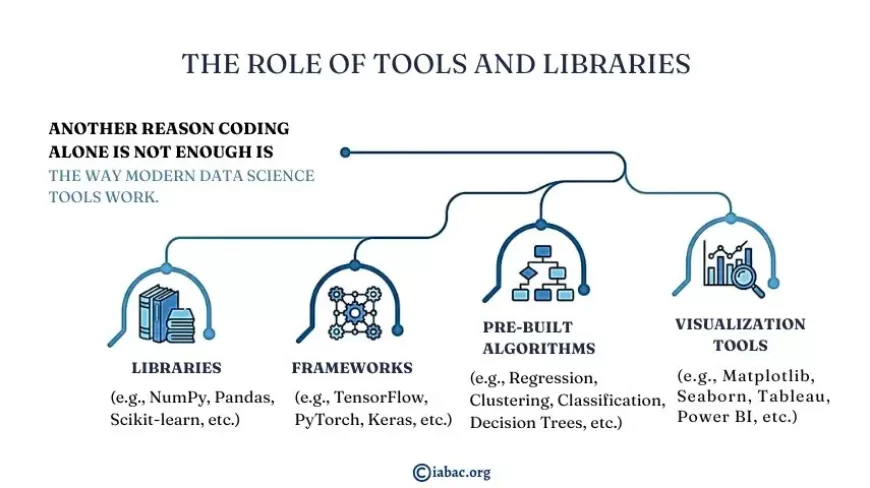
Another reason coding alone is not enough is the way modern data science tools work.
Most data scientists rely heavily on:
- Libraries
- Frameworks
- Pre-built algorithms
- Visualization tools
They are not inventing algorithms from scratch. Instead, they are:
- Selecting the right tools
- Applying them correctly
- Interpreting the output responsibly
The real skill lies in knowing what to use, when to use it, and why.
Without this understanding, even well-written code can produce misleading or useless results.
Why Data Science Is Not the Same as Software Development
Many people confuse data science with software engineering, which leads to unrealistic expectations.
Software development focuses on:
- System design
- Code efficiency
- Architecture
- Long-term maintainability
Data science focuses on:
- Exploration
- Experimentation
- Insights
- Decision support
While coding overlaps, the intent is very different.
A data scientist does not need to build complex applications. Instead, they need to extract meaning from data and explain it clearly to stakeholders who may not have technical backgrounds.
The Skill Coding Can’t Replace
One of the most overlooked aspects of data science is communication.
A great data scientist can:
- Explain findings in simple language
- Tell a story with data
- Justify decisions
- Highlight risks and limitations
Without this skill, even accurate models fail to create impact.
This is why many hiring managers value:
- Presentation skills
- Business understanding
- Project explanation
- Practical experience
Often, these matter as much as or more than coding ability.
Why Structured Learning Matters
Because data science is multidisciplinary, unstructured learning often leads to gaps.
Random tutorials teach tools, but not workflows.
Isolated coding lessons teach syntax, but not reasoning.
Structured programs and certifications address this by:
- Teaching concepts before tools
- Emphasizing real-world use cases
- Balancing theory with practice
- Building confidence step by step
Organizations like IABAC (https://iabac.org) focus on this structured approach, ensuring learners understand the complete data science process rather than treating coding as the only skill that matters.
This helps learners avoid the common trap of becoming “tool-heavy but insight-light.”
What Employers Actually Look For
From a hiring perspective, companies rarely ask:
- “How many programming languages do you know?”
Instead, they ask:
- “Can you solve this problem?”
- “Can you explain your approach?”
- “Can you work with messy data?”
- “Can you support decisions with evidence?”
Coding is evaluated as part of this—but never in isolation.
Candidates who can connect data, logic, and outcomes stand out far more than those who only demonstrate technical depth.
Why Beginners Should Stop Obsessing Over Coding
For beginners, over-focusing on coding often creates unnecessary fear.
Many people delay starting data science because they believe they must first “master” programming. In reality:
- Coding improves through usage
- You learn faster with context
- Understanding grows with application
Starting with fundamentals—data, logic, statistics, and interpretation—makes coding easier, not harder.
When learners understand why they are coding, what they are coding becomes clearer.
The Balanced Path Forward
The most effective data scientists follow a balanced path:
- Learn concepts first
- Practice tools gradually
- Focus on problem-solving
- Build real projects
- Improve communication skills
- Strengthen coding over time
This approach produces professionals who are adaptable, confident, and valuable across industries.
Coding is important in data science—but it is not the definition of data science.
A data scientist is not someone who writes the most code.
A data scientist is someone who thinks clearly with data.
When coding is combined with understanding, reasoning, and communication, it becomes powerful. On its own, it is just syntax. For anyone entering the field, remembering this distinction can make the journey smoother, more meaningful, and far more successful.