

















































Generative AI Use Cases in Business: 15 Real Examples by Industry
Learn 15 real generative AI use cases transforming healthcare, finance, marketing, & more with workflow examples, business impact, & implementation insights.

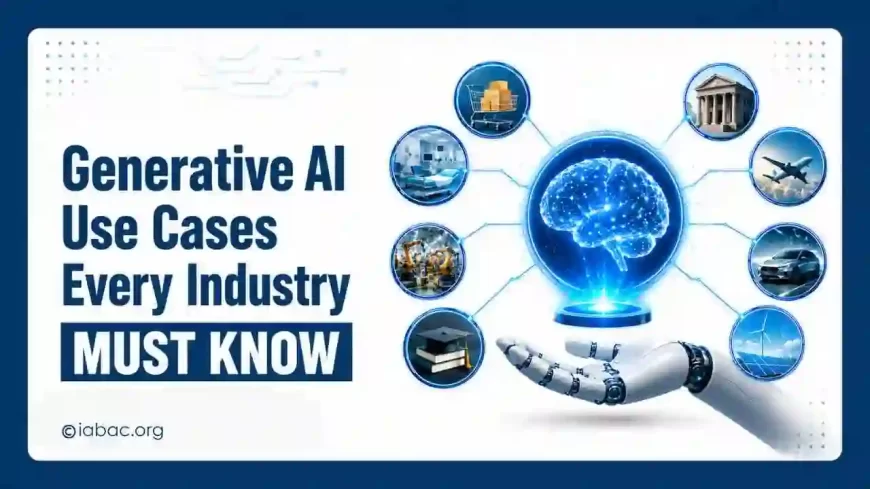
65% of organizations already use generative AI in at least one business function, with adoption growing rapidly across enterprise workflows.
What started as AI-powered chatbots and content tools has quickly evolved into something much bigger. Businesses are now using Generative AI use cases to reduce operational bottlenecks, accelerate decision-making, automate repetitive workflows, and improve productivity across departments.
From hospitals generating clinical summaries to cybersecurity teams analyzing threats faster, generative AI is becoming part of everyday business operations — not just experimentation.
As enterprise adoption grows, companies are shifting their focus from “using AI” to identifying which Generative AI use cases create business impact at scale.
What Is Generative AI in Business?
Generative AI in business refers to AI systems that create new outputs such as text, code, images, summaries, simulations, and insights based on patterns learned from massive datasets.
Unlike traditional automation tools that follow predefined workflows, generative AI adapts based on context and user intent. Modern large language models business teams use today can analyze information, generate responses, summarize reports, and assist employees across multiple tasks.
For example, a traditional support automation tool may route a ticket to the correct department. A generative AI system can summarize the issue, draft a reply, retrieve policy information, and recommend the next action within seconds.
This shift is why enterprises increasingly treat generative AI as infrastructure rather than an experimental tool.
Why Businesses Are Investing in Generative AI
McKinsey estimates generative AI could add up to $4.4 trillion annually in value across global industries — with the biggest gains in customer operations, software development, and knowledge work.
A Deloitte survey found that over 79% of enterprise leaders expect generative AI to transform their organizations within the next three years.
The rapid growth of Generative AI use cases comes from one core advantage: operational efficiency.
Businesses are using generative AI in business workflows to reduce repetitive work, speed up research, improve personalization, and support faster execution across departments.
Companies such as Microsoft, Google, OpenAI, Salesforce, Adobe, SAP, and ServiceNow are embedding generative AI across enterprise products and workflows.
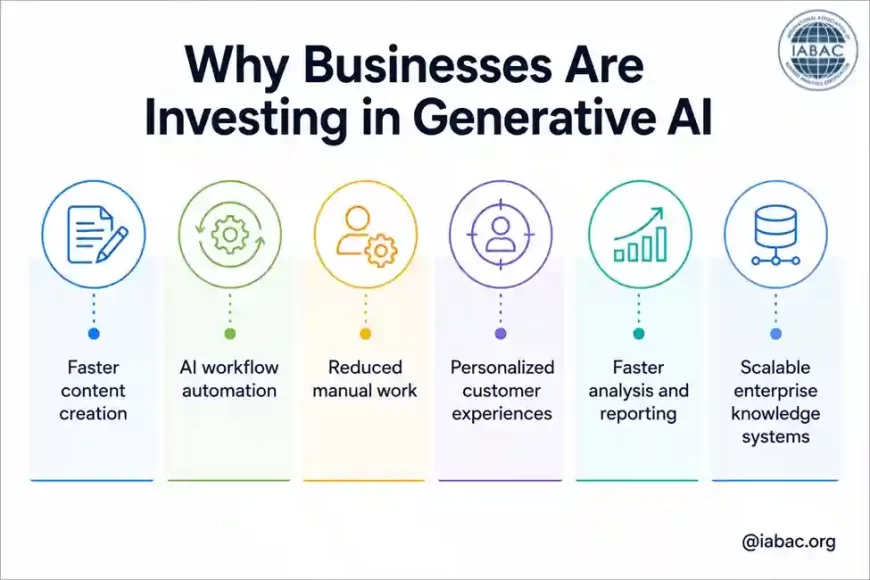
The biggest business drivers include:
-
Faster content and document creation
-
AI workflow automation across departments
-
Reduced manual administrative work
-
Personalized customer experiences
-
Faster analysis and reporting
-
Scalable enterprise knowledge systems
15 Generative AI Use Cases by Industry
Here are 15 specific generative AI examples across industries — each with a workflow snapshot and honest notes on where friction remains.
1. Generative AI in Healthcare
Healthcare teams spend an enormous amount of time on documentation. Artificial intelligence in healthcare helps reduce administrative pressure by generating physician notes, discharge summaries, prior authorization drafts, and medical transcriptions.
A hospital can use AI to convert doctor-patient conversations into structured clinical notes within minutes. Physicians still review outputs before approval, which remains essential for compliance and patient safety.
Business impact: Reduced documentation time and faster patient processing.
Challenge: Human validation remains critical for accuracy.
2. Generative AI in Finance
Financial institutions use generative AI in finance for
-
fraud investigation summaries
-
compliance documentation
-
analyst research
-
reporting assistance
For example, an AI system can analyze suspicious transactions, summarize patterns, and generate investigation reports for compliance teams.
Banks also use AI copilots to help analysts review large financial datasets faster.
Business impact: Faster investigations and improved reporting efficiency.
Challenge: Regulatory oversight and auditability requirements.
3. Generative AI in Marketing
Marketing teams are among the largest adopters of AI content generation.
Businesses use generative AI applications to create
-
campaign drafts
-
SEO content
-
email sequences
-
ad copy
-
product messaging
-
personalized recommendations
A retail brand can generate multiple ad variations for different audience segments within hours instead of days.
Poor oversight, however, can lead to repetitive or low-quality messaging. Human editing still matters.
Business impact: Faster campaign execution and personalization at scale.
Challenge: Maintaining originality and brand voice consistency.
4. Customer Support Automation
Customer service teams use generative AI business solutions to automate
-
multilingual replies
-
summarize support tickets
-
retrieve policy information
-
assist agents during conversations
For example, an e-commerce company can deploy AI to draft refund responses, summarize customer history, and suggest resolution steps during live chats.
Business impact: Faster resolution times and reduced support workload.
Challenge: AI-generated responses still require quality monitoring.
5. Software Development and Code Generation
Software companies increasingly rely on generative AI use cases for coding assistance.
Tools like GitHub Copilot help developers generate boilerplate code, debug errors, review pull requests, and create documentation.
A development team can use AI to accelerate coding tasks while engineers focus on architecture and logic.
Business impact: Improved development speed and reduced repetitive work.
Challenge: AI-generated code can still introduce security vulnerabilities.
6. Generative AI in Education
Generative AI in education supports adaptive quizzes, lesson generation, AI tutors, curriculum planning, and student feedback systems.
Educational institutions use AI to personalize learning materials based on student progress and comprehension levels.
For example, an AI tutor can generate simplified explanations for students struggling with specific topics.
Business impact: Better learning personalization and faster content preparation.
Challenge: Maintaining factual accuracy in educational material.
7. E-commerce Product Catalog Automation
E-commerce brands use generative AI examples for
-
product description generation
-
multilingual catalog updates
-
recommendation systems
-
SEO optimization
A marketplace with thousands of products can automate product copy creation while maintaining search visibility.
Business impact: Faster catalog scaling and improved product discoverability.
Challenge: Generic AI descriptions may reduce differentiation.
8. Generative AI in Manufacturing
Generative AI in manufacturing remains under-discussed despite strong adoption potential.
Manufacturers use AI to generate maintenance reports, standard operating procedures, troubleshooting guides, and factory support documentation.
A production facility can deploy AI assistants that help technicians diagnose equipment issues using historical maintenance records.
Business impact: Faster maintenance workflows and reduced operational downtime.
Challenge: AI systems require high-quality operational data.
9. Legal Contract Drafting and Review
Law firms and enterprise legal teams use generative AI to summarize clauses, review contracts, generate templates, and assist legal research.
AI can quickly identify missing clauses or compare agreements against company policies.
Business impact: Reduced document review time.
Challenge: Legal review still requires experienced professionals.
10. HR and Recruitment
Recruitment teams use generative AI in business for job descriptions, interview summaries, onboarding documents, and resume screening assistance.
An HR team can generate personalized onboarding plans for different departments automatically.
Business impact: Faster hiring workflows and reduced administrative work.
Challenge: AI bias risks during candidate evaluation.
11. Sales Prospect Research
Sales teams use AI automation in business workflows to generate account summaries, draft outreach emails, update CRM notes, and identify buying signals.
For example, AI can analyze a prospect’s company news, financial updates, and recent hiring trends before creating outreach suggestions.
Business impact: Faster lead preparation and better personalization.
Challenge: Over-automation can reduce authenticity.
12. Media and Entertainment
Media companies use generative AI for
-
video scripting
-
Localization
-
subtitle generation
-
dubbing assistance
-
thumbnail concepts
Studios increasingly use AI to speed up repetitive editing and production tasks.
Business impact: Faster content production cycles.
Challenge: Copyright and creative ownership concerns.
13. Cybersecurity Threat Analysis
Cybersecurity teams use AI-powered workflows to summarize incidents, analyze threat intelligence, and assist SOC analysts during investigations.
An AI system can correlate logs, summarize suspicious activity, and generate incident reports faster than manual workflows.
Business impact: Faster response and improved analyst productivity.
Challenge: AI-generated threat analysis still requires verification.
14. Research and Consulting
Consulting firms use Generative AI use cases to summarize reports, synthesize research, generate presentation drafts, and extract insights from large datasets.
A consulting team analyzing hundreds of pages of industry research can reduce review time significantly using AI summarization tools.
Business impact: Faster knowledge synthesis and improved productivity.
Challenge: AI may overlook contextual nuance.
15. Enterprise Knowledge Management
One of the fastest-growing Generative AI use cases involves enterprise knowledge systems.
Organizations use AI assistants to search internal documentation, summarize policies, retrieve company information, and support employees across departments.
Instead of manually searching through knowledge bases, employees can ask questions conversationally and receive contextual answers instantly.
Business impact: Faster internal information access and improved productivity.
Challenge: Access control and data governance.
Top Generative AI Tools Businesses Use in 2026
Several generative AI tools are shaping modern business operations.
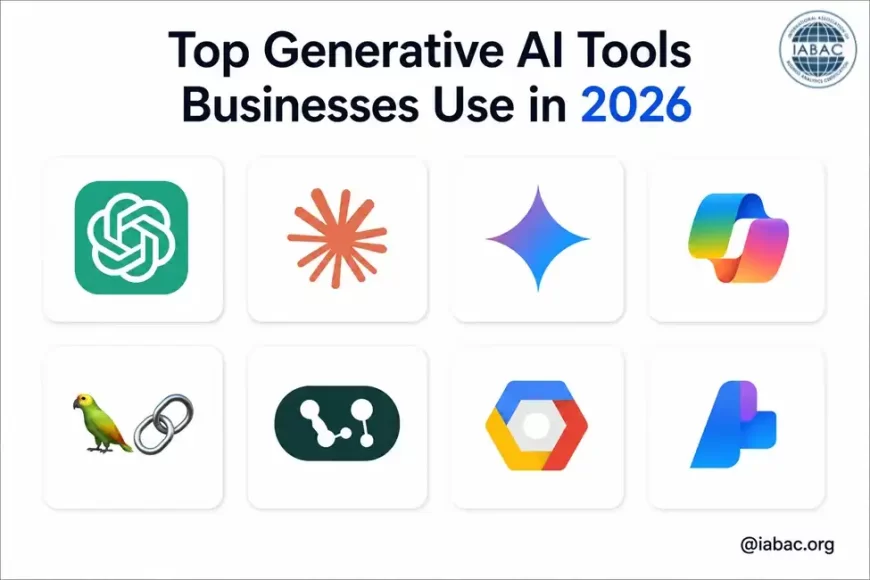
Large Language Model Platforms
-
ChatGPT Enterprise for enterprise productivity and AI copilots
-
Claude for long-document analysis
-
Gemini for Google ecosystem workflows
-
Microsoft Copilot for enterprise collaboration
Development Platforms
-
LangChain for AI workflow orchestration
-
LangGraph for agent workflows
-
Vertex AI for enterprise AI deployment
-
Azure AI Studio for enterprise integration
Creative Platforms
-
Adobe Firefly for design workflows
-
Midjourney for visual generation
-
Runway for video editing and production
Benefits of Generative AI in Business
The biggest advantage of Generative AI use cases is scalability.
With the applications of Generative AI, businesses can automate repetitive workflows, accelerate reporting, improve personalization, and increase operational speed without expanding teams at the same pace.
Key benefits include:
-
Faster execution across workflows
-
Reduced repetitive administrative work
-
Better knowledge accessibility
-
Improved personalization
-
Faster research and reporting
-
Support for AI business automation initiatives
Challenges and Risks of Generative AI
Strong adoption does not eliminate risk.
Businesses deploying generative AI business solutions still face major operational and governance challenges.
Key concerns include:
-
Hallucinated or inaccurate outputs
-
Security and data leakage risks
-
Copyright and intellectual property concerns
-
Compliance violations in regulated industries
-
Bias in AI-generated recommendations
-
Overdependence on AI-generated outputs
-
Governance and monitoring complexity
As generative AI is changing the way we work, organizations treating AI governance seriously are more likely to scale successfully than those focusing only on speed.
How Businesses Successfully Implement Generative AI
The most successful enterprise AI adoption strategies usually begin with narrow, high-impact workflows.
Instead of automating entire departments immediately, businesses often start with tasks such as:
-
internal document summarization
-
customer support assistance
-
reporting automation
-
knowledge retrieval
-
AI-powered workflow support
Human review remains essential, especially in finance, healthcare, and legal environments.
Strong implementation strategies also include:
-
governance frameworks
-
employee training
-
integration planning
-
security reviews
-
performance monitoring
Professionals planning to build a career in Generative AI increasingly need a practical understanding of large language models, AI workflow automation, and enterprise deployment strategies.
Where Enterprise AI Adoption Is Heading
The next phase of Generative AI use cases focuses heavily on autonomous execution and multimodal systems.
Businesses are moving toward:
-
AI agents capable of handling workflows independently
-
Enterprise copilots embedded into daily operations
-
Multimodal AI systems that process text, voice, images, and video together
-
AI-native internal operations
-
Synthetic business workflows combining automation and reasoning
Organizations investing in AI literacy and workforce training are better positioned for long-term adoption. Many professionals are pursuing structured artificial intelligence learning programs to understand enterprise AI systems, workflow automation, and responsible deployment practices.
Frequently Asked Questions About Generative AI Use Cases
What are generative AI use cases?
Generative AI use cases refer to practical business applications where AI systems generate content, summaries, code, insights, images, or workflow outputs to support operations and productivity.
How are businesses using generative AI?
Businesses use generative AI for customer support, marketing, software development, reporting, research, HR workflows, and enterprise knowledge management.
What industries use generative AI the most?
Healthcare, finance, marketing, software development, ecommerce, manufacturing, education, and cybersecurity are among the fastest-growing sectors adopting generative AI.
What are some real world generative AI examples?
Examples include AI-generated clinical summaries, automated fraud reports, AI coding assistants, personalized marketing campaigns, and AI-powered research synthesis tools.
Is ChatGPT used in business?
Yes. Many enterprises use ChatGPT for document drafting, workflow assistance, customer support, coding help, and enterprise productivity tasks.
Generative AI use cases have expanded far beyond content creation. Businesses now use generative AI across operations, research, customer support, software development, healthcare, cybersecurity, and enterprise knowledge systems.
The strongest results come from organizations treating AI as an operational capability rather than a short-term trend. Companies combining governance, employee training, and workflow-focused deployment strategies are seeing stronger long-term outcomes.
As enterprise AI adoption accelerates, businesses that understand how to integrate generative AI responsibly and strategically will gain a significant operational advantage.