






















































How Can a Data Analyst Fresher Get a Job in 2026?
Want your first data analyst job in 2026? Learn practical ways freshers can build skills, create projects, prepare for interviews, and get hired faster.

Every data analyst job posting says "2–3 years of experience required." You're a fresher. You have zero. So what do you do, wait two years before even applying?
No. You figure out how to get in anyway.
The truth is, companies need people who can work with data more than ever before. The tools are more accessible, the learning resources are free or cheap, and recruiters are actively looking for sharp, freshers who show the right signals.
The gap between "no job" and "first job" is rarely about talent; it's almost always about strategy.
This guide will give you that strategy.
Why 2026 Is Actually a Good Time to Start?
Many freshers assume AI is eating the data analyst role. That fear is overblown. The demand for analysts who can think critically, ask the right questions, and translate numbers into decisions is growing faster than any tool can replace.
AI is not killing the role — it is reshaping it. Analysts who know how to work alongside AI tools, validate outputs, and frame the right business questions are becoming the most sought-after professionals in the market.
According to Fortune Business Insights, the global data analytics market is projected to reach $104.39 billion by the end of 2026, growing at an annual rate of 21.5%, and is expected to explode to $495.87 billion by 2034. That kind of growth does not happen in a field that is running out of jobs.
What this means for you as a fresher: learn to work with AI tools rather than be threatened by them. Analysts who can prompt AI, validate its outputs, and interpret results are already a step ahead of those who can't.
Step 1: Build the Right Skill Stack
Most freshers make the mistake of hoarding skills without depth.
Employers in 2026 aren't looking for someone who has "heard of" Python; they want someone who has used it on real data problems.
Here's what the market actually demands:
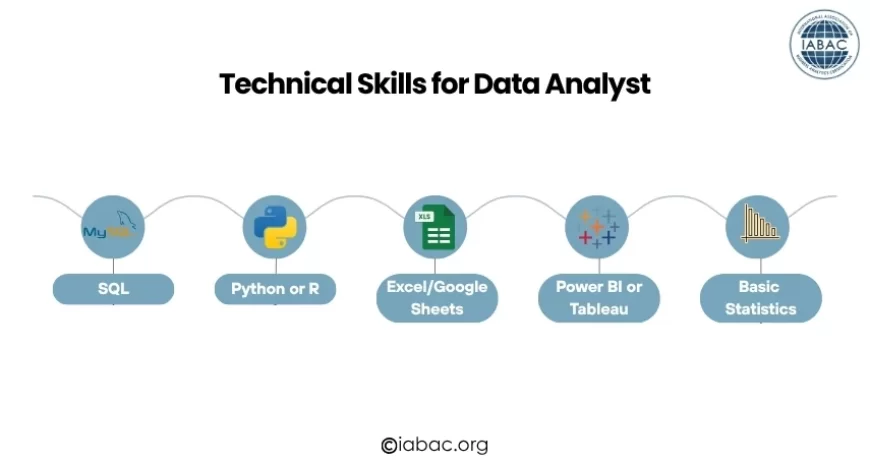
Technical Skills:
-
SQL: Non-negotiable. Learn queries, joins, CTEs, and window functions.
-
Python or R: Python wins on demand. Focus on Pandas, NumPy, and Matplotlib before jumping to machine learning.
-
Excel/Google Sheets: Underrated. Many companies still run their reporting on spreadsheets.
-
Power BI or Tableau: Pick one and go deep. A clean, interactive dashboard is a visible, impressive skill that speaks for itself in an interview.
-
Basic Statistics: Concepts like probability, hypothesis testing, and regression analysis serve as the bedrock of data analysis, giving freshers the tools to extract meaningful insights from datasets.
Soft Skills That Actually Get You Hired:
-
Storytelling with data: Can you explain a chart to someone non-technical?
-
Problem framing: Before you analyze, can you define the right question?
-
Attention to detail: Dirty data, wrong formulas, and misread results are common traps that freshers fall into.
In 2026, computer science (28%) and engineering (22%) graduates have climbed in employer preference, reflecting the growing technical demands of modern data analysis. But if your background is different, don't be discouraged — demonstrable skills matter more than degree labels to most hiring managers.
Step 2: Get Certified and Choose Wisely
Certifications give you credibility when your experience column is thin. But not all certifications carry equal weight.
Here are some things worth your time in 2026:
-
IABAC Certified Data Analyst: The International Association of Business Analytics Certification (IABAC) is one of the most industry-recognized credentials, particularly in Asian job markets, including India. It validates your understanding of data analytics concepts, tools, and business applications, and is increasingly referenced in Indian job postings as a preferred qualification.
-
Google Data Analytics Certificate: Widely recognized, beginner-friendly, and covers the full analytics workflow end-to-end.
-
Microsoft Certified: Power BI Data Analyst Associate: Strong choice if you are targeting corporate and enterprise roles.
-
IBM Data Analyst Professional Certificate: Covers Python, SQL, and visualization in a structured, practical format.
Complete one or two certifications properly rather than collecting four half-finished ones. Recruiters notice the difference.
Step 3: Build a Portfolio That Does the Talking
Here is a reality check that should sharpen your focus: in March 2026, Robert Half research found that 67% of HR leaders say AI-generated applications slow down hiring, and 65% of hiring managers say AI-polished resumes make it harder to assess real skills.
In a sea of templated applications, a real portfolio with honest, hands-on work cuts through faster than anything else.
When you first enter the job market as an entry-level analyst, it is expected that your portfolio contains mostly guided capstone projects. But you want to use it to make your passions and interests shine through — tell a story about how your skills have developed.
What makes a strong fresher portfolio:
-
2–3 end-to-end projects: Don't just clean data and stop. Go from raw data to insight to a clear recommendation.
-
Domain relevance: This is a gap most advice misses: if you want to work in e-commerce, analyze e-commerce data. If you want fintech, pick a financial dataset. Specializing in early signals genuine intent.
-
GitHub presence: Host your projects publicly. Write a clear README explaining the problem, your approach, and what you found.
-
A simple portfolio page: Even a free Notion page or GitHub Pages site listing your projects makes you look more serious than the majority of applicants.
Where to find real datasets: Kaggle, Google Dataset Search, data.gov.in for India-specific angles, and the UCI Machine Learning Repository.
Step 4: Treat Your Resume Like a Data Product
Your resume is a marketing document, not a diary.
It needs to work for two audiences: the ATS that filters it first, and the human recruiter who reads it next.
For your fresher resume:
-
Use keywords from job descriptions naturally; SQL, Python, Tableau, and Power BI should appear in context, not just dumped in a skills list.
-
Follow this format for every bullet point: Action Verb + Task + Result.
For example: "Analyzed customer churn data using Python, identifying 3 key segments that reduced predicted churn by 18%."
-
Keep it to one page and tailor each application to the specific job description — adjust your resume and cover letter for each role.
-
Add links to your LinkedIn, GitHub, and portfolio at the top.
-
Avoid tables and columns — ATS systems frequently struggle to read them, and your information gets lost.
Step 5: Make LinkedIn Work for You
Most freshers have a LinkedIn profile. Very few use it actively. That is the gap worth closing.
Openly stating your career level as a "Data Analyst Fresher" in your LinkedIn headline is actually a smart move — it sets honest expectations and helps the right recruiters find you.
Quick LinkedIn wins for freshers:
-
Write a summary that explains why you love data, not just what tools you know.
-
Post one project insight or learning every week — this builds visibility over time without needing a large following.
-
Connect with data analysts at companies you want to join and send a short, genuine note — not a copy-paste template.
-
Follow hiring managers at target companies. They often post about openings before the job goes live on a job board.
-
Join active groups like "Data Analytics Professionals" and "SQL & Python for Data Science."
Step 6: Target the Right Job Titles
Most freshers search only for "Data Analyst" and miss a large chunk of relevant openings. Companies use different titles for similar roles.
Search for these as a fresher:
-
Junior Data Analyst
-
Business Analyst (entry level)
-
Data Associate
-
Reporting Analyst
-
Analytics Intern (paid)
-
BI Analyst Trainee
-
Operations Analyst
In India specifically, Naukri, Internshala, LinkedIn, and AngelList are the most active platforms. Startups tend to be more open to freshers than large enterprises — they need hands-on contributors, and the learning curve you get working at a startup in year one often beats what you'd learn in two years at a big company.
Step 7: Prepare for Interviews Like a Problem-Solver
Fresher interviews in 2026 typically consist of three parts: a technical round covering SQL or Python, a business case or problem-solving exercise, and a behavioral conversation.
What to prepare:
-
SQL: Practice on HackerRank, LeetCode (easy to medium), and Mode Analytics.
-
Business case thinking: When given a scenario like "our sales dropped 20% last month," walk through your approach: what data would you look at, what hypotheses would you test, and what would you recommend.
-
Your own projects: Every project in your portfolio should be something you can talk through for five minutes: the problem, the data, the finding, and the recommendation.
-
Live tool work: Be ready to screen-share and work in Excel, SQL, or Python in real time.
Prepare your key topics, algorithms, and statistical approaches thoroughly. Plan to demonstrate your problem-solving abilities while working with real-world data — this is what distinguishes you in the room.
Step 8: Handle the Rejection Phase Without Losing Momentum
Here is something most career blogs skip: you will face rejections. Probably many. That is not a sign you are doing it wrong — it is part of the process.
The freshers who land jobs are rarely the most talented ones in the room. They are the ones who kept going while others quietly stopped. A few practical ways to stay in motion:
-
Set a daily application target — 5 to 10 quality, tailored applications beat 50 generic ones every time.
-
Track every application in a spreadsheet with date, company, role, status, and follow-up date.
-
Ask for feedback when rejected. You will not always get it, but when you do, it is gold.
-
Upskill during the gap. Every week without a job should add something new to your portfolio or skill set.
-
Find a community. Reddit's r/dataanalysis, Discord analytics servers, or local meetups keep you connected and accountable.
Getting your first data analyst job in 2026 is not about being perfect. It is about being prepared, visible, and persistent. Companies across fintech, healthcare, retail, and edtech in India and globally are actively looking for fresh talent that comes in curious and hungry to contribute.
Build real skills. Work on real projects. Put yourself out there on GitHub and LinkedIn. Get certified, including recognized credentials like the IABAC Certified Data Analyst, to give your profile the credibility it needs when experience is thin. And treat every rejection as data. Analyze it, learn from it, and iterate.
That is exactly the mindset that lands the first job.