



























































Data Science Career Progression: A Complete 2026 Roadmap
The complete 2026 data science career roadmap, including roles, skills, salary growth, certifications, and promotion strategies.

Data science career progression in 2026 looks fundamentally different from what it was three years ago. Fewer pure entry-level "Data Scientist" roles exist. The career ladder has new rungs, new names, and steeper expectations at every transition, driven by measurable shifts like the rise of MLOps requirements, the emergence of AI ethics roles, and employers increasingly demanding production ML experience before granting mid-level titles. Many professionals stall not because they lack technical skill, but because they don't have a clear map of where they stand or what proof employers actually want before approving the next level.
This article lays out the full data science career structure for 2026: the titles, the skills required at each rung, the salary jumps you can realistically expect, and the specific behaviors that separate professionals who advance quickly from those who plateau. For competitive US job markets, externally validated credentials have become increasingly relevant because employers want documented proof of progression, not just tenure. By the end, you'll have a concrete action plan for your next move.
Data Science Career Progression: How the Ladder Is Structured in 2026
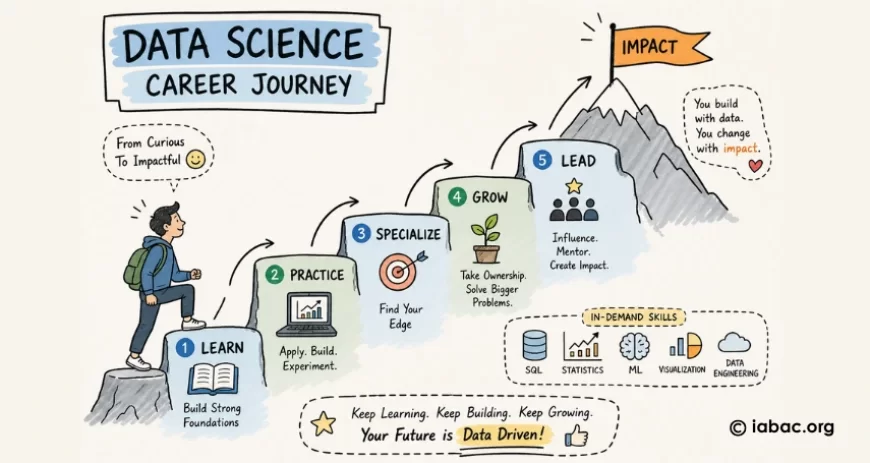
The full data scientist career ladder runs from Junior Data Analyst or Junior Data Scientist (0, 2 years) through Mid-Level Data Scientist (2, 5 years), Senior Data Scientist (5, 8 years), Lead or Staff Data Scientist (8, 10+ years), Manager or Director (8, 12+ years), and Head of Data or Chief Analytics Officer (10, 15+ years). Enterprises use formal banded ladders, typically L3 through L7 and above, while startups compress these into five to seven generalist roles where promotions happen faster but with less structure. For a practical overview of the broader Career Opportunities in Data Science, the IABAC pathway guide is a useful reference.
One critical shift in 2026: "Data Scientist" as an entry title is increasingly rare. The role now skews mid-senior or ML-specialized. Data Analyst and Machine Learning Engineer have become the dominant entry and growth roles, which means career-switchers and new graduates need to recalibrate their expectations and entry strategy from the start. Job posting analyses and role breakdowns also reflect this trend across the market (data science job roles overview).
The fork between the individual contributor (IC) path and the management path typically appears around the Senior or Lead level, roughly years seven to ten. Leading organizations in tech and finance now treat the switch to management as a lateral move rather than a promotion, recognizing both tracks as equally valid. The IC path extends to Staff Scientist, Principal Scientist, and Distinguished Scientist roles, with compensation matching or exceeding management counterparts at the Director level. Some organizations have adopted a "pendulum" approach, allowing professionals to move between IC and management roles, giving professionals a two-to-three-year window to test management before role expectations fully diverge from the IC track. For managers looking to formalize those skills, IABAC's Data Science for Managers material outlines the key competencies organizations expect.
Junior-Level Must-Haves
Junior roles require Python or R fundamentals, SQL, basic data visualization, and introductory ML using tools like Scikit-learn. The primary expectation at this stage is task execution: completing clearly scoped assignments accurately and on time, with growing ability to communicate results to a direct manager.
Senior-Level Responsibilities
Senior roles add TensorFlow or PyTorch proficiency, Spark for big data processing, MLOps practices, and production-grade model deployment. The expectation expands significantly: Senior professionals own outcomes, not just deliverables. They collaborate across teams, mentor junior colleagues, and are accountable for the business performance of the models they ship.
Data Science Career Progression, Skill Gaps That Stall Careers
Moving to mid-level means owning full ML pipelines, working across cloud platforms such as AWS, Azure, or GCP, running A/B tests, and doing advanced feature engineering. At the Lead level and above, requirements shift toward systems architecture thinking, multi-cloud strategy, ethical AI governance, and the ability to evaluate technical trade-offs across an entire data infrastructure.
The gap between Senior and Lead is less about knowing more algorithms and more about systems thinking and technical decision authority. Professionals who stall at the Senior level often have deep model-building skills but haven't demonstrated the ability to make binding technical decisions for a platform or team. That distinction is what hiring committees look for when approving Lead-level promotions.
The soft skill ceiling shows up consistently in promotion feedback across major tech and finance firms. Business storytelling is the most common blocker for promotion past mid-level. Technical output that can't be translated into revenue impact, cost savings, or strategic decisions has a low ceiling in any organization. Senior-plus roles require professionals to present to non-technical stakeholders, write executive summaries, and frame business problems as ML tasks before touching a single model.
The jump from Lead to Manager adds people management, coaching, hiring judgment, and OKR-setting to the list, areas where many data scientists lack formal training. The professionals who close this gap fastest seek out stakeholder presentations, write internal reports, and actively document mentorship of junior colleagues as part of their promotion case.
Salary Jumps You Can Realistically Expect at Each Level
Entry-level data roles in the US earn between $85,000 and $130,000 in 2026. The move to mid-level brings $115,000 to $156,000. Senior roles range from $145,000 to $200,000 or more. Lead and Principal positions command $210,000 to $280,000 or above. Head of Data and C-level analytics roles in major markets reach $300,000 in base salary, with total compensation at top tech firms, including equity, exceeding $350,000. These are not incremental steps. The jump from mid-level to Senior alone often represents a $30,000 to $60,000 increase, enough to make the investment in skill development and credentials straightforwardly rational.
US geography creates a significant multiplier on these figures. San Francisco and Mountain View roles earn 30, 50% above the national median. New York and Seattle follow closely. Some location-agnostic companies pay San Francisco-equivalent rates to fully remote professionals regardless of location, though this varies by employer. On the specialization side, NLP, Computer Vision, and AI/ML specialists command $160,000 to $220,000 or more even at mid-level, significantly above generalist peers. Choosing a high-demand specialization such as MLOps, Generative AI, or Healthcare Analytics is one of the faster ways to close the gap between your current compensation and the next level's band without waiting for a formal title change.
What Separates Fast-Tracked Data Scientists from Those Who Plateau
Employers promoting professionals to Senior and Lead roles look for a specific evidence pattern: quantified business outcomes tied directly to the candidate's technical work. "Built an ML model" is table stakes at every level. "Built a churn prediction model that reduced at-risk customer churn by 20% in Q3, preserving $2.1M in annual recurring revenue" is a promotion argument. Fast-tracked professionals document their KPIs: pipeline coverage ratios, model inference improvements, revenue attribution from data products, and team productivity gains. Stagnant careers tend to produce excellent technical work with no documented business linkage. For practical examples and a broader career perspective, see this complete guide to the data scientist career path.
Framing every project in business outcome terms, starting from day one, with specific metrics, clear timelines, and documented methods, signals not just execution capability but strategic thinking. That combination is what separates candidates who advance on schedule from those who accumulate tenure without movement. If you need a concise list of relevant operational metrics, review standard KPIs for data teams to ensure your dossier includes the metrics hiring committees expect.
One reason externally recognized credentials have gained traction at the Senior and Lead transition is precisely that internal reputation doesn't transfer. What does transfer is a benchmarked, third-party competency record. IABAC (International Association of Business Analytics Certification) offers role-specific credentials in data science, MLOps, AI, and analytics built around a structured competency framework. For US professionals, earning a role-aligned credential at the right career stage creates a documented progression milestone, particularly useful for promotion cases, salary negotiations, and cross-company moves where your internal standing means nothing to a new employer's hiring committee.
Your 6, 12 Month Action Plan to Reach the Next Level
Start with an honest level assessment. Compare your current responsibilities, the business outcomes you own, and your documented technical skills against the benchmark for the level above you. The typical gaps are predictable. Junior to mid-level means moving from task execution to full project ownership with business framing. Mid-level to Senior means shifting from individual model work to cross-team collaboration, mentorship, and production system accountability. Senior to Lead means developing roadmap ownership, architecture decision authority, and genuine stakeholder influence.
Once you know your gap, the highest-leverage move is a stretch project that forces you to operate at the next level, ideally paired with a mentor who has already cleared that bar and a credential that documents the transition to external audiences. These three inputs, pursued in parallel, compress the timeline significantly compared to waiting for tenure to do the work for you.
The sprint structure looks like this:
-
Months 1, 3: Audit your impact documentation and build a portfolio of quantified business outcomes from existing projects.
-
Months 4, 6: Take on a project with visible business stakes and seek at least one formal mentorship responsibility for a junior colleague.
-
Months 7, 9: Pursue a role-specific certification aligned to your specialization and verify it maps to a recognized competency framework, giving your manager and prospective employers a third-party benchmark to reference during promotion or hiring discussions. A helpful resource for structuring that work is Coursera'sjob-leveling matrix for data science career pathways.
-
Months 10, 12: Present your promotion case with a concrete evidence dossier: business outcomes, mentorship results, and your credentialed competency validation.
This is a structured argument, not a passive waiting game. It makes the promotion decision straightforward for decision-makers to approve because every element they need to justify it is already documented and externally validated.
The Roadmap Is Clear: Now Execute It
Data science career progression in 2026 is deliberate, not accidental. The professionals who advance fastest aren't necessarily the most technically gifted, they're the ones who understand the level expectations, close the right gaps, document their business impact consistently, and use every available tool, including credentials, to make their advancement case objectively clear. The ladder is longer and more structured than it used to be, but that also means the milestones are better defined than ever before.
Knowing your level gives you a target. Quantified impact gives you a promotion argument. A recognized, role-aligned credential gives the decision-maker something concrete to approve. The milestones are defined. Execution is the variable.