

























































What Is the Role of a Health Data Analyst in Healthcare?
Learn the role of a health data analyst in healthcare including analyzing patient data improving hospital operations and supporting better clinical decisions.

Healthcare systems generate an enormous amount of data every day. Hospitals record patient histories, laboratories store diagnostic results, pharmacies maintain prescription records, and insurance providers track claims and billing details. This information plays a major role in improving patient treatment, managing hospital operations, and shaping healthcare policies.
However, raw healthcare data by itself does not provide useful insights. It needs to be carefully examined, organized, and interpreted to support meaningful decisions. This is where a Health Data Analyst plays an important role.
A Health Data Analyst studies large healthcare datasets, identifies patterns, and helps healthcare organizations improve patient care, reduce operational costs, and support medical research. As healthcare continues to become more data-driven, professionals skilled in Data Analytics are becoming essential to hospitals, clinics, pharmaceutical companies, and public health organizations. In this guide, students will learn about the responsibilities, skills, career path, and certifications needed to become a successful Health Data Analyst.
Understanding the Role of a Health Data Analyst
A Health Data Analyst is a professional who collects, processes, and analyzes healthcare data to improve clinical and business decisions. These analysts work with patient records, treatment outcomes, hospital resource usage, and disease statistics.
Their main goal is to convert complex data into meaningful insights that help healthcare organizations function more efficiently.
Healthcare data analysts often work with information from multiple sources such as:
- Hospitals and clinics
- Insurance providers
- Pharmaceutical companies
- Public health agencies
- Diagnostic laboratories
- Rehabilitation centers
By analyzing data from these sources, analysts can identify trends in diseases, patient outcomes, and treatment effectiveness.
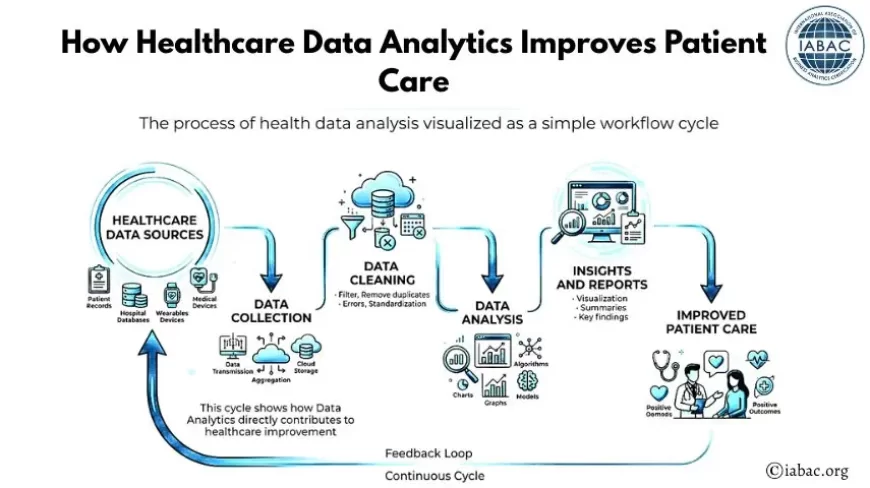
Why Health Data Analytics Is Important
Healthcare organizations depend on accurate information to provide quality patient care. When data is analyzed properly, it can help doctors, administrators, and policymakers make better decisions.
Health data analysis supports several important goals.
- Improving Patient Care: Data helps doctors understand which treatments produce the best outcomes for certain conditions.
- Identifying Disease Trends: Health data analysts can detect patterns in diseases and help identify emerging health risks.
- Managing Healthcare Costs: Hospitals can analyze operational data to reduce waste and improve resource allocation.
- Supporting Public Health Planning: Government agencies use data analysis to prepare for health emergencies and manage public health programs.
- Improving Hospital Operations: Data insights help administrators optimize staffing, equipment usage, and patient flow.
Because of these benefits, the demand for skilled Health Data Analyst professionals continues to grow.
Main Responsibilities of a Health Data Analyst
Health data analysts perform a variety of tasks related to collecting, organizing, and interpreting healthcare information.
1. Managing Healthcare Data
One of the first responsibilities of a Health Data Analyst is organizing data from different sources.
Healthcare data may include:
- Electronic health records (EHR)
- Medical imaging data
- Insurance claims
- Patient demographics
- Treatment outcomes
- Hospital operational data
Analysts must ensure the data is accurate, complete, and properly structured.
2. Cleaning and Preparing Data
Healthcare data often contains errors, duplicates, or missing values. Analysts must clean the data before performing analysis.
Typical steps include:
- Removing duplicate records
- Filling missing values
- Standardizing formats
- Correcting inconsistent entries
Clean data improves the accuracy of healthcare insights.
3. Analyzing Healthcare Trends
Once data is prepared, analysts apply Data Analytics techniques to discover trends.
Examples include:
- Studying patient recovery rates
- Evaluating hospital readmission patterns
- Identifying disease outbreaks
- Analyzing treatment effectiveness
These insights help healthcare professionals develop better strategies for patient care.
4. Creating Data Reports and Visualizations
Health data analysts present their findings through reports, charts, and dashboards.
Common tools include:
- Excel
- SQL databases
- Python or R
- Data visualization tools
Visual reports make it easier for doctors and administrators to understand complex data.
5. Supporting Decision-Making
After analyzing healthcare data, analysts provide recommendations.
For example, they may suggest:
- Improving patient discharge procedures
- Adjusting staffing levels
- Enhancing disease monitoring systems
- Introducing preventive healthcare programs
Their work directly influences healthcare decision-making.
Mathematical Foundations in Health Data Analytics
Health data analysis often uses mathematical models to interpret large datasets.
Matrix Representation of Healthcare Data
Healthcare datasets can be represented as matrices.
Each row represents a patient record.
Each column represents a medical variable.
This structure helps analysts apply statistical models to healthcare data.
Statistical Analysis Example
A simple statistical formula used in health analytics is the mean.
Mean=N∑X
Where:
-
represents the total values
-
represents the number of observations
For example, analysts may calculate the average recovery time for a specific treatment.
Key Skills Required for a Health Data Analyst
To succeed in healthcare analytics, professionals need a combination of technical and analytical skills.
Technical Skills
Important technical skills include:
- Data analysis techniques
- SQL database management
- Statistical analysis
- Data visualization tools
- Healthcare data management
- Machine learning basics
These skills help analysts work with complex healthcare datasets.
Analytical and Business Skills
In addition to technical abilities, analysts must have strong professional skills.
Important competencies include:
- Mathematics and statistics
- Communication skills
- Research capabilities
- Critical thinking
- Problem-solving ability
Health data analysts must communicate insights clearly to medical professionals and administrators.
Tools Used in Healthcare Data Analytics
Health data analysts rely on various tools to manage and analyze healthcare information.
Common tools include:
|
Tool |
Purpose |
|
SQL |
Database management |
|
Excel |
Data organization and analysis |
|
Python |
Statistical modeling and automation |
|
R |
Advanced statistical analysis |
|
Visualization tools |
Creating dashboards and reports |
These tools help transform healthcare data into meaningful insights.
Career Opportunities for Health Data Analysts
Healthcare analytics offers many career opportunities across different sectors.
Common job roles include:
- Healthcare Data Analyst
- Clinical Data Analyst
- Healthcare Business Analyst
- Public Health Data Analyst
- Healthcare Data Consultant
Professionals with Data Analytics Certifications often find better career opportunities because certifications validate their technical expertise.
Job Market Growth for Healthcare Data Analysts
The healthcare analytics field continues to expand due to increasing reliance on data-driven healthcare systems.
Several factors contribute to this growth:
- Expansion of electronic health records
- Increasing healthcare data volume
- Growth in medical research
- Rising demand for cost-effective healthcare systems
Healthcare organizations require skilled professionals who can manage and interpret health data effectively.
Educational Path to Becoming a Health Data Analyst
Students interested in this career can follow several educational pathways.
Common academic fields include:
- Data Analytics
- Computer Science
- Health Informatics
- Information Technology
- Healthcare Management
A strong educational foundation helps students understand both healthcare systems and data analysis techniques.
Importance of Data Analytics Certifications
While education provides theoretical knowledge, Data Analytics Certifications demonstrate practical skills and industry readiness.
Certifications offer several benefits.
- Professional Recognition: Certifications validate that you possess real-world analytics skills.
- Career Advancement: Certified professionals often gain access to higher-level positions.
- Skill Development: Certification programs focus on hands-on learning and practical applications.
- Employer Confidence: Employers trust certified candidates because their skills are verified.
For students pursuing healthcare analytics careers, certifications can strengthen job opportunities.
Example Workflow of Health Data Analysis
A Health Data Analyst may follow these steps in a typical project.
- Collect patient data from hospital systems
- Clean and organize the dataset
- Perform statistical analysis
- Identify patterns in treatment outcomes
- Create visual dashboards
- Present insights to healthcare administrators
This workflow supports better decision-making within healthcare organizations.
Future of Health Data Analytics
Healthcare systems are becoming increasingly digital. Technologies such as artificial intelligence, predictive analytics, and machine learning are transforming how medical data is analyzed.
Future trends include:
- Predictive healthcare models
- Real-time disease monitoring
- AI-based diagnosis systems
- Personalized medicine using data analysis
Health Data Analysts will continue to play an important role in these advancements.
Healthcare organizations depend on accurate data insights to improve patient care, optimize operations, and support public health planning. A Health Data Analyst helps convert complex medical data into meaningful information that guides important healthcare decisions. As healthcare systems generate more data, the demand for professionals skilled in Data Analytics will continue to grow. Students who develop strong analytical skills, gain hands-on experience, and earn recognized Data Analytics Certifications will be well prepared to succeed in this rewarding field.
For individuals who want to combine technology, data analysis, and healthcare improvement, becoming a Health Data Analyst offers a meaningful and impactful career path.