


























































10 Must-Have Skills Every BI Analyst Needs in 2026
Want a career in business intelligence? Discover the 10 key skills every BI analyst needs in 2026 and a step-by-step roadmap to start building them now.


There is a greater need than ever for qualified business intelligence specialists. Companies across every industry are sitting on mountains of data, and they need people who can turn that data into clear, actionable decisions. If you are considering a career in business analytics or business intelligence, the BI analyst skills you develop today will directly shape the opportunities you unlock tomorrow.
The demand is there. The tools are accessible. The missing piece, for most people, is knowing exactly which skills to build and where to begin.
Let us get into it.
What Does a BI Analyst Actually Do?
Before jumping into skills, it helps to understand the role clearly. A business intelligence (BI) analyst collects data from various sources, analyzes it, and presents insights that help organisations make better decisions. Think of them as the bridge between raw numbers and smart business strategy.
For example, a retail company might use a BI analyst to understand why sales dropped in one region, or a hospital might use one to track patient flow and reduce waiting times. The role is equal parts technical and communicative; you need to find the insight and explain it clearly.
In 2026, this role has expanded. BI analysts are now expected to work with real-time data, AI-assisted tools, and cross-functional teams. That means the skill set has grown, too.
Why 2026 Is a Defining Year for Business Intelligence Skills
The business intelligence field is going through a rapid transformation. Cloud platforms have replaced most on-premise data systems. AI and automation tools are being built directly into BI software. And organisations expect faster, more visual, and more self-service reporting than ever before.
This shift means that BI analysts who only know how to pull reports are being replaced by those who understand data modeling, storytelling, and predictive thinking. The business intelligence skills that were optional two or three years ago are now core requirements on most job descriptions.
The good news? These skills are learnable. You do not need a computer science degree to build a strong foundation; you need the right guidance and consistent practice.
The 10 Must-Have Skills for BI Analysts in 2026
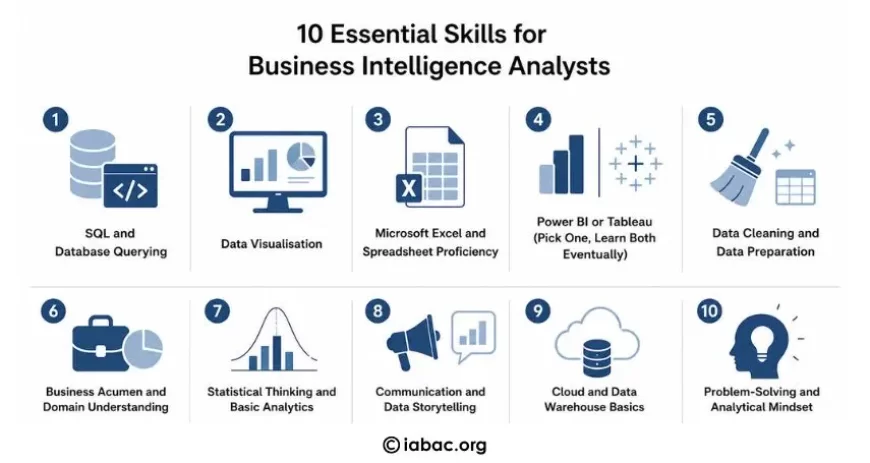
Here is what the modern BI analyst toolkit actually looks like: practical, in-demand, and buildable with the right focus
1. SQL and Database Querying
SQL (Structured Query Language) is the foundational skill every BI analyst needs without exception. It is how you pull data from databases, filter records, join tables, and calculate totals. Every major BI tool connects to a database, and SQL is how you talk to it.
A practical example: imagine you work for an e-commerce company and your manager wants to know which products were returned most in Q1. You would write a SQL query to filter orders by return status, group them by product, and rank the results. This is day-one BI analyst work.
In 2026, knowledge of cloud-based SQL environments like Google BigQuery, Amazon Redshift, and Azure Synapse is increasingly expected alongside standard SQL skills.
2. Data Visualisation
Raw data means nothing to most business stakeholders. A BI analyst's job is to translate numbers into visual charts, graphs, and dashboards that tell a story at a glance. This is one of the most valued data analytics skills for BI professionals across all industries.
Tools like Power BI, Tableau, and Looker Studio are the industry standard. Knowing how to choose the
-
right chart type
-
use consistent color coding
-
design a dashboard that answers a business question clearly
is what separates a good analyst from a great one.
A well-designed dashboard should answer its key question within five seconds of someone opening it. That is your target when building any visual.
3. Microsoft Excel and Spreadsheet Proficiency
Excel might seem basic, but it remains one of the most widely used tools in business environments globally. Many organisations still use Excel for
-
financial modeling
-
reporting
-
ad hoc analysis
A BI analyst who cannot use Excel confidently will struggle in most workplace settings.
Advanced Excel skills, pivot tables, VLOOKUP, INDEX/MATCH, conditional formatting, and Power Query are particularly useful. These functions allow you to clean, reshape, and summarize data quickly without writing a single line of code.
Think of Excel as the toolkit you reach for when you need a quick answer and do not want to spin up a full BI dashboard.
4. Power BI or Tableau (Pick One, Learn Both Eventually)
Power BI and Tableau are the two dominant BI analytics tools in the market today. Power BI is widely used in Microsoft-centric organisations and is generally more affordable, while Tableau is popular in larger enterprises for its visual flexibility and depth.
Both the tools allow you to
-
connect to data sources,
-
build interactive dashboards, and
-
share reports with your team
In 2026, employers frequently list proficiency in at least one of these tools as a non-negotiable requirement.
Start with Power BI if you are job hunting in India or working within Microsoft environments. Start with Tableau if you are targeting global enterprise roles or consulting firms.
5. Data Cleaning and Data Preparation
Most real-world data is messy. It has missing values, duplicate entries, inconsistent formats, and errors. Before you can analyze anything, you need to clean it. Data preparation can take up to 60–70% of a BI analyst's time on a project, so this skill has enormous practical value.
Tools used for this include
-
Excel Power Query
-
Python (with pandas)
-
the data transformation features within Power BI and Tableau
Even knowing how to identify a problem in a dataset, like a blank column, an outlier, or a formatting inconsistency, is a skill in itself.
Clean data leads to accurate insights. Inaccurate insights lead to poor business decisions. That chain reaction is why data cleaning is non-negotiable.
6. Business Acumen and Domain Understanding
This is the skill that most technical people underestimate. A BI analyst does not just work with data; they work with business problems. Understanding how a business makes money, what metrics matter to different departments, and what questions leadership is trying to answer will make every analysis you produce far more relevant.
For example, a BI analyst working in a bank needs to understand loan portfolios, interest margins, and risk scoring, not just how to build a chart. A BI analyst in e-commerce needs to understand conversion funnels, customer lifetime value, and inventory turnover.
You build business acumen by reading industry reports, working closely with stakeholders, and asking questions beyond the data brief.
7. Statistical Thinking and Basic Analytics
You do not need to be a data scientist, but you do need to understand the basics of statistics. This includes concepts like
-
averages
-
medians
-
distributions
-
variance
-
correlation
-
trend analysis
These foundations allow you to interpret data correctly and avoid common analytical mistakes.
For example, knowing the difference between mean and median matters when reporting salaries or house prices, where outliers can skew the average significantly. Understanding correlation vs. causation helps you avoid drawing incorrect conclusions from data.
In 2026, with AI increasingly surfacing statistical insights automatically, a BI analyst who understands what those insights mean will be far more effective than one who simply reads the output.
8. Communication and Data Storytelling
Finding a powerful insight is only half the job. The other half is communicating it effectively to people who may have no data background. This is called data storytelling, presenting your findings in a clear, compelling, and structured narrative.
BI analyst career skills increasingly include written reports, presentation decks, and verbal walkthroughs for executive audiences. A BI analyst who can say, "Our customer churn rate increased by 12% in March because of delayed deliveries in the North region; here is the data, and here is what I recommend," is enormously valuable.
Practice this skill by summarizing your analyses in plain language, building simple presentations, and asking non-technical colleagues to review your dashboards for clarity.
9. Cloud and Data Warehouse Basics
Modern data infrastructure lives in the cloud. AWS, Google Cloud, and Microsoft Azure are the three dominant platforms, and most organisations use at least one of them to store and process their data. A BI analyst in 2026 is expected to understand how cloud data warehouses work, even if they are not managing them directly.
Key tools to know include
-
Google BigQuery
-
Snowflake
-
AWS Redshift
-
Azure Synapse
You do not need to be a cloud architect, but understanding how to connect a BI tool to a cloud source, run queries efficiently, and manage basic permissions is increasingly expected.
This knowledge also opens doors to more senior BI and data engineering roles later in your career.
10. Problem-Solving and Analytical Mindset
This final skill is less about a tool and more about how you think. A BI analyst is, at their core, a problem solver. They receive vague business questions, "Why are sales falling?" or "Where are we losing customers?" and must break them down into data-answerable queries.
This requires
-
curiosity
-
structured thinking
-
the ability to hold multiple hypotheses at once
It means knowing when to dig deeper and when the data is telling a clear story. It also means being comfortable with ambiguity.
You develop this mindset by working through real case studies, practicing with public datasets and consistently asking "why" before jumping to "what."
Career Opportunities for BI Analysts in 2026
The career path for a BI analyst is both wide and well-compensated. Entry-level roles typically carry titles like BI Analyst, Data Analyst, or Reporting Analyst. With experience, professionals move into senior BI analyst, BI developer, data engineer, or Analytics Manager positions.
Industries hiring BI talent include banking and finance, healthcare, retail, logistics, IT services, and consulting. In India specifically, cities like Bengaluru, Hyderabad, Mumbai, and Pune have particularly strong demand. Globally, roles in the US, UK, Canada, and Australia are consistently well-paying with strong growth projections.
According to various job market surveys, data and analytics roles rank among the fastest-growing professional categories through 2030. The skills required for business intelligence analyst roles are transferable across sectors, making this one of the most flexible career paths in tech. Building the right technical and analytical skills can create a strong career in business analytics across multiple industries.
Is This the Right Career Path for You?
Business intelligence is a strong fit if you enjoy working with data while also staying connected to real business problems. You do not need to be a programmer, but you do need to be comfortable with numbers, tools, and structured thinking.
This path suits you if you are a recent graduate looking for a high-demand tech-adjacent career, a working professional in finance, marketing, or operations who wants to move into analytics, someone comfortable with tools like Excel who wants to level up into BI platforms, or a person who enjoys problem-solving and communicating insights to others.
If you find yourself asking "why" about business results, why did this metric drop, what caused this trend, then BI analysis is likely a natural fit.
Step-by-Step Roadmap to Build BI Analyst Skills
Building BI skills does not require years of study. A structured, consistent approach over six to twelve months can take you from beginner to job-ready.
-
Start with SQL fundamentals using free platforms. Spend four to six weeks on this before anything else.
-
Then move to Excel, focusing on pivot tables, VLOOKUP, and Power Query. These two skills alone will make you functional in most entry-level BI roles.
-
Next, pick one visualization tool, Power BI or Tableau, and build three to five real dashboards using public datasets.
-
Document this work as a portfolio.
-
Simultaneously, begin developing your business acumen by reading case studies in your target industry.
-
After that, explore basic statistics and cloud fundamentals
-
Complete a structured business analytics certification program to formalize your learning and signal credibility to employers.
Common Mistakes BI Beginners Make (And How to Avoid Them)
Most people entering the BI field do not fail because they lack talent; they stumble because of a few avoidable missteps. Knowing these early can save you months of wasted effort.
Jumping into tools before learning SQL:
Many beginners rush straight to Power BI or Tableau without building a solid SQL foundation first. The result is surface-level dashboard skills with no real data understanding underneath. SQL comes first always.
Learning everything at once:
BI has a wide toolkit, and it is tempting to study SQL, Python, Tableau, Power BI, and statistics all at the same time. This leads to shallow knowledge across everything and confidence in nothing. Pick a focused path and go deep before going wide.
Building dashboards with no business question in mind:
A common portfolio mistake is creating visually impressive dashboards that answer nothing specific. Every dashboard you build should start with a clear question: What decision does this help someone make?
Ignoring the communication side of the role:
Many beginners treat BI as a purely technical job. In reality, presenting findings clearly to non-technical stakeholders is just as important as the analysis itself. Practice explaining your work in plain language from day one.
The skills for BI analysts in 2026 span both technical and human domains, from SQL and Power BI to communication and business thinking. The role has evolved, and so has the bar for entry. But this is also a genuinely exciting time to enter the field. Tools are more accessible, learning resources are widely available, and the demand for BI talent continues to grow across every sector.
Start with the foundational skills, build a portfolio of real work, and pair your learning with a credible business analytics certification. A recognised certification does more than validate your knowledge; it signals to employers that you have invested in structured, industry-relevant learning. Whether you are a student, a career changer, or a professional looking to specialize, the path into business intelligence is clearer than it has ever been. The only step that matters now is the first one.