





















































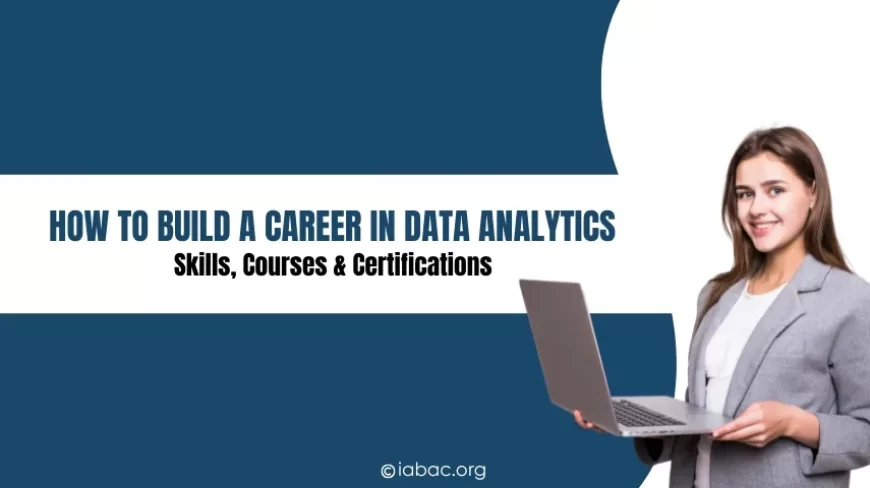
How to Build a Career in Data Analytics – Skills, Courses & Certifications
Start your data analytics career with practical skills, real projects, and trusted certifications. Learn what to study, tools to use, and how to get hired.

Data analytics is the process of collecting, cleaning, and analysing raw data to uncover patterns, trends, and actionable insights. It combines statistical methods, tools like SQL and Python, and data visualisation to support decision-making. In business, data analytics helps companies optimise performance, reduce risk, and identify growth opportunities.
Every company has one thing in common right now: they are drowning in data and desperately short on people who can make sense of it.
A data analyst walks in, cleans the noise, finds the signal, and hands decision-makers a clear answer. That skill is worth serious money.
India alone is projected to create over 11 million data analytics jobs by 2026 (NASSCOM).
If you have been wondering how to build a career in data analytics, the timing has never been better, and here’s the exact roadmap to get started.
|
11M+ New data jobs are projected in India by 2026 (NASSCOM) |
34% Projected growth in data scientist roles by 2032 (US Bureau of Labor Statistics) |
₹18L+ Senior data analyst average salary, India (2026) (upGrad Salary Report) |
What Does a Data Analyst Actually Do?
A data analyst answers one core question: what is the data telling us, and what should we do about it? They pull raw numbers from databases, clean them, run statistical checks, visualise patterns, and present findings in a way that non-technical stakeholders can act on immediately.
Think of a retail company tracking why cart abandonment spiked 40% last quarter. A data analyst queries the transaction database, cross-references it with server logs and customer survey data, builds a dashboard in Power BI for data analytics, and surfaces three actionable fixes within a week. That is the job.
To understand the foundation beneath all of this, it helps to get grounded in data analytics basics before jumping into advanced tools.
In practice, Swiggy uses data analysts to monitor delivery time deviations in real time. When a cluster of orders shows delays, analysts flag it immediately so ops teams can reassign riders, reducing customer complaints before they even land.
The Core Data Analytics Skills You Need in 2026
Hiring managers have gotten very specific about what they want. Strong resumes combine three layers: technical data analytics tools, analytical thinking, and communication. Here is a breakdown of what matters most.
Technical Skills
|
Skill |
What It Does |
Priority |
|
SQL |
Query and manage relational databases |
High |
|
Python (Pandas, NumPy) |
Data manipulation, automation, and exploratory analysis at scale |
High |
|
Excel / Google Sheets |
Fast-turnaround analysis, pivot tables, and financial modelling basics |
High |
|
Tableau / Power BI |
Build interactive dashboards that business teams can actually use |
High |
|
Statistics |
Hypothesis testing, regression, and probability - separates analysts from spreadsheet users |
High |
|
Machine Learning (basics) |
Enables predictive data analytics - forecasting, classification, anomaly detection |
Growing |
|
Cloud (AWS / GCP / Azure) |
Most enterprise data pipelines live in the cloud now |
Growing |
Soft Skills That Hiring Managers Obsess Over
Firms in 2026 find people who can code. They struggle to find people who can explain the results. Data storytelling, translating a complex regression output into a crisp three-point business recommendation, is genuinely rare and highly compensated.
Critical thinking, stakeholder communication, and the ability to frame business problems as analytical questions are skills that no automation tool can replicate. Build them deliberately.
How Data Analytics Is Used Across Industries
One of the strongest arguments for this career path is its industry-agnostic demand. Understanding how data analytics is used in business helps you pick a specialisation that aligns with your interests.
Healthcare: Patient outcome prediction, hospital resource allocation, drug trial analysis, readmission risk scoring
BFSI: Fraud detection, credit risk modelling, customer churn prediction, algorithmic trading signals
E-commerce & Retail: Cart abandonment analysis, demand forecasting, price optimisation, personalised recommendations
Telecom & Tech: Network performance monitoring, user behaviour analytics, product funnel analysis, A/B testing.
Apart from these sectors, many other industries actively use data analytics for business decisions and continue to hire data analysts at a steady pace.
Step-by-Step Roadmap: How to Build a Career in Data Analytics
The roadmap below works whether you are a fresh graduate, a career switcher, or someone already working in a data-adjacent role.
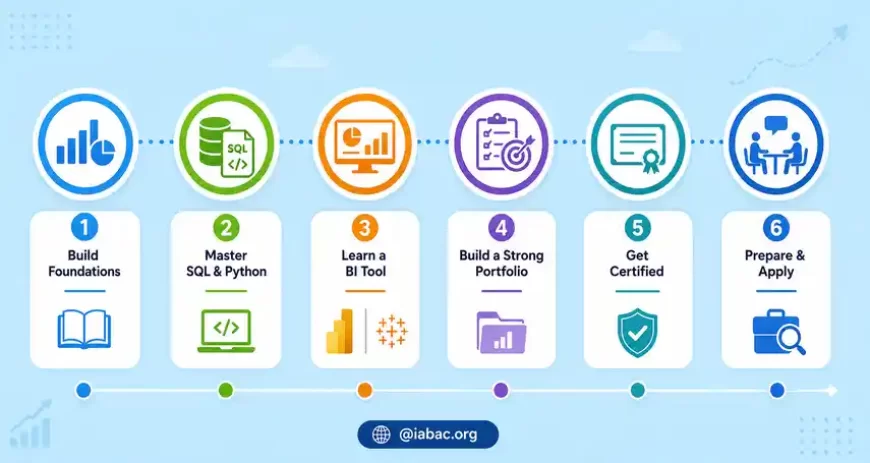
1. Build Analytical Foundations
Start with statistics, basic Excel, and logical thinking. You need to understand descriptive statistics, probability, and data types before you touch a single line of Python.
2. Master SQL and Python
SQL first, most analyst interviews are SQL-heavy. Then Python with Pandas and Matplotlib. Write 50+ queries on real datasets. Kaggle and Mode Analytics both offer free practice environments with realistic data problems.
3. Learn a BI Tool (Tableau or Power BI)
Pick one and go deep. Power BI integrates tightly with the Microsoft ecosystem and dominates enterprise India. Tableau has a strong footprint in product companies and global MNCs. Build at least three end-to-end dashboards from public datasets before you apply for jobs.
4. Build a Portfolio with Real Business Questions
Do not analyse random datasets for the sake of it. Identify a domain (e-commerce, healthcare, finance), find a real business question, and document your analysis like a consultant would, problem framing, methodology, insights, and recommendations. Recruiters notice portfolios that mirror actual work.
5. Get Certified by a Recognised Body
Certifications signal credibility, especially when you are early in your career. Choose a global certification body with industry recognition. IABAC's data analytics certifications carry global credibility and are structured around real-world competencies.
6. Prepare for Interviews and Apply Strategically
Study data analytics interview questions across SQL, statistics, case studies, and behavioural rounds. Target companies that have a defined data team, not just a "data-driven culture" in their job descriptions.
Best Courses and Certifications for Data Analytics in 2026
The market is flooded with courses. The ones worth your time combine structured learning, hands-on projects, and a credential that employers recognise. Here is a curated comparison.
|
Course / Certification |
Best For |
Format |
Credibility |
|
IABAC Certified Data Analyst |
Career switchers, serious learners |
Online + Exam |
Global |
|
Google Data Analytics (Coursera) |
Absolute beginners |
Self-paced |
Recognised |
|
IBM Data Analyst (Coursera) |
Beginners to intermediate |
Self-paced |
Recognised |
|
Microsoft PL-300 (Power BI) |
BI-focused roles, enterprise analysts |
Exam-based |
Industry standard |
Expert tip: Stacking a globally recognised certification with a strong project portfolio outperforms either one alone. Hiring managers use certifications as a filter; your portfolio is what actually wins the offer.
Data Analytics Salary in India: What to Realistically Expect
Pay in analytics scales quickly with skill depth and industry. Here is the 2026 landscape for India, with numbers drawn from the salary survey of AmbitionBox and NASSCOM's talent report.
Fresher (0–2 yrs) - ₹3.5 – 6 LPA
Mid-Level (3–5 yrs) - ₹6 – 12 LPA
Senior (6+ yrs) - ₹12 – 25 LPA
Analytics Lead / Manager - ₹25 LPA+
Career Paths After Your First Data Analyst Role
The data analyst title is an entry point, not a ceiling. Once you have two to three years of experience, several high-value paths open up:
Data Scientist: Deper statistical modelling, machine learning, and experimentation design.
Business Intelligence Analyst: Owns the dashboard layer; works closely with finance, product, and ops teams.
Analytics Manager / Head of Analytics: Leads a team, defines KPIs, and presents insights at the C-suite level.
Data Engineer: Builds the infrastructure that analysts depend on (pipelines, warehouses, transformation layers).
Product Analyst: Embedded in product teams, focused on user behaviour, funnel metrics, and feature impact.
Mistakes That Delay Your Data Analytics Career
Several pitfalls consistently slow people down, and knowing them ahead of time saves months of wasted effort.
1. Chasing tools instead of problems: Learning Tableau without a business question to answer produces empty dashboards. Always start with the question, then pick the tool. Companies want analysts who identify what to measure.
2. Skipping statistics: Many learners rush past statistics to get to Python faster. A statistically weak analyst can produce confidently wrong results. Invest serious time in descriptive statistics, distributions, and A/B testing fundamentals.
3. Portfolio projects with no business narrative: Uploading a Jupyter notebook full of code to GitHub is not a portfolio. Frame every project as a business case: what was the problem, what data did you use, what did you find, what should the company do? That framing is what separates candidates who get calls from those who do not.
4. Verify Your Skills on a Global Stage: IABAC (International Association of Business Analytics Certifications) is a globally recognised body that validates data analytics competencies through rigorous, industry-aligned certification programmes. Thousands of professionals across 80+ countries have used IABAC credentials to accelerate their careers.
Check Your Readiness: IABAC Eligibility Test
Before you start, check where you stand. The IABAC Eligibility Test evaluates your basics in statistics, logic, math, and programming through multiple-choice questions.
Why your score matters:
-
Shows if you’re ready to start learning tools like SQL and Python
-
Highlights gaps you need to fix early
-
Helps you avoid starting at the wrong level
Explore IABAC Data Analytics Certifications
Key Takeaways
-
India will need 11 million data professionals by 2026; demand far outpaces supply.
-
SQL, Python, Excel, and one BI tool (Power BI or Tableau) form the non-negotiable foundation.
-
Data storytelling and business communication are as critical as technical skills in 2026.
-
Freshers earn ₹3.5–6 LPA in India; senior analysts with 6+ years can cross ₹25 LPA.
-
Certifications from globally recognised bodies like IABAC add measurable credibility early in your career.
-
Build a portfolio of 3–5 business-framed projects before applying for roles.
-
The career path continues into data science, BI, product analytics, and analytics leadership.
Building a career in data analytics is not about mastering every tool on the market. It is about developing sharp analytical thinking, solid technical fundamentals, and the ability to translate numbers into decisions that businesses actually act on.
The demand is structural, not cyclical. Every organisation, regardless of size or sector, will continue to generate more data than it can process without skilled people. That gap is your opportunity.
Start with the foundations, build deliberately, earn a credential that carries global weight, and frame everything you learn around real business problems. The roadmap above works. What it requires is consistent effort and a clear direction.
Frequently Asked Questions
1. Can I get into data analytics without a computer science degree?
Yes. Many analysts come from non-CS backgrounds like commerce, economics, or humanities. What matters is your ability to work with data, use SQL, build dashboards, and communicate insights. A strong portfolio and relevant certification can offset the lack of a CS degree.
2. How long does it take to become job-ready?
With 10–15 hours of weekly effort, most learners become job-ready in 6–12 months. This includes learning SQL, basic Python, a BI tool, statistics, and building 3–5 projects.
3. Which should I learn first: Tableau or Power BI?
Start with Power BI, as it’s widely used in Indian corporate environments. Tableau is common in product-based and global firms. Once you learn one, switching is relatively quick.
4. Is data analytics still a good career with AI evolving?
Yes. AI handles routine tasks, but analysts are still needed for problem framing, decision-making, and communication. Those who can work effectively with AI will have an advantage.
5. Do certifications help in getting hired?
They help your CV get noticed, especially as a fresher. However, they don’t replace practical skills or projects; both are essential.