
















































What is a Generative AI certification
Learn what a Generative AI certification is and how it builds skills in AI models prompt engineering machine learning and real world generative AI applications.

Artificial Intelligence has moved from science fiction movies to everyday life. People now talk to voice assistants, get movie suggestions on streaming platforms, and even see images created by machines. Behind many of these experiences is a technology called Generative AI. Because of this change, many learners and professionals are searching for a Generative AI certification to build skills and enter the AI field.
Organizations across the world are investing heavily in Artificial Intelligence. According to industry reports, global AI spending is expected to reach more than $500 billion in the next few years, and many companies are searching for professionals who understand how AI systems work. A recognized Artificial Intelligence Certification can help individuals prove their knowledge and prepare for these roles.
This guide explains what a Generative AI certification is, why it matters, what skills you learn, and what career opportunities may come after completing the certification. The goal is to make the topic easy to understand while giving useful details for people who want to enter the Artificial Intelligence field.
Understanding Generative AI
Before learning about certification programs, it is helpful to understand what Generative AI actually means.
Generative AI is a type of Artificial Intelligence that can create new content instead of only analyzing existing information. This content may include text, images, audio, code, videos, or designs.
For example, Generative AI tools can:
- Write articles or reports
- Create realistic images from text prompts
- Generate software code
- Compose music
- Design marketing content
- Build chatbots that answer questions
Many well-known AI systems today are based on generative models. These models learn patterns from large datasets and then produce new outputs that look similar to what humans create.
Traditional AI analyzes data and predicts results, while Generative AI creates something new.
This creative ability is why Generative AI has become one of the most exciting areas in modern technology.
What is a Generative AI Certification
A Generative AI certification is a professional credential that shows a person understands the concepts, tools, and techniques used in Generative AI systems.
Certification programs usually include training and assessments that measure knowledge in areas such as:
- AI fundamentals
- Machine learning basics
- Generative models
- Natural language processing
- Prompt design
- AI tools and frameworks
- Ethical use of Artificial Intelligence
When someone completes the certification, they receive an official certificate that proves their knowledge in the field.
This certificate can help professionals demonstrate their skills to employers, clients, or organizations that require AI expertise.
Many certification programs are offered by professional bodies and technology organizations. One example is the International Association of Business Analytics Certifications, which provides AI and data science certifications through its platform iabac.org.
Why Generative AI Certifications Are Becoming Popular
The interest in Generative AI certifications has grown rapidly. There are several reasons for this.
Growth of Artificial Intelligence Jobs
The demand for AI professionals continues to grow worldwide. Companies in healthcare, finance, education, retail, and manufacturing are adopting AI solutions.
Research from industry analysts shows that the global AI workforce may require millions of skilled professionals in the coming years.
Because of this demand, employers often look for candidates with verified skills in Artificial Intelligence.
Rise of AI Tools in Everyday Work
Many industries now use AI tools to improve productivity.
Examples include:
- Marketing teams using AI for content creation
- Software teams using AI code assistants
- Customer support teams using AI chatbots
- Designers using AI-generated images
Professionals who understand how these tools work have a strong advantage in the job market.
Structured Learning
Many people learn AI through online tutorials, but certification programs provide structured learning paths. This helps learners understand the complete picture rather than isolated concepts.
Skills You Learn in a Generative AI Certification
A strong Generative AI certification program usually covers several technical and practical topics. These skills help learners build a strong foundation in Artificial Intelligence.
Artificial Intelligence Fundamentals
Learners start by understanding the basic concepts of Artificial Intelligence.
Topics may include:
- History of AI
- Types of AI systems
- Machine learning basics
- Data processing techniques
- Neural networks
This foundation helps learners understand how AI systems operate.
Generative Models
A key part of the certification focuses on generative models.
These models include:
- Generative Adversarial Networks (GANs)
- Transformer models
- Large language models
- Diffusion models
These systems allow AI to generate text, images, or other types of content.
Natural Language Processing
Natural Language Processing, often called NLP, helps computers understand human language.
Skills in this area include:
- Text processing
- Language modeling
- Chatbot development
- Sentiment analysis
These skills are widely used in AI assistants and conversational platforms.
Prompt Design
Prompt design has become an important skill in Generative AI.
A prompt is the instruction given to an AI system. The quality of the prompt often affects the quality of the output.
Learning how to write effective prompts helps users get better results from AI tools.
AI Ethics and Responsible Use
Responsible use of AI is an important topic today.
Certification programs often discuss:
- Bias in AI systems
- Data privacy
- Responsible AI development
- Ethical guidelines for AI applications
Understanding these issues helps professionals build trustworthy AI solutions.
Career Opportunities After a Generative AI Certification
Completing a Generative AI certification may open doors to several career opportunities. Many industries are searching for professionals who understand AI technologies.
Some common job roles include the following.
- AI Engineer: AI engineers design and build Artificial Intelligence systems. They develop models that can analyze data, automate processes, or generate content.
- Machine Learning Engineer: Machine learning engineers work on training AI models using large datasets. They build systems that learn patterns and improve performance over time.
- Data Scientist: Data scientists analyze large volumes of information to find patterns and insights. Many data scientists use AI models to predict trends and support business decisions.
- AI Product Specialist: AI product specialists help companies integrate AI into their products or services. They work with technical teams and business teams to develop AI-driven solutions.
- Prompt Engineer: Prompt engineers focus on creating instructions that help AI systems produce better results. This role has gained attention with the growth of Generative AI tools.
- AI Consultant: AI consultants help organizations understand how to use Artificial Intelligence to improve operations, reduce costs, or create new services.
These roles are found across industries such as healthcare, finance, retail, education, and entertainment.
Is Generative AI Certification Suitable for Beginners
Yes, many Generative AI certification programs are designed to support beginners.
Even people without a technical background can start learning Artificial Intelligence concepts with the right guidance.
Beginner-friendly programs usually start with simple topics such as:
- Basic AI concepts
- Data fundamentals
- Introduction to machine learning
- Simple AI tools and platforms
From there, learners gradually move toward advanced topics like generative models and AI applications.
One helpful tip for beginners is to focus on understanding concepts first before worrying about complex algorithms. Many learners feel nervous when they see technical terms, but once the basics are clear, the learning process becomes much easier. Many learners begin their AI journey with curiosity and a little confusion. After some practice, the same learners often realize that AI concepts are not as complicated as they first appeared.
What Job Roles Can I Get After Completing a Generative AI Certification
After completing a Generative AI certification, professionals may explore several roles in the Artificial Intelligence field.
Some of the most common roles include:
- Artificial Intelligence Engineer
- Machine Learning Engineer
- AI Data Analyst
- AI Product Manager
- Prompt Engineer
- AI Consultant
- Automation Specialist
- AI Research Assistant
The exact role may depend on a person’s background and experience. Someone with programming experience may move toward engineering roles, while someone from a business background may work on AI strategy or product development.
AI skills can also help professionals improve their existing roles. For example, marketing specialists may use AI for content generation, and analysts may use AI tools to improve data insights.
What is the Difference Between AI and Generative AI
Many people use the terms AI and Generative AI as if they mean the same thing, but they are slightly different.
Artificial Intelligence is a broad field that focuses on creating systems that can perform tasks that normally require human intelligence. These tasks may include recognizing images, analyzing data, or making predictions.
Examples of traditional AI systems include:
- Fraud detection systems
- Recommendation engines
- Voice assistants
- Image recognition tools
Generative AI is a special type of Artificial Intelligence that focuses on creating new content.
Examples of Generative AI systems include:
- Text generation tools
- AI image creators
- AI music generators
- AI video tools
So the relationship is simple.
Artificial Intelligence is the larger field, and Generative AI is one area within it that focuses on content creation.
Importance of Certification in the AI Industry
In the technology industry, certifications often help professionals show their knowledge and skills.
A recognized Artificial Intelligence Certification can help in several ways.
Proof of Knowledge
Certification shows that a learner understands AI concepts and has completed structured training.
Career Growth
Many professionals use certifications to move into new roles or gain promotions.
Industry Recognition
Employers often prefer candidates who have certifications from recognized organizations.
Global Opportunities
Because AI is used worldwide, certified professionals may find opportunities across different countries and industries.
Professional organizations like the International Association of Business Analytics Certifications provide certification programs that focus on practical industry skills. These programs are designed to help professionals apply AI knowledge in real-world situations.
Learning Resources for Generative AI
People interested in Generative AI can begin their learning journey using several resources.
These include:
- Online courses
- Certification programs
- AI communities
- Research papers
- Hands-on projects
Practical experience is very important. Experimenting with AI tools and building small projects helps learners understand how AI systems behave in real scenarios.
The Future of Generative AI
The influence of Generative AI is expected to continue growing.
Many industries are exploring new applications for this technology.
Examples include:
- AI-generated medical reports
- AI-assisted software development
- AI-created marketing campaigns
- Personalized learning systems in education
- AI-generated design prototypes
Industry analysts estimate that the Generative AI market could exceed $100 billion within the next decade.
As technology evolves, professionals who understand Artificial Intelligence and generative models will likely remain in high demand.
Artificial Intelligence certification to Generative AI
Artificial Intelligence (AI) has evolved from simple rule-based systems to powerful Generative AI models that can create text, images, and even code. Today, AI is not just a technological innovation—it is a career revolution. For students and professionals aiming to enter the tech industry, understanding the journey from Artificial Intelligence certification to Generative AI can open doors to high-demand roles and global career opportunities.
This blog explains how AI has developed over time, why AI certification matters, and how mastering Generative AI can enhance your career growth.
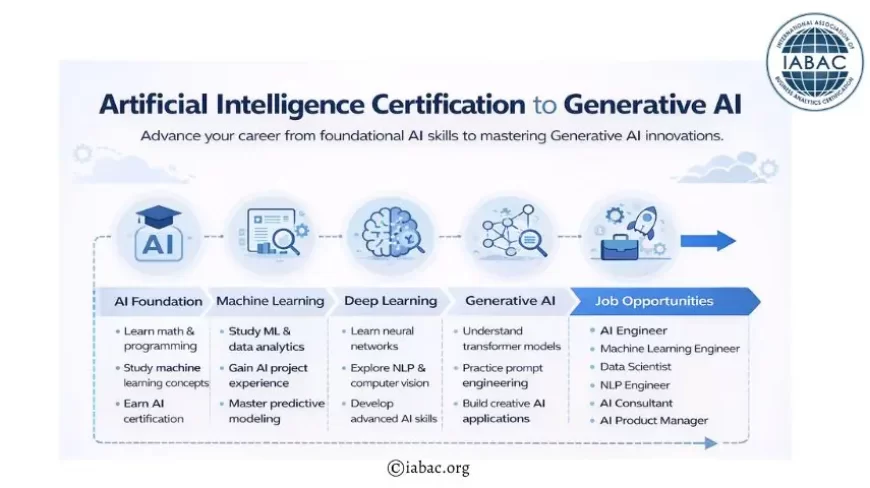
The Evolution of Artificial Intelligence
Artificial Intelligence began in the 1950s with the goal of building machines that could mimic human reasoning. Early AI systems focused on logic, rules, and symbolic reasoning. Over time, AI shifted from manual programming toward data-driven learning models.
In the 1980s and 1990s, Machine Learning emerged as a breakthrough. Instead of programming machines step-by-step, developers created algorithms that allowed systems to learn from data. This led to applications such as predictive analytics, fraud detection, and recommendation systems.
By the 2010s, Deep Learning transformed AI further. Neural networks with multiple layers enabled machines to process complex data like images, speech, and videos. Technologies such as computer vision and natural language processing (NLP) became more accurate and practical.
Today, we are in the era of Generative AI, powered by advanced models like transformers and large language models (LLMs). These systems can generate original content, automate tasks, and assist in decision-making processes across industries.
Why Artificial Intelligence Certification Matters
As AI technology grows, so does the demand for certified professionals. An Artificial Intelligence certification validates your knowledge in AI concepts, machine learning algorithms, deep learning models, and AI applications. It proves to employers that you have practical skills and industry-ready expertise.
Certifications also help students:
- Build structured knowledge in AI fundamentals
- Gain hands-on project experience
- Improve resume value
- Increase job interview opportunities
- Stay updated with emerging AI tools
Professional certification programs offered by recognized institutions provide credibility and career guidance. For example, students often explore programs and resources available through platforms like https://iabac.org, which focus on practical learning and global industry standards.
From AI Foundations to Machine Learning
A strong AI career begins with foundational skills. Learning Python programming, statistics, probability, and linear algebra forms the technical base. Once the basics are clear, students can move toward machine learning concepts such as:
- Supervised learning
- Unsupervised learning
- Reinforcement learning
- Predictive modeling
- Data analytics
Machine learning engineers and data scientists use these techniques to analyze data, build intelligent systems, and solve real-world business problems.
Related keywords such as AI development, data science certification, AI training programs, and machine learning certification are often associated with this stage of learning.
Deep Learning and Advanced AI Skills
Deep learning is a specialized branch of machine learning that uses artificial neural networks to process large datasets. It powers technologies like facial recognition, voice assistants, autonomous vehicles, and medical image analysis.
Students who want to advance in AI should learn:
- Neural networks
- Convolutional Neural Networks (CNNs)
- Recurrent Neural Networks (RNNs)
- Natural Language Processing (NLP)
- Computer Vision
These advanced AI skills significantly increase job opportunities and salary potential. Companies are actively hiring professionals who can build intelligent automation systems and AI-driven applications.
The Rise of Generative AI
Generative AI is the latest frontier in artificial intelligence. Unlike traditional AI systems that analyze data, Generative AI creates new content. It can write articles, generate images, compose music, and even assist in coding.
Technologies such as large language models, transformer architecture, prompt engineering, and AI-powered automation tools are reshaping industries like marketing, education, healthcare, and software development.
Learning Generative AI adds a competitive edge to your profile. It prepares you for modern job roles that require creativity combined with technical expertise.
Job Relevance and Career Opportunities
Artificial Intelligence is one of the most in-demand career fields globally. Organizations across industries are investing heavily in AI solutions to improve efficiency and innovation.
Popular AI job roles include:
- AI Engineer
- Machine Learning Engineer
- Data Scientist
- NLP Engineer
- AI Consultant
- AI Product Manager
These roles require strong analytical skills, programming knowledge, and practical experience with AI tools. Certified professionals often receive better salary packages and faster career growth.
How to Build a Career in AI
To build a successful AI career, follow a clear learning path:
First, strengthen your fundamentals in mathematics and programming. Next, learn machine learning algorithms and work on practical projects. Then, move toward deep learning and Generative AI tools. Finally, earn a recognized AI certification to validate your expertise.
Hands-on projects, internships, and continuous learning are essential. AI is a rapidly evolving field, so staying updated with new technologies and tools is important for long-term success.
The journey from Artificial Intelligence certification to Generative AI represents the transformation of technology and career opportunities. AI is no longer limited to research labs—it is shaping industries, businesses, and everyday life. For students and professionals, investing in AI education and certification is a smart career decision. With structured learning, practical experience, and recognized credentials, you can position yourself as a skilled AI professional ready for the future.
Artificial Intelligence is not just a technical skill—it is a powerful career pathway that offers innovation, growth, and global opportunities.