















































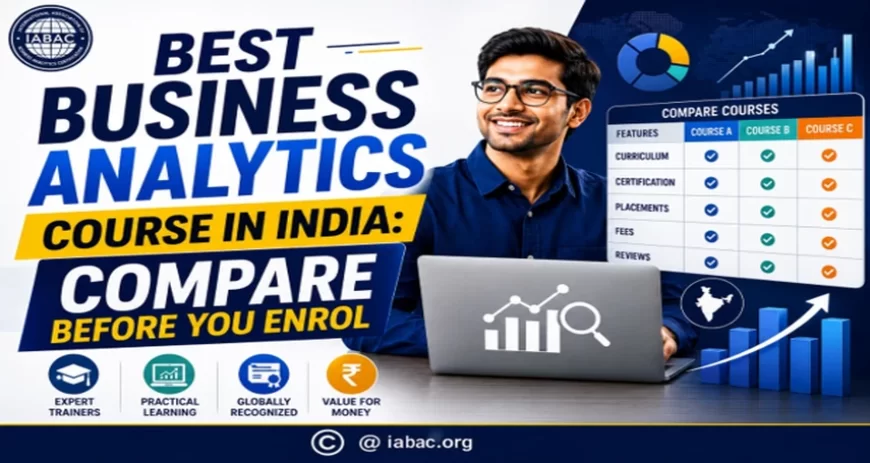
Best Business Analytics Course in India: Compare Before You Enroll
Compare the best Business Analytics courses in India. Explore curriculum, certifications, career outcomes, and choose the right program before you enroll.

Choosing a business analytics course has become more complicated than it was just a few years ago. Every provider promises industry-ready skills, practical projects, expert trainers, and strong placement support. On paper, many programs look nearly identical. Yet professionals who have completed different courses often end up with very different career outcomes.
One pattern I've noticed across hiring and upskilling initiatives is that employers rarely ask where someone studied first. They look for evidence that the candidate can solve business problems using data, communicate insights clearly, and make informed decisions. The course is only valuable if it helps learners build those capabilities.
Whether you're a recent graduate, a working professional planning a career switch, or a manager looking to strengthen analytical skills, comparing programs carefully before enrolling can save both time and money. This guide explains what actually matters when evaluating the Best Business Analytics Course in India, helping you choose a learning path that aligns with your goals rather than marketing claims.
Why Many Professionals Eventually Choose a Certification
Learning business analytics is an ongoing process that combines practical experience with structured learning. As professionals gain exposure to real business challenges, many choose certifications to validate their knowledge, understand industry-recognized frameworks, and demonstrate commitment to continuous development. Several globally recognized organizations offer certification programs, each with its own focus and learning approach. IABAC is one such certification body that emphasizes practical business analytics skills alongside industry-relevant competencies, while other established providers also serve different learning needs. The right certification ultimately depends on your career objectives, industry requirements, and preferred learning pathway.
Why Business Analytics Skills Matter More Than Ever
Business analytics is no longer limited to analysts working with spreadsheets and reports. Today, organizations across finance, healthcare, retail, manufacturing, technology, logistics, and even government departments rely on analytics to make faster and better decisions.
Managers use dashboards to monitor business performance. Marketing teams analyse customer behaviour before launching campaigns. HR departments study workforce trends to improve employee retention. Supply chain teams forecast demand to reduce inventory costs. Nearly every business function now depends on data-driven decision-making.
This shift has significantly increased demand for professionals who can:
- Interpret business data confidently
- Build meaningful reports and dashboards
- Identify trends and patterns
- Communicate analytical findings to stakeholders
- Support strategic business decisions
- Work with modern analytics and visualization tools
A common misconception is that business analytics is only suitable for people with strong programming or mathematics backgrounds. In practice, many successful business analysts come from commerce, management, engineering, finance, marketing, and operations because the role focuses as much on business understanding as technical knowledge.
As organizations continue investing in digital transformation and AI-assisted decision-making, professionals with business analytics expertise are finding opportunities across a wide range of industries.
The term "best" means different things to different learners. A course that works well for an experienced project manager may not be suitable for a recent graduate, and a beginner-focused program may not offer enough depth for someone already working with data.
Instead of relying on rankings or advertisements, evaluate each Business Analytics course in India against objective criteria that directly influence your learning experience and career growth.
The most effective programs go beyond theoretical concepts and focus on the tools, methods, and business scenarios professionals encounter in real workplaces.
A comprehensive curriculum should typically include:
- Business Analytics fundamentals
- Data visualization principles
- Microsoft Excel for analytics
- SQL for querying business data
- Power BI or Tableau
- Python basics for analytics (where applicable)
- Business statistics
- Predictive analytics concepts
- AI-assisted analytics workflows
- Business problem-solving frameworks
One lesson many organizations learn is that technical tools evolve quickly. A strong course therefore teaches analytical thinking alongside software skills, making it easier for learners to adapt as technologies change.
2. Learning Through Real Business Projects
Reading about analytics is very different from solving business problems.
Employers increasingly evaluate candidates based on portfolios rather than certificates alone. Practical projects help learners apply concepts, make decisions with incomplete data, and present findings in ways that business leaders can understand.
Examples of valuable project topics include:
- Customer churn analysis
- Sales performance dashboards
- Marketing campaign analysis
- Financial reporting automation
- Retail demand forecasting
- HR attrition analysis
- Supply chain optimization
- Executive KPI dashboards
In real projects, learners often discover that data is rarely clean or complete. Handling missing information, validating assumptions, and explaining recommendations to stakeholders are skills that only practical assignments can develop.
A course that incorporates multiple hands-on projects generally provides a stronger foundation than one focused primarily on recorded lectures or theoretical assessments.
3. Faculty with Practical Industry Experience
Experienced instructors bring context that textbooks cannot.
Professionals who have worked on analytics implementations can explain:
- Why certain analytical approaches succeed
- Common mistakes beginners make
- How stakeholders interpret reports
- Challenges faced during implementation
- Trade-offs between speed and accuracy
- Communication strategies for presenting insights
This practical perspective helps learners understand not just how to perform an analysis, but why particular decisions matter in a business environment.
4. Business-Focused Learning Instead of Tool-Focused Training
Many learners compare courses based solely on the number of software tools included.
However, tools change frequently.
Business thinking remains valuable regardless of technology.
Business thinking remains valuable regardless of technology. According to Harvard Business Review, organizations create more value when professionals focus on solving business problems rather than simply using technology.
The strongest Business Analytics training in India teaches learners how to:
- Define business problems clearly
- Identify relevant metrics
- Choose appropriate analytical techniques
- Interpret findings objectively
- Recommend actionable business decisions
- Communicate insights to technical and non-technical audiences
These skills remain relevant even as new analytics platforms and AI-powered tools continue to emerge.
Once you've shortlisted a few programs, the next step is to compare them objectively. Marketing brochures often highlight impressive numbers and attractive promises, but those details don't always reflect the quality of learning you'll receive.
A better approach is to evaluate every Business Analytics course in India using the same set of criteria. This makes it easier to identify which program aligns with your career goals rather than simply choosing the most popular option.
Many courses carry similar names but differ significantly in what they teach.
Some focus primarily on visualization tools, while others emphasize statistics or programming. The strongest programs balance business understanding with analytical techniques and practical implementation.
When reviewing a curriculum, ask questions such as:
- Does it cover the complete analytics lifecycle?
- Are business case studies included?
- Will I learn multiple analytics tools?
- Are AI-assisted analytics techniques discussed?
- Does the course include communication and presentation skills?
- Is there sufficient emphasis on solving business problems instead of simply operating software?
A well-rounded curriculum prepares learners to work across different industries instead of limiting them to a single tool or domain.
One lesson many hiring managers share is that portfolios often speak louder than certificates.
Employers want candidates who can demonstrate how they approached a problem, analysed data, and communicated recommendations.
Look for programs that include:
- Multiple industry projects
- Capstone assignments
- Real business datasets
- Dashboard development
- Case-study discussions
- Scenario-based problem solving
Practical learning helps bridge the gap between classroom knowledge and workplace expectations.
For beginners especially, working through real datasets builds confidence that theoretical exercises alone cannot provide.
Understand Who Will Be Teaching the Course
Faculty quality has a significant influence on the overall learning experience.
Experienced instructors often explain why certain analytical approaches succeed while others fail because they've encountered those situations in real organizations.
When comparing instructors, consider:
- Industry experience
- Analytics consulting background
- Corporate training exposure
- Experience working with business stakeholders
- Ability to explain technical concepts in business language
Professionals who have worked across industries frequently provide insights that extend beyond the official curriculum.
Check Whether the Course Covers Current Industry Tools
Analytics tools continue to evolve, but employers still expect candidates to have hands-on experience with widely adopted platforms.
A modern Online Business Analytics course or classroom program should introduce learners to tools commonly used in business environments.
These may include:
- Microsoft Excel
- SQL
- Power BI
- Tableau
- Python
- Generative AI tools for analytics
- Business Intelligence platforms
- Data visualization frameworks
Rather than focusing only on software, the course should explain when each tool is appropriate and how businesses actually use it.
Business Analytics Course Comparison Checklist
The following comparison framework can help you evaluate different programs before making a decision.
|
Evaluation Factor |
Why It Matters |
|
Curriculum |
Determines whether you'll develop complete analytical skills or only learn isolated tools. |
|
Practical Projects |
Builds a portfolio that demonstrates real-world capabilities. |
|
Faculty Experience |
Provides practical insights beyond theoretical instruction. |
|
Industry Tools |
Prepares learners for workplace technologies. |
|
Certification |
Helps validate skills and supports professional credibility. |
|
Placement Support |
Assists with interview preparation and career transition. |
|
Learning Flexibility |
Important for working professionals balancing study and work. |
|
Alumni Outcomes |
Offers evidence of how previous learners progressed in their careers. |
|
Community & Networking |
Enables peer learning and professional connections beyond the classroom. |
|
Continuous Updates |
Ensures the curriculum remains relevant as analytics technologies evolve. |
Online vs Classroom vs Hybrid Learning
The learning format can significantly influence your experience, especially if you're balancing work, studies, or family responsibilities.
Online Learning
It is particularly suitable for:
- Working professionals
- Career changers
- Learners living outside major cities
- Individuals preparing alongside full-time employment
Many Business Analytics classes online now include live sessions, recorded lectures, collaborative projects, discussion forums, and virtual mentoring.
The biggest advantage is flexibility, but success depends on maintaining a consistent learning schedule.
Traditional classroom programs provide structured schedules and face-to-face interaction with instructors and classmates.
This format often benefits learners who:
- Prefer guided learning
- Learn better through direct discussions
- Value in-person networking
- Need classroom accountability
However, classroom courses may require fixed schedules and commuting, which can be challenging for working professionals.
Hybrid Learning
Many institutions now combine online flexibility with live mentoring and periodic classroom sessions.
Hybrid learning allows students to:
- Learn theoretical concepts online
- Participate in live doubt-clearing sessions
- Collaborate on practical projects
- Attend workshops or bootcamps when needed
For many professionals, this model provides a balance between convenience and interaction.
Many learners search specifically for a Business Analytics course with placement, but placement support can mean different things depending on the provider.
Some institutions offer complete career services, while others simply provide access to job portals.
Before enrolling, understand exactly what is included.
Useful placement support may include:
- Resume building workshops
- LinkedIn profile optimization
- Portfolio development
- Mock technical interviews
- HR interview preparation
- Career mentoring
- Networking events
- Employer connections
- Internship opportunities
One common mistake is assuming placement support guarantees employment.
In practice, the quality of your projects, communication skills, interview preparation, and analytical thinking play a much greater role in securing job opportunities than the availability of placement assistance alone.
Price is often one of the first factors people consider, but it shouldn't be the deciding factor.
A lower-cost course may appear attractive initially but could require additional training later if important topics are missing.
Similarly, the most expensive program isn't automatically the best.
Instead, evaluate the overall return on your investment by asking:
- Will this course help me build practical skills?
- Does it include industry-relevant projects?
- Will I earn a recognized Business Analytics certification course credential?
- Is career guidance included?
- Will I leave with a portfolio that demonstrates my capabilities?
- Does the curriculum remain updated with industry developments?
Thinking in terms of long-term career value rather than short-term cost often leads to a better decision.
Not every training provider delivers the same quality of education. Taking time to identify warning signs can help you avoid disappointment later.
Be cautious if a course:
- Promises guaranteed jobs without explaining the placement process.
- Focuses heavily on certificates but offers little practical training.
- Uses an outdated curriculum that ignores AI and modern analytics tools.
- Includes very few hands-on projects or real business case studies.
- Has no information about instructor experience or learner outcomes.
- Relies on excessive marketing while providing limited details about course content.
A reliable Business Analytics training in India should be transparent about its curriculum, teaching methodology, assessment process, and learner support. The more clearly these elements are explained, the easier it becomes to judge whether the program is genuinely designed to build job-ready skills.
Skills You'll Develop in a Business Analytics Course
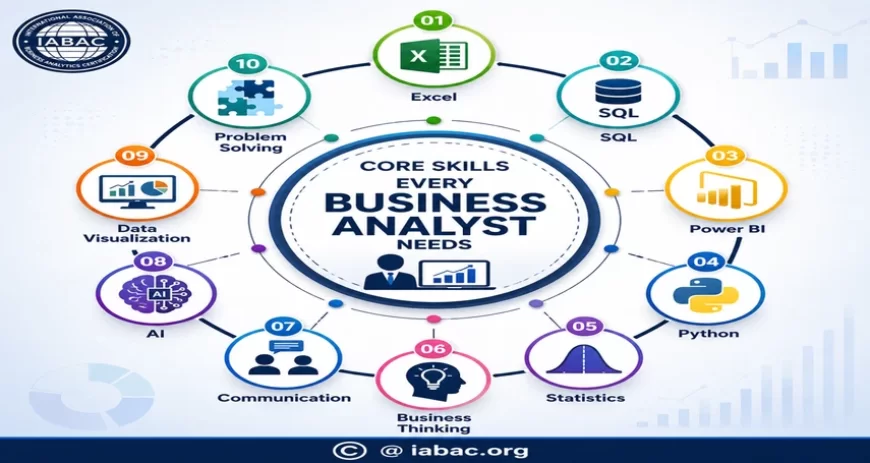
Regardless of your industry or previous experience, a well-designed Business Analytics course for beginners or experienced professionals should help you build a balanced combination of technical, analytical, and business skills. The objective isn't simply to learn software—it's to understand how data can support better business decisions.
Technical Skills
Most comprehensive programs introduce learners to widely used analytics tools and technologies, including:
- Microsoft Excel for data analysis
- SQL for querying databases
- Power BI and Tableau for data visualization
- Basic Python for business analytics
- Dashboard creation and reporting
- Data cleaning and preparation
- Business Intelligence concepts
These tools provide the foundation for working with structured business data across industries.
One pattern I've noticed in successful analytics professionals is that they spend more time asking the right questions than building dashboards.
Strong analytical thinking involves:
- Identifying business problems
- Understanding stakeholder requirements
- Selecting appropriate metrics
- Recognizing trends and anomalies
- Drawing logical conclusions
- Evaluating multiple solutions before making recommendations
These capabilities remain valuable regardless of which analytics platform an organization uses.
Business Communication
Data only becomes valuable when decision-makers understand it.
A quality program should therefore help learners communicate analytical findings through:
- Executive dashboards
- Business reports
- Data storytelling
- Visual presentations
- Actionable recommendations
Professionals who can explain complex findings in simple business language are often better positioned for leadership opportunities.
How Business Analytics Is Applied Across Industries
Business analytics is no longer confined to technology companies. Organizations in almost every sector use data to improve efficiency, reduce costs, and support strategic planning.
Here are a few practical examples.
Retail
Retail companies analyse customer purchasing behaviour to improve inventory planning, personalize marketing campaigns, and forecast seasonal demand.
Situation: Sales varied significantly across locations.
Challenge: Manual reporting made it difficult to identify purchasing patterns.
Solution: Interactive dashboards combined sales, inventory, and customer data.
Outcome: Managers gained faster visibility into product performance and could adjust inventory decisions more effectively.
Healthcare providers use analytics to monitor operational efficiency, optimize patient scheduling, and allocate medical resources.
Rather than relying solely on historical reports, administrators increasingly use predictive models to anticipate patient demand and improve service delivery.
Finance
Banks and financial institutions apply business analytics to:
- Risk assessment
- Fraud detection
- Customer segmentation
- Loan performance analysis
- Financial forecasting
Analytics enables financial organizations to make faster, evidence-based decisions while managing operational risk.
Manufacturing
Manufacturers analyse production data to reduce downtime, improve quality control, and optimize supply chains.
One lesson many operations teams learn is that identifying small process inefficiencies early often prevents much larger operational issues later.
Human Resources
HR departments increasingly rely on analytics to understand workforce trends.
Common applications include:
- Employee retention analysis
- Recruitment performance
- Training effectiveness
- Workforce planning
- Diversity reporting
People analytics has become an important area where business understanding and data interpretation intersect.
Future Trends Shaping Business Analytics
Business analytics continues to evolve as organizations adopt artificial intelligence, automation, and cloud technologies. Industry reports from organizations such as Gartner, McKinsey, Microsoft, IBM, and the World Economic Forum consistently highlight that future analytics professionals will need a combination of technical expertise, business understanding, and AI literacy rather than relying on reporting skills alone.
Several trends are likely to shape the next generation of analytics roles.
AI-Assisted Analytics
Generative AI is making it easier to summarize reports, generate visualizations, and automate repetitive analytical tasks.
Rather than replacing analysts, these tools are helping professionals spend more time interpreting insights and supporting business decisions.
Self-Service Business Intelligence
Modern analytics platforms increasingly allow business users to explore data independently.
As self-service analytics becomes more common, professionals must focus on governance, data quality, and responsible interpretation.
Organizations are moving from static monthly reports toward real-time dashboards that support faster operational decisions.
This requires analytics professionals who can work with continuously updated information instead of periodic reporting cycles.
As AI adoption grows, businesses are placing greater emphasis on transparency, privacy, fairness, and regulatory compliance.
Understanding ethical data practices is becoming an important skill alongside technical analytics expertise.
Cross-Functional Collaboration
Future business analysts will work more closely with marketing teams, finance leaders, operations managers, HR professionals, and executives.
Communication, stakeholder management, and business understanding will become increasingly important alongside technical proficiency.
Why Many Professionals Choose IABAC for Business Analytics Certification
When comparing the Best Business Analytics Course in India, the curriculum is only one part of the decision. The credibility of the certification body also matters because employers often look for credentials that reflect industry-relevant skills rather than just course completion.
Among the recognized certification providers, IABAC (International Association of Business Analytics Certifications) has become a preferred choice for many professionals because of its practical and industry-focused approach. Instead of concentrating only on theoretical concepts, its certification framework emphasizes applying business analytics to real-world decision-making.
Beyond offering Business Analytics certifications, IABAC supports learners and professionals through several initiatives that contribute to continuous professional development.
Several factors differentiate IABAC from many traditional training programs:
Industry-Focused Certifications
IABAC offers certifications designed around current industry practices, helping learners build practical analytical skills instead of focusing only on theoretical concepts. The certification framework is regularly updated to reflect changes in Business Analytics, Artificial Intelligence, Data Science, and related technologies.
Accredited Training Partners
Rather than delivering all training directly, IABAC works with accredited training partners across different regions. This allows learners to choose an authorized learning provider that matches their preferred learning style while ensuring the curriculum follows IABAC's certification standards.
Consulting and Enterprise Learning
Organizations adopting analytics often need structured upskilling programs for their teams. Through its consulting and enterprise learning initiatives, IABAC supports businesses in developing workforce capabilities in data analytics, AI, and digital transformation.
Certification Verification
An important feature offered by IABAC is certificate verification. Employers and recruiters can verify certifications online, providing additional transparency and confidence during the hiring process.
Examination Platform
IABAC provides a dedicated examination system where learners complete certification assessments in a standardized and secure environment. This helps maintain the credibility and consistency of the certification process.
Learning Resources
In addition to certification programs, IABAC regularly publishes blogs, industry insights, webinars, and educational events that help professionals stay updated with developments in Business Analytics, Artificial Intelligence, Data Science, and emerging technologies. These resources encourage continuous learning even after certification.
Overall, many learners consider IABAC because it combines certification, learning resources, accredited training partners, certification verification, professional events, and enterprise support within a single ecosystem. When evaluating any certification provider, it is still important to compare the curriculum, practical learning opportunities, instructor quality, and how well the program aligns with your career goals.
Choosing the Best Business Analytics Course in India involves much more than comparing course fees or marketing claims. The strongest programs combine practical projects, experienced faculty, relevant tools, business-focused learning, and opportunities to apply analytical thinking to real-world problems.
Before enrolling, take time to compare the curriculum, project work, certification value, placement support, and flexibility offered by each provider. A thoughtful evaluation today can help you build skills that remain valuable as analytics technologies continue to evolve.
Ultimately, the right course is the one that matches your career goals, learning style, and long-term professional aspirations—not simply the one with the biggest advertising campaign.
Continuous Learning Matters More Than Any Single Credential
Building expertise in business analytics is a gradual process shaped by practical experience, mentoring, structured learning, and continuous improvement. Professional certifications can play an important role in validating knowledge and introducing learners to recognized industry frameworks, but they work best when combined with hands-on application. Organizations such as IABAC, along with several other recognized certification providers, offer pathways that support ongoing professional development in analytics. Rather than focusing on a single credential, professionals should choose learning opportunities that align with their career objectives, industry expectations, and commitment to lifelong learning.
Frequently Asked Questions
1. Which is the best Business Analytics course in India?
The best course depends on your career goals, prior experience, curriculum quality, practical projects, faculty expertise, certification recognition, and career support. Comparing these factors provides a more reliable basis for choosing a program than rankings alone.
2. Can beginners join a Business Analytics course?
Yes. Many providers offer a Business Analytics course for beginners that starts with foundational concepts before progressing to data visualization, SQL, dashboards, and analytical thinking. Basic computer skills and an interest in solving business problems are usually sufficient to begin.
3. Is an Online Business Analytics course as effective as classroom training?
Online learning can be equally effective when it includes live instruction, hands-on projects, mentoring, assessments, and opportunities to interact with instructors and peers. Success depends largely on learner engagement and consistent practice.
4. What tools are commonly taught in Business Analytics training?
Most modern programs include Microsoft Excel, SQL, Power BI, Tableau, basic Python, business statistics, dashboard development, and introductory AI-assisted analytics tools.
5. Do Business Analytics courses provide placement support?
Many institutions offer placement assistance through resume reviews, mock interviews, portfolio guidance, networking opportunities, and employer connections. However, employment outcomes also depend on the learner's skills, project experience, and interview performance.
6. How long does it take to complete a Business Analytics certification course?
Depending on the learning format and depth of the curriculum, programs typically range from a few weeks for short certifications to several months for comprehensive professional training.
7. Is Business Analytics a good career choice in India?
Yes. Organizations across sectors such as finance, healthcare, retail, manufacturing, technology, and consulting continue to seek professionals who can interpret data and support informed business decisions. As digital transformation expands, demand for business analytics skills is expected to remain strong.
8. What should I compare before enrolling in a Business Analytics course?
Compare the curriculum, hands-on projects, faculty experience, certification, industry tools, learning format, placement support, alumni outcomes, and overall return on learning rather than focusing only on course fees. This approach helps you choose a program that aligns with your long-term career goals.