






























































The Biggest Risks Companies Face Without Financial Consulting in 2026
See the biggest risks companies face without financial consulting in 2026, from poor planning and cash flow problems to higher business costs.


Companies that skip financial consulting tend to run into the same set of problems: poor cash flow planning, weak risk management, bad pricing and budgeting decisions, missed compliance requirements, and slow or wrong reactions to market changes. These issues often build up quietly for months before they show up as a real crisis, like a missed loan payment, a failed audit, or a bad investment decision. Financial consulting, whether hired externally or built through an internal analytics and finance team trained via a recognized certification like IABAC, gives a company a second, informed set of eyes on decisions that are too costly to get wrong. This article breaks down exactly where those risks come from, how to fix them, and how to build a consulting career yourself.
Key Takeaways
- Companies without any financial consulting support tend to make decisions based on gut feeling or outdated numbers, which raises the chance of costly mistakes.
- The biggest risks include cash flow problems, weak budgeting, compliance failures, bad pricing decisions, and poor risk planning around debt and investment.
- Financial consulting isn't only for large companies. Small and mid-size businesses often need it more, since they usually don't have a full internal finance team.
- Data science and analytics skills are becoming a normal part of financial consulting work, since companies now expect consultants to work with real data, not just spreadsheets and assumptions.
- A recognized, independently checked certification, such as those from IABAC, helps someone build a credible path into financial and data consulting work, whether they want to freelance, join a firm, or register as an independent consultant.
- Businesses that bring in financial consulting early tend to avoid the bigger, more expensive problems that show up later, like failed audits or cash shortages.
- The field is shifting toward consultants who can combine financial judgment with data analysis, not just traditional accounting knowledge.
Most companies don't fail because of one big mistake. They fail because of a string of smaller financial decisions that were never checked properly: a pricing model that didn't account for rising costs, a cash flow forecast built on hope instead of real numbers, a compliance requirement that got missed because nobody was watching for it. By the time these problems become visible, they're usually expensive to fix. This is exactly the gap financial consulting is built to close. A financial consultant brings an outside, trained perspective to a company's money decisions: how it manages cash, how it prices its products or services, how it plans for taxes and compliance, and how it handles risk. Companies that skip this step aren't necessarily doing anything wrong on purpose. They just don't have anyone checking the math and the assumptions behind their biggest decisions.
This guide covers the real risks companies take on when they go without financial consulting, what financial consulting actually involves, how the field is changing with data and analytics tools, and how someone, whether a student, a career switcher, or a working professional, can build a career in this space, including how certification bodies like IABAC support that path.
What Financial Consulting Actually Means
Financial consulting is the practice of giving a business outside, expert advice on how it manages money: budgeting, cash flow, investment decisions, risk, compliance, and financial planning. A financial consultant doesn't run the company's day-to-day finance department. Instead, they review decisions, spot risks, and recommend changes, often working alongside the company's existing finance or accounting staff rather than replacing them.
Financial consulting typically covers:
- Cash flow management — making sure the company always has enough cash on hand to cover its bills, payroll, and short-term obligations.
- Budgeting and forecasting — building realistic plans for revenue, spending, and growth based on actual data rather than guesses.
- Risk management — identifying financial risks like too much debt, bad customer concentration, or currency exposure, and putting plans in place to handle them.
- Compliance and regulatory guidance — making sure the company is following tax rules, reporting requirements, and industry-specific financial regulations.
- Investment and capital decisions — helping a company decide how to use its money, whether that's expanding, hiring, buying equipment, or holding cash in reserve.
A growing part of financial consulting today also includes data analysis. Instead of relying only on spreadsheets and past experience, many financial consultants now use data science and analytics tools to model different scenarios, spot patterns in spending and revenue, and make forecasts that are backed by real numbers instead of guesswork. This is part of why certification paths that combine financial thinking with data and analytics skills, like the tracks offered through IABAC, have become more relevant to this field.
How Financial Consulting Works in Practice
Financial consulting usually follows a fairly predictable process, whether the consultant is brought in for a single project or an ongoing relationship.
Step 1: Assessment The consultant reviews the company's current financial state: cash flow, debt, spending patterns, pricing, and compliance status. This step is about finding the real problems, not just the ones the company already knows about.
Step 2: Diagnosis The consultant identifies specific weak points. This might be a cash flow gap three months out, a pricing model that's losing money on certain products, or a compliance requirement the company isn't meeting.
Step 3: Recommendation The consultant puts together a clear, practical plan. This is where good consulting is different from generic advice: recommendations should be specific to the company's actual numbers and situation, not a copy-paste template.
Step 4: Implementation Support Many consultants stay involved to help put the plan into action, whether that means setting up new reporting processes, training internal staff, or building tools and dashboards the company can use going forward.
Step 5: Monitoring Ongoing consulting relationships usually include regular check-ins to track whether the changes are working and to catch new risks early, before they become expensive problems.
This process applies whether a company hires an outside consulting firm, brings in an independent consultant, or builds internal capability by training existing staff, for example, through a recognized certification program like the ones IABAC offers, which cover both financial analytics and applied data skills.
Types of Financial Consulting Services
Financial consulting isn't one single service. Companies typically bring in different types of support depending on their size, industry, and specific problem.
- Cash flow and working capital consulting — focused on making sure a business can meet its short-term obligations and avoid cash shortages.
- Budgeting and financial planning consulting — building realistic budgets, forecasts, and financial models for growth planning.
- Risk management consulting — identifying and reducing financial risks like debt exposure, customer concentration, or currency risk.
- Tax and compliance consulting — making sure the business meets tax obligations and industry-specific financial regulations.
- Mergers, acquisitions, and investment consulting — supporting decisions around buying, selling, or investing in other businesses or assets.
- Data and analytics-driven financial consulting — using data science techniques to model scenarios, forecast more accurately, and find patterns in financial data that wouldn't be obvious from a spreadsheet alone. This is one of the fastest-growing types of consulting, and it's where certifications like IABAC's data science and analytics tracks become directly useful.
Larger companies often use several of these types together, while small and mid-size businesses might start with just one, usually cash flow or budgeting support, since that's where the most immediate risk tends to show up.
The Biggest Risks Companies Face Without Financial Consulting
This is the core of the issue, and it's worth going through each risk in detail, since these are the problems that quietly build up inside companies that never bring in outside financial expertise.
Risk 1: Cash Flow Blind Spots
Many businesses track profit closely but don't properly track cash flow, which is a different thing. A company can be profitable on paper and still run out of cash if payments come in slower than bills go out. Without financial consulting, this gap often goes unnoticed until the business can't cover payroll or a major expense, at which point the options are limited and usually expensive, like emergency loans or missed payments.
Risk 2: Poor Budgeting and Unrealistic Forecasts
Budgets built without outside review tend to reflect what a company hopes will happen, not what's realistic based on actual data. This leads to overspending in some areas and underinvestment in others. A financial consultant brings a more disciplined, data-based approach to forecasting, which reduces the chance of a budget that falls apart halfway through the year.
Risk 3: Bad Pricing Decisions
Pricing is one of the most common places where companies lose money without realizing it. Without a proper review of costs, competitor pricing, and margin targets, businesses often set prices too low to cover their real costs, or too high to stay competitive. A financial consultant checks pricing against real numbers instead of guesswork.
Risk 4: Compliance and Regulatory Failures
Tax rules and financial reporting requirements change often, and they vary by industry and region. A company without financial consulting support can miss a requirement simply because nobody was specifically watching for it. The cost of catching a compliance failure late, through fines, penalties, or a failed audit, is almost always higher than the cost of catching it early.
Risk 5: Too Much or Poorly Managed Debt
Debt isn't automatically bad, but debt taken on without a clear plan for repayment and without stress-testing against slower-than-expected revenue is a common cause of financial trouble. Financial consultants help companies understand how much debt they can safely carry and how to structure it.
Risk 6: Weak Risk Management Around Customers and Revenue
A business that depends heavily on one or two large customers is carrying more risk than it might realize. If a major customer leaves or delays payment, the impact can be severe. Financial consultants help identify this kind of concentration risk and recommend ways to reduce it.
Risk 7: Missed Investment and Growth Opportunities
Without proper financial analysis, companies often make growth decisions, like expanding into a new market or buying equipment, based on instinct rather than a clear look at the numbers. This can lead to spending money on the wrong opportunities while missing better ones.
Risk 8: Falling Behind on Data-Driven Decision Making
More and more, financial decisions are being informed by data analysis: forecasting models, scenario planning, and pattern detection in spending and revenue. Companies that rely only on traditional accounting methods, without any data or analytics capability, risk falling behind competitors who are making faster, better-informed decisions. This is one of the clearest signs of why financial consulting and data science consulting are becoming closely connected fields.
Risk 9: No Outside Perspective on Big Decisions
Internal teams, even good ones, can develop blind spots simply from being close to the business every day. An outside consultant brings a fresh, less biased view, which often catches problems or opportunities that internal staff have gotten used to overlooking.
Risk 10: Slow Reaction to Market and Economic Changes
Companies without financial consulting support often react to market shifts, rising costs, interest rate changes, and industry disruption, more slowly, simply because nobody is specifically responsible for watching those signals and translating them into action.
Benefits of Financial Consulting
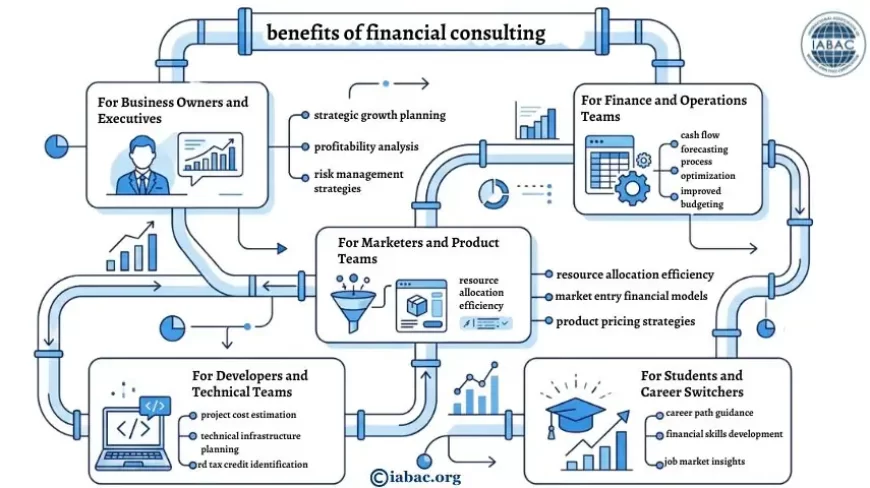
For Business Owners and Executives
Financial consulting reduces the chance of being blindsided by a cash flow crisis, a compliance failure, or a bad pricing decision. It also frees up leadership time, since a consultant can focus specifically on financial risk instead of it being one more thing an already busy executive has to track.
For Finance and Operations Teams
Bringing in a consultant, even briefly, often improves internal processes and reporting long after the engagement ends. Many companies keep using the dashboards, forecasting models, and reporting habits a consultant helped set up.
For Marketers and Product Teams
Pricing and budgeting decisions affect marketing and product strategy directly. A financial consultant's input on realistic pricing and budget allocation helps these teams plan campaigns and product launches with numbers they can actually trust.
For Developers and Technical Teams
As financial consulting increasingly involves data science and analytics tools, technical teams often end up working directly with consultants on building forecasting models, dashboards, and data pipelines that support financial decision-making.
For Students and Career Switchers
Financial consulting, especially the data-driven side of it, is a genuinely open career path right now. It doesn't require a traditional finance degree alone. A strong analytics or data science certification, like the tracks IABAC offers, combined with an understanding of financial fundamentals, is enough for many people to start building a consulting career, whether inside a company or as an independent consultant.
Challenges and Risks in the Consulting Relationship Itself
Financial consulting isn't automatically a fix-all, and it comes with its own set of things to watch for.
- Choosing the wrong consultant. Not every consultant has real, checkable expertise. Ask about specific experience, certifications, and past results, not just general claims.
- Unclear scope. Vague consulting agreements lead to vague results. A good engagement defines specific problems to solve and specific outcomes to measure.
- Over-reliance without internal capability building. If a consultant fixes a problem but doesn't train internal staff or leave behind usable tools and processes, the company can end up right back where it started once the engagement ends.
- Cost without a clear plan. Financial consulting isn't free, and companies should have a clear sense of what problem they're paying to solve, rather than hiring a consultant simply because it feels like the responsible thing to do.
- Ignoring data quality. A consultant, even a skilled one, can only give good advice based on good data. Companies with messy, incomplete, or unreliable financial records should expect the first phase of any consulting engagement to focus on fixing that.
Illustrative Case Studies
The following are made-up, composite examples that reflect common patterns seen across companies of different sizes, not specific verified case reports.
Case 1: A Small Retail Business and a Cash Flow Crisis A small retail company was profitable on paper but kept running into trouble covering payroll every few months. A financial consultant reviewed the business and found the real issue wasn't profit, it was timing: customer payments were coming in slower than supplier bills were going out. The consultant helped set up a rolling cash flow forecast and renegotiated payment terms with suppliers, which resolved the recurring shortfall within a few months.
Case 2: A Mid-Size Company and a Pricing Correction A mid-size service company had kept the same pricing structure for several years without adjusting for rising costs. A financial consultant's review found that several of the company's most popular services were actually losing money once true costs were accounted for. After adjusting pricing based on the consultant's analysis, the company's overall margin improved without losing significant customer volume.
Case 3: A Growing Company Building Internal Data Capability A fast-growing company brought in a financial consultant with a data science background to help build forecasting models instead of relying on basic spreadsheets. Over the engagement, the consultant also trained two internal team members, who went on to pursue a formal data science and analytics certification (in a pattern similar to IABAC's applied tracks) to keep building on those skills after the consulting engagement ended.
These patterns show a consistent theme: financial consulting works best when it solves a specific, identifiable problem and leaves the company more capable than before, not simply dependent on outside help indefinitely.
Tools and Technologies Used in Modern Financial Consulting
Financial consulting in 2026 goes well beyond spreadsheets. A well-rounded consultant, or a company building internal capability, should be comfortable with:
Core Financial Tools
- Spreadsheet modeling for budgeting and forecasting
- Accounting and ERP systems for financial reporting
- Cash flow forecasting tools
Data and Analytics Tools
- SQL for pulling and organizing financial data
- Python or R for building forecasting and scenario models
- Data visualization tools for building dashboards executives can actually use
Risk and Compliance Tools
- Risk modeling frameworks for debt, customer concentration, and market exposure
- Compliance tracking systems for tax and regulatory requirements
Emerging Tools
- AI-assisted forecasting and anomaly detection, used to flag unusual spending or revenue patterns early
- Scenario simulation tools that model multiple possible financial futures based on different assumptions
Consultants who combine traditional financial knowledge with these data and analytics tools are increasingly in higher demand than those who rely only on spreadsheets and manual review, which is part of why data-focused certifications, including those from IABAC, are becoming a common addition to a financial consultant's background.
A Roadmap for Bringing Financial Consulting Into Your Company
Step 1 — Identify the specific problem. Don't hire a consultant simply because it seems like a good idea. Get clear on the actual issue: cash flow, pricing, compliance, risk, or something else.
Step 2 — Decide between hiring externally or building internal capability. For a one-time problem, an outside consultant is often faster. For an ongoing need, training internal staff, for example through a recognized certification program, may be more cost-effective long term.
Step 3 — Check credentials and past results. Ask specific questions about a consultant's experience with businesses similar in size and industry to yours, and ask for concrete examples of results, not just general claims.
Step 4 — Set a clear scope and measurable goals. Define what success looks like before the engagement starts, whether that's a specific cash flow improvement, a completed compliance review, or a new forecasting model.
Step 5 — Make sure knowledge transfer is part of the deal. A good consulting engagement leaves your team more capable, not just the immediate problem solved. Ask for documentation, training, or tools your team can keep using.
Step 6 — Set a follow-up review. Check in a few months after the engagement ends to confirm the changes are still working and to catch any new issues early.
Common Failure Points
- Hiring a consultant without a clear problem to solve, which leads to vague, low-value engagements.
- Ignoring data quality issues, which limits how useful any consulting advice can actually be.
- Treating consulting as a one-time fix rather than an ongoing discipline, especially for fast-growing companies whose financial risks change quickly.
- Not training internal staff, leaving the company dependent on outside help for problems it could eventually handle itself.
- Choosing a consultant based on price alone, without checking their actual track record or relevant certifications.
- Ignoring the data and analytics side of consulting, and relying only on traditional, manual financial review methods that are slower and more prone to human error.
Future Trends in Financial Consulting
- Data science and financial consulting are merging. Companies increasingly expect consultants to bring both financial judgment and the ability to work directly with data, not just spreadsheets and assumptions.
- AI-assisted forecasting is becoming standard, helping consultants build faster, more accurate models, while human judgment remains essential for interpreting what those models actually mean for a specific business.
- Independent and freelance consulting is growing, supported by recognized, independently checked certifications, like those from IABAC, which give individual consultants a credible way to prove their skills without needing to join a large firm first.
- Smaller businesses are getting more access to consulting support, as remote work and independent consulting make it more affordable to bring in outside financial expertise without a full-time hire.
- Compliance and risk consulting are growing in importance as financial regulations continue to shift and become more complex across regions and industries.
Career Opportunities: How to Become and Register as a Consultant
Financial and data-driven consulting is one of the more accessible paths into a stable, well-paying career, especially for people willing to build both financial and analytical skills together.
Common roles in this space include:
- Financial Consultant — advising businesses on budgeting, cash flow, and financial planning
- Data and Analytics Consultant — applying data science techniques to financial forecasting and decision-making
- Risk and Compliance Consultant — helping companies manage financial risk and meet regulatory requirements
- Independent/Freelance Consultant — working directly with small and mid-size businesses on a project basis
- Internal Financial Analyst with Consulting Responsibilities — a growing hybrid role inside larger companies
How to register or start working as an independent consultant:
- Build a strong skill foundation. This typically means a mix of financial fundamentals (budgeting, forecasting, risk analysis) and, increasingly, data and analytics skills.
- Get an independently checked certification. A credential from a recognized, independent certifying body, such as IABAC, gives potential clients or employers a trustworthy signal of your actual skill level, since the group certifying you isn't the same group that taught you.
- Build a portfolio of real project work. Case studies, even from small or volunteer projects, help demonstrate practical ability beyond the certificate itself.
- Register your consulting business, if working independently. This usually involves registering as a sole proprietor, freelancer, or small business according to your local regulations, along with any required tax registration.
- Start with a narrow specialty. New consultants often find more traction focusing on one specific area, like cash flow consulting for small retail businesses, rather than trying to offer every type of financial consulting service at once.
- Keep building your data and analytics skills. As the field shifts toward data-informed consulting, ongoing skill-building through additional certification tracks helps keep your services relevant.
A Learning Path for Students and Career Changers
For someone starting from a student or early-career position, a sensible learning path looks like this:
- Foundational financial literacy — understanding budgeting, cash flow, and basic financial statements.
- Core data and analytics skills — statistics, Python or SQL, and data visualization basics.
- Applied financial analysis — forecasting, scenario modeling, and risk analysis.
- A recognized certification — validating your skills through an independent body like IABAC, which offers structured tracks combining analytics and applied business skills.
- A capstone or portfolio project — a real financial analysis or forecasting project you can show to future clients or employers.
- Early client or project experience — starting with smaller, well-defined engagements to build a track record before taking on larger consulting work.
Comparison: In-House Finance Team vs. Bringing in a Financial Consultant
|
Factor |
In-House Finance Team Only |
Financial Consultant |
|
Outside perspective |
Limited, since the same |
Strong, brings an outside, |
|
Cost structure |
Fixed salary cost year-round |
Often project-based or as-needed |
|
Specialized expertise |
Depends on existing staff skills |
Can bring specific expertise, |
|
Speed to address a |
Can be slower if the team |
Often faster, since the consultant |
|
Long-term capability |
Builds up naturally over time |
Depends on whether knowledge |
Conclusion and Next Steps
Companies that skip financial consulting aren't usually making one obvious mistake. They're quietly accumulating smaller risks, in cash flow, pricing, compliance, and planning, that eventually turn into much bigger, more expensive problems. Financial consulting, especially the modern, data-informed version of it, gives a company a way to catch these risks early, while they're still cheap and simple to fix. For business owners and executives, the next step is straightforward: identify your company's specific financial blind spots, and bring in outside expertise before those blind spots turn into a real crisis. For students and career changers, this is a genuinely open field right now, especially for people willing to combine financial fundamentals with data and analytics skills through a recognized certification path like the ones offered through IABAC.
As a next step:
- If you run a business, identify one specific financial risk area, cash flow, pricing, compliance, or risk management, and get it reviewed before it becomes a bigger problem.
- If you're building a consulting career, start with a strong foundation in both finance and data analytics, and validate your skills through an independently checked certification such as IABAC.
- Whichever side of this you're on, treat financial consulting as an ongoing discipline, not a one-time fix, since financial risks change as a company grows and as market conditions shift.
Sources Referenced
This article draws on general, widely recognized patterns in financial consulting practice, business risk management, and professional certification standards, as understood in early 2026. Specific statistics, cost figures, and market trends change frequently, so readers should verify current information directly through:
- IABAC's official certification and program documentation
- National and regional business and financial regulatory bodies relevant to your industry
- Established professional organizations covering financial consulting, risk management, and business analytics
- Current, region-specific tax and compliance guidance for your business type
Note: This article intentionally avoids citing specific numerical statistics that could not be independently verified at the time of writing. Readers seeking current market-size, cost, or growth-rate figures should consult up-to-date primary sources before relying on them for business decisions.