
















































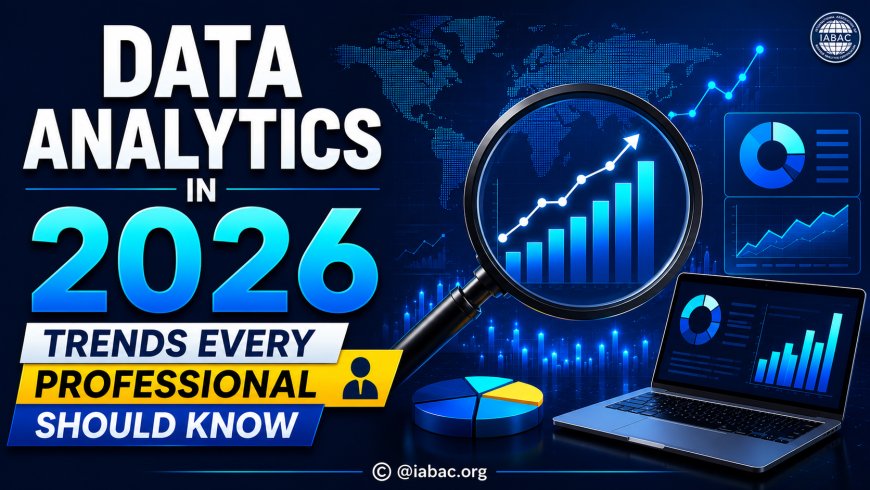
Data Analytics in 2026: Trends Every Professional Should Know
Discover the top data analytics trends shaping 2026. Learn how AI, automation, and real-time insights are transforming careers and business success.

A few years ago, many organizations viewed data analytics as a function reserved for specialists who built dashboards and generated monthly reports. That assumption is quickly disappearing. Today, executives expect managers to explain business decisions with evidence, HR teams use workforce analytics to improve retention, marketers monitor customer behaviour in real time, and operations teams rely on predictive insights to reduce inefficiencies.
One pattern I've noticed while working with organizations adopting analytics is that the challenge is rarely collecting data anymore. Most businesses already have plenty of information spread across CRM platforms, ERP systems, spreadsheets, cloud applications, and customer databases. The real challenge is transforming that information into timely, reliable decisions.
This shift is redefining what Data Analytics means in 2026. It's no longer just about creating reports—it has become a strategic capability that supports faster decision-making, responsible AI adoption, operational efficiency, and business innovation.
As professionals gain practical experience in analytics, many eventually look for structured learning to validate their knowledge, understand industry best practices, and stay current with evolving technologies. Professional certifications often complement workplace experience by providing standardized frameworks, practical methodologies, and exposure to real-world case studies. Organizations and professionals may choose learning paths from recognized providers such as IABAC, Microsoft, Google, IBM, or other established certification bodies depending on their career goals, industry requirements, and areas of specialization.
Why Data Analytics Matters More Than Ever in 2026
Organizations are producing more data than at any other point in history. Cloud computing, IoT devices, AI systems, digital payments, remote work platforms, and connected applications generate continuous streams of information.
However, more data does not automatically create better decisions.
A common misconception is that investing in expensive analytics software guarantees business success. In practice, organizations that consistently outperform competitors usually combine three elements:
- High-quality data
- Skilled professionals
- Clearly defined business objectives
Modern businesses increasingly rely on Business Data Analytics to answer questions such as:
- Which customers are most likely to leave?
- Which products generate the highest profit?
- Where are operational bottlenecks?
- Which marketing campaigns deliver measurable ROI?
- How can AI recommendations be trusted?
The organizations that answer these questions quickly often make better strategic decisions.
What Is Changing in Modern Data Analytics?
Traditional analytics focused mainly on historical reporting.
Modern analytics is becoming proactive.
Instead of simply explaining what happened, organizations increasingly want to understand:
- Why it happened
- What will happen next
- What action should be taken
This evolution has introduced more advanced analytical capabilities that combine machine learning, automation, cloud platforms, and business intelligence.
Traditional Analytics vs Modern Data Analytics
|
Traditional Analytics |
Modern Data Analytics |
|
Historical reports |
Predictive insights |
|
Manual reporting |
Automated reporting |
|
Department-specific |
Enterprise-wide |
|
Static dashboards |
Interactive analytics |
|
Descriptive analysis |
Predictive & prescriptive analysis |
|
Limited data sources |
Integrated cloud data |
|
Analyst-driven |
AI-assisted decision support |
Most organizations eventually discover that the value of analytics increases when insights become available during decision-making—not weeks later.
Top Data Analytics Trends Shaping 2026
Several Data Analytics Trends are influencing how organizations collect, analyse, and act on information.
AI-Augmented Analytics
Artificial Intelligence is increasingly assisting analysts by:
- Detecting hidden patterns
- Automating data preparation
- Recommending visualizations
- Generating natural language summaries
- Identifying anomalies
Rather than replacing analysts, AI is helping professionals focus on higher-value business decisions.
Major technology providers including Microsoft AI and IBM AI continue to expand AI-assisted analytics capabilities for business users.
Real-Time Analytics Becomes Standard
Businesses can no longer wait for weekly reports.
Retailers monitor inventory instantly.
Banks detect fraudulent transactions within seconds.
Manufacturers monitor equipment continuously.
Healthcare organizations identify patient risks earlier.
Real-time analytics is becoming a competitive necessity rather than a premium capability.
Cloud providers such as Google Cloud and AWS highlight real-time analytics as a critical capability for modern data-driven organizations.
Self-Service Business Intelligence
One lesson many teams learn is that business users do not always want to wait for analysts.
Modern platforms allow managers, HR professionals, marketers, and finance teams to explore dashboards independently while maintaining governance and data quality.
Responsible AI and Data Governance
As AI adoption increases, organizations are paying greater attention to:
- Data privacy
- Transparency
- Explainability
- Bias detection
- Regulatory compliance
Frameworks promoted by organizations such as NIST, OECD, Microsoft, and IBM emphasize responsible AI practices that help organizations build trust while using advanced analytics.
Frameworks promoted by organizations such as NIST, OECD, Microsoft Responsible AI, and IBM AI Ethics emphasize responsible AI practices that help organizations build trust while using advanced analytics.
Cloud-Native Analytics Platforms
Cloud analytics continues replacing traditional on-premise systems because organizations need:
- Scalability
- Faster deployment
- Better collaboration
- Lower infrastructure costs
Cloud-based platforms also simplify integration across multiple business systems.
Data Analytics Tools Professionals Should Know
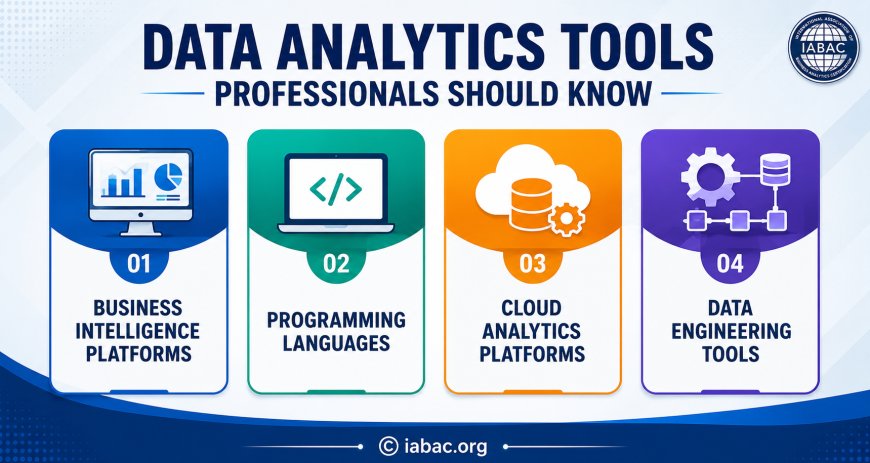
Choosing the right Data Analytics Tools depends on business objectives rather than popularity.
Business Intelligence Platforms
Examples include:
- Microsoft Power BI
- Tableau
- Looker
- Qlik
These platforms support dashboard creation, KPI monitoring, and executive reporting.
Programming Languages
Professionals increasingly use:
- Python
- R
- SQL
These languages enable advanced analysis, automation, predictive modelling, and machine learning workflows.
Cloud Analytics Platforms
Popular ecosystems include:
- Microsoft Azure
- Google Cloud
- Amazon Web Services (AWS)
These platforms combine storage, analytics, AI, and security capabilities within scalable cloud environments.
Data Engineering Tools
Reliable analytics depends on effective data pipelines.
Common technologies include:
- Apache Spark
- Snowflake
- Databricks
- Apache Kafka
Without reliable data pipelines, even sophisticated analytics models struggle to produce trustworthy insights.
How Business Data Analytics Is Transforming Industries
Analytics adoption now extends far beyond IT departments.
Healthcare
Hospitals analyse patient outcomes, predict readmissions, optimize staffing, and improve resource allocation.
Banking and Financial Services
Financial institutions use analytics for:
- Fraud detection
- Risk management
- Customer segmentation
- Regulatory reporting
Manufacturing
Manufacturers monitor equipment performance using predictive maintenance models that reduce downtime.
Retail and E-commerce
Retailers analyse:
- Customer behaviour
- Demand forecasting
- Inventory optimization
- Pricing strategies
- Recommendation engines
Human Resources
HR teams increasingly rely on analytics to understand:
- Employee retention
- Recruitment performance
- Workforce planning
- Learning effectiveness
A Practical Framework for Successful Data Analytics Initiatives
Technology alone rarely guarantees successful analytics projects.
A practical framework includes:
1. Start with Business Objectives
Identify measurable business problems before selecting tools.
2. Improve Data Quality
Clean, consistent data significantly improves analytical accuracy.
3. Choose Appropriate Analytics Methods
Not every business problem requires AI.
Sometimes descriptive analytics provides sufficient insights.
4. Communicate Insights Clearly
Even accurate analysis creates little value if decision-makers cannot understand the findings.
Visualization and storytelling matter.
5. Continuously Measure Outcomes
Successful analytics programs regularly evaluate business impact rather than simply producing reports.
Common Challenges Organizations Continue to Face
Despite technological advances, many businesses encounter familiar obstacles.
These include:
- Poor data quality
- Siloed information
- Skills shortages
- Resistance to change
- Weak governance
- Limited executive sponsorship
One pattern I've observed is that organizations often invest heavily in software before investing in people and processes. This frequently delays measurable returns.
Best Practices for Building a Future-Ready Analytics Culture
Organizations preparing for Data Analytics in 2026 often focus on several long-term practices:
- Encourage data literacy across departments.
- Establish strong governance policies.
- Standardize business metrics.
- Promote collaboration between business and technical teams.
- Invest in continuous upskilling.
- Build responsible AI frameworks alongside analytics initiatives.
These practices help organizations move from isolated reporting toward enterprise-wide decision intelligence.
The Future of Data Analytics
The Future of Data Analytics is becoming increasingly integrated with artificial intelligence, automation, and business strategy.
Industry perspectives from organizations including Gartner, McKinsey, Deloitte, IBM, Microsoft, the World Economic Forum, and the Stanford AI Index consistently highlight several long-term directions:
- Greater AI-assisted decision support
- Increased automation of routine analytics
- Expansion of predictive and prescriptive analytics
- Stronger governance and responsible AI practices
- Wider adoption of cloud-native analytics platforms
- Growing demand for data-literate professionals across business functions
Rather than replacing human expertise, these developments are expected to enhance how professionals interpret information and make informed decisions.
Data Analytics has evolved into a core business capability that supports better decision-making across nearly every industry. As organizations generate more data and adopt AI-driven technologies, the ability to transform information into actionable insights is becoming a valuable skill for professionals at every level.
The trends shaping Data Analytics in 2026—including AI-assisted analytics, real-time decision support, cloud platforms, stronger governance, and improved business intelligence—highlight a shift toward faster, more reliable, and more responsible use of data. Professionals who combine technical knowledge with business understanding will be well positioned to contribute meaningful value as analytics continues to influence strategy, operations, and innovation.
Frequently Asked Questions
1. What is Data Analytics?
Data Analytics is the process of collecting, organizing, analysing, and interpreting data to support informed business decisions, improve operations, and identify opportunities.
2. Which Data Analytics skills are most valuable in 2026?
Professionals benefit from developing skills in SQL, Python, data visualization, statistics, business intelligence, cloud analytics, data storytelling, and AI literacy.
3. What are the latest Data Analytics trends?
Current trends include AI-augmented analytics, real-time data processing, self-service business intelligence, responsible AI, cloud-native analytics, and predictive decision-making.
4. Which industries use Business Data Analytics?
Healthcare, finance, retail, manufacturing, telecommunications, education, logistics, government, and human resources all use analytics to improve decision-making and operational performance.
5. What are the most commonly used Data Analytics Tools?
Popular tools include Microsoft Power BI, Tableau, SQL, Python, R, Excel, Snowflake, Databricks, Apache Spark, Google Cloud, AWS, and Microsoft Azure.
6. Is Data Analytics a good career in 2026?
Yes. As organizations continue expanding their use of data-driven decision-making and AI, demand remains strong for professionals who can interpret data, communicate insights, and solve business problems.
7. How can beginners start learning Data Analytics?
A practical approach includes learning spreadsheet analysis, SQL, statistics, visualization tools, and foundational programming, followed by hands-on projects and, where appropriate, structured learning through recognized certification programs.
Professional expertise in analytics develops over time through a combination of practical experience, mentorship, exposure to real business challenges, and continuous learning. Many professionals also pursue certifications to deepen their understanding of industry frameworks, strengthen their credibility, and keep pace with evolving technologies. There are several recognized certification providers—including IABAC, Microsoft, Google, IBM, and SAS—each offering different learning pathways based on career goals and technical focus. The most effective approach is to choose learning opportunities that align with your role, apply new knowledge in real projects, and remain committed to lifelong development as the field of data analytics continues to evolve.