




















































The Future of Data Analytics: AI and Machine Learning Trends
Find out how AI and machine learning are transforming data analytics, key trends shaping the future, real-world uses, challenges, and industry impact.


The field of data analytics is continuously changing. New tools make it possible to turn mountains of raw data into useful decisions, and artificial intelligence and machine learning are the engines behind that change. I’ll explain where data analytics came from, where it is now, the important trends to watch, how industries will use them, the problems we must solve, and practical steps you or your team can take to stay ready.
Why data analytics matters
Every organization, big or small, now collects data. Sales numbers, website clicks, machine sensor readings, patient records, customer chats: it all adds up. But data on its own is just noise. Analytics turns that noise into signals: which products sell best, when a machine will likely fail, and what customers want next week.
AI and ML multiply what analytics can do. They help detect patterns that humans miss, predict what will happen next, and automate repetitive analysis. That combination helps teams move faster, reduce waste, and make better decisions.
History of data analytics
Data analysis did not start with computers. For centuries, people used basic counting and record-keeping, tracking crops, taxes, or trade.
Mechanization and early computers in the 20th century let us handle larger datasets and do statistical tests faster. In the 1990s and 2000s, businesses built warehouses and reporting tools. In the last decade, cloud computing, cheap storage, and connected devices (IoT) made data far larger and more varied text, images, streams, logs, and created the need for smarter analysis tools.
This long evolution matters because every layer of rules, storage, modeling builds on what came before. The systems we use today are a result of many small improvements over time.
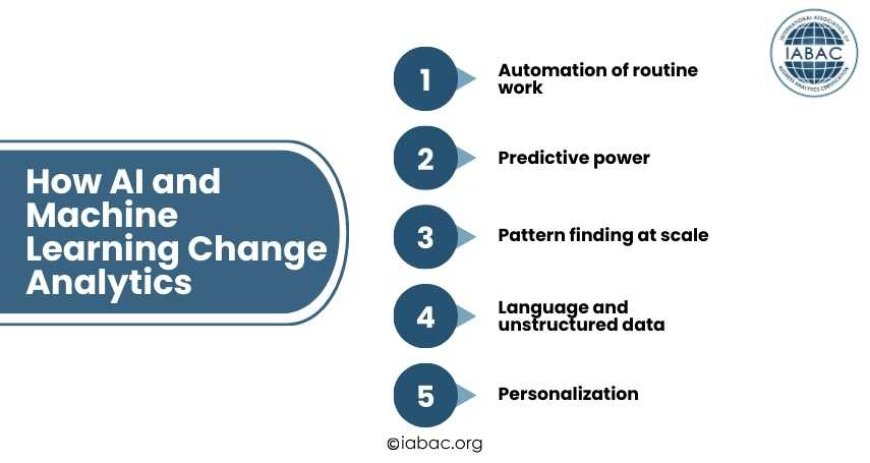
How AI and Machine Learning Change Analytics
Data analysts are not replaced by AI and ML; instead, they are given better tools.
-
Automation of routine work. Cleaning, joining, and summarizing data are boring but necessary. AI tools can do much of this work automatically, so people spend their time asking better questions.
-
Predictive power. Rather than only reporting past sales, ML models can forecast demand, helping teams plan inventory or staffing.
-
Pattern finding at scale. Models can spot signals inside huge datasets that humans would miss fraud rings, subtle product issues, or hidden customer segments.
-
Language and unstructured data. Natural language processing (NLP) helps extract insight from text support tickets, reviews, and social media, so companies can measure sentiment and priorities without manual reading.
-
Personalization. Recommendation systems tailor content or product suggestions for individual users, improving engagement and revenue.
These capabilities make analytics both more powerful and more widely useful.
Key trends to watch and why they matter
The trends influencing the next 3 to 5 years are listed below. Each is explained simply and connected to practical applications.
1. Augmented analytics
AI is used in augmented analytics to speed up data comprehension. The technology makes chart recommendations, highlights intriguing patterns, and explains why a statistic changed rather than having a human write every query. Faster insights and fewer manual tasks are the outcome.
Why it matters: teams can go from creating static reports to finding opportunities that were previously missed.
(Related trend: "self-service analytics" provides non-technical users with secure data exploration tools.)
2. Explainable and transparent AI
People want to know why a model made a specific prediction as models become more influential in decision-making. Explainable AI enables stakeholders to trust, audit, and improve models by illuminating the causes of results.
Why it matters: Organizations are compelled to implement explainable processes due to regulatory requirements, consumer trust, and compliance. Enterprises and regulators are increasingly demanding solutions that are easy for humans to understand.
3. Edge computing and real-time analytics
Edge computing moves data processing closer to where data is created on machines, gateways, phones, or local servers, instead of sending everything to the cloud. This cut-down in travel time (latency) lets systems react instantly. Examples include immediate anomaly detection on factory equipment or on-device language translation.
Why it matters: faster decisions, less cloud cost, better privacy for sensitive data. Major tech players and chip makers are investing heavily in edge AI infrastructure and products.
4. Data fabric and better architectures
“Data fabric” is a way to think about a unified layer that makes data easy to find and use across many systems. It connects databases, lakes, and streaming systems so teams can access consistent data without heavy integration work.
Why it matters: consistent, trusted data means faster analytics and fewer mistakes.
5. Data governance, privacy, and security
Rules regarding who can access what, how it is stored, and how it is used become crucial as data and models become more advanced. Policies are developed by data governance teams, and privacy-preserving methods (such as anonymization) reduce less risk.
Why it matters: preventing costly breaches, customer trust, and compliance.
6. Democratization and self-service analytics
Tools are now easier to use, so business users, not just data scientists, can explore data. This speeds up decisions, but it must be balanced with governance to prevent inconsistent or risky analyses.
Why it matters: more people can answer data questions directly, reducing dependency on overloaded data teams.
7. AutoML and model operations (MLOps)
AutoML tools automate parts of model building, feature selection, hyperparameter tuning, and model selection, so teams can prototype faster. MLOps brings a software engineering discipline to deploying and managing models in production.
Why it matters: shorter time from idea to production and more reliable model operations.
8. Natural language interfaces
Asking data questions in plain English and getting charts or answers back becomes common. This lowers the barrier to insights for non-technical users.
Why it matters: broader access to analytics and faster decision cycles.
Real-world uses: how industries benefit
This is how these mentioned trends appear in everyday life.
AI and analytics improve diagnoses, optimize hospital staffing, and predict patient risk. Real-time monitoring devices and edge analytics offer faster alerts and shorter critical delays.
Finance
Machine learning is used by banks for credit scoring, fraud detection, and personalized financial guidance. Predictive models increase customer happiness and reduce losses.
Manufacturing
Predictive maintenance models, which minimize expensive downtime by scheduling repairs before malfunctions, are fed by sensors on equipment.
Retail and e-commerce
Recommendation engines, demand forecasting, and dynamic pricing help stores match inventory and marketing to customer behaviour.
Transportation and logistics
Route optimization, predictive maintenance for fleets, and traffic management improve delivery times and reduce costs.
These are a few examples, but nearly every sector will see AI-enhanced analytics reshape how decisions are made.
What organizations should do: practical steps
Here are some simple steps that have a significant impact if you manage analytics in a company.
-
Start by asking detailed questions. Don't gather information just for its own sake. Identify the choices you wish to make better.
-
Invest in clean, trusted data. Make data quality and master data management a priority.
-
Adopt a governance framework. Define roles, policies, and access rules early.
-
Pilot edge or real-time projects where latency matters. Use one small, high-value case to show results.
-
Bring business people into analytics. Train non-technical users and give them self-service tools with guardrails.
-
Plan for model monitoring and retraining. Treat models like software: deploy, monitor, update.
-
Focus on explainability and ethics. Use tools and processes that make model decisions understandable.
What individuals should learn: a simple roadmap
Here is a simple way to pursue a career in analytics:
-
Basic skills: Excel, SQL, and basic statistics.
-
Programming: Python (for data work) and a bit of scripting.
-
Visualization: Learn to build clear charts and dashboards.
-
Cloud basics: Understand storage, compute, and managed analytics services.
-
Model basics: Learn simple machine learning: regression, classification, and evaluation.
-
Practical projects: Build a few small projects with public datasets to show what you can do.
-
Soft skills: Communication and domain know-how are as important as technical skills.
Recognized certifications show potential employers that you have mastered a structured curriculum. IABAC provides internationally recognized certifications in data analytics that meet industry standards.
Tools and platforms
Not every instrument is necessary. Select those that address your issues:
-
Storage and Compute: Cloud data warehouses and data lakes.
-
ETL / DataOps tools: For moving and preparing data reliably.
-
BI and dashboarding: For visualization and self-service.
-
AutoML & model platforms: For faster prototyping.
-
MLOps tools: For deployment and monitoring.
When evaluating technologies, prioritize security, integration ease, and community support.
The future: what to expect in the next 3-5 years
Here are some practical changes you could expect to see:
-
Increased processing near the edge. Expect increased inference and analytics from devices and local servers, which will reduce latency and safeguard privacy. Big suppliers and chip manufacturers are preparing for this change.
-
AI with improved self-explanation. Explainability tools and model audits will become commonplace as users and regulators demand transparency.
-
Analytics for everyone. Self-service tools and natural language interfaces will let more people ask data questions and get trusted answers.
-
Hybrid architectures. A mix of edge, cloud, and on-premises systems will be the norm, each used where it makes sense.
-
Tighter governance. Policies and technical controls for data use, retention, and privacy will grow sharper as laws and expectations tighten. Industry reports and analyst briefs agree that these are core priorities for business strategy.
How to measure success
Make use of simple business impact metrics:
-
Time saved per decision.
-
Percentage improvement in forecast accuracy.
-
Cost savings from reduced downtime.
-
Revenue uplift from personalization or recommendations.
-
Reduction in false positives for fraud detection.
Select a few that are important and monitor them regularly.
Data analytics, powered by AI and ML, is moving from an experimental phase into everyday business practices. The future will be faster, smarter, and more distributed, processing will happen where it makes sense (including on devices), models will need to be understandable, and teams will need better data hygiene and governance to succeed.
If you’re a practitioner or leader, start small with well-scoped pilots that solve meaningful problems, invest in clean data and governance, and build the skills that let your organization act on insights quickly.
If you want a concrete credential to show employers or clients you know how to use analytics responsibly and effectively, consider pursuing the Data Analytics certification as a recognized, industry-aligned option.