




















































Business Analytics Certification: Which Is Best in 2026?
Which business analytics certification is worth it in 2026? Compare top certifications, India salary trends, career paths, costs, and best options by level.

If you are a working professional evaluating business analytics certifications, you are probably asking one of three questions: Which certification do employers actually recognize? How much will it cost, and how long will it take? Will it genuinely improve my career prospects and salary?
This guide answers all three with specific programs, real salary data, honest comparisons, and a clear certification path based on where you are in your career right now.
What Is Business Analytics and Why Does It Need a Certification?
Business analytics is the practice of using data, statistical analysis, and quantitative methods to drive business decisions. It sits between pure data science (model building and prediction) and traditional reporting (dashboards and summaries), combining technical skills with business judgment to answer questions like, "Why did revenue drop in Q3?" Which customers are most likely to churn? Where should we open the next store?
Every industry now depends on professionals who can do this work.
According to the NASSCOM Tech Talent Report 2025, business analytics roles in India grew 38% between 2023 and 2025.
The World Economic Forum's Future of Jobs Report 2025 ranks data analysts and business analytics professionals among the top five fastest-growing job categories through 2030.
The certification question matters because business analytics sits at a skills intersection, part statistics, part business strategy, and part data tools, where credentials from a recognized body provide a clearer signal to employers than a self-reported skill list. A certification shows you have been assessed on specific competencies, not just that you watched some courses.
Understand the full scope of data analytics careers
Business Analytics vs Data Analytics vs Data Science — Know the Difference Before You Certify
Many professionals certify in the wrong area because these three terms are used interchangeably. They are not the same.
Business analytics focuses on using data to make business decisions, analyzing past and current performance, forecasting outcomes, and recommending actions. Primary audience: business managers, analysts, consultants, and finance and operations professionals. Tools: Excel, SQL, Power BI, Tableau, basic statistical methods.
Data analytics is more technical, involving data engineering, data pipeline management, and deeper statistical analysis. More technical than business analytics but less model-focused than data science. Primary audience: data analysts, BI engineers, analytics engineers.
Data science involves building predictive models and machine learning systems. The most technically demanding of the three requires Python or R, statistics, linear algebra, and ML frameworks. Primary audience: data scientists, ML engineers, AI researchers.
If your background is in business, finance, marketing, operations, HR, or management and your goal is to make better data-driven decisions in your current or next role, business analytics certification is the right path. You do not need a data science certification to add analytics value in a business role.
Full comparison of data roles and certifications
Top Business Analytics Certifications in 2026 — Compared
Quick Comparison Table
|
Certification |
Provider |
Cost |
Duration |
Best For |
India Recognition |
|
Certified Business Analytics Expert (CBAE) |
IABAC |
₹15K–₹30K / ~$200–$350 |
3–5 months |
Mid-level professionals |
Very High |
|
Business Analytics for Managers (BAM) |
IABAC |
₹12K–₹25K |
2–4 months |
Business managers, team leads |
Very High |
|
Business Analytics Foundation (BAF) |
IABAC |
₹8K–₹15K |
1–3 months |
Beginners, freshers |
High |
|
Certified Business Intelligence Professional (CBIP) |
TDWI |
$695 |
3–6 months |
Senior BI professionals |
Medium (global focus) |
|
Certified Analytics Professional (CAP) |
INFORMS |
$695 |
3–6 months |
Experienced analytics professionals |
Medium |
|
CBAP (Certified Business Analysis Professional) |
IIBA |
$450–$725 |
3–6 months (+ experience req.) |
Business analysts with 5+ yr exp |
Medium-High |
|
IBM Data Analyst Certificate |
IBM/Coursera |
~$200 total |
3–4 months |
Beginners, career switchers |
Medium |
|
Google Data Analytics Certificate |
Google/Coursera |
~$200 total |
4–6 months |
Entry-level analysts |
Medium |
1. IABAC Certified Business Analytics Expert (CBAE)
What it is: The Certified Business Analytics Expert is IABAC's flagship business analytics credential for mid-level and senior professionals. It validates end-to-end business analytics competency — from data interpretation and statistical analysis to strategic business recommendations.
What it covers: The CBAE program covers business data analysis fundamentals, statistical techniques for business problems (descriptive statistics, hypothesis testing, regression analysis), data visualization and dashboard design, business intelligence tools (primarily Excel and Power BI), predictive analytics basics, business problem framing, and translating data insights into strategic recommendations.
Advanced modules include customer analytics, financial analytics, operations analytics, and decision modeling.
Who it is for: Finance professionals adding analytics to their skill set. Operations managers who need to make data-driven resource decisions. Marketing professionals building customer analytics capability. Business analysts wanting a formal credential. HR professionals moving into people analytics.
Assessment: Competency-based evaluation with online examination. Credentials are verifiable through iabac.org; employers can validate certification status directly.
Cost: Approximately ₹15,000–₹30,000 in India (contact IABAC for current rates). USD equivalent $200–$350.
Duration: 3–5 months depending on study pace and prior background.
India recognition: Strong across IT services, consulting, BFSI, and corporate analytics teams. IABAC's network of employer relationships in India makes this credential meaningful in the hiring context where it is most frequently used.
CBAE certification program details
2. IABAC Business Analytics Certification for Managers
What it is: A certification track designed specifically for managers and business leaders who need to use analytics to drive team decisions, evaluate performance, and communicate data-driven strategy without necessarily running the analysis themselves.
What it covers: Reading and interpreting analytics reports, setting KPIs and defining measurement frameworks, understanding statistical significance for business decisions, working with analytics teams effectively, data-driven strategy development, and communicating analytics findings to senior leadership and boards.
Who it is for: Mid-level to senior managers across any function — sales, marketing, operations, finance, supply chain, HR. Particularly valuable for professionals whose teams are producing analytics output but who need to understand and challenge that output rather than produce it.
Assessment: Examination and case study based.
Why this certification exists as a separate track: Many analytics certifications are designed for the people running the analysis. This one is designed for the people making decisions based on that analysis, a significantly different skill set that most certification programs ignore.
3. IABAC Business Analytics Foundation
What it is: An entry-level certification covering the fundamentals of business analytics — designed for professionals with no prior analytics background.
What it covers: What business analytics is and why it matters, basic data concepts, Excel for data analysis, introduction to data visualization, reading and interpreting basic statistical outputs, business reporting fundamentals.
Who it is for: Freshers entering analytics roles. Professionals from non-analytical backgrounds (sales, HR, marketing, and operations) are adding analytics literacy. Managers who want a structured introduction before pursuing CBAE.
Cost: Approximately ₹8,000–₹15,000 in India.
Duration: 1–3 months.
4. IABAC Industry-Specific Business Analytics Certifications
One of IABAC's strongest differentiators is its industry-specific certification tracks — business analytics applied to the specific data challenges and regulatory context of individual sectors.
Business Analytics Specialist – Banking
It covers risk analytics, credit scoring models, customer lifetime value in banking, financial fraud detection, and regulatory reporting analytics. For professionals in banking, NBFCs, and financial services.
Business Analytics Specialist – Healthcare
Covers clinical analytics, patient outcome modeling, healthcare operations efficiency, and population health management. For professionals in hospitals, insurance, and pharma.
Business Analytics Specialist – Retail
Covers demand forecasting, customer segmentation, inventory optimization, and promotional analytics. For professionals in e-commerce, FMCG, and retail operations.
Business Analytics Specialist – HR Analytics
It covers workforce analytics, attrition prediction, talent acquisition metrics, and compensation benchmarking. For HR professionals building people analytics capability.
Business Analytics Specialist – Logistics
It covers supply chain optimization, route efficiency, warehouse analytics, and demand planning. For professionals in logistics, manufacturing, and supply chain management.
Industry-specific certifications are particularly valuable when you already have domain expertise — they combine your business knowledge with analytics skills, creating a combination that pure analytics professionals without your domain background cannot replicate.
HR analytics certification details
Healthcare analytics certification
5. CBAP — Certified Business Analysis Professional
What it is: The Certified Business Analysis The Professional is a senior-level credential for experienced business analysts.
Important distinction: CBAP is a business analysis certification — focused on requirements gathering, stakeholder management, and process improvement. It is not a business analytics certification focused on data, statistics, and quantitative analysis. The names are easily confused, but the content is significantly different.
Who it is for: Business analysts with at least 5 years of relevant work experience. It has strict eligibility requirements you cannot sit for CBAP as a fresher or early-career professional.
Cost: $450–$725 depending on IIBA membership status.
When to choose CBAP over CBAE: If your role is primarily business analysis (requirements, process modeling, stakeholder communication) rather than data and quantitative analytics — CBAP is appropriate. If your role involves data, dashboards, statistical analysis, and quantitative decision support — CBAE is more relevant.
6. Certified Analytics Professional (CAP) — INFORMS
What it is: A senior-level credential from INFORMS (the professional society for operations research and analytics). Strong in academic and large enterprise environments in the USA and Europe.
Who it is for: Experienced analytics professionals (typically 3+ years) targeting senior roles in large enterprises, particularly in the USA.
India relevance: Limited compared to IABAC. CAP is not widely recognized by Indian employers as a hiring filter. Better suited for professionals targeting global or multinational organizations.
Cost: $695 USD.
Business Analytics Certification Salary Impact — India and USA
India Salary Data
Business analytics professionals with recognized certifications consistently earn higher compensation than uncertified equivalents in Indian hiring.
|
Role |
Without Certification |
With IABAC/Recognized Cert |
Difference |
|
Business Analyst (0–2 yr) |
₹4 – ₹7 LPA |
₹6 – ₹9 LPA |
+₹1–3 LPA |
|
Business Analytics Specialist (2–5 yr) |
₹8 – ₹15 LPA |
₹10 – ₹20 LPA |
+₹2–5 LPA |
|
Senior Business Analyst / Analytics Manager (5–8 yr) |
₹15 – ₹25 LPA |
₹18 – ₹30 LPA |
+₹3–8 LPA |
|
Analytics Lead / Head of Analytics (8+ yr) |
₹25 – ₹45 LPA |
₹30 – ₹55 LPA |
+₹5–12 LPA |
The salary impact works through three mechanisms: improved selection rate (certified candidates pass initial screening more often), stronger negotiation leverage during offer discussions, and faster promotion timelines as organizations increasingly require formal analytics credentials for senior titles.
City-Wise Salary for Business Analytics Professionals in India
|
City |
Analytics Manager (5–8 yr) |
Avg Package |
|---|---|---|
|
Bangalore |
₹18 – ₹32 LPA |
Highest — tech + analytics concentration |
|
Mumbai |
₹16 – ₹28 LPA |
BFSI + consulting demand |
|
Hyderabad |
₹15 – ₹26 LPA |
IT services + product companies |
|
Pune |
₹14 – ₹24 LPA |
IT services + manufacturing |
|
Delhi / NCR |
₹14 – ₹25 LPA |
Consulting + FMCG + e-commerce |
|
Chennai |
₹13 – ₹22 LPA |
IT services + healthcare |
USA Salary Data
|
Role |
Annual Salary (USA) |
|
Business Analyst (entry) |
$65K – $85K |
|
Business Analytics Specialist |
$85K – $115K |
|
Analytics Manager |
$110K – $145K |
|
Director of Analytics |
$145K – $195K |
|
VP / Chief Analytics Officer |
$200K – $350K+ |
Check the Full data analyst salary guide
Who Should Pursue a Business Analytics Certification?
Business analytics certifications deliver the most value for specific professional profiles. Understanding whether you are in the right segment matters before investing time and money.
Strong Fit
Business professionals adding analytics to their existing role. Finance managers, HR directors, marketing heads, and operations leaders who now receive data reports but want to understand, challenge, and use them more effectively. A CBAE or BAM certification gives these professionals the quantitative foundation to lead analytics-driven decisions rather than depend on analysts to do it for them.
Early-career professionals entering analytics. Freshers with commerce, economics, or management backgrounds who want to enter business analytics without a data science degree. The foundation-to-expert path gives structured progression.
Domain experts adding analytics specialization. A nurse who wants to move into healthcare analytics. A banker wanting to specialize in risk analytics. A supply chain manager building operations analytics skills. Industry-specific certifications directly address this combination.
Professionals preparing for senior roles. Analytics credentials are increasingly listed in job descriptions for Analytics Manager and Head of Analytics titles. Certification positions you for these transitions.
Weaker Fit
If your goal is machine learning and model building. Business analytics certification is the wrong path — you want data science or ML engineering certification instead.
If you already have 8+ years of analytics experience and a strong track record. At senior levels, employers weight demonstrated outcomes over credentials. Your portfolio of analytics projects and business impact is more persuasive than a new certification.
Exception: industry-specific credentials that add domain credibility you currently lack.
If you want a cloud platform focus. AWS, Azure, and GCP certifications are more appropriate for professionals focused on data infrastructure and model deployment.
The Right Certification Path for Business Analytics
Many professionals make the mistake of jumping to advanced certifications without the foundation skills. Here is the structured path that produces the best outcomes:
Path 1 — Complete Beginner (No Analytics Background)
Month 1–2: Build prerequisites: Microsoft Excel at intermediate level (pivot tables, VLOOKUP, basic formulas), basic SQL for data querying (SELECT, WHERE, JOIN, GROUP BY), introduction to statistics (mean, median, variance, basic probability), and familiarity with one BI tool (Power BI recommended).
Month 3–4: Foundation Certification IABAC Business Analytics Foundation — structured curriculum covering the basics with formal assessment. Gives you a credential while building core skills.
Month 5–8: Core Certification IABAC Certified Business Analytics Expert — the primary professional credential. Covers statistical analysis, data visualization, business intelligence, predictive analytics basics, and business problem framing.
Month 9–12: Specialization Choose the industry-specific certification that matches your target sector — Banking, Healthcare, Retail, HR, or Logistics.
Path 2 — Mid-Career Professional (Some Analytics Experience)
Month 1–3: Fill Skill Gaps Identify which analytics skills you currently lack — statistics, SQL, Power BI, or business communication. Fill those gaps first.
Month 3–6: IABAC CBAE Directly pursue the Certified Business Analytics Expert — skip the foundation if you have relevant experience.
Month 6–9: Specialization or Management Track If targeting leadership roles: Business Analytics for Managers. If targeting domain-specific senior roles: Industry-specific certification in your sector.
Path 3 — Manager or Business Leader
Month 1–3: Business Analytics for Managers (BAM) This is your primary credential — designed specifically for decision-makers rather than practitioners.
Month 3–6: Optional Specialist Track For deeper analytics involvement, add CBAE. For sector-specific authority, add the industry certification for your domain.
Path 4 — Career Switcher From Non-Analytics Role
Month 1–4: Foundation + Tools SQL and Power BI/Tableau are the minimum technical entry requirements for most analytics roles. Invest here first before certification.
Month 4–8: IABAC Foundation → CBAE Use the structured foundation-to-expert path.
Month 8–12: Portfolio Building Two to three analytics projects using public datasets, documented clearly on LinkedIn or GitHub. Certification + portfolio is the winning combination for career switchers.
What the Business Analytics Certification Curriculum Covers
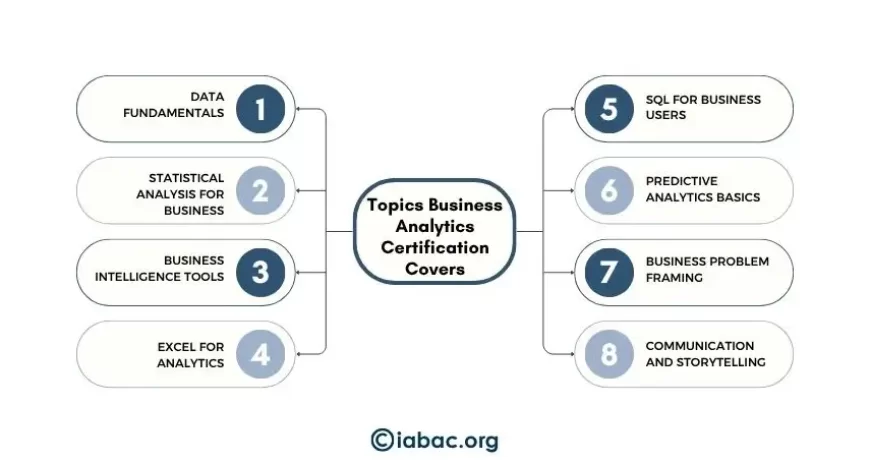
This section answers one of the most common pre-enrollment questions: what will I actually learn?
A comprehensive business analytics certification program covers these core areas:
Data Fundamentals: Understanding data types, data sources, data collection methods, data quality assessment, and data governance principles. How businesses collect and store data from transaction databases to customer CRM systems to operational sensors.
Statistical Analysis for Business: Descriptive statistics for business reporting, probability and risk assessment, hypothesis testing for business decisions (A/B testing, significance testing), regression analysis for forecasting, and correlation analysis. The goal is not mathematical derivation but practical application: when to use each technique and how to interpret the output for a non-technical audience.
Business Intelligence Tools: Power BI or Tableau for dashboard design and data visualization. Best practices for creating charts that communicate clearly. Common visualization mistakes that mislead stakeholders. Building interactive reports that update automatically from data sources.
Excel for Analytics: Advanced Excel functions (VLOOKUP, INDEX-MATCH, pivot tables, data validation), basic statistical functions, forecasting tools, and scenario modeling. Excel remains the most widely used analytics tool in business environments in 2026.
SQL for Business Users: Writing queries to extract data from databases, joining multiple tables, aggregating data, and creating views. Business-appropriate SQL — focused on data retrieval and analysis, not database administration.
Predictive Analytics Basics: What regression and classification models do, how to interpret model outputs, how to evaluate whether a model is good enough for a business decision, and how to communicate model findings to non-technical stakeholders.
Business Problem Framing: Translating vague business questions into precise analytical problems. Defining the right metric. Distinguishing between correlation and causation. Understanding the difference between a data problem and a process problem.
Communication and Storytelling: Presenting data findings to senior leadership. Building an analytics narrative. Handling challenges to your analysis from non-technical stakeholders.
Business Analytics Certification for Non-Technical Professionals
One of the most important questions and one completely absent from the original article is whether business analytics certification is accessible to professionals without a technical or quantitative background.
The answer is yes, with the right expectations.
Business analytics at the foundation and professional level does not require programming skills or advanced mathematics. The tools are largely Excel, SQL (which is learnable in 4–6 weeks), and visualization platforms. The statistical concepts required for understanding means, distributions, and hypothesis testing are accessible with structured learning even for professionals from pure business or humanities backgrounds.
Where non-technical professionals need to invest more time: SQL (the single most important technical skill in business analytics), basic statistics (probability and hypothesis testing are the most important concepts), and learning to think quantitatively about business problems.
The IABAC Business Analytics Foundation program is specifically designed to be accessible to professionals from business, management, finance, HR, and operations backgrounds who have no prior analytics experience.
Realistic timeline for a non-technical professional: 6–9 months from zero to holding the CBAE credential, assuming 10–12 hours per week of study time.
Business Analytics Certification in India: Market Reality
India accounts for a significant and growing share of global business analytics talent demand. Understanding the India market specifically helps in choosing the right certification.
Where Business Analytics Jobs Are in India
Bangalore, Mumbai, Hyderabad, Pune, and Delhi/NCR account for the majority of business analytics hiring. But the growth is not limited to metros; manufacturing analytics roles in Pune and Chennai, BFSI analytics in Mumbai and Ahmedabad, and healthcare analytics in Hyderabad and Bengaluru are creating demand in sector-specific clusters.
Who Hires Business Analytics Professionals in India
IT Services and Consulting: TCS, Infosys, Wipro, HCL, Accenture, Deloitte, EY, KPMG, Mu Sigma, Fractal Analytics, Latent View, Tiger Analytics all have large business analytics practices and hire IABAC-certified professionals.
BFSI: HDFC Bank, ICICI Bank, Kotak Mahindra, Bajaj Finserv, HDFC Life, and NBFCs are among the heaviest hirers of business analytics talent in India, particularly for risk analytics, customer analytics, and regulatory reporting.
E-commerce and Retail: Amazon India, Flipkart, Myntra, Meesho, and Nykaa all run significant analytics operations for pricing, demand, customer experience, and supply chain.
Healthcare and Pharma: Apollo, Fortis, Max Healthcare, Sun Pharma, and Dr. Reddy's growing analytics adoption across clinical operations, patient outcomes, and commercial analytics.
Manufacturing: Tata Steel, Mahindra, Bosch India, L&T — Industry 4.0 driving strong demand for operations analytics skills.
India-Specific Certification Considerations
IABAC certifications are particularly well-suited for the Indian market because they are designed by an organization that understands India's analytics hiring landscape. Credentials are verifiable by Indian employers through iabac.org, which is important in a market where certificate fraud is a documented concern.
For professionals targeting international roles in the UAE, Singapore, the UK, Canada, and Australia, IABAC's global recognition network also supports career mobility beyond India.
Is Business Analytics Certification Worth It? Honest Assessment
This is what every professional genuinely wants to know before investing.
Where it clearly adds value:
For professionals in Indian and Gulf markets targeting analytics roles in IT services, consulting, and BFSI, a recognized credential from IABAC provides a meaningful competitive advantage in screening processes where certified candidates are preferred.
For career switchers who need to overcome the "no analytics experience" barrier, certification provides the structured learning path and the credential that signals readiness to employers who would otherwise filter you out.
For business professionals who want to move from being a data consumer to a data communicator, the BAM certification specifically addresses this need in a way that no other credential does.
Where the certification adds less marginal value:
For senior professionals with a strong track record of analytics impact your portfolio of outcomes is more persuasive than a credential.
For roles requiring deep technical skills (machine learning, data engineering, statistical modeling) a business analytics certification is not sufficient. You need data science or ML-specific credentials.
For pure tool certifications (Power BI, Tableau, SAS) these are complementary to business analytics certification, not substitutes for it.
Business analytics certification is worth it when you are at the right career stage (building, transitioning, or formalizing skills); targeting the right market (India, the Gulf, or global analytics roles), and pursuing the right level for your experience (foundation for beginners, CBAE for mid-level, or BAM for managers).
Frequently Asked Questions
What is the best business analytics certification in 2026?
For the Indian market and global analytics roles, IABAC's Certified Business Analytics Expert (CBAE) is the strongest credential because of its competency assessment, employer verification, and recognition across Indian hiring organizations. For senior business analysts, CBAP from IIBA adds credibility. For professionals in large global enterprises, the Certified Analytics Professional (CAP) from INFORMS is respected internationally.
Can I pursue business analytics certification without a technical background?
Yes. Business analytics certifications at foundation and professional level are accessible to professionals from business, management, finance, HR, and operations backgrounds. The primary technical requirement is intermediate Excel and basic SQL — both learnable within 4–6 weeks with consistent practice.
How long does it take to complete a business analytics certification?
The IABAC Business Analytics Foundation takes 1–3 months. The CBAE program takes 3–5 months. The full path from foundation to certified expert typically takes 5–8 months depending on study pace and prior background.
What is the salary after business analytics certification in India? Mid-level business analytics professionals with recognized certifications earn ₹10–20 LPA in major Indian cities. Senior analytics managers earn ₹18–35 LPA. Certification typically improves selection rate in hiring processes and provides 20–35% better negotiation leverage compared to uncertified candidates with equivalent experience.
What is the difference between business analytics and data analytics certification?
Business analytics focuses on using data to drive business decisions — statistical analysis, BI tools, business problem framing, and strategic recommendations. Data analytics is more technically oriented — data pipelines, advanced SQL, programming, and BI engineering. Both are valuable but serve different career trajectories. Business professionals typically benefit more from business analytics certification.
Is IABAC business analytics certification recognized by employers?
IABAC credentials are recognized across India, the UAE, and Southeast Asia. Major Indian employers including TCS, Infosys, Wipro, Accenture, Mu Sigma, Fractal Analytics, and BFSI organizations have hired IABAC-certified professionals. Credentials can be verified by employers directly through iabac.org.
What is the difference between CBAP and CBAE?
CBAP (Certified Business Analysis Professional) from IIBA focuses on business analysis — requirements gathering, process modeling, stakeholder management, and project scope definition. CBAE (Certified Business Analytics Expert) from IABAC focuses on data analytics, statistical analysis, and quantitative decision-making. They are complementary but distinct credentials serving different professional needs.
Do I need coding skills for business analytics certification?
No programming skills are required for IABAC's business analytics certifications. Excel and SQL are the primary tools. SQL can be learned at a working level in 4–6 weeks. For advanced analytics and data science roles, Python becomes important — but that is a separate career track from business analytics.
Business analytics is one of the most accessible high-value skills available to working professionals in 2026—accessible because it does not require advanced mathematics or programming and high-value because every organization in every industry needs professionals who can translate data into decisions.
The right certification choice depends on three factors: your current skill level, your target role, and your target market.
For most Indian professionals at foundation to mid-level, IABAC Business Analytics Foundation followed by CBAE is the clearest, most recognized path. For managers: the Business Analytics for Managers track is specifically designed for your needs. For domain specialists, the industry-specific certifications combine your existing expertise with formal analytics validation.
The certification is not the endpoint — it is the credential that validates the skills you build along the way. Pair it with real projects, domain knowledge, and strong communication skills, and you have the combination that consistently opens doors in the analytics market.
Refer to these links for more information:
Explore IABAC business analytics certifications
Importance of data analytics in business