





















































Future Opportunities in Deep Learning
Deep learning is shaping AI’s future with advancements in automation, healthcare, finance, and more, creating new career and business opportunities.


Deep learning has truly changed the way I see Artificial Intelligence. When I first started learning about neural networks, I was both excited and curious about their endless possibilities. As AI continues to grow, many industries need experts who can use deep learning to solve real-world problems. Earning an Artificial Intelligence Certification helped me understand deep learning better and opened up amazing career opportunities. From improving healthcare to powering self-driving cars, deep learning is helping to shape the future. Having seen its impact firsthand, I can say with confidence that those who focus on this field today are preparing for some of the most rewarding roles in technology.
What is Deep Learning?
Deep learning is a type of machine learning that uses artificial neural networks, especially deep neural networks, to process data. These networks are designed to imitate the way the human brain works, with many layers of interconnected nodes that process information in steps. Each layer extracts specific features from the input data, allowing the system to understand more complex information. To train a deep learning model, large datasets are fed into a neural network, and the connections between the neurons are adjusted using a method called backpropagation. Algorithms like stochastic gradient descent (SGD) and Adam are used to reduce errors and improve the model's accuracy.
How deep learning works
Deep learning is a type of machine learning that uses a structure called neural networks to automatically find patterns in data. Here’s a simple breakdown of how deep learning works:
1. The Structure of Deep Learning
At the core of deep learning are artificial neural networks (ANNs), which are inspired by the way the human brain works. These networks are made up of layers of neurons (also called nodes) that process data.

- Input Layer: This is where the raw data, like images, text, or numbers, enters the system.
- Hidden Layers: These are the layers in the middle that work to refine and understand the features of the data.
- Output Layer: This layer gives the final result, such as a prediction or classification. Each neuron in one layer is connected to neurons in the next layer through weights and biases, which are adjusted during the learning process.
2. Forward Propagation: Data Moving Through the Network
When data is input into the network:
- Each neuron in a layer does its part by processing the data using a simple math function.
- The data then moves through the network from one layer to the next until it reaches the final output.
Here’s a basic formula for how the data flows:
- Z = W * X + b
- Z is the result of combining the input (X) with the weights (W) and bias (b).
- A = f(Z)
- A is the output after the data has passed through an activation function (f).
3. Activation Functions: Adding Complexity
Activation functions help the network learn complex patterns by adding non-linearity to the process. Some common activation functions are:
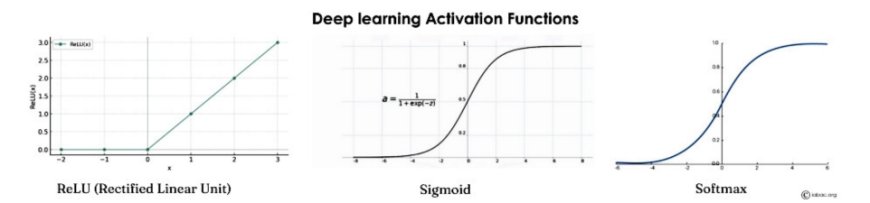
- ReLU (Rectified Linear Unit): The function takes the maximum of 0 and the input value.
- Sigmoid: This is used when we need the output to be a probability.
- Softmax: Typically used for problems that involve multiple classes or categories.
4. Backpropagation and Training
Training a deep learning model means adjusting the network to improve its predictions. This is done through:
- Backpropagation: This technique sends the error backward through the network, helping adjust the weights.
- Gradient Descent: This is a method used to find the best values for the weights and biases by minimizing the error over time. The training process happens over multiple rounds (called epochs) until the model improves.
5. Optimization Algorithms: Making Learning Better
To improve how the model learns, we use optimization techniques like:
- Stochastic Gradient Descent (SGD)
- Adam (Adaptive Moment Estimation)
- RMSprop These help the model adjust more effectively and speed up the training process.
6. Training Data and Feature Learning
Deep learning requires large amounts of labeled data to make accurate predictions. Unlike traditional machine learning, deep learning models can automatically identify patterns or features in raw data, so you don’t need to manually set them up.
7. Applications of Deep Learning
Deep learning has a wide range of uses across different fields, including:
- Computer Vision: Tasks like image recognition and facial detection.
- Natural Language Processing (NLP): For chatbots and translating languages.
- Speech Recognition: Used in voice assistants like Siri or Google Assistant.
- Robotics: Helps robots perform complex tasks, such as self-driving cars.
- Healthcare: Deep learning helps in detecting diseases and making medical diagnoses.
Key Components of Deep Learning

-
Neural Networks: These networks are the core of deep learning. They consist of layers of nodes that process data in a structured way.
-
Activation Functions: Functions like ReLU (Rectified Linear Unit), Sigmoid, and Tanh decide how a neuron should be activated and how it contributes to learning.
-
Loss Functions: These functions help measure how far off a model's predictions are from the actual values, guiding the learning process.
-
Optimization Algorithms: Methods like SGD, Adam, and RMSprop help fine-tune the model’s parameters to improve its performance.
-
Training Data: Having high-quality and diverse data is essential for training a good deep-learning model.
-
Hardware Acceleration: GPUs (Graphics Processing Units) and TPUs (Tensor Processing Units) speed up deep learning computations, making it possible to train large models efficiently.
Applications of Deep Learning
Deep learning is changing many fields, providing advanced solutions to tough problems. Some of its key uses include:
-
Computer Vision: Recognizing objects, identifying faces, powering self-driving cars, and analyzing medical images.
-
Natural Language Processing (NLP): Improving chatbots, translating languages, analyzing sentiment, and recognizing speech.
-
Healthcare: Helping diagnose diseases, discover new drugs, and create personalized treatment plans.
-
Finance: Detecting fraud, supporting algorithmic trading, and assessing risks.
-
Robotics: Enabling autonomous systems and improving interactions between humans and machines.
Challenges and the Future of Deep Learning
Although deep learning has achieved great things, there are still some challenges:
-
Data Needs: Deep learning models need large amounts of labeled data to train effectively.
-
High Computational Costs: Training deep learning models requires powerful computers and lots of time.
-
Understanding the Models: Many deep learning models are difficult to understand because they work like "black boxes," making it hard to explain how they make decisions.
-
Overfitting: Models may perform well with the data they are trained on but struggle with new, unseen data.
Future Opportunities in Deep Learning
Deep learning is transforming various industries and creating new opportunities. In healthcare and biotechnology, AI is helping to discover new drugs, personalize treatments, and improve medical diagnoses. Autonomous systems, like self-driving cars and drones, are set to change transportation, logistics, and security. Intelligent robots are making manufacturing and healthcare processes more efficient. Advances in natural language processing are improving conversations, real-time translations, and even AI-generated content.
In finance and cybersecurity, AI is playing a key role in detecting fraud, improving trading strategies, and securing online transactions. The creative industry is benefiting from AI-generated art and music, while AI is also helping solve problems related to sustainability by creating smart energy solutions to manage resources and address climate issues. Quantum AI is pushing the boundaries of problem-solving, and AI-human collaboration is boosting productivity and creativity in many fields.
At the heart of these changes are technologies like deep learning, robotics, and neural networks, which are making all of this possible.
Eligibility for Deep Learning Courses
The requirements for deep learning courses depend on the course level. Beginner courses are open to everyone, though it's helpful to have basic knowledge of Python and math. Intermediate courses need you to be comfortable with Python, understand machine learning concepts, and know some linear algebra and calculus. For advanced courses, you'll need a strong foundation in AI and machine learning, experience with frameworks like TensorFlow or PyTorch, and an understanding of optimization methods. Some advanced programs may also require a related degree or previous project experience. Different institutions and certifications may have specific prerequisites, so it’s important to check the course details before signing up.
Deep learning is set to improve many industries with smarter and more efficient solutions. It’s important to focus on ethical AI development to make sure we move forward responsibly. For professionals looking to get involved, an Artificial Intelligence Certification can help build the skills needed to be part of this growing field.