
























































Your Guide to Becoming a Certified Data Analyst
Learn the essential steps to become a certified data analyst, from gaining key skills to earning certification, and improve your career in this field.


I’ve worked with professionals and businesses, helping them make sense of difficult data and transform it into actionable insights. Along this path, I've learnt that knowing the appropriate skills and learning route frequently makes the difference between success and difficulty.
Studying tools is only one aspect of being a qualified data analyst; another is understanding how to use them in practical situations. I'll help you through the process, offer helpful tips gained from real experiences, and give you the confidence to begin your data analytics journey.
What is a Data Analyst?
A data analyst is a person who gathers, arranges, and analyses data to help organisations in making informed decisions. Consider them to be problem solvers who employ statistics and patterns to provide answers to significant queries.
For example, a retail business would be curious as to why sales decreased from the previous quarter. To identify the cause and offer solutions, a data analyst would look at market trends, sales statistics, and customer reviews.
Data analysts are more than simply mathematicians. They are storytellers who simplify difficult concepts so that everyone can understand it.
Why Become a Data Analyst?
It's important to understand the benefits of becoming a data analyst before choosing a professional route. Here are some explanations:
1. High Demand
Data analysts are important for organisations across all industries. Businesses in a variety of industries, including healthcare, banking, technology, retail, and government, are looking for individuals with data-related skills.
2. Great Career Opportunities
You can work as a financial analyst, marketing analyst, business analyst, or graduate into more complex positions like data scientist if you have the skills needed.
3. Competitive Salary
Data analysts frequently earn high salaries. Companies are willing to pay the highest salaries for talented people since their skills are in high demand.
4. Continuous Learning
Data analytics is a constantly changing field. This means your job will remain fresh and future-proof as you continuously acquire new methods, techniques, and tools.
Skills You Need to Become a Data Analyst
You'll need both soft and technical skills to be successful as a data analyst. Let's study them:

Technical Skills
-
Excel: One of the most essential tools for analysing data. It facilitates the creation of calculations, charts, and reports.
-
SQL (Structured Query Language): Used to interact with databases and retrieve data.
-
Programming languages: R and Python are frequently used for automation and deep studies.
-
Data Visualisation Tools: To display your findings, you may make charts and dashboards using programs like Tableau, Power BI, or Excel.
-
Mathematics and Statistics: Accurate data analysis requires a fundamental understanding of statistics.
Soft Skills
-
Critical Thinking: You need to be able to analyse information and formulate relevant questions.
-
Solving problems: Companies depend on you to do more than just identify issues.
-
Communication: A key component of the work is putting complicated findings into simple terms.
-
Attention to Detail: Accuracy is important since even small errors in data might result in bad decisions
Steps to Becoming a Certified Data Analyst
After learning the necessary skills, let's take a step-by-step look at the process of becoming a certified data analyst.
Step 1: Understand the Role
Spend some time learning what data analysts do before you start learning tools and topics. Consult with industry experts, view career videos, or read job descriptions. This will provide you with a thorough knowledge of the daily tasks.
Step 2: Learn the Basics
Start by learning the basics. Learn the different kinds of data, the fundamentals of statistics, and how companies use data. Online resources, including as tutorials, blogs, and beginner-friendly courses, are available for free.
Step 3: Build Technical Skills
This is where you concentrate on programming languages and tools. For instance:
-
Learn how to use pivot tables, charts, and Excel formulas.
-
Develop your skills to write SQL queries that retrieve data from databases.
-
For analysis and automation, start learning R or Python.
-
Try out visualisation programs such as Power BI or Tableau.
Step 4: Work on Real Projects
While theory is important, practice is what prepares you for the workforce. Work with datasets from the real world. Free datasets are available online through open-source initiatives, government portals, and websites like Kaggle. Make an effort to examine the information and provide reports that address specific questions.
Step 5: Build a Portfolio
As you finish tasks, build a portfolio. A compilation of your work that you can present to possible employers is called a portfolio. It may be a personal website, a GitHub repository, or even a PDF file with a number of case studies.
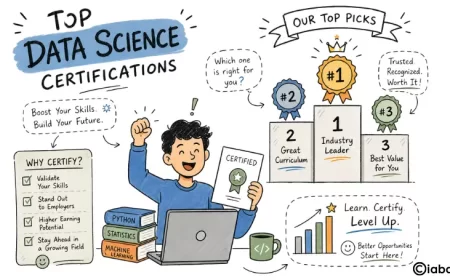
Step 6: Get Certified
Getting certified is a great way to show your skills. It shows potential employers that you possess the skills and education necessary to function as a data analyst. We'll look at certifications offered by various organisations in the next section.
Step 7: Apply for Jobs
Apply for positions as soon as you have the necessary certification, abilities, and portfolio. Do not hesitate to start with entry-level jobs. You can move into more senior positions with experience.
Why Certification Matters
You may ask yourself, "Do I really need a certification if I have the skills?" Yes, particularly if you're just getting started.
Here’s why certification matters:
-
Credibility: A certification shows potential employers that your abilities have been reviewed and validated.
-
Confidence: Reviewing and strengthening your knowledge is facilitated by certification exam preparation.
-
Career Improvement: Professionals with certifications frequently have access to improved employment prospects and higher pay.
-
Global Recognition: A lot of certifications are accepted all around the world, which can lead to employment opportunities abroad.
Tips for Success as a Data Analyst
-
Practice Every Day: Over time, even modest SQL, Excel, or Python workouts will help you get better.
-
Keep Up: To stay abreast of data analytics trends, follow blogs, podcasts, or LinkedIn groups.
-
Network: Make connections with other analysts at local events or online. Job chances are frequently the result of networking.
-
Have patience: It takes time to learn data analytics. Don't give up and continue to be consistent.
Becoming a qualified data analyst is not as difficult as it appears. You may create a fulfilling career in this growing sector provided you have the necessary skills, training, and certification.
To show your proficiency, start with the fundamentals, pick up the necessary skills, work on actual projects, and obtain a certification. You will gradually develop into a professional who can utilize data to influence choices and have an impact.
If you're looking for a trusted certification, the Certified Data Analyst Certification is an excellent option that is recognized globally.