

























































Module 1: Neural Networks The Mind of Machines
Start your journey to becoming an Artificial Intelligence Expert. Learn how neural networks think, learn, and evolve in Module 1 of our AI learning series.

The first step in your journey to becoming an Artificial Intelligence Expert.
Where Intelligence Truly Begins
Every great invention starts with a simple idea, and in the world of Artificial Intelligence, that idea is the neural network.
Imagine teaching a child to recognize animals. At first, they guess randomly, calling a cat a dog or a horse a cow. But after enough examples and gentle corrections, they start to see the difference: the ears, the nose, the shape. That’s how learning works by trial, error, and feedback.
Now imagine doing that not with a child, but with a computer.
That’s the foundation of a neural network, the very first step toward becoming an Artificial Intelligence Expert. It’s the system that allows machines to see, understand, and decide, forming the backbone of deep learning, natural language processing, and even modern-day generative AI.
In this module, we’ll explore how neural networks think, learn, and evolve — from simple data inputs to smart predictions.
What Exactly Is a Neural Network?
At its core, a neural network is inspired by how the human brain works. It’s made up of layers of “neurons,” each one connected to others, passing information like tiny messengers of logic.
Let’s break it down simply:
-
Input Layer: Where information enters, like pixels of an image or words in a sentence.
-
Hidden Layers: The thinkers. These layers process and interpret data.
-
Output Layer: The decision-maker. It tells us what the AI believes the answer is, like identifying that an image contains a “cat.”
Each connection has something called a weight, think of it as “importance.” The more a connection matters, the higher its weight. But how do we decide what’s important? That’s where learning begins.
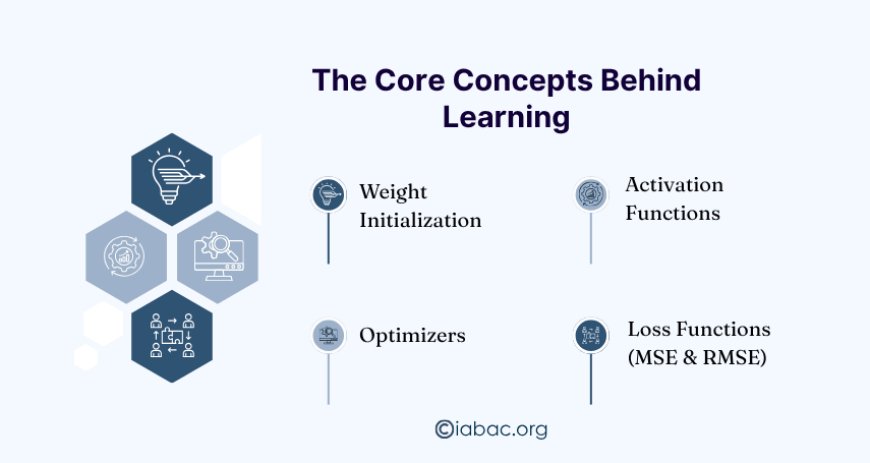
The Core Concepts Behind Learning
To make a neural network intelligent, it needs a few key ingredients:
1. Weight Initialization
When training begins, weights are set randomly. Over time, through learning, the network adjusts these values to minimize mistakes — just like how humans learn through repetition.
2. Optimizers
An optimizer is the “coach” of the neural network. It helps the model adjust its weights efficiently so it doesn’t get stuck making the same errors.
Common examples include SGD (Stochastic Gradient Descent) and Adam Optimizer — tools that help AI learn smarter, not harder.
3. Activation Functions
If weights are the brain cells, activation functions are the sparks that bring them to life. They decide which signals to pass forward and which to ignore.
Without activation functions, a neural network is like a brain that never “fires.”
4. Loss Functions (MSE & RMSE)
A loss function measures how wrong the AI was — like a report card after every test.
-
MSE (Mean Squared Error) shows the average squared difference between predictions and actual values.
-
RMSE (Root Mean Squared Error) provides a more human-readable scale of that difference.
Each learning round (or epoch) uses this “score” to figure out how to get better.
Feedforward: How AI Makes Its First Prediction
When you feed an image or a piece of text into a neural network, the information travels one way — from the input to the output layer.
This process is called feedforward propagation.
Here’s a simple example:
-
You input an image of a handwritten “5.”
-
Each layer of neurons extracts a pattern of edges, curves, and shapes.
-
The output layer predicts: “This is a 5.”
If it’s wrong, no worries. That’s where the magic of backpropagation comes in.
Backpropagation: Learning Through Mistakes
Backpropagation is how neural networks learn from failure — one of the most beautiful ideas in AI.
After making a prediction, the model checks how far it was from the correct answer (using the loss function). Then, it traces back through the layers, adjusting the weights slightly so it performs better next time.
This happens hundreds or even thousands of times until the model becomes confident — and accurate.
Think of it like learning to shoot a basketball. You miss the first few shots, but with each try, your brain adjusts your aim until you get it right. That’s exactly how neural networks improve.
Building Confidence as a Learner
Here’s the truth: most beginners find neural networks intimidating.
The math, the layers, the functions, it can look overwhelming.
But remember: every Artificial Intelligence Expert you admire started right here, at the same place.
The goal isn’t to memorize every formula; it’s to understand the logic. Once you see how data flows, how errors are corrected, and how intelligence takes shape, you’ll start to think like AI.
And that shift from confusion to clarity is what separates learners from experts.
The Power of Neural Networks in the Real World
You’ve already seen neural networks in action — you just may not have realized it:
-
Healthcare: Detecting tumors in X-rays or predicting diseases.
-
Finance: Identifying fraudulent transactions in real time.
-
Retail: Powering product recommendations on Amazon or Netflix.
-
Agriculture: Monitoring crop health through image recognition.
Neural networks are no longer a futuristic idea — they’re the invisible force running the digital world.
The experts who understand them aren’t just part of the future — they’re the ones creating it.
What You’ll Learn Practically in This Module
By completing this first step of your journey to becoming an Artificial Intelligence Expert, you’ll gain:
-
A solid understanding of neural network structure and flow
-
Knowledge of weight initialization and optimization techniques
-
The purpose of activation functions and how they shape learning
-
The role of MSE and RMSE in evaluating model performance
-
Hands-on concepts of feedforward and backpropagation algorithms
-
The ability to visualize how AI systems “think” through data
Real-World Reflection: The Spark That Starts It All
Every great AI model, from ChatGPT to Tesla’s Autopilot, began as a simple neural network.
This first module may seem technical, but it’s where your mindset shifts.
You begin to see intelligence not as something mystical, but as something buildable, explainable, and creative.
As you explore and experiment, you’ll realize that learning AI is less about code — and more about curiosity.
What’s Next?
Congratulations — you’ve just taken your first step toward becoming an Artificial Intelligence Expert.
Now that you understand how machines think, it’s time to make them learn.
Next Module: [Implementing Deep Neural Networks — Bringing AI to Life (Module 2)]
You’ll take everything you’ve learned here and start building your first real AI models using TensorFlow 2.X and Keras.
Get ready to see your code come alive.