



















































Artificial Intelligence vs Machine Learning : What’s the Real Difference
Confused between AI and ML? Learn the key differences, how each works, real-world uses, and why they matter for your career and business today.


Every time someone says “AI”, half the room imagines the Terminator, and the other half thinks of Netflix recommendations. Meanwhile, Machine Learning quietly powers most of what we call AI today — yet it rarely gets the applause it deserves.
Let’s fix that.
In this guide, we’ll clear the fog:
- What AI and ML actually mean (and how they relate).
- How they evolved historically.
- How they’re used across industries today.
- Their benefits, limitations, ethics, and what’s next.
By the end, you’ll know exactly how AI, ML, and Deep Learning fit together — and how organizations and professionals can use them responsibly and effectively.
Then the Deeper Dive
Here’s the TL;DR version before we go deep:
-
Artificial Intelligence (AI) is the broad science of creating systems that can perform tasks requiring human-like intelligence — such as reasoning, perception, or decision-making.
-
Machine Learning (ML) is a subset of AI that focuses on algorithms that learn from data rather than being explicitly programmed.
-
Deep Learning (DL) is a subset of ML that uses large, multi-layered neural networks — responsible for many of today’s AI breakthroughs.
Metaphor time: AI is the house, ML is the heating system, and Deep Learning is the high-efficiency heat pump that finally made winter bearable.
How We Got Here: A Short, Useful History of AI
The dream of intelligent machines started long before Siri and ChatGPT.
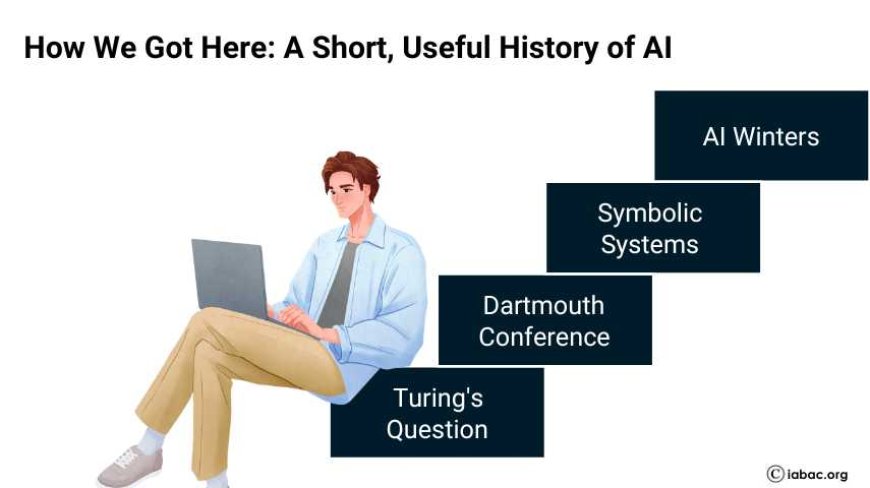
- 1950s – Alan Turing asked, “Can machines think?” sparking the theoretical groundwork for AI.
- 1956 – The term “Artificial Intelligence” was born at the Dartmouth Conference, marking AI’s official entry into computer science.
- 1960s–1980s – AI grew through symbolic systems (rule-based “if–then” logic), followed by the first AI winters — periods of disappointment when progress and funding stalled.
Then, two revolutions changed everything:
1. The Deep Learning Breakthrough (2012)
When the AlexNet model crushed the ImageNet competition, neural networks suddenly became cool again. Trained on massive datasets using GPUs, it drastically improved computer vision — showing that deep architectures could outperform traditional methods.
2. The Transformer Revolution (2017–Present)
Enter transformer architectures — the technology behind Large Language Models (LLMs) like GPT and BERT. With massive data and compute, these models learned to understand and generate language, leading to chatbots, copilots, and creative AI tools we use daily.
Old AI = hand-coded rules.
Modern AI = learned patterns from data at scale.
Understanding the Hierarchy (AI ⊃ ML ⊃ DL)
Think of it as a Venn diagram of intelligence technologies:
Artificial Intelligence (AI)
AI covers any system that can perceive its environment and act toward a goal. It includes:
- Rule-based expert systems
- Optimization algorithms
- Robotics and planning engines
- Machine learning models
AI is the umbrella concept — the science of making machines smart.
Machine Learning (ML)
ML gives machines the ability to learn from data. Instead of coding every rule, we feed examples and let algorithms detect patterns.
Main ML types include:
- Supervised Learning: Learn from labeled data (e.g., predicting house prices).
- Unsupervised Learning: Find structure in unlabeled data (e.g., customer segmentation).
- Reinforcement Learning: Learn by trial and reward (used in robotics and gaming).
Deep Learning (DL)
DL uses multi-layered neural networks to automatically extract features from raw data like images, audio, or text.
It powers speech recognition, language translation, and computer vision — and forms the backbone of tools like ChatGPT and self-driving cars.
Why it matters: Not every problem needs a massive DL model. For regulated or explainable decisions (like finance or healthcare), simpler ML models might be better.
How These Technologies Actually Work
Let’s demystify the tech without drowning in math.
Supervised Learning
Feed the algorithm examples with answers.
Example: Show thousands of cat and dog photos labeled correctly. The model learns to classify new images.
Used for: spam detection, fraud detection, sales forecasting.
Unsupervised Learning
No labels, just raw data.
The model groups similar data points — discovering patterns or anomalies.
Used for: market segmentation, anomaly detection, and recommendations.
Reinforcement Learning
Here, an agent interacts with an environment — it tries, fails, and learns from rewards or penalties.
Used in: robotics, game AI (like AlphaGo), and self-driving systems.
Deep Learning
Deep neural networks automatically learn hierarchical patterns. For example, a vision model’s early layers detect edges, mid-layers detect shapes, and deeper layers detect objects.
Transformers added attention mechanisms, allowing models to “focus” on relevant parts of input — why LLMs understand context so well.
Real-World Use Cases (Where AI & ML Actually Deliver Value)
AI isn’t just a buzzword — it’s a proven business engine.
1. Manufacturing
- Predictive maintenance via ML models prevents downtime.
- IoT sensors detect anomalies before machines fail.
- Energy optimization reduces waste and cost.
2. Healthcare
- ML models help radiologists detect tumors.
- NLP systems structure messy clinical notes.
- AI chatbots assist patient triage.
Note: Regulation and explainability are critical in this field.
3. Finance
- Fraud detection systems flag unusual transaction patterns.
- ML-based risk scoring improves credit assessments.
- Chatbots handle customer queries efficiently.
4. Retail & E-commerce
- Recommendation engines boost sales.
- Demand forecasting optimizes stock levels.
- AI chatbots improve post-sale support.
5. Transportation
- Route optimization saves fuel and time.
- Self-driving systems combine deep learning and reinforcement learning.
6. Enterprise Productivity
- Document summarization, auto-tagging, and code generation accelerate workflows.
- LLM-based assistants enhance internal knowledge management.
Success tip: Start small — one high-value, measurable use case — and scale once results prove ROI.
Why Organizations Invest in AI & ML
The hype exists for a reason. Businesses adopt AI/ML for measurable outcomes:
|
Benefit |
Impact |
|
Automation & Scale |
Reduce repetitive tasks and human errors. |
|
Accuracy & Insights |
Data-driven predictions outperform manual judgment. |
|
Personalization |
Tailor content, ads, or experiences to individual users. |
|
Speed & Agility |
Real-time decision-making and quicker responses. |
|
Cost Reduction |
Streamlined operations and predictive maintenance save millions. |
But — success depends on data readiness, governance, and a clear business metric (e.g., “reduce process X time by 30%”).
The “Not-Magic” Reality: Challenges and Limitations
AI and ML are powerful, but not perfect.
- Data Problems: Poor quality, biased, or insufficient data lead to poor predictions.
- Explainability: Deep models are black boxes — problematic for regulated industries.
- Adversarial Risk: Tiny input changes can fool models (especially in vision tasks).
- Compute Cost: Training large models consumes massive energy and money.
- Talent Gap: Lack of data science and MLOps skills derails many projects.
- Ethical Bias: Models mirror society’s biases if not carefully tested.
Fix: Combine technical rigor (testing, monitoring) with governance (audits, human oversight).
Ethics, Privacy, and Regulation: The Responsible AI Checklist
As AI impacts more lives, responsibility is no longer optional.
Global guidance includes:
- ICO (UK): Demands fairness, transparency, and accountability in automated decisions.
- GDPR (EU): Gives individuals rights over their personal data and automated decisions.
Must-Do Governance Steps
- Data Provenance & Consent: Know where your data came from — and that you’re allowed to use it.
- Bias Testing: Continuously test across demographic groups.
- Documentation: Keep “model cards” describing purpose, data, and limitations.
- Human-in-the-Loop: Humans should review and override critical AI decisions.
- Monitoring & Response: Track model drift and errors post-deployment.
Treat compliance as a living process, not a one-time audit.
Cutting-Edge Trends to Watch
AI is evolving faster than any previous tech wave. Here are the frontiers shaping the next decade:
1. Generative AI & Foundation Models: LLMs like GPT or Claude can be fine-tuned for diverse tasks — text, code, design, or support. They’re shifting AI from toolsets to platforms.
2. Edge AI: Running AI models locally on devices improves privacy and speed (think: phones, cameras, IoT). Great for sensitive or latency-critical tasks.
3. Federated Learning: Allows ML models to train across multiple data sources without sharing raw data. Perfect for healthcare and finance sectors.
4. Responsible & Explainable AI Tools: Fairness toolkits, bias dashboards, and explainability libraries (like SHAP, LIME) are making ethical AI practical.
5. MLOps & AI Infrastructure: Building, deploying, and maintaining AI at scale now requires dedicated pipelines — just like DevOps transformed software.
6. Quantum & Hardware Advances: AI-specialized chips (like TPUs) are cutting costs. Quantum computing, still experimental, may one day supercharge ML training.
Choosing the Right AI/ML Approach — A Decision Framework
Before your organization jumps into AI, ask:
- Is the problem valuable?
→ Does it affect cost, revenue, or risk measurably? - Do you have the data?
→ Enough, clean, and relevant data? - Can it be modeled?
→ Is accuracy vs interpretability trade-off acceptable? - Are there legal or ethical constraints?
→ If yes, plan extra governance. - Do you have MLOps readiness?
→ Deployment pipelines, monitoring, and rollback systems? - Do you have the right team or partners?
→ Sometimes, collaboration beats starting from scratch.
Start small → Measure impact → Scale gradually.
Career & Learning Pathways in AI & ML
For professionals, theory alone isn’t enough — projects prove your skill.
Core technical skills:
- Python, statistics, probability
- Libraries like Scikit-learn, TensorFlow, PyTorch
- Data preprocessing and visualization
- Model evaluation and tuning
Non-technical skills:
- Problem framing
- Ethical reasoning
- Communicating results to non-technical stakeholders
Certifications help (especially for structured learning and credibility):
- Data Science Foundation Certification
- Machine Learning Expert Certification
- Certified Data Scientist
These showcase your competence and commitment to employers, especially when backed by real-world projects or open-source work.
The TL;DR
- AI is the goal (build intelligence).
- ML is the method (learn from data).
- Deep Learning is a specialized subset of ML responsible for today’s biggest breakthroughs.
The big shift:
From symbolic rules → to data-driven deep learning → to transformer-based general models.
Success factors:
- Clean data
- Clear metrics
- Governance & ethics
- Human oversight
AI isn’t magic — it’s math, data, and discipline working together responsibly.
Checklist for Organizations
|
Step |
Action Item |
|
Identify pilot use cases |
Pick 1–3 high-value, measurable problems. |
|
Audit your data |
Check data quality, freshness, and compliance. |
|
Choose the simplest model |
Don’t start with deep learning if linear regression works. |
|
Monitor and iterate |
Watch for drift, errors, and fairness. |
|
Establish governance |
Documentation, oversight, and ethics guardrails. |
|
Build MLOps foundations |
Automate deployment and model updates. |
Further Reading & Trusted Resources
- Google Cloud – AI vs Machine Learning Explainer
- Pinecone – Deep Learning & ImageNet History
- Wikipedia – AI Timeline
- ICO Guidance – AI and Data Protection
- IBM – AI vs ML vs DL Overview
Artificial Intelligence and Machine Learning are no longer futuristic buzzwords — they’re the invisible engines behind how businesses operate, innovate, and compete.
Understanding the difference isn’t just academic — it’s strategic. Whether you’re a business leader mapping AI adoption or a professional building your career, the key is to stay curious, stay ethical, and stay grounded in data.