

























































What Is Edge AI?
Understand Edge AI technology, its benefits, and how it powers smart, on-device AI across healthcare, retail, and industrial use cases.

Edge AI combines two technologies: edge computing and artificial intelligence. It lets devices run AI tasks directly on them, without needing to send all the data to the cloud. This means decisions can be made faster, with less delay, lower data usage, and better privacy.
You’ve probably used Edge AI without realizing it. For example, when your phone unlocks with your face, or when a voice assistant replies quickly, or when a smart camera sends an alert after detecting movement. All of these happen directly on the device, in real time, without depending on an internet connection.
As more devices—like sensors, cameras, and smart machines—generate huge amounts of data, sending everything to the cloud slows things down. Edge AI helps by processing the data locally, making systems faster and more efficient.
What Exactly Is Edge AI?
Edge AI refers to the deployment of AI models on the “edge” of a network, meaning data processing occurs directly on the device where the data is generated. This device could be a smartphone, surveillance camera, wearable sensor, drone, or any computing unit embedded in a system.
The goal is simple: instead of sending raw data to the cloud for analysis, the edge device processes it locally using a pre-trained AI model. Only essential insights, alerts, or summaries are shared with the cloud—if at all.
This shift from centralized to decentralized intelligence reduces the need for continuous data transmission, resulting in faster response times, increased reliability, and better data control.
How Edge AI Works in Practice
Let’s break down how Edge AI functions from data capture to decision-making:
1. Data Collection
Sensors or input devices—such as cameras, microphones, or accelerometers—gather raw data like images, sound, or environmental readings.
2. Local AI Inference
A lightweight, pre-trained AI model (e.g., for object detection or speech recognition) is deployed directly on the edge device. This model processes the raw data in real time, generating inferences or predictions.
3. Action or Communication
The device can then take action autonomously. For example:
-
A machine halts if it detects overheating.
-
A camera flags suspicious activity.
-
A wearable alerts the user to abnormal heart rhythms.
Only critical outcomes may be logged or sent to a cloud dashboard for human review or archival.
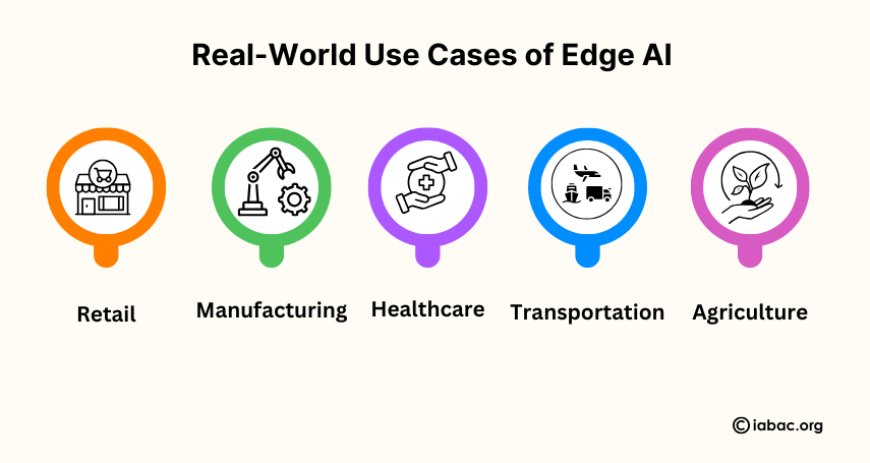
Real-World Use Cases of Edge AI
Edge AI is no longer a theoretical concept—it’s deployed across industries where speed, privacy, and real-time decision-making are critical.
Retail
-
Smart shelves monitor stock levels and customer interaction.
-
Cameras analyze foot traffic to optimize store layouts.
Manufacturing
-
Machines detect faults or anomalies in production lines before breakdowns occur.
-
Predictive maintenance avoids downtime by monitoring vibrations, heat, or pressure changes.
Healthcare
-
Wearables continuously track health metrics and flag abnormalities.
-
Portable diagnostic devices run offline in remote or resource-limited areas.
Transportation
-
Autonomous vehicles process sensory input instantly to navigate or avoid hazards.
-
Traffic monitoring systems optimize signal timing based on real-time congestion.
Agriculture
-
Edge-enabled drones analyze soil health and crop growth on the spot.
-
Field sensors monitor irrigation, detecting leaks or soil dryness locally.
Advantages of Edge AI Over Cloud-Based AI
Edge AI offers tangible benefits that make it preferable in many scenarios:
1. Low Latency
Since data doesn’t travel to a remote server for processing, responses are nearly instantaneous. This is essential in time-critical applications like autonomous navigation or industrial control systems.
2. Reduced Bandwidth Usage
Only the necessary results—such as an alert or processed insight—are transmitted. This conserves network bandwidth, especially in locations with limited connectivity.
3. Improved Privacy and Data Security
Sensitive information doesn’t leave the device, minimizing the risks associated with data breaches or regulatory non-compliance.
4. Offline Functionality
Edge AI systems continue functioning without an internet connection. This makes them ideal for rural areas, manufacturing floors, or in emergency response scenarios.
5. Cost Efficiency
By reducing dependency on cloud resources, organizations may lower infrastructure and data transmission costs in the long term.
Edge AI vs. Cloud AI: A Balanced Comparison
Understanding the distinction between Edge AI and Cloud AI helps clarify their respective roles:
|
Criteria |
Edge AI |
Cloud AI |
|
Location of Processing |
On-device (local) |
Centralized data center or cloud |
|
Latency |
Very low (real-time responses) |
Higher (due to data transfer and queuing) |
|
Internet Dependence |
Works offline |
Requires constant connectivity |
|
Privacy |
High (data stays on device) |
Lower (data uploaded and stored externally) |
|
Use Case Fit |
Real-time, mobile, or remote applications |
Complex analysis, large-scale training |
|
Scalability |
Limited by hardware |
Easily scalable with resources |
Cloud AI is still vital for training large models and handling vast datasets. Edge AI, meanwhile, brings intelligent execution closer to where it's needed.
Edge AI Hardware and Devices
Edge AI depends on hardware capable of running machine learning inference efficiently, even with limited resources. Some widely used platforms include:
-
NVIDIA Jetson Nano / Xavier – High-performance modules for robotics and video analytics
-
Google Coral Dev Board – Features an Edge TPU optimized for low-power AI tasks
-
Intel Movidius Neural Compute Stick – USB-based deep learning accelerator for inference
-
Qualcomm Snapdragon SoCs – Embedded AI in smartphones and wearables
-
Raspberry Pi (with acceleration) – Entry-level prototyping for edge applications
These platforms allow developers to embed AI capabilities into cameras, drones, gateways, and custom hardware.
Challenges in Edge AI
Despite its potential, Edge AI comes with unique technical and operational challenges:
1. Hardware Constraints
Edge devices often have limited processing power, memory, and battery life. Models must be lightweight and efficient.
2. Model Optimization
AI models need to be compressed, quantized, or pruned to fit into constrained environments without sacrificing too much accuracy.
3. Versioning and Deployment
Pushing updates or retraining models across thousands of devices can be complex and requires robust deployment pipelines.
4. Security Risks
Physical access to edge devices increases vulnerability. Ensuring firmware integrity and secure boot processes is essential.
Future Trends and Outlook for Edge AI
Edge AI is positioned to become a foundational component of modern digital infrastructure. With the growth of IoT, 5G, and AI chips tailored for edge processing, adoption will likely accelerate.
What’s Driving the Growth?
-
Increased sensor deployments in urban infrastructure, homes, and factories
-
AI chip innovation delivering more compute per watt
-
Stricter data regulations encouraging local processing
-
5G networks enabling high-speed communication between edge nodes and central systems
Industry forecasts estimate the Edge AI market will surpass $40 billion by 2030, with sectors like healthcare, smart cities, and logistics leading adoption.
FAQs About Edge AI
Is Edge AI part of IoT?
Edge AI is often deployed within IoT systems, but they’re not the same. IoT refers to connected devices, while Edge AI adds intelligence to those devices.
Can Edge AI replace Cloud AI?
Not entirely. Edge AI is better for real-time, local decisions, while Cloud AI is still required for large-scale data processing and model training.
How is Edge AI trained?
Most training is still performed in the cloud using high-powered resources. Once trained, the model is optimized and deployed to the edge device for inference.
Is Edge AI expensive to implement?
Initial development and deployment require investment in specialized hardware and model optimization, but long-term costs are offset by reduced bandwidth and cloud resource usage.
Edge AI transforms how data is processed and how decisions are made—right at the point of interaction. It allows businesses to build more responsive, private, and cost-efficient systems without relying solely on centralized cloud infrastructure.
Whether it’s powering real-time analytics on a factory floor or enabling offline functionality in a wearable device, Edge AI is becoming integral to the next generation of smart technology.