



























































Benefits of Marketing Analytics in Business Analytics
Marketing analytics in business analytics helps track campaign performance improve customer targeting increase ROI and support data driven marketing decisions.

Data is created every second. When someone clicks an advertisement, visits a website, opens an email, or interacts with a social media post, information is recorded. Businesses collect large amounts of this information every day. However, having data alone is not enough. What matters is understanding what that data means and how it can help a company grow. This is where Marketing Analytics becomes very useful. It helps companies study marketing data and understand how their marketing activities affect business results. When Marketing Analytics becomes part of Business Analytics, companies can clearly see how marketing efforts support revenue growth, customer satisfaction, and long-term success.
Today, companies prefer decisions based on numbers rather than assumptions. They want clear answers about what works and what does not. Marketing Analytics helps provide those answers by turning raw data into useful insights that guide business decisions. Professionals who understand Marketing Analytics and Business Analytics are valuable in many industries. Organizations of all sizes use data to improve marketing strategies, attract customers, and improve business performance.
Understanding Marketing Analytics in Business Analytics
Marketing Analytics focuses on studying marketing-related data. This includes campaign results, customer interactions, website activity, and conversion rates. The goal is to understand how marketing activities perform and how they influence customer behavior. Business Analytics, on the other hand, studies data from multiple areas of a company. It includes information from marketing, finance, operations, customer service, and sales. Business Analytics helps leaders understand the overall performance of the organization. When Marketing Analytics is combined with Business Analytics, companies gain a complete view of how marketing contributes to business results. Instead of simply asking if a campaign received clicks or impressions, companies look deeper. They ask whether the campaign increased sales, attracted new customers, or improved customer loyalty.
For example, tracking website visits can show how many people come to a site. But Marketing Analytics can show how many of those visitors actually make a purchase. This connection between marketing activity and business results helps companies make smarter choices.
Because of this value, many organizations invest in marketing data analysis tools, customer behavior analysis, and performance tracking systems.
Benefits of Marketing Analytics in Business Analytics
When Marketing Analytics is integrated into Business Analytics systems, companies gain several clear advantages. These benefits help organizations improve strategies, reduce wasted spending, and increase business performance.
1. Better Business Decision Making
One of the biggest advantages of Marketing Analytics is better decision making.
Companies collect data from many marketing channels such as websites, advertisements, social media campaigns, and email marketing. When this information is analyzed, businesses gain useful insights about customer behavior and campaign performance.
Important metrics that companies study include:
- Conversion rate
- Customer acquisition cost (CAC)
- Return on marketing investment (ROMI)
- Customer lifetime value (CLV)
By studying these numbers, companies can see which marketing strategies produce results. Instead of increasing marketing budgets randomly, businesses invest in strategies that show measurable success. This leads to smarter planning and better use of resources.
2. Improved Return on Investment (ROI)
Marketing campaigns require significant spending. Without proper analysis, companies may invest money in campaigns that produce little value.
Marketing Analytics helps businesses track campaign performance in real time. It shows how customers respond to advertisements, content, and promotional campaigns.
Common metrics used include:
- Click-through rate (CTR)
- Engagement rate
- Lead conversion rate
- Sales growth
By monitoring these metrics, companies can quickly identify successful campaigns and pause or improve weaker ones. Research shows that businesses using data-based marketing decisions often improve marketing ROI by around 15–20 percent.
This improvement helps companies achieve more results without increasing marketing budgets.
3. Stronger Customer Understanding
Customers show patterns in their behavior. Marketing Analytics helps businesses identify and understand these patterns.
By studying customer data, companies can learn about:
- Buying behavior
- Product preferences
- Seasonal purchasing patterns
- Customer feedback
- Loyalty trends
With this information, companies can create more personalized marketing campaigns. Personalized communication often leads to higher engagement and stronger customer relationships.
For example, an online store may recommend products based on previous purchases. This simple strategy can increase both customer satisfaction and sales.
4. Predictive Business Insights
Modern analytics tools help companies estimate future outcomes using historical data. This approach is called predictive analysis.
Predictive insights help businesses prepare for upcoming trends rather than reacting after changes occur.
Examples include:
- Predicting when customers may stop buying from a company
- Estimating product demand for upcoming seasons
- Identifying customers who may generate higher revenue
- Forecasting campaign performance
With these insights, companies can plan marketing activities more effectively and reduce uncertainty when making decisions.
5. Competitive Advantage
Businesses that use Marketing Analytics often respond faster to changes in the market.
When campaigns are monitored closely, companies can see immediately if something is working well or performing poorly. This quick feedback allows teams to adjust strategies quickly.
For example, if a marketing message performs well on social media, businesses can increase spending on that campaign. If a product receives strong customer interest, companies can promote it more actively.
This quick response helps businesses stay ahead of competitors who rely on traditional marketing methods without detailed analysis.
6. Better Budget Allocation
Marketing budgets are always limited. Marketing Analytics helps ensure that every part of the budget is used effectively.
Companies can compare performance across different channels such as search advertising, social media campaigns, email marketing, and content marketing.
Important comparisons include:
- Cost per lead
- Cost per acquisition
- Channel performance
- Advertising effectiveness
Using this information, companies can invest more in high-performing channels and reduce spending in areas that produce weaker results.
This careful allocation helps maximize marketing impact without unnecessary expenses.
7. Clear Performance Measurement
Marketing Analytics also provides transparency for business leaders.
Executives and managers want clear reports showing how marketing activities contribute to business growth. Analytics dashboards present this information in an easy-to-understand format.
These reports often include:
- Revenue growth
- Campaign performance
- Customer acquisition results
- Market expansion indicators
This transparency improves communication between marketing teams and company leadership. Everyone can clearly see how marketing activities influence business success.
Tools Used in Marketing Analytics
Companies use several tools to collect, analyze, and present marketing data. Many of these tools are included in training programs and Business Analytics certification courses.
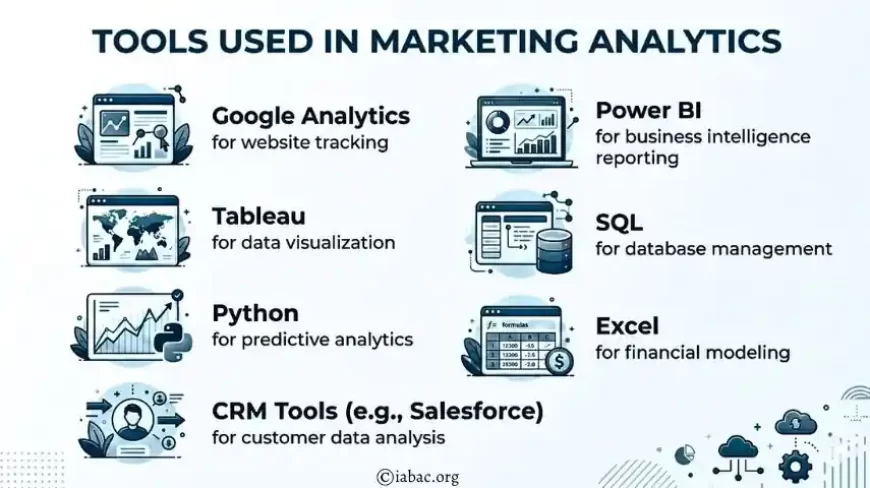
Common tools include:
- Google Analytics – tracks website visitors and user behavior
- Power BI – creates business reports and data dashboards
- Tableau – provides visual data analysis and reporting
- SQL – helps manage and query large databases
- Python – used for data analysis and predictive modeling
- Excel – widely used for calculations and financial analysis
- CRM systems such as Salesforce – manage customer information and interactions
Professionals who understand these tools often gain better career opportunities because companies rely heavily on them for data analysis.
Career Opportunities in Marketing Analytics
Companies across many industries use Marketing Analytics to improve marketing results and business strategies.
Common job roles include:
- Marketing Analyst
- Digital Marketing Analyst
- Business Analyst
- Data Analyst with marketing focus
- Campaign Performance Manager
- Customer Insights Specialist
These roles exist in industries such as retail, banking, healthcare, technology, education, and e-commerce.
Entry-level marketing analysts in many countries may earn between $50,000 and $70,000 per year, while experienced professionals often earn higher salaries depending on their technical skills and experience.
Importance of a Business Analytics Certification
Learning Marketing Analytics independently is possible. However, structured learning programs can help professionals gain organized knowledge and practical experience.
A Business Analytics certification helps individuals understand:
- Data analysis methods
- Marketing performance measurement
- Business intelligence tools
- Predictive analysis techniques
- Strategic decision support
Well-known organizations such as International Association of Business Analytics Certifications (IABAC) provide structured training programs that include both theoretical knowledge and practical project work.
Programs available through www.iabac.org help learners build strong skills in analytics concepts and real business applications. This structured learning helps professionals build confidence and improve job opportunities.
Skills Needed for Marketing Analytics
To build a successful career in Marketing Analytics, professionals should develop several important skills.
These include:
- Analytical thinking
- Basic statistical knowledge
- Data interpretation skills
- Communication skills
- Problem-solving ability
- Technical tool knowledge
Communication skills are particularly important. Analysts must explain data insights clearly so that managers and decision-makers can understand them easily.
Long-Term Career Value of Marketing Analytics
Marketing Analytics continues to grow in importance as businesses collect more digital data.
New technologies such as automation, artificial intelligence, and machine learning are improving marketing analysis methods. Professionals who already understand analytics can easily learn these new technologies as they develop.
Analytics-related careers are expected to grow steadily in the coming years, making Marketing Analytics a strong career choice for individuals interested in data and business strategy.
Marketing Analytics plays an important role within Business Analytics because it connects marketing activities with actual business results. It helps companies improve decision making, increase return on investment, understand customers better, and plan future strategies with greater confidence. For professionals, knowledge of Marketing Analytics opens many career opportunities across industries. Learning the right tools, understanding data patterns, and gaining structured training through a Business Analytics certification can help individuals build strong careers in analytics.
Businesses today rely on data to guide their actions. Professionals who understand how to analyze that data will continue to play an important role in helping organizations grow and succeed. Marketing Analytics is not only about tracking clicks or measuring social media engagement. It is about understanding how marketing activities contribute to overall business performance and long-term growth.